

Content
- 1 Why Fiber Feeding Accuracy Matters in Nonwoven Production
- 2 Operating Principle of the HYGM Vibrating Feeder
- 3 Core Construction and Functional Components
- 4 Main Advantages Compared with Conventional Feeding Arrangements
- 5 Application Areas
- 6 Manufacturing Strengths of the Supplier
- 7 Engineering and Configuration Considerations
- 8 Operational Benefits for Manufacturers
- 9 Maintenance and Daily Inspection
- 10 Installation and Commissioning
- 11 Purchasing Guidance for a Vibrating Feeder
- 12 Why Manufacturer Experience Adds Value
- 13 Frequently Asked Questions
- 13.1 What is the main function of the HYGM Vibrating Feeder?
- 13.2 Which fibers can the machine process?
- 13.3 How does the photoelectric control work?
- 13.4 Does the feeder replace a carding machine?
- 13.5 What working widths are available?
- 13.6 What is the production capacity?
- 13.7 What power supply is required?
- 13.8 How often should the machine be cleaned?
- 13.9 Can the machine be integrated into an existing line?
- 13.10 What information should be supplied when requesting a quotation?
- 13.11 What after-sales support is available?
- 14 Conclusion
- 15 References
- 16 Product: HYGM Vibrating Feeder
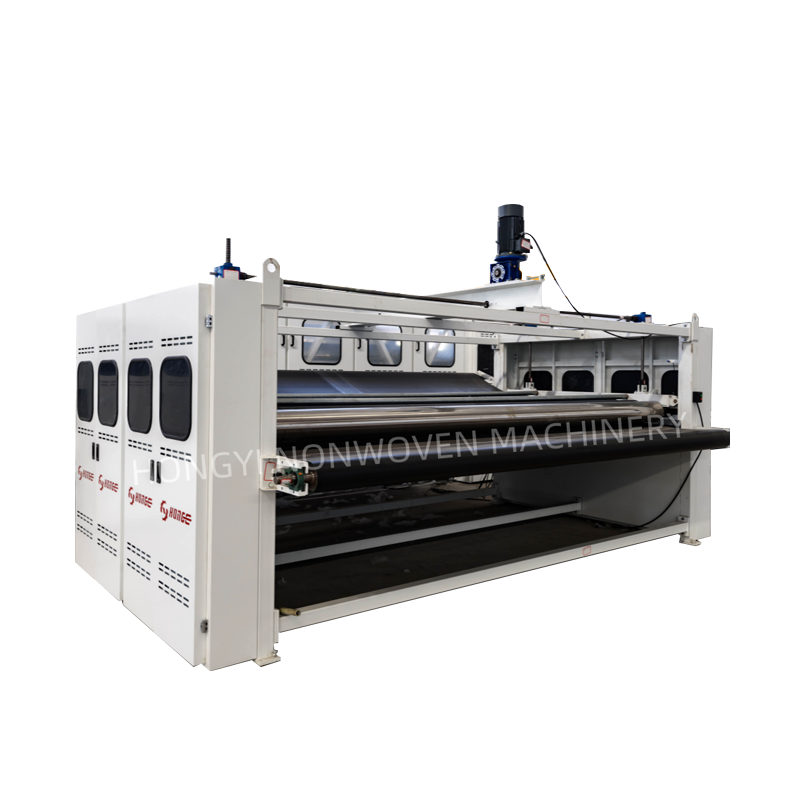
In nonwoven manufacturing, fiber preparation and feeding have a direct influence on the quality, productivity, and stability of the entire production line. Even when the opening, blending, carding, web forming, and bonding machines are properly designed, irregular fiber feeding can create variations in web weight, uneven material distribution, fiber lumps, and unnecessary production losses. A reliable vibrating feeder provides an important connection between the opening process and the next carding or web-forming stage by storing prepared fibers and delivering them in a controlled, even layer across the working width.
The HYGM Vibrating Feeder is designed for medium- to coarse-denier fibers used in nonwoven fabric production. It receives opened and blended fibers, further improves their distribution, and feeds a balanced quantity to the following process. Its operating concept combines storage, mechanical fiber regulation, photoelectric level control, adjustable vibration, and carefully coordinated feeding components. The result is a practical solution for manufacturers producing polyester, viscose, nylon, polypropylene, glass fiber, and other compatible nonwoven materials.
Manufactured by Changshu Hongyi Nonwoven Machinery Co., Ltd., the HYGM series is available for customized production-line configurations. The company has more than 20 years of experience in nonwoven machinery and supplies individual machines as well as complete production lines for needle-punched, thermal-bonded, airlaid, automotive, geotextile, carpet, felt, and other nonwoven applications.
Why Fiber Feeding Accuracy Matters in Nonwoven Production
Fiber feeding is sometimes treated as a simple conveying operation, but it is actually a key process-control function. The opening machine separates compressed fiber bales and loosens the material. However, opened fibers do not always leave the opener with a perfectly uniform density or distribution. Differences in fiber length, crimp, moisture, static electricity, blend ratio, and opening intensity can cause fluctuations in the material flow.
If these fluctuations are transferred directly to a carding machine, the card may receive too much material at one moment and too little at another. An overloaded card can experience increased mechanical resistance, fiber accumulation, and unstable web formation. An underfed card may produce a thin web, reduce output, or create visible variations in the final product. In both situations, the production line becomes more difficult to operate and the final nonwoven fabric may fail to meet target specifications.
A vibrating feeder addresses this problem by acting as an intermediate buffer and metering unit. It temporarily stores opened fiber, helps distribute it, and transfers a regulated quantity toward the next machine. This buffer function makes the overall production line less sensitive to short-term fluctuations from the opening process. It also gives the operator a more stable and controllable material flow.
The importance of uniform feeding becomes even greater in products that require consistent basis weight or thickness. Needle-punched geotextiles, filtration materials, automotive interior fabrics, insulation felts, carpet substrates, and cleaning cloths all depend on controlled fiber distribution. The feeder does not replace the carding process, but it helps the card work under more stable conditions.
Operating Principle of the HYGM Vibrating Feeder
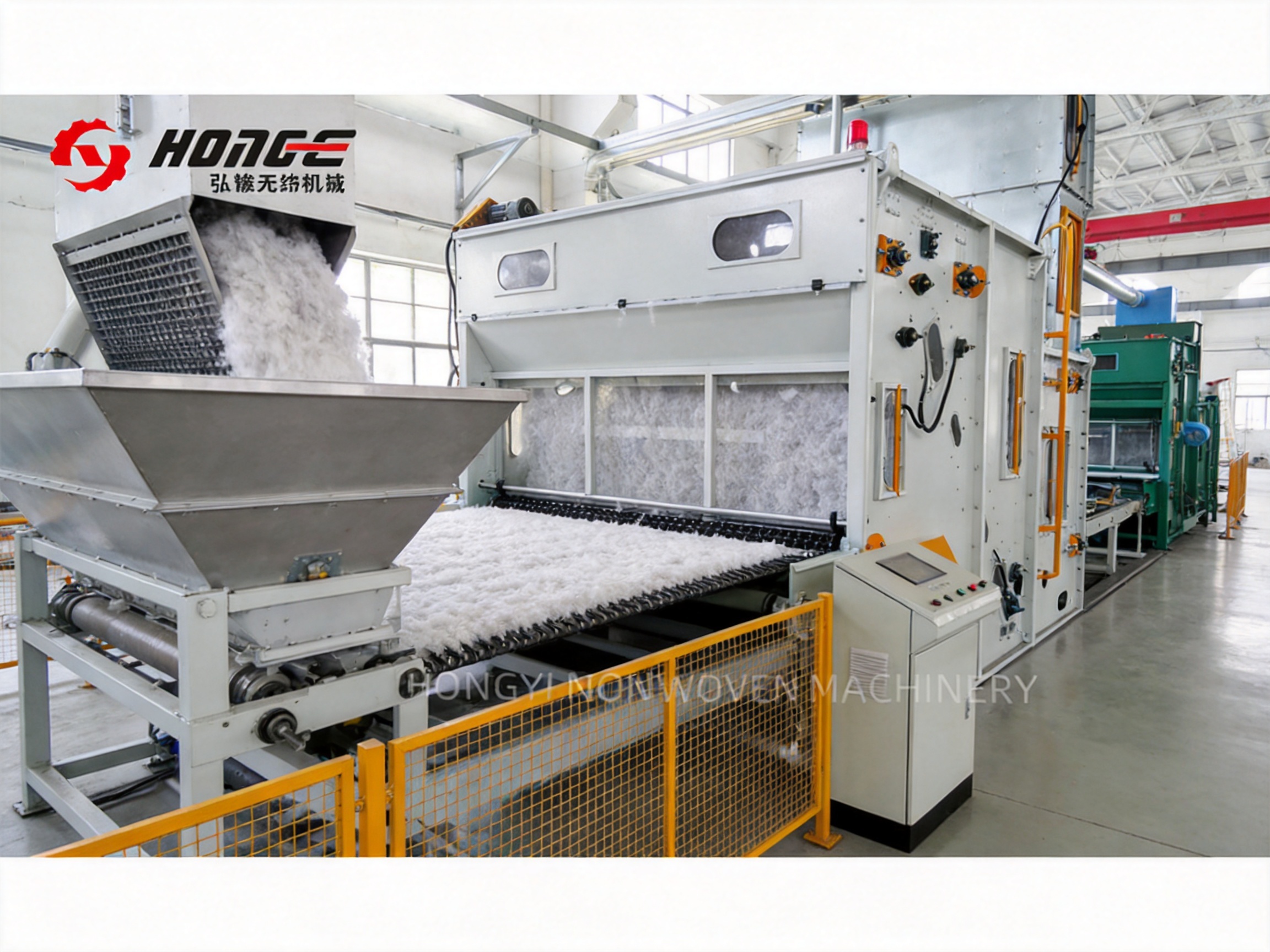
The HYGM Vibrating Feeder is positioned after the opening and blending equipment and before the carding or related downstream process. Opened fibers are delivered into the feeder through a combination of feeding and leveling components. The spike lattice and oblique lattice move the fiber into the storage area while helping distribute the material across the machine width.
The evener roller removes excess fiber from the incoming layer. This prevents excessive accumulation and helps regulate the amount that enters the vibrating cabin. A stripper then separates the fiber from the relevant working surface so that it can drop into the vibrating section. The material is subsequently leveled and advanced by the controlled vibration of the feeder plate or cabin.
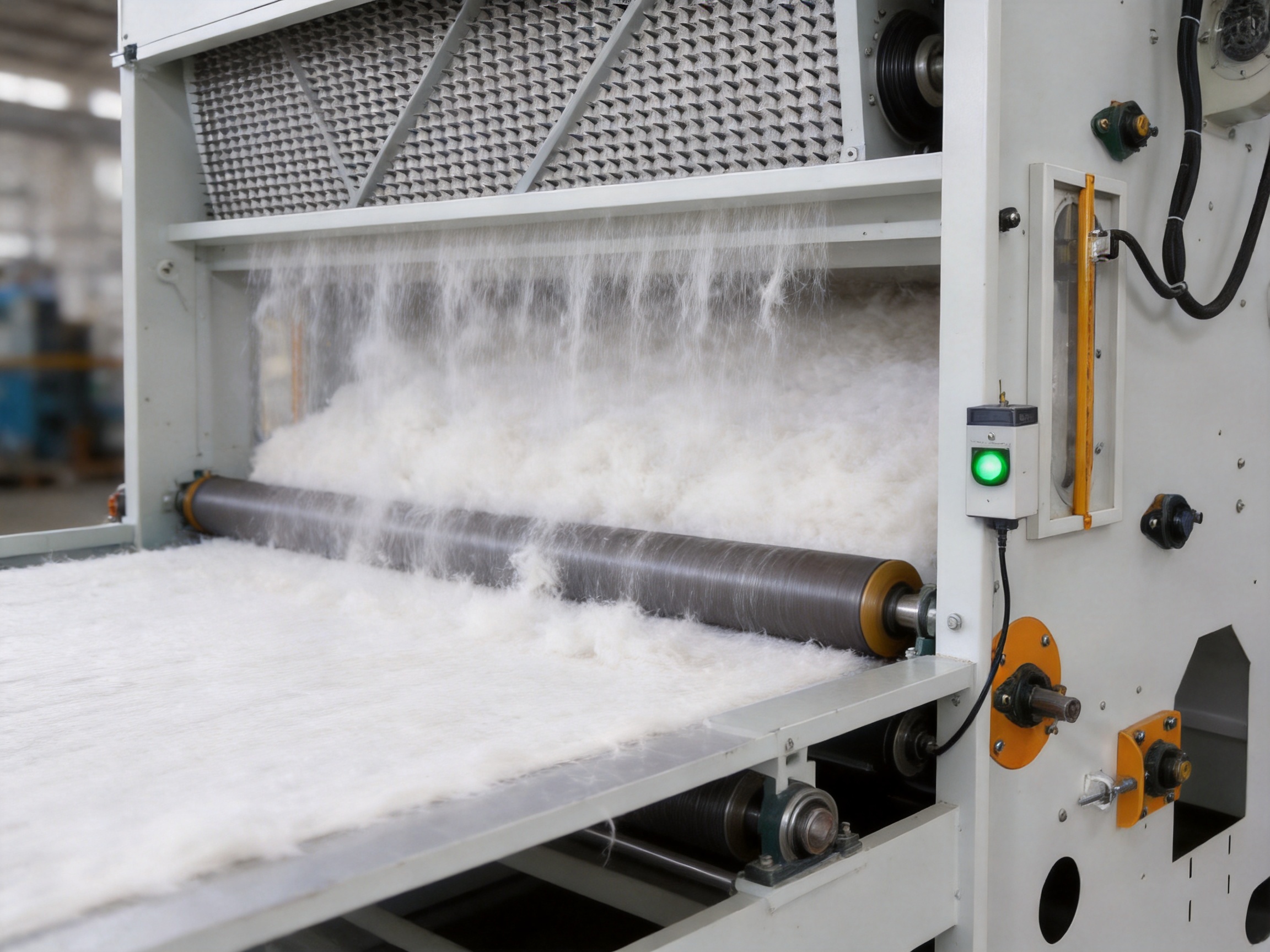
The Start-Stop operation of the spike lattice and oblique lattice is controlled by a photoelectric system. When the storage level reaches the required position, the photoelectric sensor sends a control signal to regulate material admission. This helps maintain a suitable amount of fiber in the storage area without requiring constant manual intervention.
The vibrating section then moves the fiber forward in a more uniform layer. Vibration can be adjusted according to the material characteristics and production requirements. This allows the operator to adapt the feeding action to different fiber types, blend compositions, densities, and target outputs.
The machine is therefore more than a basic hopper or transport conveyor. It performs several coordinated tasks:
First, it provides temporary storage for opened fiber.
Second, it supports additional blending and distribution after the main opening stage.
Third, it removes or regulates excess material before it enters the vibrating cabin.
Fourth, it uses photoelectric control to respond to storage-level changes.
Fifth, it produces a more even fiber layer for the next carding or web-forming process.
Sixth, it can be integrated into customized nonwoven production lines according to working width, material, capacity, and plant layout.
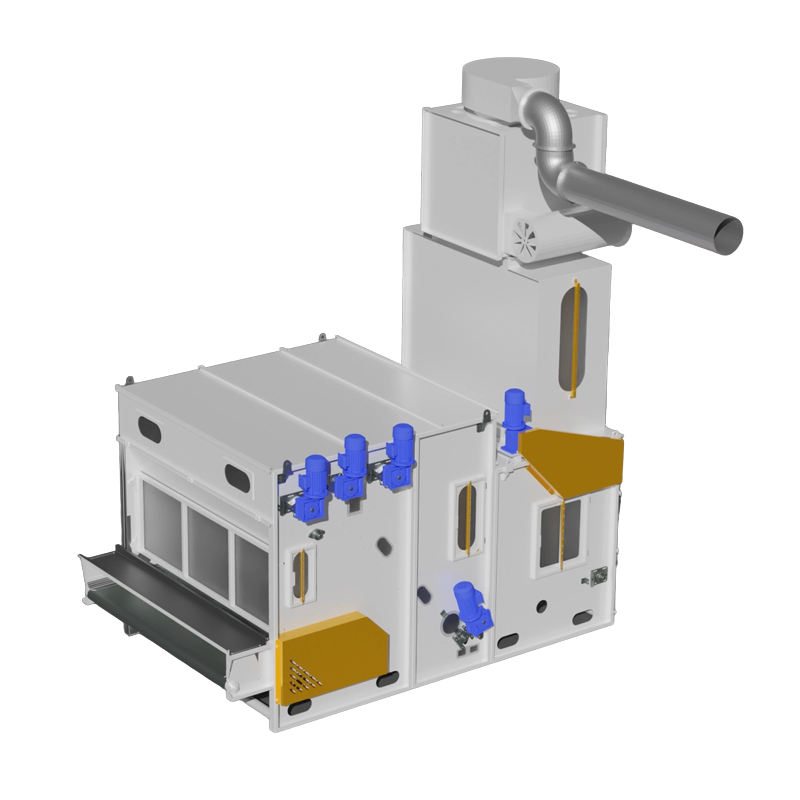
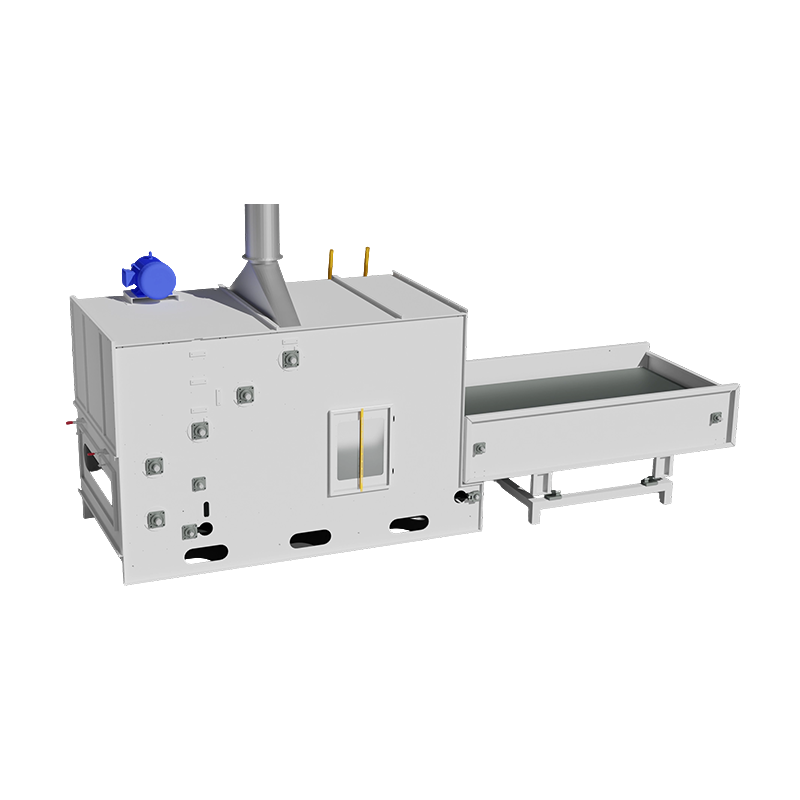
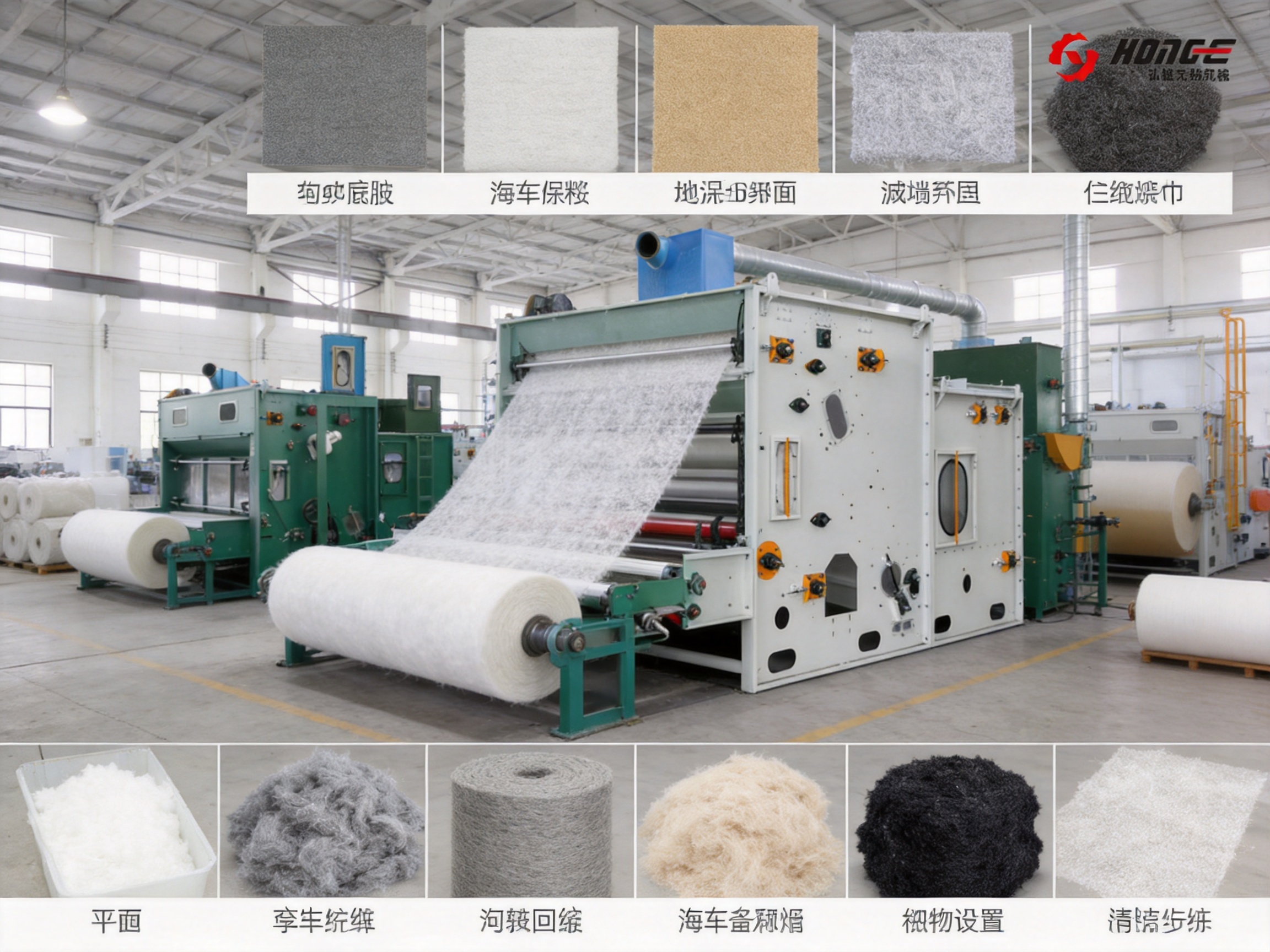
HYGM Vibrating Feeder
Core Construction and Functional Components
Spike Lattice and Oblique Lattice
The spike lattice and oblique lattice are responsible for receiving and moving fibers from the upstream opening equipment. Their arrangement supports the transfer of fiber into the feeder while helping prevent uncontrolled accumulation in one area. The lattice system is particularly useful when the incoming material has an irregular density or contains fibers with different degrees of openness.
Because different fibers behave differently during conveying, the lattice movement must be coordinated with the evener roller and photoelectric control. Polyester, viscose, nylon, polypropylene, and glass fiber may differ in friction, bulk, resilience, static behavior, and tendency to cling to machine surfaces. A properly configured lattice system helps the feeder handle these differences more consistently.
Evener Roller
The evener roller plays an important role in controlling the incoming fiber layer. It removes excess material and helps reduce peaks in the fiber flow. Without an effective leveling action, a dense section of fiber could enter the vibrating cabin and create an uneven feed to the card.
The evener roller also contributes to process stability by reducing the effect of short-term variations from the opener. Its function is not simply to remove material; it helps transform a less uniform incoming flow into a more manageable and consistent layer.
Stripper
The stripper separates fiber from the feeding and leveling surfaces and allows the material to drop into the vibrating cabin. Fiber can sometimes cling to a roller, lattice, wool board, or other surface because of static electricity, fiber crimp, moisture, or surface friction. The stripper helps release this material and maintain the intended flow path.
Regular inspection is important because hanging fiber can accumulate on the stripper, evener roller, or wool board. If this material is not removed, it may eventually fall into the process as a lump or cause an uneven feed. The manufacturer recommends that operators remove hanging fiber in a timely manner to protect product quality and evenness.
Vibrating Cabin and Adjustable Plate
The vibrating cabin receives the regulated fiber and advances it through controlled vibration. The vibrating plate can be adjusted to match the characteristics of the fiber and the requirements of the downstream equipment. This adjustable feeding action gives the machine greater flexibility than a fixed-speed transfer device.
Vibration is especially helpful when the fiber must be distributed across a broad working width. Rather than relying only on a narrow transfer point, the vibrating mechanism assists in spreading and advancing the material. The final result depends on correct setup, but the machine provides the mechanical foundation for a uniform feed.
Photoelectric Storage Control
The photoelectric system monitors the storage condition and controls the Start-Stop operation of the spike and oblique lattices. This prevents the feeder from being continuously overloaded and reduces the possibility of the storage section becoming empty.
Automatic storage control also reduces operator workload. Instead of manually starting and stopping the upstream feeding components based on visual judgment alone, the system responds to the actual fiber level. This improves repeatability and supports more stable production during long operating periods.
Main Advantages Compared with Conventional Feeding Arrangements
Improved Fiber Layer Uniformity
The most important advantage of the HYGM Vibrating Feeder is its ability to help create a more even fiber layer for downstream processing. The combined action of the lattice system, evener roller, stripper, photoelectric control, and vibrating cabin is designed to moderate fluctuations before they reach the carding machine.
A basic conveyor may only move material from one machine to another. It may not provide adequate storage, leveling, or automatic quantity control. By contrast, the HYGM unit is designed as a process-conditioning machine. It does not merely transport fiber; it helps prepare fiber for the next stage.
Better Adaptability to Different Fiber Types
The feeder can be applied to polyester, viscose, nylon, polypropylene, glass fiber, and other compatible materials. This flexibility is valuable for manufacturers that produce multiple nonwoven products or change raw materials according to customer requirements.
Different fibers may require different vibration settings, feed rates, storage levels, and cleaning intervals. The adjustable configuration allows the machine to be adapted rather than forcing every material to run under one fixed condition. This is an important advantage over equipment designed for only one narrow type of fiber.
Automatic Material-Level Regulation
Photoelectric control helps maintain a suitable fiber volume in the storage section. Automatic regulation makes the machine less dependent on continuous manual observation and reduces the risk of unstable upstream feeding.
The sensor-based approach also supports coordination with the production line. When the storage section reaches a defined condition, the lattice system can start or stop accordingly. This helps reduce unnecessary fiber buildup and supports a smoother transfer to the carding process.
Reduced Risk of Card Overfeeding
Feeding too much fiber into a card can cause excessive loading and reduce the stability of the carding action. The evener roller and storage-control system help reduce sudden increases in fiber quantity. Although correct card settings remain essential, a more stable upstream feed gives the card a better operating environment.
Wide Range of Working Widths
The available configurations cover a range of widths for different production capacities and line designs. Listed specifications include widths such as 1.4 meters, 1.7 meters, 1.8 meters, 2 meters, 2.2 meters, and 2.8 meters. Other dimensions can be customized according to the customer’s production requirements and plant layout.
Working width should be selected together with the carding width, target output, raw-material blend, and required basis weight. A correctly matched width helps reduce edge effects and supports more consistent distribution across the full production area.
Integration into Complete Production Lines
The HYGM feeder can be used as an individual machine or integrated into a complete nonwoven manufacturing line. Changshu Hongyi Nonwoven Machinery Co., Ltd. supplies equipment for opening and blending, feeding and carding, web forming, needle punching, thermal bonding, heat setting, airlay processing, winding, cutting, and auxiliary operations.
This broader manufacturing capability makes it easier to coordinate the feeder with adjacent machines. The customer can discuss the opening capacity, card type, line speed, control system, working width, and product requirements with one machinery supplier. This can simplify engineering communication and reduce compatibility problems between separate suppliers.
| Item | HYGM Vibrating Feeder Information |
|---|---|
| Product type | Industrial vibrating feeder for nonwoven fiber |
| Primary process position | Between opening or blending equipment and the next carding process |
| Suitable materials | Polyester, viscose, nylon, polypropylene, glass fiber, and other compatible fibers |
| Control method | Photoelectric storage control with adjustable vibrating feeding |
| Working-width options | Approximately 1.4 to 2.8 meters, with customized dimensions available |
| Capacity reference | Approximately 0.1 to 5 tonnes per hour, subject to material and configuration |
| Power supply | AC 220 V or 380 V, according to project requirements |
| Installed-power reference | Approximately 4.45 kW for the listed configuration |
| Automation | Automatic operation with customized control arrangements |
| Certification | CE and ISO9001 certification information provided for the product and company |
| Warranty | One-year warranty and after-sales service |
| Typical delivery period | Approximately two to three months, depending on customization and order conditions |
| Origin | Changshu, Jiangsu, China |
Application Areas
Needle-Punched Geotextiles
Geotextile production requires stable fiber preparation because the final fabric must provide consistent thickness, tensile performance, filtration behavior, and dimensional stability. An uneven fiber feed can create weak areas or local changes in fabric density. The HYGM feeder can help prepare a more consistent layer before carding and needle punching.
For heavy geotextile products, the required feed quantity may be relatively high. The feeder configuration should therefore be selected according to the desired basis weight, line speed, fiber type, and card capacity. A properly sized storage and feeding system can help maintain production continuity while reducing short-term fluctuations.
Nonwoven Carpet Materials
Carpet substrates and related nonwoven materials often use polyester, polypropylene, recycled fibers, or fiber blends. These materials may have different bulk and feeding characteristics. The ability to adjust the vibration and configure the working width helps the feeder support a range of product specifications.
Consistent feeding is particularly important when the carpet material must have a regular surface and uniform support. Irregular fiber distribution upstream can become visible after web forming, bonding, or finishing. Stable feeding helps reduce this risk.
Automotive Interior Materials
Automotive interior nonwovens may be used for trunk liners, floor coverings, acoustic components, insulation, and other interior applications. These products often require controlled thickness, weight, stiffness, acoustic performance, and appearance.
Production lines for automotive materials may use blended fibers or recycled content. The HYGM feeder can serve as a material-buffering and distribution unit before carding. Its automatic storage control can also support the stable operation needed for extended production runs.
Thermal-Bonded Wadding and Insulation
Thermal-bonded wadding depends on a well-formed web before the material enters the bonding oven or heat-setting equipment. If the feed to the card is inconsistent, the final wadding may have variations in thickness and thermal performance.
By supporting an even quantity of fiber across the machine width, the vibrating feeder helps create a more stable starting condition for carding and subsequent thermal bonding. The final result still depends on oven temperature, line speed, fiber properties, and bonding conditions, but uniform feeding is an essential first step.
Cleaning Cloth and Felt Products
Needle-punched cleaning cloths, wool felts, jute felts, and similar products benefit from stable fiber distribution. These products may use natural fibers, synthetic fibers, or mixed materials. A controlled feed helps improve the consistency of the web and reduces material accumulation before carding.
Glass Fiber and Specialized Nonwovens
Glass fiber and other specialized fibers can present different handling requirements from standard polyester or viscose. Fiber breakage, static, surface adhesion, and operator safety must be considered during line design. The feeder can be configured for compatible materials, but the final selection should be confirmed through a technical review of fiber specifications and process conditions.
Manufacturing Strengths of the Supplier
Changshu Hongyi Nonwoven Machinery Co., Ltd. has more than 20 years of experience in the nonwoven machinery sector. Its product scope includes individual machines and complete production lines. This experience is valuable because nonwoven machinery performance depends not only on individual components but also on the interaction between machines.
A vibrating feeder must be matched to the opener, card, web former, needle-punching machine, thermal-bonding oven, winding unit, and control system. A supplier with experience across these processes can evaluate the complete material flow rather than treating the feeder as an isolated device.
Complete Equipment Portfolio
The company’s equipment portfolio includes needle-punched geotextile production lines, nonwoven carpet production lines, airlaid waste-felt lines, automotive interior-material lines, needle-punching cleaning-cloth lines, wool-felt lines, jute-felt lines, carding machines, airlaid machines, ironing machines, thermal-bonding machines, heat-setting ovens, winding machines, cutting machines, and auxiliary equipment.
This portfolio supports project development at different levels. A customer may purchase a single HYGM feeder for an existing line, replace a specific unit, or request an integrated production solution. The same supplier can also assist with working-width matching and the arrangement of upstream and downstream equipment.
Customization Capability
The product information identifies the HYGM feeder as customizable. Customization may include working width, overall dimensions, color, power supply, control arrangement, production capacity, and connection details. The correct configuration should be determined from the customer’s raw materials, target output, factory space, and existing equipment.
Customization is especially important for nonwoven plants because products vary considerably. A line for lightweight thermal-bonded wadding may require a different feeding arrangement from a line for heavy geotextile or automotive felt. A standard machine platform with configurable dimensions allows the supplier to adapt the equipment while retaining a proven operating concept.
Quality and Certification Information
The HYGM Vibrating Feeder is listed with CE and ISO9001 certification information. Certification and quality-management systems provide a foundation for controlled manufacturing, documentation, inspection, and delivery. Customers should confirm the specific certification documents, applicable standards, electrical requirements, and machine configuration during the purchasing process.
The supplier also provides video outgoing inspection. This can help customers review the machine condition and operating functions before shipment. For export projects, outgoing inspection is particularly useful because it allows technical teams to identify questions before the equipment leaves the factory.
International Supply Experience
Hongyi machinery has been supplied to more than 20 countries, including Mexico, Argentina, Brazil, Turkey, Algeria, Egypt, Bangladesh, Vietnam, Thailand, and other Asian markets. International supply experience requires attention to electrical standards, packaging, documentation, installation conditions, language requirements, spare parts, and after-sales communication.
The company uses nude packing or polyethylene-film packing according to the equipment and transport arrangement. The final packing method should be confirmed based on the shipping route, container type, weather exposure, and customer requirements.
Focus on Efficiency and Reliability
The company states a focus on efficiency, reliability, quality, advanced technology, precision engineering, automatic control, energy-saving capabilities, and customized solutions. For a vibrating feeder, these principles are reflected in the effort to coordinate mechanical feeding with automatic storage control and adjustable vibration.
Efficiency should not be judged only by motor power or nominal capacity. It also involves stable operation, reduced manual intervention, lower material waste, fewer interruptions, and compatibility with the downstream process. A feeder that consistently supplies the card can improve the productivity of the entire line even when its own mechanical function appears relatively simple.
Engineering and Configuration Considerations
Working Width
The working width should match the width of the card or the effective width of the next process. The available information includes several working-width options, from approximately 1.4 meters to 2.8 meters. The final width should be selected after reviewing edge trim, web-forming requirements, product width, and line layout.
A feeder that is too narrow may create excessive edge concentration or require additional spreading equipment. A feeder that is unnecessarily wide may increase investment and floor-space requirements. Correct width matching supports both product quality and cost control.
Capacity
The listed capacity range is approximately 0.1 to 5 tonnes per hour. Actual output depends on fiber type, fiber density, blend ratio, opening degree, target basis weight, vibration setting, working width, and downstream machine speed. Capacity should therefore be treated as a project reference rather than a universal guaranteed value for every material.
When requesting a quotation, customers should provide the expected hourly output, product weight, operating width, raw-material composition, and line speed. This information allows the supplier to select suitable feeding components and control parameters.
Electrical Supply
The product information includes AC 220 V or 380 V power supply options and customized voltage arrangements. Electrical requirements must be confirmed before manufacture, especially for export projects. The customer should provide the local voltage, frequency, phase arrangement, control-panel requirements, and applicable electrical standards.
The listed installed-power reference is approximately 4.45 kW, while one specification identifies a 24 W power entry. These figures may refer to different components or configurations. They should be verified in the final technical proposal and electrical drawings before purchase. A complete electrical schedule should identify the motor power, control power, inverter rating, sensor circuits, and total installed power.
Fiber Characteristics
Material information should include fiber type, denier, length, moisture, crimp, recycled content, static tendency, and blend ratio. Medium- to coarse-denier fibers are identified as a primary application for this feeder. If the material includes unusually long fibers, highly cohesive fibers, fragile glass fibers, or a high proportion of reclaimed waste, additional testing may be advisable.
Fiber characteristics influence the required lattice speed, evener-roller setting, vibration amplitude, cleaning frequency, and storage height. A technical discussion before manufacture helps ensure that the selected machine is appropriate for the intended materials.
Line Synchronization
The feeder should be synchronized with the opening machine and carding machine. The upstream equipment must deliver material at a compatible rate, while the downstream card must be able to accept the regulated quantity. Control signals, emergency stops, start-up sequences, and fault alarms should be reviewed as part of the complete line design.
Good synchronization reduces material accumulation and helps operators manage the start-up and shutdown process. It also makes it easier to isolate a problem without allowing fiber to spill into unrelated machine sections.
Operational Benefits for Manufacturers
A well-configured vibrating feeder can produce benefits in several areas of plant operation. The first is production stability. By buffering fiber and controlling its transfer, the feeder reduces the effect of short-term variations from the opener.
The second is quality consistency. A more even feed helps the card produce a more uniform web, which can support consistent basis weight, thickness, tensile behavior, and appearance after bonding or needle punching.
The third is labor efficiency. Automatic photoelectric control reduces the need for continuous manual starting and stopping of the feeding lattice. Operators can spend more time monitoring overall line performance, raw-material preparation, and quality control.
The fourth is material utilization. Uneven feeding can lead to waste, off-specification fabric, and repeated adjustments. By stabilizing the incoming material flow, the feeder can help reduce avoidable losses. Actual savings depend on the existing process and the quality of the previous feeding arrangement.
The fifth is production flexibility. Adjustable vibration and customizable working widths support different products and line capacities. This flexibility is useful for manufacturers that need to serve multiple markets instead of producing only one fixed product.
Maintenance and Daily Inspection
Regular maintenance is essential for achieving stable operation. The feeder contains moving components that interact with loose fiber, so dust, lint, and hanging material can gradually accumulate. A planned inspection routine helps prevent small issues from developing into quality or mechanical problems.
Cleaning
Operators should inspect the stripper, evener roller, wool board, lattice surfaces, vibrating cabin, and nearby guards. Hanging fiber should be removed in a timely manner, especially when processing fibers with high static or strong adhesion. Cleaning should be carried out according to the plant’s lockout and safety procedures.
Mechanical Inspection
Check the lattice, rollers, bearings, fasteners, drive components, and vibration mechanism for unusual noise, looseness, heat, or wear. The machine should not be operated if a guard is missing or if a moving component is damaged.
Sensor Inspection
The photoelectric sensor should be kept clean and correctly aligned. Dust or fiber covering the sensor can cause inaccurate level detection. Operators should confirm that the Start-Stop response is consistent and that the signal is correctly connected to the control system.
Feeding Adjustment
Vibration settings should be adjusted gradually. Excessive vibration may disturb the fiber layer or increase mechanical stress, while insufficient vibration may lead to slow transfer or accumulation. The correct setting depends on the material and production rate.
Documentation
Maintenance records should include cleaning intervals, sensor checks, bearing lubrication where applicable, replacement parts, vibration settings, and operating problems. These records help identify changes in machine behavior and support preventive maintenance.
Installation and Commissioning
Before installation, the customer should prepare a level foundation, sufficient access space, suitable electrical connections, and safe material-transfer interfaces. The feeder must be positioned so that the upstream opener can deliver fiber reliably and the downstream card can receive it without excessive drops or obstructions.
During commissioning, the supplier or installation team should check the mechanical alignment, electrical rotation, sensor operation, lattice movement, evener-roller clearance, stripper position, vibration response, and emergency-stop function. Initial testing should begin at a low material rate before gradually increasing to the planned operating condition.
Fiber trials should be performed with the actual or representative production materials. The trial should evaluate storage-level stability, layer uniformity, transfer rate, card loading, web appearance, and the response of the photoelectric control. If several fiber blends are used, each important blend should be tested rather than assuming that one setting will suit all materials.
Commissioning also provides an opportunity to train operators. They should understand how to adjust the feed, identify hanging fiber, respond to sensor alarms, stop the machine safely, and communicate with maintenance personnel when a problem occurs.
Purchasing Guidance for a Vibrating Feeder
When comparing suppliers, buyers should evaluate more than the initial machine price. A suitable comparison should include machine construction, working width, actual material compatibility, storage capacity, sensor control, vibration adjustment, capacity, electrical configuration, spare parts, warranty, installation support, documentation, and the supplier’s experience with complete nonwoven lines.
Customers should ask for a clear technical specification showing the selected model, working width, capacity basis, motor and inverter details, control-panel arrangement, dimensions, electrical requirements, and interface points. If the line is customized, the quotation should distinguish standard components from project-specific components.
It is also useful to provide the supplier with samples or detailed information about the fibers. A machine designed for clean polyester staple fiber may require different settings from one processing recycled fiber, viscose, glass fiber, or a mixed waste stream. Early material disclosure reduces the risk of choosing an unsuitable configuration.
The supplier’s after-sales capability is another important consideration. The product information includes a one-year warranty, video outgoing inspection, and international supply experience. Buyers should also confirm commissioning arrangements, remote support, recommended spare parts, troubleshooting procedures, and the availability of technical drawings.
Why Manufacturer Experience Adds Value
Nonwoven production is a process chain. A problem observed at the card may originate in the opener, feeder, raw-material preparation, control system, or downstream web-forming equipment. A machinery manufacturer with experience in several stages of the process is better positioned to analyze these relationships.
Changshu Hongyi Nonwoven Machinery Co., Ltd. manufactures and supplies equipment for opening and blending, carding, web forming, needle punching, thermal bonding, airlaying, heat setting, winding, cutting, and auxiliary operations. This broad capability supports an integrated approach to engineering and troubleshooting.
The company’s experience exporting equipment to multiple countries also supports the practical requirements of international projects. These requirements include adapting machines to local power systems, preparing export documents, coordinating transport packing, and communicating with customers across different production environments.
For buyers seeking a long-term machinery partner, the ability to obtain a single feeder, a replacement unit, or a complete customized nonwoven line can simplify future expansion. It can also help maintain a consistent engineering approach when the customer adds new production capacity.
Frequently Asked Questions
What is the main function of the HYGM Vibrating Feeder?
The main function is to store opened fiber and feed a more even layer or quantity across the machine width to the next carding or web-forming process. It also helps blend and distribute the fibers after the main opening stage.
Which fibers can the machine process?
The feeder is intended for medium- to coarse-denier fibers and can be applied to polyester, viscose, nylon, polypropylene, glass fiber, and other compatible nonwoven fibers. Final compatibility should be confirmed according to fiber length, denier, moisture, static behavior, and blend composition.
How does the photoelectric control work?
The photoelectric system detects the fiber condition or storage level and controls the Start-Stop operation of the spike and oblique lattices. This helps maintain a suitable amount of fiber in the storage area and reduces the need for continuous manual control.
Does the feeder replace a carding machine?
No. The feeder is an upstream feeding and conditioning machine. It prepares and regulates the fiber flow for the carding process but does not perform the complete carding function of opening, separating, and orienting fibers.
What working widths are available?
Listed working-width options include approximately 1.4 meters, 1.7 meters, 1.8 meters, 2 meters, 2.2 meters, and 2.8 meters. Customized widths and dimensions can be discussed according to the customer’s carding machine and production-line requirements.
What is the production capacity?
A reference capacity of approximately 0.1 to 5 tonnes per hour is provided. Actual capacity depends on the fiber type, working width, target basis weight, line speed, feeding settings, and downstream equipment. A technical evaluation is recommended for a precise project specification.
What power supply is required?
The available information includes AC 220 V and 380 V power supply options, with customized arrangements possible. The final voltage, frequency, phase, installed power, and control-panel details should be confirmed in the approved electrical documentation.
How often should the machine be cleaned?
Cleaning frequency depends on the fiber type, production hours, dust level, and amount of loose material. Operators should inspect the machine regularly and remove hanging fiber from the stripper, evener roller, wool board, and other areas as soon as it appears.
Can the machine be integrated into an existing line?
Yes. The feeder can be configured as an individual machine or integrated into an existing or new nonwoven line. The supplier should review the upstream opener, downstream card, working width, material flow, electrical signals, floor space, and safety requirements before confirming the design.
What information should be supplied when requesting a quotation?
Customers should provide the fiber types and specifications, blend ratios, desired production capacity, target product weight, working width, carding-machine details, local power supply, factory layout, automation requirements, and preferred delivery schedule. Samples or photographs of the raw material can also assist technical evaluation.
What after-sales support is available?
The product information includes a one-year warranty and video outgoing inspection. Customers should confirm installation, commissioning, operator training, spare-parts recommendations, remote assistance, and response procedures as part of the final order agreement.
Conclusion
The HYGM Vibrating Feeder is a purpose-designed solution for stabilizing the fiber flow between opening and carding in nonwoven production. Its combination of spike and oblique lattices, evener roller, stripper, vibrating cabin, adjustable feeding plate, and photoelectric storage control provides more process functions than a simple transfer conveyor.
By helping regulate fiber quantity and distribution, the feeder can support improved web uniformity, lower manual intervention, smoother carding, and greater production flexibility. Its compatibility with polyester, viscose, nylon, polypropylene, glass fiber, and other suitable materials makes it applicable to a wide range of nonwoven products.
Available working widths, customized dimensions, automatic control options, and integration with complete production lines allow the equipment to be adapted to different factory requirements. The manufacturing experience of Changshu Hongyi Nonwoven Machinery Co., Ltd., together with its broader product portfolio and international supply capability, provides additional value for customers seeking individual machines or complete nonwoven machinery solutions.
For the best result, the feeder should be selected as part of the complete process rather than as an isolated purchase. Fiber characteristics, card capacity, product basis weight, production speed, electrical standards, maintenance conditions, and line layout should all be reviewed before finalizing the design. With correct configuration, installation, and operation, the HYGM Vibrating Feeder can become an important component in a stable, efficient, and scalable nonwoven production system.
References
1. Product technical information for the HYGM Vibrating Feeder, including operating principle, components, applications, and specifications.
2. Changshu Hongyi Nonwoven Machinery Co., Ltd. company information and nonwoven machinery product portfolio.
3. ISO 9001, Quality Management Systems: Requirements.
4. General principles of nonwoven textile manufacturing, including fiber opening, blending, carding, web formation, bonding, and finishing.
5. General industrial guidance for machinery installation, preventive maintenance, electrical safety, and operator training.