

Content
- 1 The Role of a Big Chamber Blender in Nonwoven Production
- 2 Core Advantages of the Equipment
- 3 Machine Structure and Operating Principle
- 4 How the Blending Process Works
- 5 Technical Configurations and Selection Options
- 6 Advantages Compared with Basic Fiber Storage Equipment
- 7 Manufacturing Strengths and Engineering Approach
- 8 Applications in Different Nonwoven Industries
- 9 Installation and Commissioning Considerations
- 10 Operation and Maintenance Guidelines
- 11 Energy Efficiency and Production Economics
- 12 Why Manufacturer Support Matters
- 13 Recommended Purchasing Checklist
- 14 Performance Expectations and Practical Limitations
- 15 Q&A
- 15.1 What is the primary purpose of a big chamber blender?
- 15.2 Which raw materials can the machine process?
- 15.3 How does the machine improve blending uniformity?
- 15.4 What role do the photoelectric sensors perform?
- 15.5 What working widths are available?
- 15.6 What storage volumes can be selected?
- 15.7 What output range is available?
- 15.8 Why are the stripper and evener roller independently driven?
- 15.9 Is the machine suitable for recycled fibers?
- 15.10 How is internal cleaning performed?
- 15.11 Can the machine be customized?
- 15.12 What certifications are listed for the equipment?
- 15.13 What after-sales support is available?
- 15.14 How should buyers compare this machine with competing products?
- 16 Conclusion
- 17 References
- 18 Product: HYDC Big chamber blender
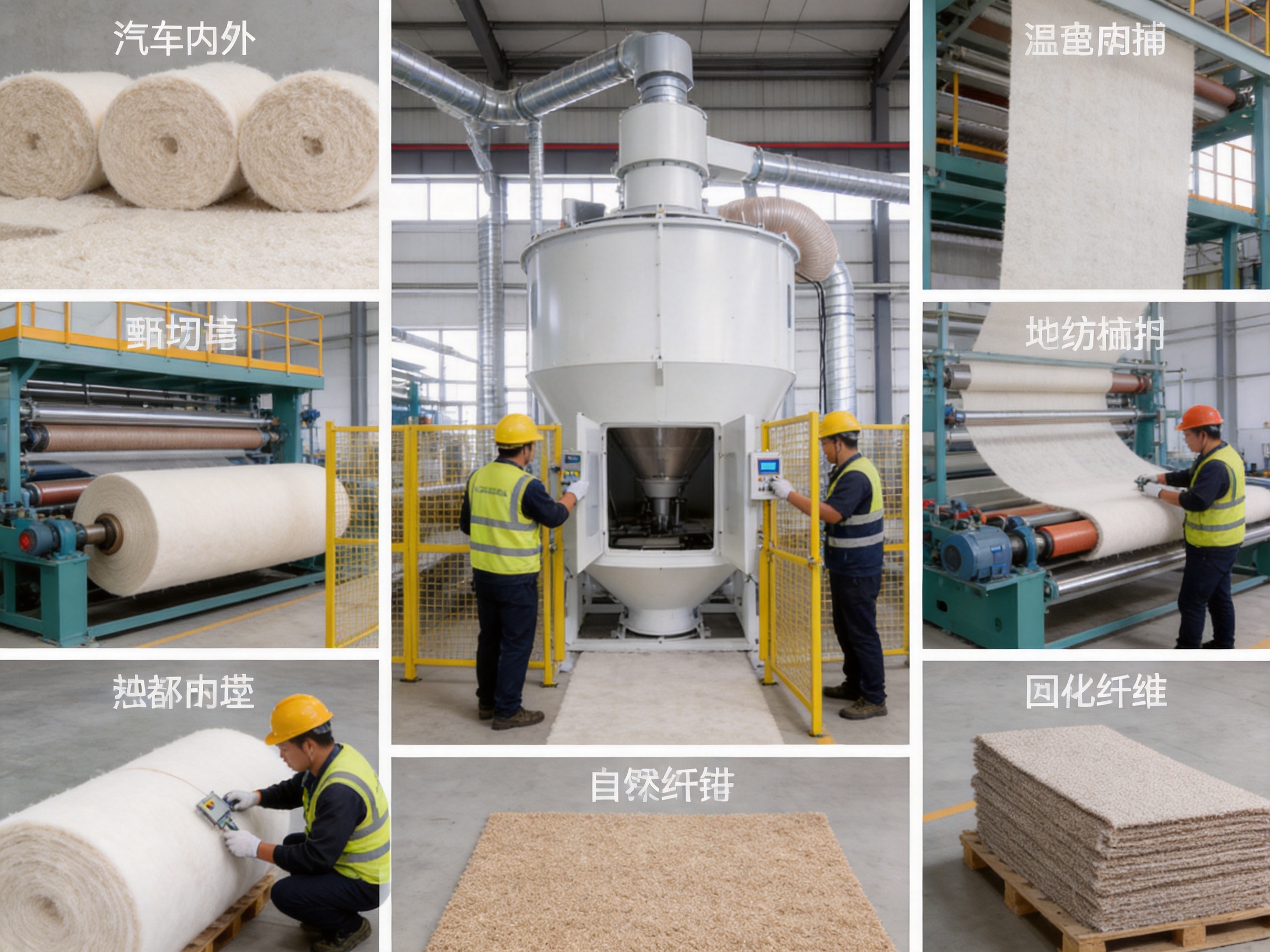
Modern nonwoven fabric production depends on stable fiber preparation. Before fibers reach the carding, airlay, thermal bonding, or needle punching stages, they must be opened, mixed, buffered, and delivered at a consistent rate. Any variation in blend composition, feed density, or material flow can affect web uniformity, fabric strength, appearance, and production efficiency. A big chamber blender is designed to solve these problems by combining opened fibers, storing them temporarily, and supplying a continuous feed to the next machine in the line.
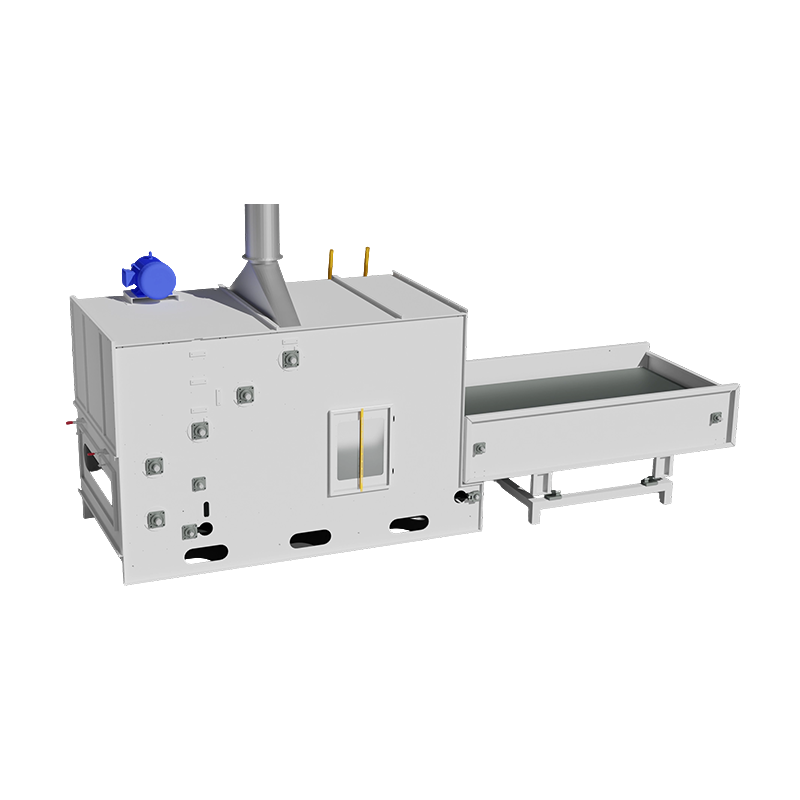
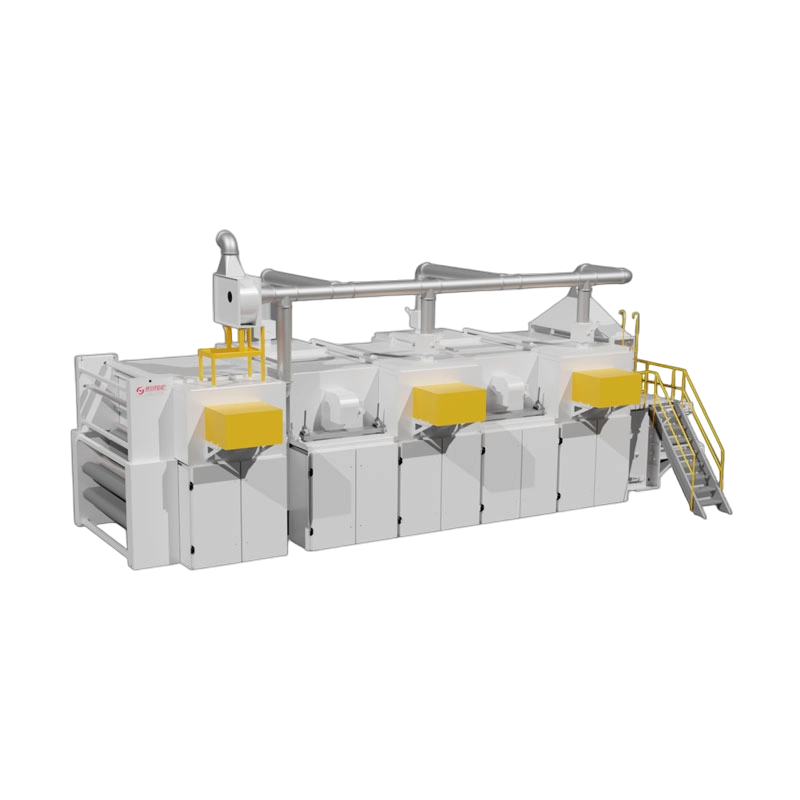
The HYDC Big Chamber Blender is a mechanical fiber blending and storage machine developed for nonwoven manufacturing applications. It is suitable for polyester fiber, polypropylene staple fiber, wool, cotton, coir fiber, jute fiber, ES fiber, waste fiber, and other opened materials. By distributing fibers throughout a large chamber and controlling the feeding process through photoelectric sensors, the machine helps manufacturers achieve a more even fiber mixture and a stable supply to carding or other downstream equipment.
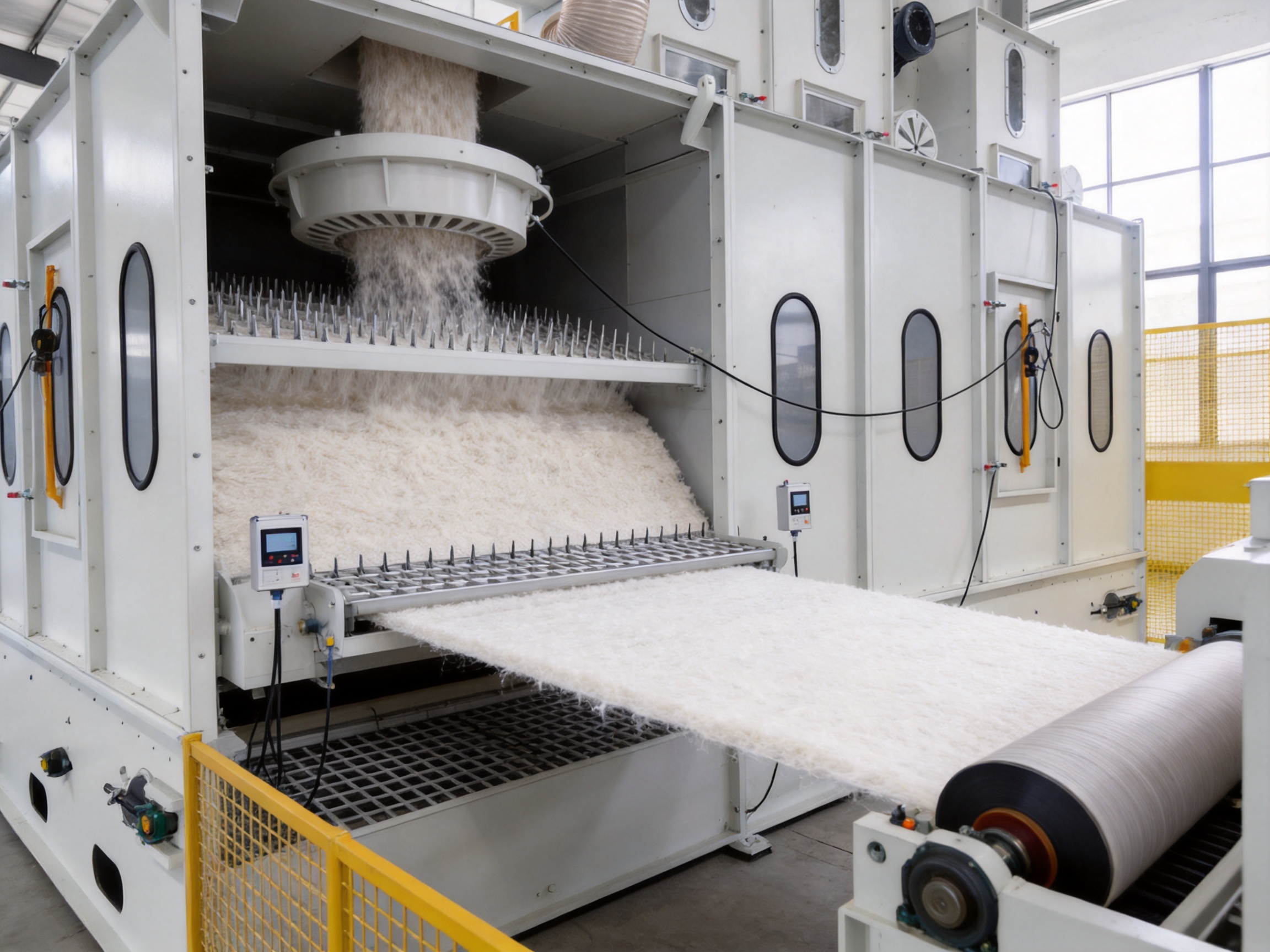
Its design combines a horizontal delivery lattice, spike lattice, rotary separator, stripper, evener roller, photoelectric control, and safety access features. These systems work together to improve blending consistency, reduce interruptions, and simplify operation and maintenance. Available working widths, storage volumes, and output capacities allow the equipment to be configured for different production requirements, from medium-sized nonwoven plants to larger industrial lines.
The Role of a Big Chamber Blender in Nonwoven Production
Fiber preparation is one of the most important stages in a nonwoven production line. Fibers may arrive in bales or loose packages with different degrees of compression, moisture content, color, length, fineness, and surface characteristics. Opening machines separate and loosen the fibers, but opening alone does not guarantee a uniform mixture. The opened fibers must be blended and stored in a controlled manner before they are fed to the carding or web-forming equipment.
A big chamber blender provides three main functions. First, it receives opened fibers from one or more upstream opening machines. Second, it mixes and distributes the fibers inside a storage chamber. Third, it delivers the blended material continuously to the next process. This buffering function is particularly valuable when the opening process and carding process operate at different instantaneous rates.
Without an adequate buffer, a temporary fluctuation in bale opening, material delivery, or downstream demand may cause the card line to receive too much or too little fiber. Overfeeding can overload equipment, while underfeeding can create thin areas in the web and reduce production efficiency. The chamber blender helps absorb these fluctuations and maintain a more stable feed condition.
The machine is also useful when several raw materials must be combined. For example, a manufacturer may blend polyester with recycled fiber, polypropylene with color fiber, or natural fibers with synthetic fibers. The large chamber gives the materials space to distribute and overlap before they are taken out for the next stage. This supports improved blend uniformity compared with simple, short-distance transfer arrangements.
Core Advantages of the Equipment
Consistent Fiber Distribution
The rotary separator distributes incoming fiber across the width of the chamber. This prevents the material from accumulating in a single location and supports a more even filling pattern. As the fiber is distributed over the storage area, different portions of the blend are layered and combined, helping reduce concentration differences between materials.
Even distribution is important for nonwoven products that require consistent basis weight, color, density, thermal response, or mechanical performance. A poorly distributed blend may cause localized differences in web formation. The rotary separator and controlled lattice movement are intended to reduce these variations before the fibers reach the card or web-forming machine.
Continuous Feeding to the Card Line
The HYDC Big Chamber Blender is designed to ensure a continuous supply of prepared fiber. The horizontal delivery lattice transports material toward the outlet, while the spike lattice lifts and moves the fiber in a controlled direction. This arrangement helps maintain a steady material flow and reduces the risk of sudden interruptions.
Continuous feeding is especially important in high-speed nonwoven production. When the card line stops because of an unstable fiber supply, the production line may lose time during cleaning, restart, adjustment, and web stabilization. A reliable intermediate storage and feeding machine helps the line operate more smoothly and may reduce unnecessary downtime.
Photoelectric Process Control
Two photoelectric sensors monitor the feeding status inside the machine. These sensors are used to identify changes in the material level and control the operating condition of the feeding system. Automatic detection reduces the need for constant manual observation and supports more responsive operation.
Photoelectric control can also help coordinate the blender with upstream and downstream machinery. When the chamber requires additional material, the system can respond to the available level. When the chamber is sufficiently filled, the feeding action can be adjusted. The exact control logic can be adapted according to the line configuration and the customer’s automation requirements.
Independent Drive for the Stripper and Evener Roller
The stripper and evener roller use independent transmission. This is an important design feature because it allows their operating speeds and working conditions to be adjusted separately. Different fibers and blend compositions may require different settings. A separate drive provides greater flexibility than a single fixed transmission system.
Independent transmission also supports easier maintenance and troubleshooting. Operators can inspect, adjust, or service one component without relying on a mechanically linked system for every function. The result is a more adaptable machine with improved dependability in daily production.
Large Storage Capacity
The equipment is available in several storage volume configurations, including approximately 15 cubic meters, 20 cubic meters, 30 cubic meters, and 37 cubic meters. These options allow the machine to be selected according to raw material consumption, line speed, available factory space, and the desired buffer time.
A larger chamber can be beneficial when the production line handles high output, multiple raw materials, or irregular upstream supply. A smaller configuration may be more suitable for a compact line or a plant that requires a shorter storage period. The selection should be made after reviewing the required working width, fiber type, hourly capacity, and connection layout.
Broad Raw Material Compatibility
The blender can be used with many types of opened fiber. Typical materials include polyester fiber, polypropylene staple fiber, wool, cotton, coir fiber, jute fiber, ES fiber, waste fiber, and other materials used in nonwoven manufacturing. This flexibility makes the machine suitable for a wide range of applications.
Synthetic fibers are commonly used for thermal bonded wadding, automotive materials, filtration products, and general nonwoven fabrics. Natural fibers such as cotton, wool, coir, and jute are used in felts, insulation materials, mats, floor coverings, and environmentally oriented products. The ability to accommodate different materials helps manufacturers use one blending platform for multiple product programs.
Machine Structure and Operating Principle
Machine Frame
The main frame is constructed from wall boards welded with Q235-A armor plate and assembled with bolts. This construction provides a practical combination of strength, modularity, and installation convenience. A bolted assembly can simplify transportation and site installation, while the welded wall boards provide support for the internal conveying and blending mechanisms.
Frame rigidity is important in a large fiber-processing machine. The structure must support moving components, withstand vibration, and maintain alignment during continuous operation. A stable frame also helps reduce mechanical noise and unnecessary wear on bearings, rollers, chains, and drive components.
Horizontal Delivery Lattice
The horizontal delivery lattice uses an anti-skidding leather belt. Multiple rollers reinforce the center section, and wooden battens are installed on both sides. This configuration helps the belt carry loose fiber without excessive slipping or uncontrolled movement.
The lattice forms the lower transport surface of the chamber. It moves fiber toward the delivery section at a controlled rate. The belt and roller arrangement is designed to handle lightweight, bulky material while maintaining a stable conveying action. The side battens help guide the fiber and support the working shape of the lattice.
Spike Lattice
The spike lattice is made from high-quality wood with canvas interlining and is supported around its perimeter by angle steel. The spike structure engages with the loose fiber and lifts it through the chamber. Because fiber is relatively light and compressible, the spike lattice must move it without producing excessive compaction or uncontrolled clumps.
The combination of the wooden structure, canvas interlining, and angle steel support provides a balance between working flexibility and structural stability. The machine can be adjusted to suit the material condition and the required feeding rate. Proper adjustment is important because different fibers have different lengths, crimp levels, friction characteristics, and bulk densities.
Rotary Separator
The rotary separator is positioned to distribute the incoming fiber evenly within the chamber. Instead of allowing all material to fall in one narrow stream, the separator spreads it across the storage area. This is particularly useful when the machine receives fiber from a bale opener or an opening and cleaning section with a concentrated outlet.
Uniform filling improves the blending effect. As successive portions of material enter the chamber, they are placed across a broader area. The stored fiber therefore contains overlapping layers rather than a single localized pile. When the material is later withdrawn, the outgoing blend is more representative of the combined input.
Photoelectric Sensors
The two photoelectric sensors monitor the level or feeding status of the fiber. Their signals help the control system determine whether the chamber requires material or whether feeding should be reduced or stopped. Automatic monitoring contributes to safer and more stable operation, particularly when the machine is integrated into a complete production line.
Sensor cleanliness is important. Fiber dust and lint should be removed regularly so that the photoelectric system can operate accurately. The control cabinet, sensor wiring, and safety circuits should also be inspected as part of the plant’s preventive maintenance program.
Cleaning Gate and Safety Switch
A dodge gate is installed at the end of the chamber to make internal cleaning more convenient. Fiber can accumulate around the bottom, corners, or transfer areas during normal production. Convenient access allows operators to remove residual material and inspect internal components without unnecessary disassembly.
The gate is equipped with a safety switch. The switch is intended to prevent operation when the access gate is open, helping protect personnel during inspection and cleaning. Operators should still follow the plant’s lockout and power-isolation procedures before entering or reaching into any part of the machine.
How the Blending Process Works
Operation begins when opened fiber enters the upper or inlet section of the chamber. The rotary separator distributes the material across the chamber width. The fiber gradually accumulates in a controlled storage zone, where different incoming materials can intermingle.
As the control system detects the material level, the relevant feeding components operate according to the programmed or adjusted conditions. The spike lattice engages with the stored fiber and carries it toward the delivery area. The horizontal lattice then transports the material to the outlet. The stripper and evener roller help regulate the amount of material leaving the chamber and improve the uniformity of the delivered layer.
The system is not intended merely to store fiber as a passive bin. Its internal movement creates a controlled blending and feeding process. Material is repeatedly distributed, lifted, leveled, and delivered. The result is a more stable feed to carding machines, airlay equipment, or other downstream units.
The actual performance depends on fiber type, blend ratio, moisture, bale-opening quality, working width, storage volume, and operating speed. For this reason, the machine should be configured and commissioned according to the specific production process rather than operated with one universal setting for every material.
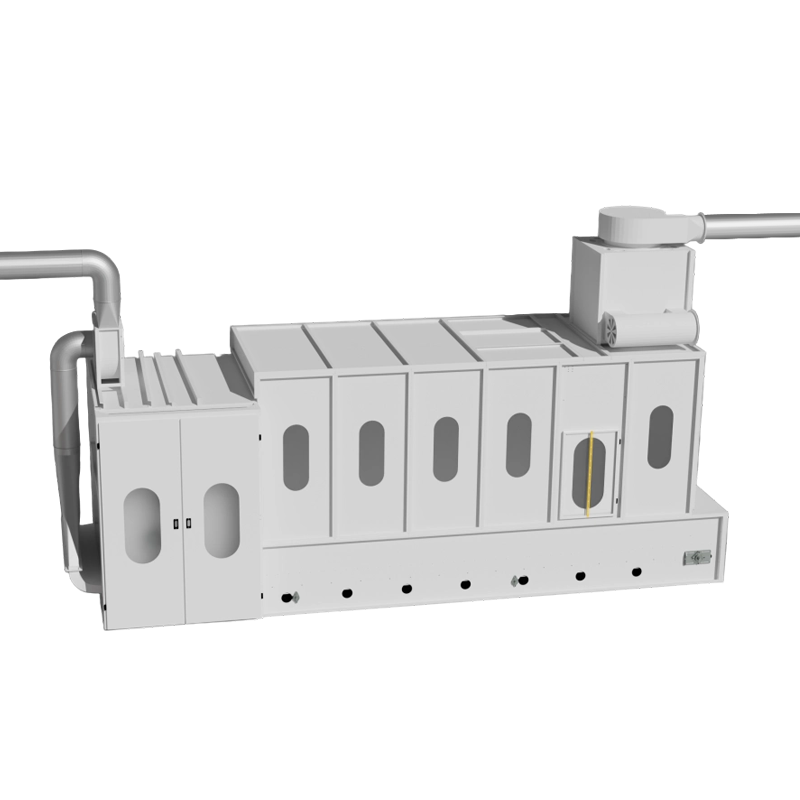
HYDC Big chamber blender
Technical Configurations and Selection Options
The equipment is available in multiple working widths and storage volumes. Reported working widths include 1,700 mm, 2,000 mm, 2,500 mm, and 3,000 mm. The appropriate width should correspond to the width of the carding or web-forming line and the required material distribution pattern.
Reported capacity configurations include approximately 300 kilograms per hour, 500 kilograms per hour, 800 kilograms per hour, and 1,000 kilograms per hour. One listed HYDC-170 configuration specifies a maximum capacity of approximately 650 kilograms per hour per set. Actual output should be confirmed during technical discussions because capacity can vary with fiber density, material type, blend composition, moisture, and machine settings.
Available storage volumes are listed as approximately 15, 20, 30, and 37 cubic meters. The installed power information supplied for different configurations includes 8.8 kW and 15.7 kW. These figures indicate that power selection may vary according to working width, storage size, conveyor arrangement, and customer requirements.
| Item | Available or Listed Configuration | Production Significance |
|---|---|---|
| Model family | HYDC | Big chamber blending and fiber storage platform |
| Example model | HYDC-170 | Configuration associated with a 1,700 mm working width |
| Working width | 1,700 mm, 2,000 mm, 2,500 mm, 3,000 mm | Matches different card and web-forming widths |
| Storage volume | 15 m³, 20 m³, 30 m³, 37 m³ | Provides different levels of material buffering |
| Capacity range | Approximately 300–1,000 kg/h | Supports different line speeds and product requirements |
| Example capacity | Up to approximately 650 kg/h per set | Reference value for a listed configuration |
| Listed installed power | Approximately 8.8–15.7 kW depending on configuration | Supports mechanical conveying, blending, and control systems |
| Control method | Photoelectric monitoring with automatic operation | Helps regulate material levels and feeding status |
| Certification information | CE and ISO9001-related certification listed | Supports quality and market-compliance requirements |
| Color and layout | Customizable | Allows adaptation to factory and line requirements |
The figures in the table should be treated as configuration references rather than a substitute for a formal technical proposal. A complete quotation should identify the selected working width, chamber volume, motor arrangement, electrical standard, control interface, inlet and outlet dimensions, conveying belt length, and required auxiliary equipment.
Advantages Compared with Basic Fiber Storage Equipment
Blending Rather Than Simple Holding
A basic storage hopper may hold fiber for a short period but may not provide sufficient distribution or active blending. The big chamber blender combines storage with movement and leveling. This is advantageous when the production process uses several fiber types or when raw materials arrive in uneven batches.
Active internal movement helps reduce the chance that one material remains concentrated in a specific region. The rotary separator creates a broader distribution pattern, while the spike lattice and evener roller support controlled withdrawal. This makes the machine more suitable for blended nonwoven products than a simple passive container.
Better Process Continuity
Simple transfer equipment may move fiber directly from the opener to the card, leaving little tolerance for fluctuations. The chamber blender adds a reserve of prepared fiber between the two processes. This buffer can help the card line continue operating during short variations in upstream supply.
Production continuity has a direct effect on utilization. Every interruption can involve labor, discarded material, machine restart time, and possible quality variation. A stable buffer is therefore a practical advantage for plants seeking reliable output rather than only a high nominal machine speed.
Improved Adjustment Flexibility
The independent transmission of the stripper and evener roller provides more adjustment flexibility than a fully linked mechanical arrangement. Operators can adapt the material withdrawal behavior to different fiber blends and bulk densities. This is valuable for a manufacturer producing several grades of nonwoven fabric on the same line.
Adjustment flexibility also supports commissioning. During startup, the production team can gradually tune feed rates, sensor positions, and roller speeds while observing the web quality at the card or web-forming machine. This approach can reduce the risk of overfeeding and help establish stable operating conditions.
Designed for Industrial Integration
The equipment is intended to operate as part of an opening and blending section rather than as an isolated machine. Its dimensions, conveying belt length, working width, sensor system, and outlet can be coordinated with bale openers, opening machines, carding machines, airlay systems, or complete nonwoven production lines.
Integration is a significant advantage because line performance depends on the relationship between individual machines. A blender that is correctly matched to the upstream and downstream equipment can reduce manual handling, improve housekeeping, and make production data easier to manage through a central control system.
Manufacturing Strengths and Engineering Approach
The manufacturer, Changshu Hongyi Nonwoven Machinery Co., Ltd., has more than 20 years of experience in the nonwoven machinery field. Its product range includes individual opening, blending, carding, airlay, needle punching, thermal bonding, ironing, winding, cutting, and complete nonwoven production lines.
This broad product experience is relevant to the design of a chamber blender. Because the machine is connected to other line equipment, understanding the behavior of upstream opening systems and downstream carding systems is important. Experience across the complete process helps the manufacturer develop practical interfaces, select appropriate capacities, and address material-flow problems during line planning.
The company supplies machinery to customers in more than 20 countries, including markets in Asia, Europe, Africa, and Latin America. International project experience can strengthen the ability to manage different electrical standards, factory layouts, languages, operating conditions, and product specifications.
Modular Construction
The machine is described as having a modular design. Modular construction can simplify production planning, transport, installation, and future maintenance. Large industrial equipment often has to pass through factory entrances, be shipped in sections, and be assembled at the customer’s site. A modular structure can make these activities more manageable.
Modularity also supports customization. Working width, storage volume, belt length, power configuration, color, control arrangement, and connection dimensions can be considered according to the line design. This is preferable to forcing every customer to use one standard size regardless of production requirements.
Quality-Control Orientation
The company operates with ISO9001-related quality certification information and lists CE certification for the equipment. Quality management systems are useful for controlling purchasing, fabrication, assembly, inspection, documentation, and after-sales procedures.
For a chamber blender, quality control should include checking frame dimensions, weld quality, roller alignment, belt tracking, sensor operation, motor performance, safety interlocks, and control-cabinet wiring. Accurate assembly is essential because misalignment can cause belt deviation, uneven feeding, vibration, or premature wear.
Engineering for Reliability
The structure uses reinforced wall boards, support angles, multiple rollers, and independent transmission components. These features reflect an engineering approach focused on continuous industrial use. Reliability is not produced by one component alone; it results from proper structural support, suitable material selection, accurate assembly, correct adjustment, and routine maintenance.
The use of a safety switch on the cleaning gate is another example of practical engineering. Fiber machines require regular cleaning, and access points must be designed with safety in mind. Combining convenient access with an interlock can reduce risk while helping operators maintain the internal chamber.
Customer-Specific Production Lines
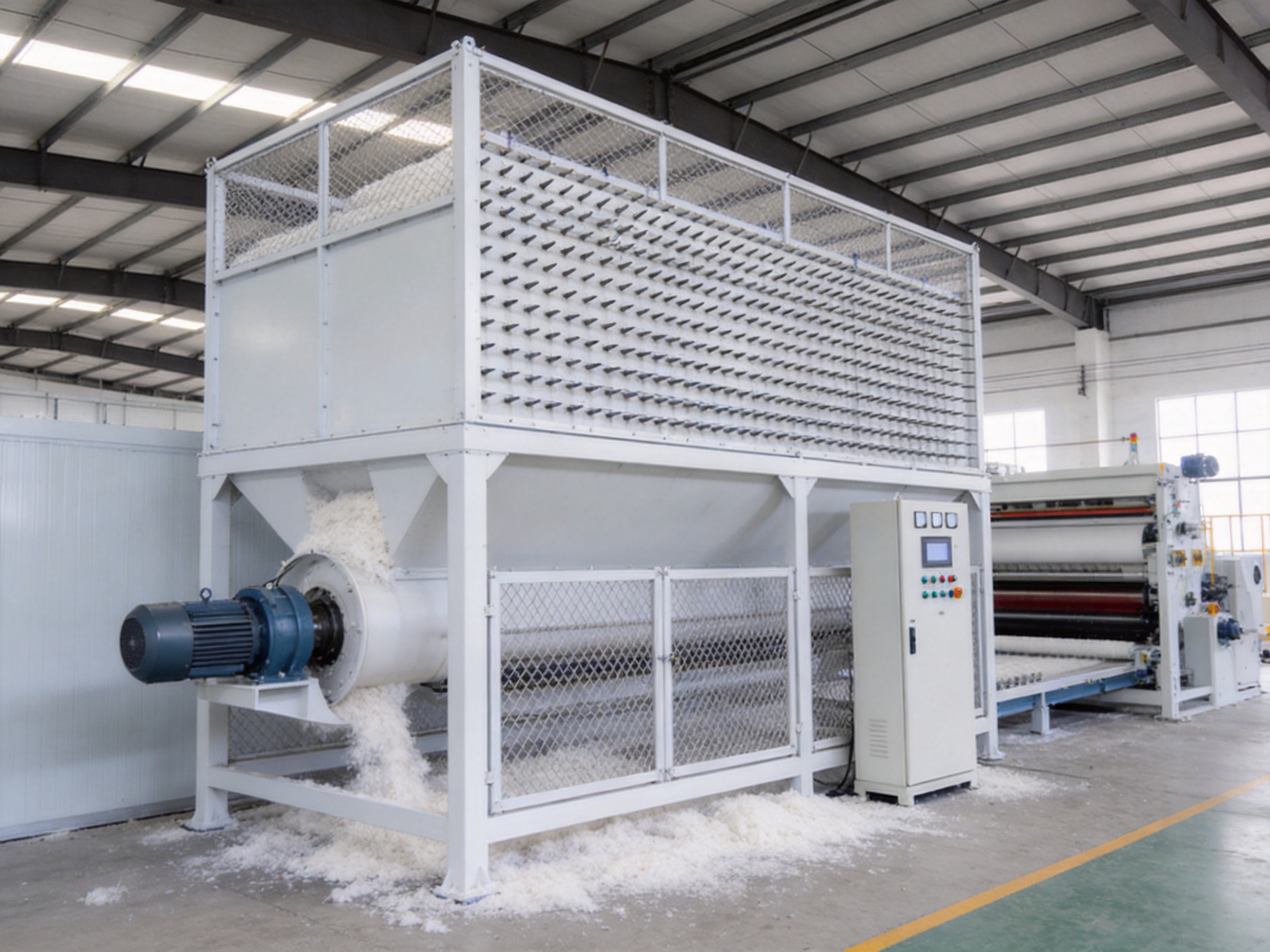
The manufacturer provides complete lines for needle-punched geotextiles, nonwoven carpets, airlaid waste felt, automotive interior materials, cleaning cloth, wool felt, jute felt, and other applications. This means the blender can be evaluated as part of a complete material solution rather than only as a standalone product.
For a customer, this can simplify project communication. The same engineering partner may review raw materials, product width, basis weight, line capacity, opening requirements, carding, web formation, bonding, needle punching, winding, and cutting. A complete process review can help ensure that the blender is not oversized, undersized, or poorly matched to the rest of the line.
Applications in Different Nonwoven Industries
Automotive Interior Materials
Automotive interior materials often require controlled fiber blends, stable thickness, good resilience, and consistent surface quality. Polyester and other synthetic fibers may be combined with recycled or special-function fibers. A stable blending stage helps maintain the intended composition before carding and web formation.
For automotive applications, process repeatability is especially important because material performance must remain consistent across production batches. The blender’s storage and control functions can support a more stable supply to the carding machine, helping reduce sudden changes in web density.
Needle-Punched Geotextiles
Geotextiles may use polyester, polypropylene, recycled fibers, or combinations of these materials. Large production lines need a dependable supply of prepared fiber to maintain continuous web formation before needle punching. The available wider working widths and higher capacity configurations can be considered for industrial geotextile lines.
Fiber distribution affects the quality of the carded web and therefore the final needle-punched structure. While the blender alone does not determine geotextile performance, it contributes to the stable preparation conditions required by the card and needle punching machines.
Carpets and Floor Coverings
Nonwoven carpets and floor coverings may use polyester, polypropylene, wool, jute, coir, or recycled fibers. A manufacturer may need to change colors, fiber types, or blend ratios depending on the product range. The broad material compatibility of the chamber blender is useful in such environments.
Natural fibers can differ considerably from synthetic fibers in length, density, friction, and moisture response. Operators should establish appropriate settings for each material, but the adjustable blending and feeding design provides a foundation for handling these variations.
Thermal Bonded Wadding
Thermal bonded wadding commonly uses polyester, polypropylene, low-melting ES fiber, or other thermally responsive materials. The blend must be prepared consistently before it passes through carding and a thermal bonding oven. Variations in ES fiber concentration may affect bonding behavior and final product resilience.
A big chamber blender can help distribute the thermally bonding component throughout the main fiber. The downstream oven still requires correct temperature, speed, and air-flow control, but a stable input blend supports more consistent thermal processing.
Wool, Jute, and Natural-Fiber Felts
Wool felt, jute felt, coir products, and mixed natural-fiber materials require equipment that can handle bulky, irregular, and sometimes variable raw materials. The large chamber provides space for storing and distributing opened natural fibers before carding or web formation.
Natural fibers may carry dust, short fibers, and variable moisture. Effective opening and cleaning upstream, regular machine cleaning, and suitable sensor maintenance are important. The cleaning gate assists access to the chamber and can support a more disciplined maintenance routine.
Recycled Fiber Products
Recycled fibers are increasingly used in nonwoven insulation, automotive materials, felt, carpet underlay, and other products. Recycled inputs can vary in fiber length, color, density, and contamination level. Blending and buffering help manufacturers manage these variations before the material reaches the card line.
The chamber blender should be used together with appropriate opening, cleaning, and quality-control procedures. It supports mixing, but it does not replace contamination removal or raw-material inspection. A complete recycling-oriented line should be designed around the specific source and condition of the recycled fibers.
Installation and Commissioning Considerations
Before installation, the buyer should prepare a level foundation, adequate access space, electrical connections, lighting, ventilation, and material-handling facilities. The chamber blender must be positioned so that upstream and downstream machines can connect without sharp transitions or unnecessary conveying distance.
The required conveying belt length should be determined according to the number and arrangement of bale openers or other upstream machines. The factory layout should allow access to the cleaning gate, sensors, drive components, control cabinet, and inspection points. Sufficient space around the machine improves safety and reduces maintenance time.
During mechanical installation, the frame sections should be aligned carefully. The horizontal lattice must track correctly, and the rollers should be checked for parallel alignment. The spike lattice, stripper, evener roller, rotary separator, and safety gate should be inspected before test operation.
Electrical commissioning includes checking motor rotation, sensor signals, emergency stops, safety switches, grounding, overload protection, control-panel functions, and communication with other machines. The system should first be tested without fiber, followed by a low-rate material test and then a gradual increase toward the required operating condition.
Commissioning should also include product-quality checks. Operators should observe whether the chamber fills evenly, whether the feed level remains stable, whether the delivered fiber is free of excessive clumps, and whether the card line receives material consistently. Adjustments should be recorded so that successful settings can be repeated.
Operation and Maintenance Guidelines
Daily Inspection
Before starting the machine, operators should inspect the belt, lattice, rollers, safety gate, sensor surfaces, drive guards, and electrical indicators. Any loose material around the machine should be removed. Unusual noise, vibration, belt movement, or motor heating should be investigated before normal production begins.
During operation, operators should monitor chamber level, material distribution, feeding stability, and downstream web condition. A sudden change in web thickness may indicate a problem with the blender, upstream opening, sensor response, or carding equipment. Early detection can prevent a larger production interruption.
Cleaning
Fiber dust and lint can accumulate on rollers, sensors, structural surfaces, and drive components. Cleaning frequency depends on the raw material and production environment. Natural fibers, recycled fibers, and short fibers may require more frequent cleaning than clean, uniform synthetic fibers.
The dodge gate provides access for internal cleaning. Power must be isolated before opening or entering any protected area. The safety switch should be checked regularly, but it should never be bypassed. Compressed air, vacuum equipment, brushes, and other cleaning tools should be selected according to the plant’s safety procedures and dust-control requirements.
Lubrication and Mechanical Checks
Bearings, chains, gearboxes, and other moving components should be lubricated according to the manufacturer’s maintenance schedule. Over-lubrication can attract fiber dust, while insufficient lubrication can cause heat, wear, and noise. The maintenance team should keep records of lubrication dates, component condition, and replacement parts.
Belt tension and tracking should be checked periodically. A belt that is too loose may slip or form an unstable conveying surface. A belt that is too tight can increase bearing load and reduce service life. The spike lattice and support components should also be inspected for damage or deformation.
Sensor and Control-System Maintenance
Photoelectric sensors should be kept clean and correctly aligned. If the sensors receive inconsistent signals, the chamber may overfill, underfill, or feed irregularly. Wiring, connectors, control relays, and safety circuits should be checked by qualified personnel.
Control parameters should be documented. When the machine is used for several fiber blends, the plant may maintain separate operating recipes or adjustment records for each material. This can reduce setup time and improve repeatability between production batches.
Energy Efficiency and Production Economics
The listed installed power is relatively moderate for an industrial fiber storage and blending machine, although the actual requirement depends on the selected configuration. Efficient operation is influenced not only by motor power but also by correct sizing, belt alignment, component lubrication, sensor control, and avoidance of unnecessary empty running.
Automatic photoelectric control can help reduce overfeeding and unnecessary operation. When the chamber reaches the required level, the upstream feeding action can be controlled rather than continuing without regard to the available storage space. This can reduce material handling losses and support more efficient coordination between machines.
Production economics should be evaluated using total line performance rather than the purchase price of the blender alone. A reliable machine may reduce downtime, lower manual handling, improve blend consistency, and protect the operating stability of expensive carding and web-forming equipment. These benefits can have a significant effect on the cost per kilogram of finished product.
Manufacturers should also consider the cost of maintenance parts, installation, training, power consumption, cleaning labor, and integration with existing control systems. A properly selected machine can provide better long-term value than a lower-cost unit that lacks sufficient capacity, adjustment flexibility, or technical support.
Why Manufacturer Support Matters
Fiber blending equipment is closely related to raw-material behavior. A machine that performs well with clean polyester may require different settings when processing wool, jute, coir, recycled fiber, or a mixed synthetic blend. Manufacturer support during selection and commissioning can therefore be as important as the mechanical design.
The supplier’s experience with complete nonwoven lines enables technical discussions covering the entire process. The customer can provide raw-material details, target product specifications, working width, desired output, factory layout, and existing machinery. The engineering team can then evaluate the appropriate chamber volume, conveyor arrangement, control method, and interface requirements.
The supplied trade information lists FOB, CNF, or CIF terms, a typical lead time of approximately 90 days after deposit, and payment terms of 30 percent advance with the balance before delivery. These commercial conditions should be confirmed in the final contract because delivery schedules may vary according to customization, production planning, shipping conditions, and customer approval procedures.
A twelve-month warranty after mechanical and electrical commissioning is listed. Installation and debugging support are also described, with the buyer responsible for travel, accommodation, medical treatment, safety, translation, labor cooperation, electrical cables, and installation tools. The final scope of installation should be clearly defined before shipment, including the number of engineers, estimated duration, commissioning responsibilities, and acceptance criteria.
Recommended Purchasing Checklist
Before ordering a big chamber blender, the buyer should prepare a clear technical specification. The specification should identify every raw material, fiber length range, blend ratio, moisture condition, expected hourly output, product width, and downstream machine type.
The buyer should confirm the following points with the supplier:
1. Required working width and the matching inlet and outlet dimensions.
2. Required storage volume and estimated buffering time at the target production rate.
3. Expected capacity for each fiber type and blend composition.
4. Installed power, voltage, frequency, and electrical-control standard.
5. Sensor type, control logic, communication interface, and emergency-stop arrangement.
6. Conveying belt length and its relationship to the bale opener or opening line.
7. Access space required for cleaning, inspection, and component replacement.
8. Spare parts supplied with the machine and recommended maintenance inventory.
9. Installation, commissioning, operator training, and acceptance procedures.
10. Warranty conditions, response time, remote support, and availability of service engineers.
11. Packing method, transport dimensions, shipping weight, and unloading requirements.
12. Documentation supplied, including manuals, electrical drawings, foundation information, and maintenance schedules.
These details reduce the risk of misunderstanding and help the buyer compare competing equipment on a technically meaningful basis. Capacity alone should not be the only comparison point. Blending quality, control stability, maintenance access, integration capability, and support services are equally important.
Performance Expectations and Practical Limitations
A chamber blender can improve material distribution and feeding stability, but it should be viewed as one part of the complete fiber-preparation system. The quality of the final nonwoven fabric also depends on bale opening, dust removal, fiber quality, carding settings, web formation, bonding, needle punching, thermal treatment, winding, and cutting.
The machine cannot correct every problem caused by unsuitable raw material. Excessive moisture, severely tangled fiber, contamination, extreme fiber-length differences, or incorrect blend ratios may still affect performance. Upstream opening and cleaning should therefore be properly designed, and the operator should monitor raw materials continuously.
Capacity should also be interpreted carefully. A stated maximum output may be achievable under specific material and operating conditions, but bulky low-density fibers may occupy more chamber volume than dense synthetic fibers. Product width, basis weight, and downstream line speed can change the actual required feed rate. Testing and engineering confirmation are recommended before final selection.
Even with these limitations, the machine provides an effective method for combining active fiber blending, temporary storage, and controlled feeding. Its value is greatest when the production line requires stable operation across changing raw materials and continuous supply to the carding section.
Q&A
What is the primary purpose of a big chamber blender?
Its primary purpose is to blend and store opened fibers while supplying a continuous and more uniform feed to a carding machine or another downstream nonwoven process. It acts as both a mixing unit and a buffer between the opening section and the web-forming section.
Which raw materials can the machine process?
The machine is suitable for many opened fibers, including polyester, polypropylene staple fiber, wool, cotton, coir, jute, ES fiber, waste fiber, and other materials used in nonwoven production. The best operating settings depend on fiber length, density, moisture, blend ratio, and opening quality.
How does the machine improve blending uniformity?
The rotary separator spreads incoming fiber across the chamber, while the storage movement, spike lattice, stripper, and evener roller support controlled mixing and withdrawal. This active distribution is more effective for many applications than simply holding fiber in a passive box.
What role do the photoelectric sensors perform?
The photoelectric sensors monitor the feeding or material-level condition. Their signals help control the operation of the feeding system so that the chamber can receive material when required and avoid unnecessary overfilling.
What working widths are available?
Listed working widths include approximately 1,700 mm, 2,000 mm, 2,500 mm, and 3,000 mm. The final selection should match the width and capacity of the carding or web-forming line.
What storage volumes can be selected?
Listed storage volumes include approximately 15 cubic meters, 20 cubic meters, 30 cubic meters, and 37 cubic meters. The appropriate volume depends on output, raw-material supply, factory layout, and the desired buffer time.
What output range is available?
Reference capacities include approximately 300, 500, 800, and 1,000 kilograms per hour. A listed HYDC-170 configuration specifies a maximum of approximately 650 kilograms per hour per set. Actual capacity should be confirmed for the customer’s materials and production conditions.
Why are the stripper and evener roller independently driven?
Independent transmission allows operators to adjust their operating conditions separately. This provides greater flexibility for different fiber blends, improves process adjustment, and can simplify maintenance and troubleshooting.
Is the machine suitable for recycled fibers?
Yes, it can be used with waste and recycled fibers when they have been properly opened and prepared. Because recycled materials may vary in length, density, and cleanliness, the opening, cleaning, blending, and carding settings should be developed for the specific recycled feedstock.
How is internal cleaning performed?
A dodge gate at the end of the chamber provides convenient access for removing residual fiber and inspecting internal areas. The power should be isolated before cleaning, and the safety switch must remain functional and must not be bypassed.
Can the machine be customized?
Customization can include working width, storage volume, conveying belt length, color, electrical configuration, control interface, and connection arrangement. Final customization should be based on the complete line layout and confirmed in the technical agreement.
What certifications are listed for the equipment?
The supplied information lists CE and ISO9001-related certification. Buyers should request the applicable certificates and technical documents for the exact configuration being purchased.
What after-sales support is available?
The supplied trade information describes installation and debugging support, a twelve-month warranty after mechanical and electrical commissioning, and international service arrangements. The final contract should define the responsibilities of the seller and buyer in detail.
How should buyers compare this machine with competing products?
Buyers should compare more than nominal capacity. Important factors include fiber distribution, storage volume, sensor control, independent roller transmission, maintenance access, frame construction, line integration, customization, installation support, spare parts, warranty, and the manufacturer’s experience with complete nonwoven production systems.
Conclusion
The big chamber blender is a key machine for manufacturers that need dependable fiber mixing, intermediate storage, and continuous feeding in nonwoven production. By combining a reinforced frame, anti-skidding horizontal lattice, spike lattice, rotary separator, photoelectric sensors, independent stripper and evener roller transmission, and a convenient cleaning gate, the equipment addresses several common challenges in fiber preparation.
Its available working widths, storage volumes, and capacity configurations make it suitable for a broad range of applications, including geotextiles, carpets, automotive interior materials, thermal bonded wadding, natural-fiber felts, cleaning cloth, and recycled-fiber products. The machine is particularly useful where several fibers must be blended evenly or where the carding line requires a stable supply despite fluctuations in upstream material delivery.
The manufacturer’s experience in opening, blending, carding, airlay, needle punching, thermal bonding, and complete nonwoven production lines adds value during project design and commissioning. Modular construction, customizable configurations, international supply experience, and listed quality certifications support its use in both standalone installations and complete production lines.
For the best result, buyers should provide detailed information about raw materials, output, working width, product specifications, factory layout, and control requirements. With correct sizing, professional installation, suitable operating settings, and preventive maintenance, the HYDC Big Chamber Blender can contribute to more consistent fiber preparation, smoother line operation, and improved long-term production efficiency.
References
1. Product technical information for the HYDC Big Chamber Blender, including structure, functions, configurations, and operating features.
2. Manufacturer-provided specifications for HYDC-series nonwoven fiber blending and storage equipment.
3. Manufacturer company information concerning nonwoven machinery production, complete production lines, international supply, and engineering services.
4. ISO 9001 quality management principles for manufacturing and process control.
5. General technical principles of fiber opening, blending, card feeding, web formation, thermal bonding, and needle punching in nonwoven production.
6. General industrial safety practices for mechanical equipment, electrical isolation, guarding, interlocks, and maintenance access.