

Content
- 1 Purpose of a Thermal Bonding Oven in Nonwoven Production
- 2 Working Principle of the HYHX Nonwoven Fabric Oven
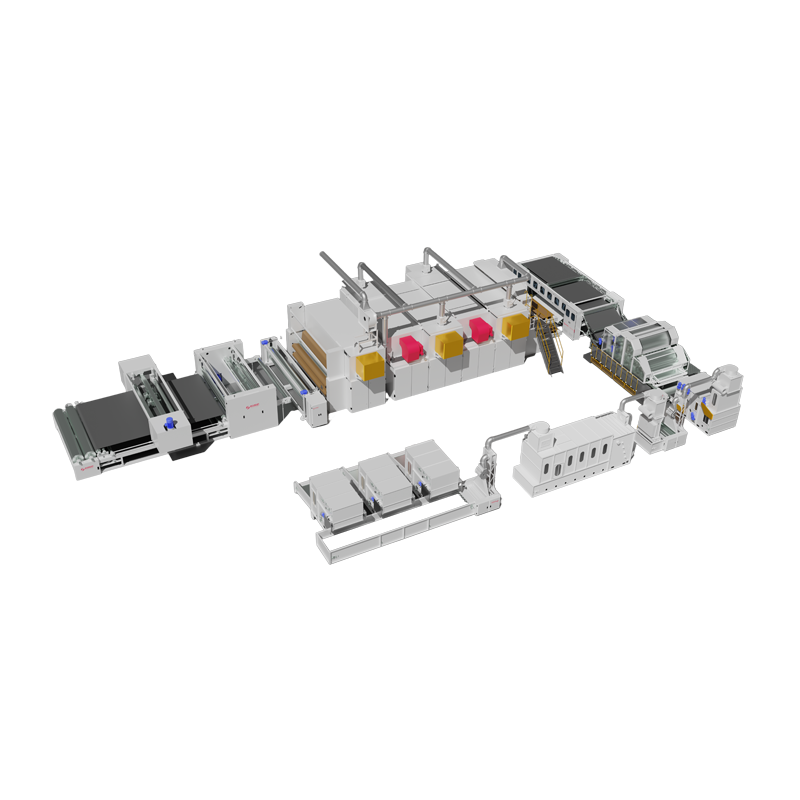
- 3 Core Construction and Machine Configuration
- 4 Product Performance Range
- 5 Advantages Compared with Conventional Bonding Equipment
- 6 Applications of Thermally Bonded Wadding
- 7 Engineering and Manufacturing Strengths
- 8 Advanced Manufacturing Process for the Equipment
- 9 Process Parameters That Influence Product Quality
- 10 Installation, Commissioning, and Operator Training
- 11 Maintenance and Long-Term Reliability
- 12 How the Oven Supports Factory Efficiency
- 13 Selection Guide for Buyers
- 14 Why Choose a Specialized Nonwoven Machinery Supplier
- 15 Frequently Asked Questions
- 15.1 What is the HYHX Nonwoven Fabric Oven used for?
- 15.2 Which raw materials can be processed?
- 15.3 What is the maximum working width?
- 15.4 What product thickness can the oven handle?
- 15.5 What product weight range is available?
- 15.6 What heating methods are available?
- 15.7 Can the oven be customized?
- 15.8 What are the listed oven length options?
- 15.9 Why is automatic belt correction important?
- 15.10 How does inverter control benefit production?
- 15.11 Is the oven suitable for thick thermal-bonded wadding?
- 15.12 What certifications are listed for the machine?
- 15.13 What after-sales service is provided?
- 15.14 How should a buyer prepare for quotation?
- 15.15 Can the oven be integrated into a complete nonwoven line?
- 16 Conclusion
- 17 References
- 18 Product: HYHX Nonwoven Fabric Oven
Thermal bonding is one of the most important stages in the production of nonwoven materials. It determines how individual fibers are joined, how much strength the finished web can achieve, how evenly thickness is maintained, and how reliably the product performs during later converting or use. For manufacturers working with polyester fiber, PP staple fiber, or blended fiber structures, a carefully designed hot-air oven can provide a highly effective method of bonding without depending on mechanical stitching or excessive compression.
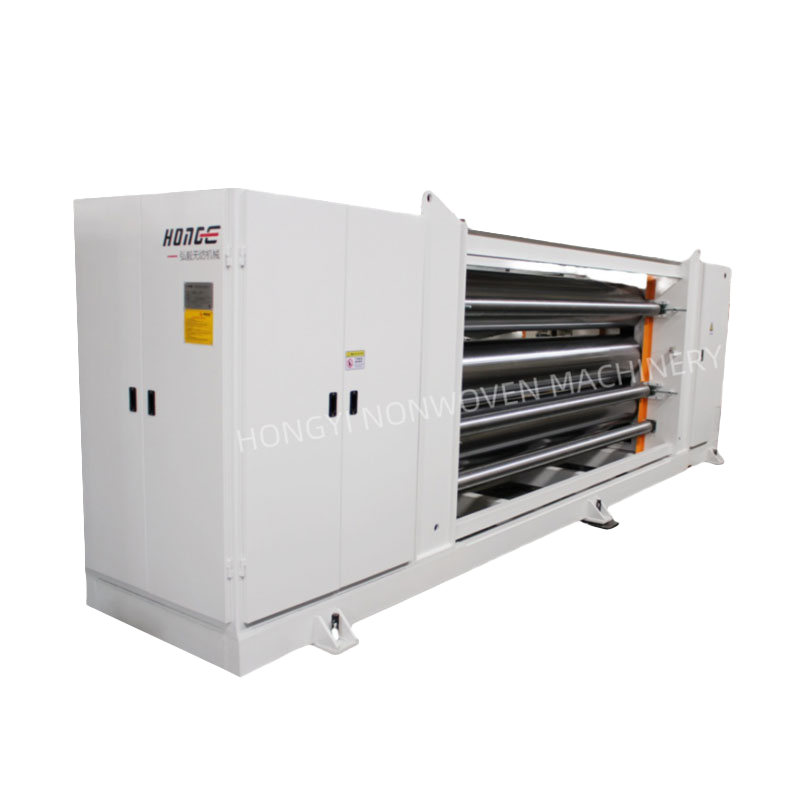
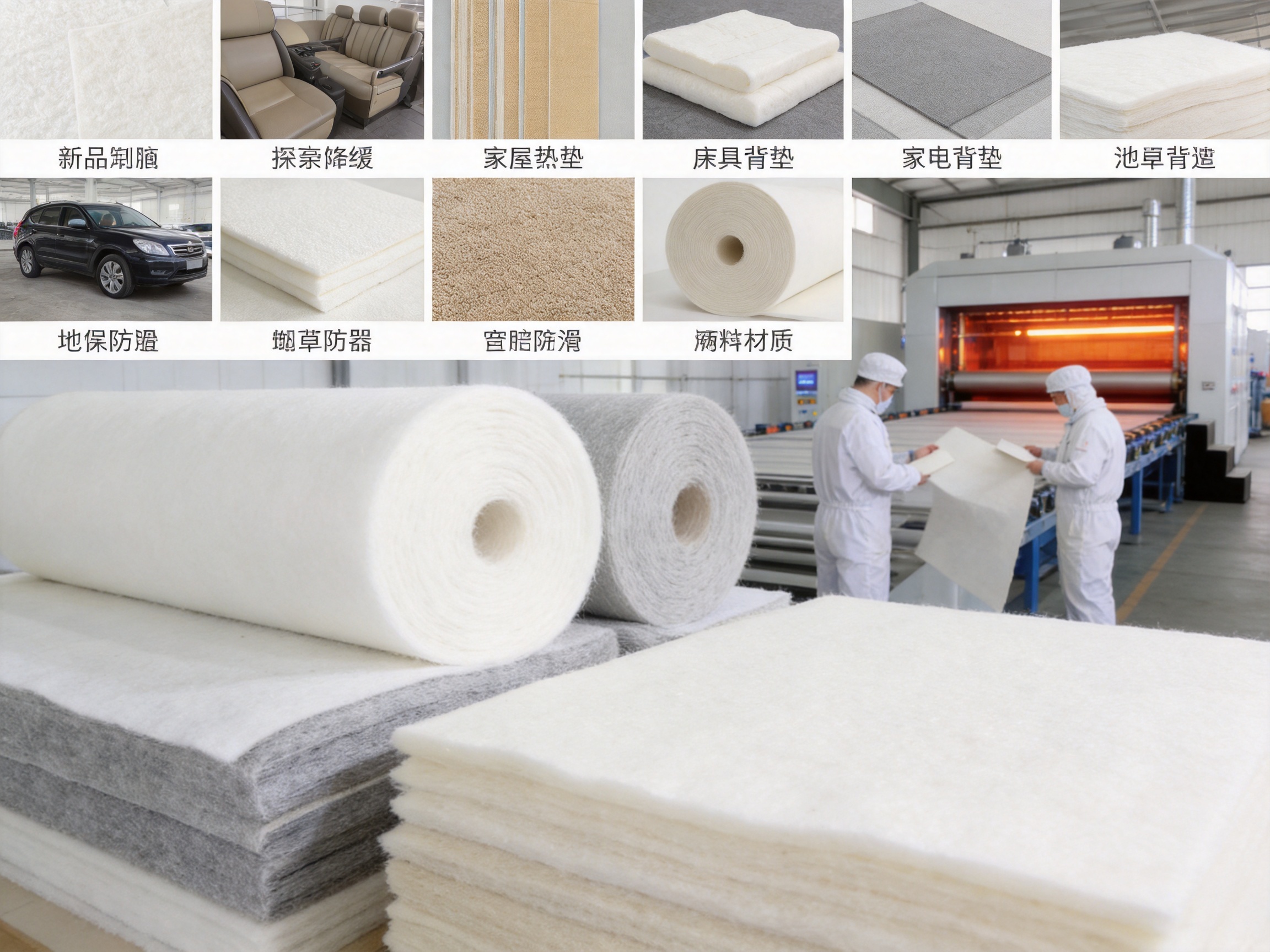
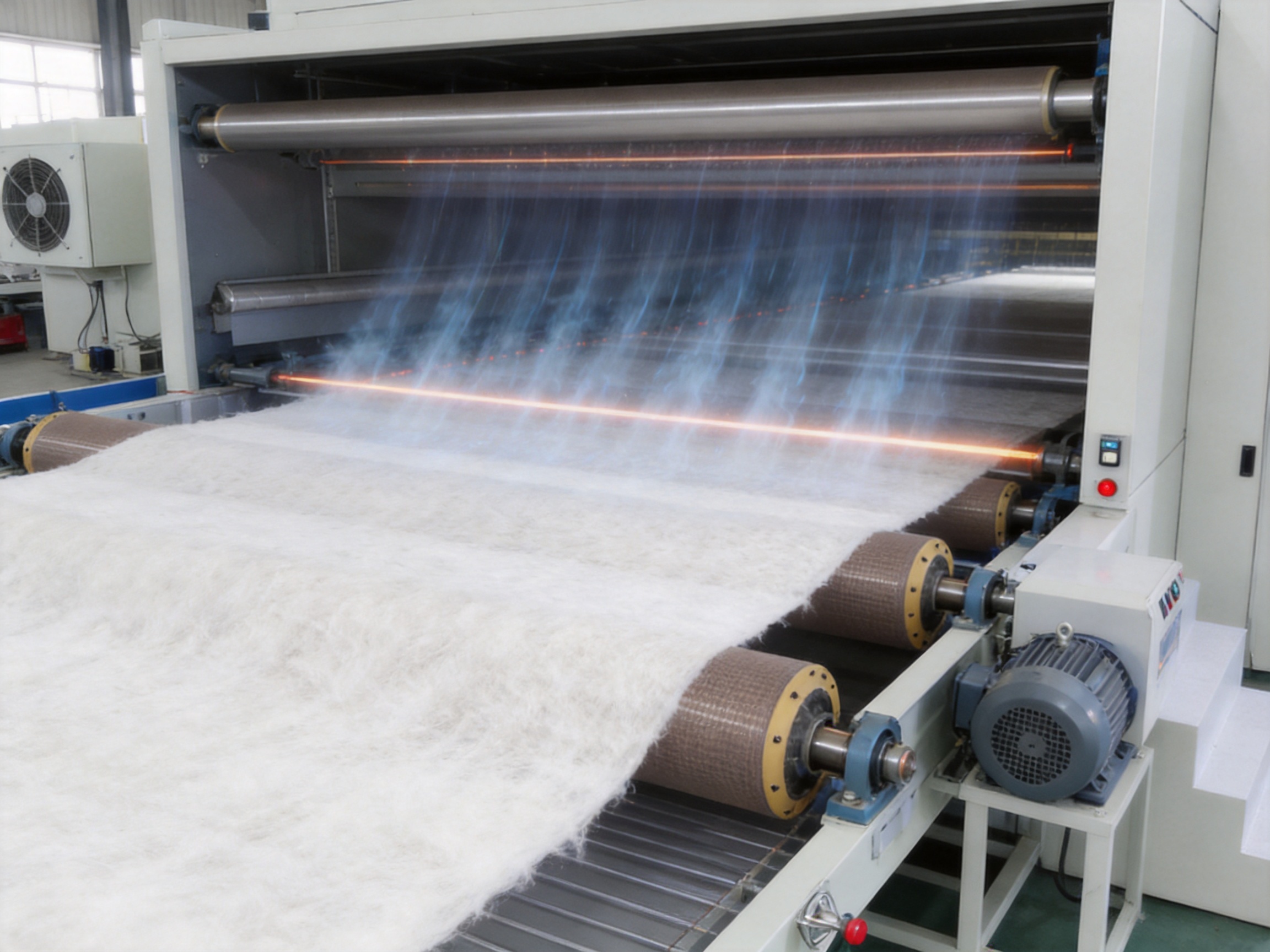
The HYHX Nonwoven Fabric Oven is designed to thermally bond a fiber web supplied by a cross lapper. During operation, hot air penetrates the web and melts the low-melt fiber component. The melted binder fiber combines surrounding fibers and, after cooling, forms a reinforced wadding with a stable structure. The machine is suitable for producing hard and thick thermal-bonded waddings, insulation materials, filtration substrates, automotive interior materials, mattress components, carpet backing, and other nonwoven products requiring controlled bonding and heat setting.
Its design combines controlled heating, web support, belt conveying, automatic belt correction, adjustable drive control, and customized configuration. Working widths can reach 5,000 mm or less, product thickness can range from 3 to 200 mm, and the available product weight range is approximately 60 to 1,500 GSM. The heat-setting temperature can reach up to 220°C, depending on the selected configuration, raw material, and production requirements.
Purpose of a Thermal Bonding Oven in Nonwoven Production
A nonwoven web produced by carding, airlaying, or another web-forming process normally consists of fibers that are only loosely arranged. Although the web may have the desired basis weight and approximate thickness, it does not yet have sufficient cohesion for handling or end use. A bonding process is therefore required to join the fibers into a stable sheet.
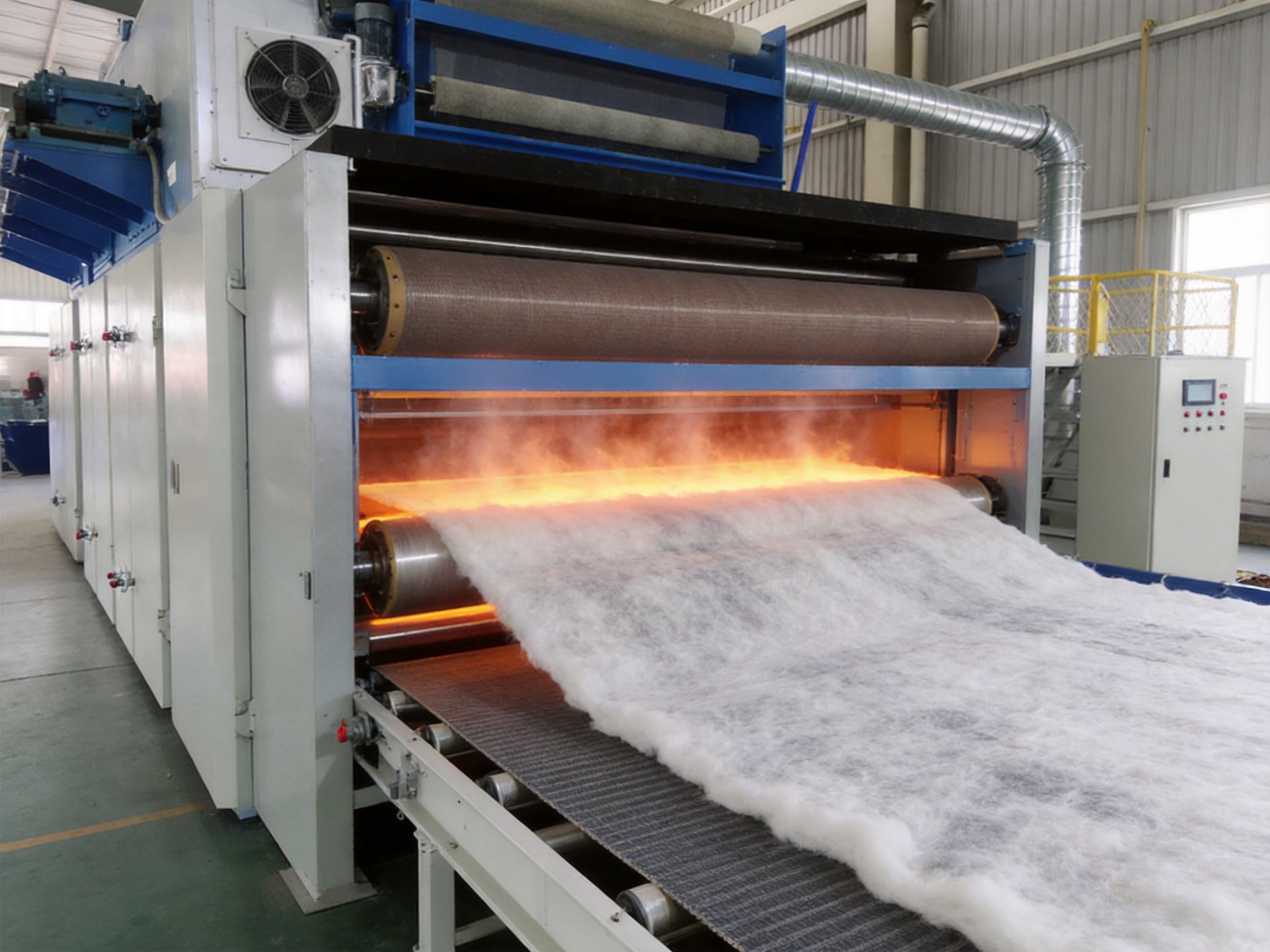
Thermal bonding uses heat-sensitive fibers or powders to create internal adhesion. In the case of the HYHX oven, low-melt fiber is incorporated into the web before the web enters the oven. The oven raises the web temperature until the low-melt component becomes soft or molten. Hot air passes through the material, allowing heat to reach the internal layers instead of heating only the surface. As the web leaves the heated section and cools, the binder solidifies and locks the surrounding fibers together.
This method is particularly useful when the producer wants a thick, resilient, and relatively uniform material. Compared with some surface-heating methods, hot-air penetration can distribute thermal energy more thoroughly through the entire web. This supports bonding throughout the cross-section and helps reduce the risk of a hard surface with a weak internal core.
The process can also be adapted to different products by adjusting the temperature, air volume, conveyor speed, belt pressure, web thickness, and residence time. These settings allow manufacturers to balance softness, stiffness, recovery, tensile strength, loft, density, and dimensional stability according to the target application.
Working Principle of the HYHX Nonwoven Fabric Oven
The production process begins when the fiber batt from the cross lapper is transferred toward the oven inlet. The cross lapper forms overlapping layers, helping distribute fibers in the machine direction and cross direction. The resulting batt enters the oven on a heat-resistant belt or between upper and lower belts, depending on the selected machine arrangement.
Inside the oven, a controlled hot-air system circulates heated air through the web. The air transfers heat to the low-melt fibers distributed within the batt. Once the required bonding temperature is reached, the low-melt fibers soften and connect neighboring fibers. The main structural fibers retain their overall form while the binder component creates points of adhesion throughout the web.
After the heating zone, the product passes through a cooling section or cooling system. Cooling is essential because the bonding structure must stabilize before the material is subjected to strong pulling, winding, cutting, or further processing. The cooling stage helps preserve the desired thickness and reduces the chance of deformation caused by premature handling.
The web is supported by one or two belts throughout the process. A single-belt arrangement can be selected for applications where the web needs greater loft or where the product structure does not require strong compression. A double-belt structure can provide more controlled thickness and improved stability for products that require a defined caliper or a flatter surface.
The main drive and fan can be controlled by inverters. Variable-frequency control allows the operator to adjust the conveying speed and air circulation according to the product recipe. This is important because thick, heavy, or high-basis-weight products generally require different heating conditions from light webs. Inverter control also supports smoother starting and stopping, reducing mechanical shock and improving process flexibility.
Core Construction and Machine Configuration
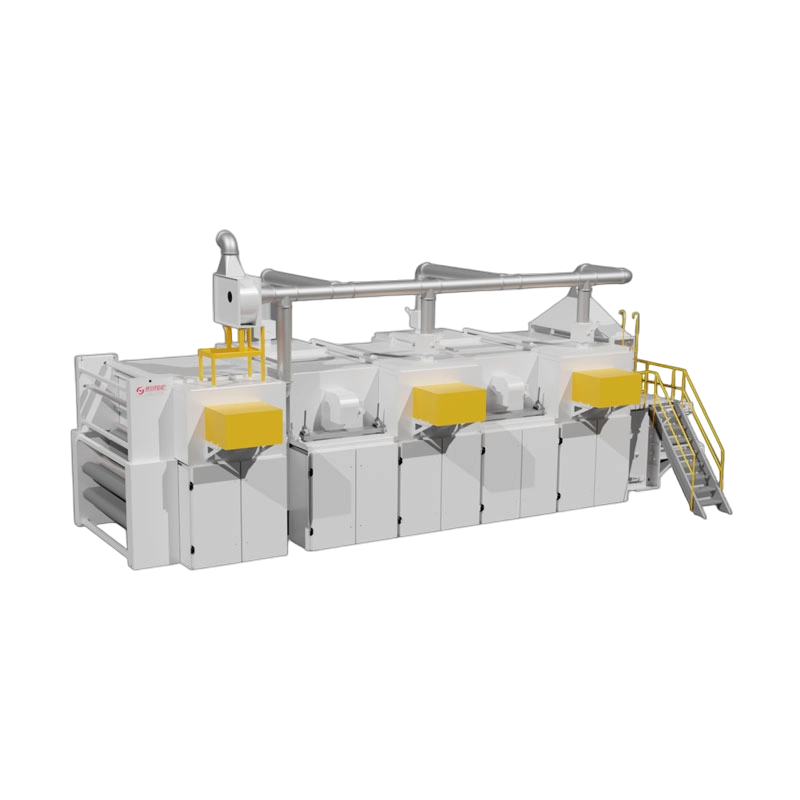
Single-Layer, Single-Belt Configuration
The single-layer, single-belt design is suitable for materials that require hot-air bonding with relatively open support conditions. It can be useful for bulky waddings, insulation products, and applications where maintaining loft is a priority. The web is carried through the heating area on a heat-resistant conveyor belt, while hot air circulates through the material.
This configuration may offer a straightforward production route and can be adapted to a wide range of fiber blends. It is also suitable when the final product does not need intensive compression during thermal bonding. The precise configuration should be selected according to the raw material, target thickness, product weight, and desired surface appearance.
Double-Belt Configuration
The double-belt structure holds the web between upper and lower belts as it enters the heating and forming zones. This arrangement provides additional control over the web position and product thickness. It is especially valuable when the product must maintain a more consistent caliper across the working width.
Upper and lower belts can guide the material through the oven while limiting excessive movement or uneven expansion. By controlling the distance between the belts, the manufacturer can establish a more repeatable forming condition. This makes the double-belt configuration suitable for denser waddings, automotive materials, structural padding, and products that require a controlled surface profile.
Heat-Resistant Belt and Automatic Correction
The oven is equipped with a high-temperature-resistant belt designed to operate in the thermal environment of the machine. Belt stability is essential because the web must remain aligned as it travels through the heating and cooling sections. A belt that drifts laterally can create uneven product width, edge damage, irregular thickness, and unplanned downtime.
The automatic correction device helps keep the belt in its intended path. Continuous correction reduces the need for frequent manual adjustment and supports more stable operation. It can also help protect the belt edges and associated mechanical components from excessive contact or misalignment.
Belt selection and maintenance remain important even when an automatic correction system is installed. Operators should follow the recommended inspection routine, check belt tension, remove accumulated fiber, monitor tracking performance, and verify that temperature conditions are within the specified operating range.
Heating and Cooling Arrangement
The available heating methods include hot oil circulation and electric heating. The appropriate method depends on the plant's energy supply, production scale, utility costs, temperature requirements, and preferred control method. Electric heating can offer direct control and a compact installation concept, while hot oil circulation can be integrated into a broader thermal system where a heat-transfer oil circuit is already available.
The heat-setting temperature is specified at up to 220°C. The actual working temperature must be established through trials because different fibers and binder components have different softening and melting characteristics. Excessive temperature may damage the main fiber, create undesirable shrinkage, or produce a board-like product. Insufficient temperature may leave the binder incompletely activated and result in poor strength.
The cooling system supports the transition from the bonded state to the finished stable structure. Cooling conditions should be balanced with production speed and product thickness. A heavy 200 mm web may need a different cooling arrangement from a thin 3 mm sheet. Customized air volume, cooling length, belt arrangement, and operating speed can help achieve the required result.
Product Performance Range
The HYHX Nonwoven Fabric Oven is designed for a broad operating range. Its working width can be customized up to 5,000 mm or less, allowing the machine to serve both medium-width and wide-width production lines. A wide working width can improve output capacity and reduce the number of longitudinal cuts required for large-format products.
| Parameter | Available Information | Production Significance |
|---|---|---|
| Model | HYHX | Identifies the thermal bonding oven series |
| Working width | Up to 5,000 mm | Supports wide nonwoven web production |
| Product thickness | 3–200 mm | Suitable for thin sheets and thick waddings |
| Product weight | 60–1,500 GSM | Accommodates light, medium, and heavy products |
| Heat-setting temperature | Up to 220°C | Provides a thermal range for low-melt fiber activation |
| Heating methods | Hot oil circulation or electric heating | Allows adaptation to different plant utilities |
| Structure | Single layer, single belt, or double belt | Enables configuration for loft, thickness, and forming needs |
| Specification options | 6 m, 8 m, and 10 m | Provides different heating-zone lengths |
| Control | Main drive and fan inverter control | Supports variable speed and airflow adjustment |
| Certification | CE and ISO9001:2000 listed | Supports conformity and quality-management requirements |
The stated thickness range is one of the machine's important advantages. Some thermal bonding equipment is optimized mainly for thin webs, while other systems are designed for a narrow group of thick products. A configurable oven covering 3 to 200 mm provides greater opportunity to use one production platform for multiple product families, subject to the correct process recipe and machine configuration.
The 60–1,500 GSM weight range also supports product diversification. Light webs may be used for filtration, hygiene-related structures, or lightweight insulation. Medium-weight webs can be used for furniture padding, mattress layers, and carpet backing. Heavy products may be used for automotive interior parts, industrial insulation, geotextile-related composite structures, and other applications that require substantial body.
These figures should be treated as design parameters rather than a guarantee that every material can run at every combination of width, thickness, weight, temperature, and speed. Final performance depends on fiber type, binder percentage, web uniformity, moisture, line speed, air permeability, and the customer's quality standard. A technical trial is recommended before finalizing the machine specification.
HYHX Nonwoven Fabric Oven
Advantages Compared with Conventional Bonding Equipment
More Thorough Internal Heating
One of the main advantages of hot-air penetration is that heat can move through the web rather than remaining concentrated at the surface. For thick products, this is especially important. Surface contact heating may create a bonded skin before the inside of the web has reached the correct temperature. If the process is stopped at that point, the final product may have a hard exterior and insufficient internal cohesion.
The HYHX oven directs heated air through the fiber assembly. This makes it possible to activate low-melt fibers inside the web and form a more continuous internal bonding structure. Correct airflow and residence time remain essential, but the process principle is well suited to thick thermal-bonded waddings.
Flexible Product Development
The combination of adjustable speed, fan inverter control, selectable belt structure, and alternative heating methods allows manufacturers to develop more than one product on the same platform. This flexibility can be valuable for factories serving several markets or responding to changing customer requirements.
Instead of purchasing separate equipment for every basis weight or thickness range, a producer can use a configurable oven and establish different recipes. The recipes may vary in temperature, conveyor speed, air volume, belt spacing, cooling intensity, and feed rate. The ability to customize the equipment according to the product portfolio can improve long-term investment value.
Controlled Thickness and Web Forming
The upper and lower belts in a double-belt arrangement help hold the web in position while it is heated and formed. This can support more consistent thickness across the width and reduce uncontrolled expansion. For products sold according to caliper, density, or volume, thickness consistency is a key commercial requirement.
Single-belt and double-belt options also allow the machine to be matched to the physical behavior of the raw material. A highly lofty web may need gentle handling, whereas a heavy batt may benefit from greater guidance. The chosen arrangement should be confirmed through production trials and mechanical design review.
Improved Operating Stability
Automatic belt correction contributes to stable continuous production. Manual belt tracking requires operator attention and may lead to interruptions if drift develops rapidly. Automatic correction does not eliminate the need for maintenance, but it can reduce routine intervention and support more consistent web travel.
Inverter control for the main drive and fans also improves operating flexibility. The operator can make gradual adjustments rather than relying only on fixed-speed operation. Smooth speed control can help match the oven to upstream carding, cross-lapping, and downstream winding or cutting equipment.
Wide Customization Potential
Working width, heating length, belt structure, temperature system, color, and other details can be customized according to customer needs. The listed specifications include 6 m, 8 m, and 10 m machine options, while the configuration can be adjusted for different line layouts and products.
Customization is particularly important in nonwoven production because the same nominal product category may have very different requirements. For example, a mattress wadding producer may prioritize loft and softness, an automotive supplier may require dimensional stability and controlled density, and an insulation manufacturer may focus on thickness recovery and low thermal conductivity. A standard machine platform with application-specific engineering can address these differences more effectively than a rigid, one-size-fits-all design.
Applications of Thermally Bonded Wadding
Automotive Interior Materials
Thermal-bonded nonwovens are used in vehicle interiors for acoustic absorption, insulation, trunk liners, floor coverings, door panels, headliners, and other components. These products often require controlled thickness, low weight, good recovery, and stable dimensions. The oven's ability to process polyester or PP staple fiber and thick webs makes it suitable for development in this field.
Automotive applications also require repeatability. A material that varies significantly in density or caliper may create problems during die cutting, molding, lamination, or assembly. The controlled belt path, adjustable heating, and cooling stages can support a repeatable process when properly set up and maintained.
Mattress and Furniture Wadding
Mattress layers, quilted padding, sofa filling, chair padding, and furniture interlinings often require bulk, resilience, and a comfortable hand. Thermal bonding can stabilize the fiber structure while retaining a degree of softness. The production recipe can be adjusted to avoid excessive compression and preserve the desired loft.
For these applications, producers may use different fiber blends and binder percentages to achieve specific softness and recovery. The oven must provide even heating across the width so that the finished wadding does not have soft or hard bands.
Insulation Materials
Thermally bonded nonwovens can be used for thermal and acoustic insulation in buildings, equipment, transportation, and industrial systems. Product performance depends on fiber type, density, thickness, air permeability, and the final installation method. A wide-width oven can support production of large rolls or panels, reducing the need for excessive joining.
Thick products may particularly benefit from through-air heating because the binder must be activated across the full cross-section. The cooling stage then helps stabilize the thickness before winding or cutting.
Carpet Backing and Floor Covering Components
Carpet backing requires dimensional stability and adequate strength to support the face structure. Thermal-bonded webs can serve as backing layers, underlay components, or cushioning materials. The double-belt configuration may be useful when a controlled thickness and relatively even surface are required.
Filtration and Industrial Substrates
Nonwoven filtration substrates must balance strength, porosity, thickness, and resistance to handling. Thermal bonding can improve structural integrity without necessarily relying on chemical binders. The process settings must be selected carefully so that bonding does not close the pore structure more than the application allows.
For industrial products, the ability to customize the machine and run different basis weights can help manufacturers serve multiple filtration segments. Product trials should evaluate air permeability, pressure drop, tensile strength, thickness recovery, and resistance to the intended service environment.
Cleaning Cloth and Technical Felt Products
Thermal-bonded webs can also be integrated into cleaning materials, technical felts, protective layers, and composite substrates. The oven may be installed as part of a larger production line that includes opening, blending, carding, cross-lapping, needle punching, winding, or cutting equipment.
Engineering and Manufacturing Strengths
Changshu Hongyi Nonwoven Machinery Co., Ltd. is a professional Chinese manufacturer and trader with more than 20 years of experience in the nonwoven machinery field. Its product scope includes complete nonwoven production lines and individual machines for needle-punched geotextiles, nonwoven carpets, airlaid waste felt, automotive interior materials, cleaning cloth, wool felt, jute felt, carding, airlaying, ironing, needle punching, and thermal bonding.
This broad product background is relevant to the design of a thermal bonding oven because an oven rarely operates as an isolated machine. It must communicate mechanically and operationally with upstream fiber preparation and web-forming equipment, as well as downstream winding, cutting, laminating, or packaging equipment. Experience across the production line can support more practical equipment integration.
Application-Based Equipment Design
A major strength of an experienced nonwoven machinery manufacturer is the ability to begin with the product rather than only the machine model. The customer’s fiber composition, target GSM, thickness, width, line speed, finished-roll dimensions, heating utility, and factory layout all affect the final design.
For the HYHX oven, the listed configuration can be customized according to customer needs. This means that the machine may be specified around the intended production objective, rather than forcing every customer to adopt exactly the same belt arrangement, heating method, or oven length. A project-based approach is useful when the customer needs a complete production line or has unusual material requirements.
Mechanical Material Selection
The stated mechanical materials are mostly steel and iron. These materials are widely used in industrial machinery because they provide structural strength, stability, and suitability for heavy-duty frames and support systems. In a large thermal oven, frame rigidity is important because the equipment must support belts, rollers, heating assemblies, fans, insulation, and the moving web over a long working width.
Material selection must also consider temperature, thermal expansion, wear, vibration, and accessibility for maintenance. Components exposed directly to heat and airflow require appropriate design and surface treatment. The exact material grade and component specification should be confirmed in the technical documentation for each project.
Quality and Certification Framework
The product information lists CE and ISO9001:2000 certification. CE marking relates to applicable European conformity requirements, while ISO-based quality management supports controlled procedures for design, manufacturing, inspection, and service. Certification does not replace application testing, but it provides an important framework for equipment supply and export projects.
Quality management is particularly valuable for customized machinery. When a machine is built to a specific width, heating method, and belt arrangement, document control and inspection procedures help maintain consistency between the approved design and the delivered equipment. A structured quality system can also support traceability during assembly and after-sales service.
Global Export Experience
The company reports that its machinery has been supplied to more than 20 countries, including Mexico, Argentina, Brazil, Turkey, Algeria, Egypt, Bangladesh, Vietnam, Thailand, and other Asian markets. International experience can help a supplier understand differences in factory conditions, electrical standards, shipping requirements, operator expectations, and local service needs.
The oven can be transported using nude packing or PE film, depending on the project and shipping arrangement. Export preparation should include a review of package dimensions, lifting points, corrosion protection, documentation, spare parts, and installation requirements. Customers should confirm these details before shipment, particularly for long or wide machine sections.
Advanced Manufacturing Process for the Equipment
Manufacturing a large thermal bonding oven requires coordination between engineering, fabrication, machining, electrical assembly, testing, and final commissioning. Although each project may follow a different schedule, a reliable production process normally begins with technical clarification and continues through design approval, component preparation, assembly, inspection, and testing.
Technical Requirement Review
The first stage is to define the production target. Important information includes the raw material, binder fiber type, fiber blend ratio, target GSM, thickness, working width, production speed, heating temperature, heating source, cooling method, and downstream process. The customer should also identify whether the final material will be wound, cut into sheets, laminated, molded, or fed into another machine.
This review helps determine whether a single-belt or double-belt arrangement is more appropriate. It also supports the selection of oven length, belt width, heating zones, air circulation capacity, and control functions. Early clarification reduces the risk of selecting a machine that is mechanically suitable but not optimized for the intended material.
Mechanical Design and Fabrication
After the requirements are confirmed, the engineering team develops the machine layout and component specifications. The frame, belt support, rollers, heating chamber, fan system, insulation, cooling section, drive assemblies, and access points must be arranged as a complete system.
Steel and iron structural parts are fabricated and assembled to provide a stable platform. Dimensional accuracy is important because belt tracking and web alignment depend on the relative position of rollers, supports, and guides. Large equipment also requires attention to transportation sections and site assembly, especially when the oven length is 6, 8, or 10 meters.
Heating and Airflow Integration
The heating system must be integrated with air circulation so that the web receives sufficient and reasonably uniform thermal energy. The heating method may be electric or based on hot oil circulation. Fans, ducts, chambers, and control elements must be coordinated to achieve the required process conditions.
Airflow is not simply a matter of fan capacity. The direction, distribution, velocity, pressure, and return path all influence how heat moves through the web. A well-designed system should reduce major hot and cold areas across the working width. Customers should evaluate samples from different positions across the web during commissioning to verify cross-width uniformity.
Drive, Inverter, and Control Assembly
The main drive and fan inverter controls enable the operator to adjust production speed and air circulation. Electrical assembly includes motors, inverters, control cabinets, sensors, switches, protection systems, and operator controls. The exact automation level can be customized according to the project.
A practical control system should allow operators to monitor temperature, speed, fan operation, belt movement, and alarms. It should also provide safe stopping functions and access protection. The final control philosophy should be documented so that operators can understand how to start, run, stop, clean, and maintain the equipment.
Assembly, Inspection, and Testing
During assembly, the belt path, roller alignment, heating chamber, fan system, and drive components are checked together. The belt should run smoothly and remain stable during empty-machine operation. The machine should also be checked for unusual vibration, abnormal noise, temperature leakage, and control faults.
Factory testing may include electrical checks, mechanical operation, belt tracking, fan operation, heating tests, temperature measurement, and safety-function verification. When possible, a material trial using the customer's fiber blend provides additional confirmation. A final acceptance plan should define the test material, target conditions, measurement methods, and permitted tolerances.
Process Parameters That Influence Product Quality
Temperature
Temperature must be high enough to activate the low-melt fiber but low enough to protect the main fiber and preserve the intended product properties. The nominal maximum of 220°C does not mean that every product should be processed at this temperature. The correct setting depends on the binder's melting range and the thermal sensitivity of the main fiber.
Temperature should be measured at suitable locations, including the air path and, where practical, the product zone. Operators should allow the oven to reach a stable condition before judging the quality of the first material. Start-up material may not represent the final process once the chamber, belts, and airflow have stabilized.
Residence Time
Residence time is affected by oven length and conveyor speed. A longer oven provides more time for heat transfer at a given speed. Alternatively, a shorter oven may process the same material at a lower speed, although the production output will differ. The 6 m, 8 m, and 10 m specifications provide different opportunities for matching process conditions to the web.
Thick and heavy webs generally need more time for heat to reach the interior. If the speed is too high, the outer layers may bond while the center remains under-bonded. If the speed is too low, the product may become excessively dense or thermally damaged. Process trials should measure both surface and internal performance.
Airflow
Airflow influences the rate and uniformity of heating. Higher airflow may increase heat transfer, but excessive velocity can disturb a loose web, create fiber migration, or cause uneven surface effects. Lower airflow may reduce disturbance but lead to slow or incomplete bonding.
Fan inverter control gives the operator an additional process variable. This is an advantage over fixed-airflow systems because different products can require different air conditions. The final setting should be determined through trial production and quality testing rather than by relying on temperature alone.
Belt Pressure and Product Thickness
In a double-belt system, the belt spacing and pressure influence the final thickness and density. More compression may improve dimensional control but reduce loft. Less compression may preserve bulk but increase thickness variation. The correct balance depends on whether the product is intended to be soft and lofty or dense and stable.
A single-belt design may be preferable when the material needs more freedom to expand. The selected structure should therefore be linked directly to the product specification. It is not enough to choose a belt arrangement based only on machine price or available floor space.
Cooling
Cooling helps stabilize the bonded structure. If the web is wound or cut while the binder remains soft, the material may compress, stick, deform, or lose thickness. Sufficient cooling time and airflow can improve handling stability and reduce roll-quality problems.
The cooling requirement is influenced by product thickness, line speed, binder type, and ambient conditions. A technical proposal should consider the cooling stage as part of the complete process rather than treating it as an optional accessory.
Installation, Commissioning, and Operator Training
Installation begins with a review of the factory foundation, floor loading, access routes, electrical supply, heating utilities, ventilation, and line layout. A long oven requires adequate space for assembly, maintenance access, and safe movement of operators. The upstream cross lapper and downstream equipment must be positioned so that the web enters and exits without unnecessary deflection.
Before commissioning, mechanical fasteners, belt alignment, lubrication points, electrical connections, safety guards, and control-panel functions should be inspected. Heating and cooling utilities must be connected according to the approved technical plan. The customer should also verify that the plant has sufficient power, hot oil capacity, exhaust arrangements, and compressed air or other utilities if required by the selected configuration.
Commissioning normally proceeds from empty-machine testing to low-speed material trials and then to production conditions. This sequence allows the team to identify belt-tracking problems, abnormal noise, airflow issues, temperature irregularities, or control faults before the machine reaches full output.
Operator training should cover start-up, temperature adjustment, speed adjustment, fan control, belt correction, emergency stop procedures, cleaning, inspection, and shutdown. Operators should understand that changes in fiber blend, binder percentage, thickness, and GSM may require a new process recipe. A stable production record should be maintained for each product.
Maintenance and Long-Term Reliability
Regular maintenance protects productivity and helps preserve product quality. Fiber lint can accumulate around belts, rollers, fan inlets, ducts, sensors, and heating components. Accumulated lint may reduce airflow, create contamination, interfere with belt tracking, or create a safety risk in a hot environment. Cleaning intervals should be established according to production hours and raw-material characteristics.
The belt should be inspected for wear, edge damage, contamination, and loss of tracking. Rollers and bearings should be checked for smooth operation. Automatic correction devices should be verified regularly rather than assumed to operate indefinitely without adjustment. Drive components, fan motors, electrical cabinets, and temperature sensors also require scheduled inspection.
Temperature readings should be compared with expected values. A gradual rise in energy consumption or a widening temperature difference across the machine may indicate insulation deterioration, airflow blockage, fan wear, or sensor problems. Early detection can prevent larger failures and reduce unplanned downtime.
Maintenance personnel should follow the supplier's recommended procedures for lubrication, belt tension, electrical inspection, and replacement parts. The one-year warranty listed for the machine provides an initial service period, but good maintenance remains essential after the warranty period ends.
How the Oven Supports Factory Efficiency
Production efficiency is not determined only by nominal machine speed. It also depends on start-up time, web stability, product changeover, belt tracking, energy use, downtime, and the percentage of material that meets specification. The HYHX design addresses several of these factors through inverter control, automatic belt correction, customizable configuration, and a broad product range.
Variable control allows the operator to match the oven to the actual output of the upstream web-forming equipment. If the oven is too fast for the cross lapper, the web may stretch or become irregular. If it is too slow, upstream accumulation may occur. A coordinated line speed reduces waste and improves overall equipment utilization.
Customization can also support efficiency by reducing unnecessary oversizing. A machine should be selected according to the intended production range, available utilities, and future expansion plans. An oversized oven may require unnecessary energy and floor space, while an undersized machine may limit product development. Engineering review helps identify a suitable balance.
Thermal bonding may reduce reliance on additional chemical adhesives for selected product types. This can simplify the material structure and support cleaner processing, although the suitability of the approach depends on the required end-use performance. Customers should compare the complete production cost, including fiber, energy, labor, maintenance, and yield.
Selection Guide for Buyers
Before ordering a nonwoven fabric oven, buyers should prepare a detailed product and factory information sheet. The following questions help ensure that the proposed configuration is technically appropriate.
- What fiber types will be processed?
- What low-melt fiber or binder component will be used?
- What are the target GSM, thickness, width, density, and production speed?
- Is a single-belt or double-belt structure more suitable?
- Will the heating system use electricity or hot oil circulation?
- What utilities are available at the installation site?
- What cooling performance is required before winding or cutting?
- What final roll width, sheet size, or downstream format is required?
- What electrical, safety, and certification requirements apply in the destination country?
- What spare parts, training, installation, and after-sales support are included?
Buyers should also request a clear list of included and excluded equipment. A complete line may require a cross lapper, feeding system, oven, cooling unit, winding machine, cutting machine, control cabinet, exhaust system, and material-handling equipment. Defining the supply boundary at the quotation stage reduces confusion during installation.
Sample testing is strongly recommended. The supplier can evaluate the customer's fiber blend and determine whether the proposed heating length, belt structure, and process settings are suitable. Test results should include thickness, GSM, tensile strength, bonding quality, recovery, appearance, and any application-specific requirements.
Why Choose a Specialized Nonwoven Machinery Supplier
A specialized supplier understands that nonwoven equipment must be matched to fiber behavior. A general industrial oven may provide heat, but it may not offer the belt control, air penetration, web support, cooling, and line integration required for a stable nonwoven process.
Changshu Hongyi Nonwoven Machinery Co., Ltd. focuses specifically on nonwoven machinery and production lines. Its experience covers opening and blending, feeding and carding, web forming, needle punching, thermal bonding, airlaying, winding, cutting, and auxiliary equipment. This specialization supports a more complete understanding of how the HYHX oven fits into a production system.
The company also offers customized and wholesale solutions. For international buyers, factory-direct communication can simplify technical discussions, commercial negotiation, documentation, and project coordination. The reported export experience across more than 20 countries indicates familiarity with overseas equipment supply, although each project still requires separate confirmation of local standards and service arrangements.
The combination of a broad product range, engineering customization, CE and ISO9001:2000 certification information, one-year warranty, and global supply capability gives the oven a practical position for manufacturers seeking a configurable thermal bonding solution. Its strongest competitive advantages are not limited to the heating chamber itself; they also include adaptability, line integration, process control, and support from a supplier dedicated to nonwoven production.
Frequently Asked Questions
What is the HYHX Nonwoven Fabric Oven used for?
It is used to thermally bond a fiber web from a cross lapper. Hot air penetrates the web and melts low-melt fiber, allowing the binder fiber to join surrounding fibers. After cooling, the web becomes a harder and thicker thermal-bonded wadding.
Which raw materials can be processed?
The listed raw materials include polyester fiber and PP staple fiber. The exact suitability depends on the fiber blend, low-melt component, melting range, web structure, and target product. A trial is recommended for any new material combination.
What is the maximum working width?
The stated working width is up to 5,000 mm. The final width should be confirmed according to the machine layout, product requirements, heating design, belt width, and customer factory conditions.
What product thickness can the oven handle?
The listed product thickness range is 3 to 200 mm. Actual performance depends on GSM, density, fiber type, binder content, belt arrangement, heating length, airflow, and production speed.
What product weight range is available?
The listed product weight range is 60 to 1,500 GSM. The most suitable operating point should be established through product trials because a single machine may require different settings for light and heavy webs.
What heating methods are available?
The available heating methods are hot oil circulation and electric heating. The correct choice depends on the plant's energy infrastructure, operating cost, temperature-control preference, and production scale.
Can the oven be customized?
Yes. The configuration can be customized according to customer needs. Options may include working width, heating method, oven length, single-belt or double-belt structure, control system, color, and other project-specific details.
What are the listed oven length options?
The listed specifications include 6 m, 8 m, and 10 m options. The appropriate length depends on the material, required residence time, production speed, target thickness, and available factory space.
Why is automatic belt correction important?
Automatic belt correction helps maintain belt alignment as the machine operates. Stable tracking supports consistent web width and reduces the need for frequent manual adjustment. Routine inspection and maintenance are still required.
How does inverter control benefit production?
Inverter control allows the operator to adjust the main drive and fan speed. This helps match conveyor speed and airflow to different fiber blends, GSM levels, thicknesses, and production conditions. It can also provide smoother machine starting and stopping.
Is the oven suitable for thick thermal-bonded wadding?
Yes. The machine is specifically described as processing fiber batts to obtain hard and thick thermal-bonding wadding. Hot-air penetration and a suitable cooling system help activate the binder through the web, although the final result depends on the product recipe and configuration.
What certifications are listed for the machine?
The product information lists CE and ISO9001:2000 certification. Buyers should request the applicable certificates and technical documents for the specific order and destination market.
What after-sales service is provided?
The listed after-sales service includes a one-year warranty. Installation assistance, commissioning, training, spare parts, and remote or on-site service should be confirmed in the commercial and technical agreement.
How should a buyer prepare for quotation?
The buyer should provide the raw material, binder fiber, GSM, thickness, working width, line speed, heating utility, product application, downstream equipment, factory layout, and electrical requirements. This information allows the supplier to recommend a more accurate configuration.
Can the oven be integrated into a complete nonwoven line?
Yes. It can be considered as part of a line that includes opening and blending, carding, cross-lapping, winding, cutting, or other auxiliary equipment. Integration details should be reviewed during the project design stage.
Conclusion
The HYHX Nonwoven Fabric Oven provides a configurable hot-air thermal bonding solution for manufacturers producing stable, thick, and reinforced nonwoven materials. Its central process advantage is the penetration of hot air through the fiber batt, allowing low-melt fibers to bond the surrounding structure throughout the web. The cooling stage then helps stabilize the finished product for winding, cutting, or further conversion.
With single-belt and double-belt options, working widths up to 5,000 mm, product thickness from 3 to 200 mm, product weights from 60 to 1,500 GSM, heat-setting temperatures up to 220°C, and electric or hot-oil heating methods, the machine can be adapted to a broad range of nonwoven applications. Inverter-controlled drives and fans provide process flexibility, while the automatic belt correction device supports reliable web transport.
Its competitive value is strengthened by the manufacturing and engineering background of Changshu Hongyi Nonwoven Machinery Co., Ltd. The company offers individual machines and complete production lines, has more than 20 years of experience in nonwoven machinery, supplies international markets, and provides customized equipment solutions. The listed CE and ISO9001:2000 certifications, one-year warranty, and technical customization options further support its suitability for industrial projects.
For the best result, buyers should treat the oven as part of a complete process rather than as an isolated heating unit. Careful selection of the fiber blend, binder percentage, belt structure, heating method, oven length, airflow, cooling system, and downstream equipment will determine the final performance. With appropriate engineering, commissioning, and maintenance, the HYHX oven can serve as a flexible foundation for thermal-bonded wadding and other high-value nonwoven products.
References
1. Product specification sheet for the HYHX Nonwoven Fabric Oven, including operating range, construction, heating methods, and control features.
2. Technical information supplied by Changshu Hongyi Nonwoven Machinery Co., Ltd. concerning nonwoven machinery, complete production lines, customization, certification, and after-sales service.
3. General principles of thermal bonding in nonwoven manufacturing, including low-melt fiber activation, through-air heating, cooling, web support, and product stabilization.
4. Industrial guidelines for nonwoven process control, covering GSM, thickness, residence time, airflow, temperature, belt tracking, and maintenance.
5. Quality-management and machinery-conformity practices relevant to CE-marked industrial equipment and ISO-based manufacturing systems.