

Content
- 1 The Role of Bale Opening in Nonwoven Production
- 2 HYKB Bale Opener Product Overview
- 3 Three-Stage Functional Structure
- 4 Fiber Blending Flexibility
- 5 Key Technical Data
- 6 Advantages Compared with Manual or Less Integrated Systems
- 7 Manufacturing Strengths and Engineering Approach
- 8 How the HYKB Bale Opener Supports Production Quality
- 9 Applications in Nonwoven Manufacturing
- 10 Installation and Line Integration
- 11 Operation and Maintenance Considerations
- 12 Safety and Workforce Training
- 13 Why Choose a Specialized Nonwoven Machinery Supplier?
- 14 Purchasing Guidance for the HYKB Bale Opener
- 15 Quality Control from Specification to Delivery
- 16 Environmental and Efficiency Considerations
- 17 Frequently Asked Questions
- 17.1 What is the main function of the HYKB Bale Opener?
- 17.2 Can the machine process more than one type of fiber?
- 17.3 What working widths are available?
- 17.4 What is the listed capacity?
- 17.5 How does automatic weighing improve production?
- 17.6 Can the bale opener be added to an existing nonwoven line?
- 17.7 What raw materials can be used?
- 17.8 Is the machine customizable?
- 17.9 What electrical information should be confirmed?
- 17.10 What certification is listed?
- 17.11 What is the warranty period?
- 17.12 Does the supplier provide installation support?
- 17.13 How long is the delivery period?
- 17.14 What should buyers prepare before installation?
- 18 Conclusion
- 19 References
- 20 Product: HYKB Bale Opener
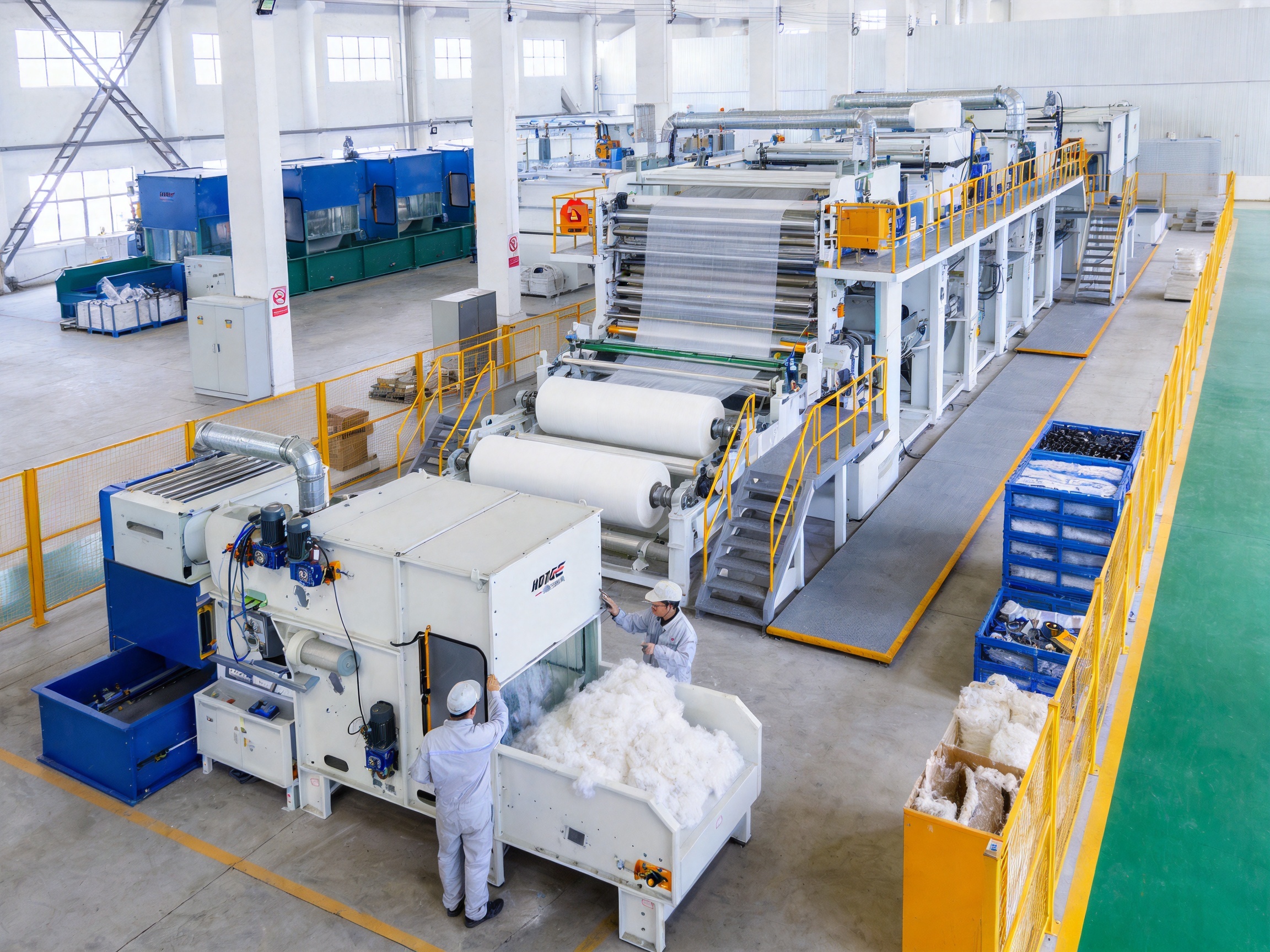
Modern nonwoven fabric production depends on stable fiber preparation. Before fibers can be carded, airlaid, thermally bonded, or needle punched, they must be opened from compacted bales, measured accurately, blended consistently, and delivered to the next process in a controlled condition. If the opening and blending stage is unstable, the entire production line can suffer from irregular web formation, uneven fabric weight, poor strength distribution, excessive waste, and inconsistent product quality.
The HYKB Bale Opener is designed to address these requirements in one integrated preparation system. It pre-opens fibers from bales, stores and feeds the material, weighs predetermined quantities, and transfers the material through a cross conveyor to the following opening or blending equipment. The system can also combine several bale opener units so that multiple fiber types can be processed according to a selected blend ratio.
Manufactured by Changshu Hongyi Nonwoven Machinery Co., Ltd., the HYKB Bale Opener is intended for nonwoven manufacturers that need a practical, automatic, and adaptable solution for fiber preparation. It is suitable for a broad range of fibers used in nonwoven applications, including polyester fiber and other compatible raw materials. With several working-width options, automatic operation, electronic weighing, customized voltage, and support for complete nonwoven production lines, the machine can be configured for different plant layouts and production objectives.
The Role of Bale Opening in Nonwoven Production
Fibers supplied in bales are highly compressed for transportation and storage. Although compression reduces logistics costs, it also creates a material condition that is unsuitable for direct feeding into carding or web-forming equipment. A bale must first be broken down into smaller fiber tufts. These tufts must then be opened sufficiently to support homogeneous blending and regular feeding.
A bale opener is therefore more than a simple conveying machine. It is the first important preparation unit in many nonwoven processes. Its performance affects the quality of the fiber mixture, the operating stability of downstream machines, and the repeatability of the finished fabric.
In a typical line, the bale opener receives one or more types of fiber, performs initial opening, controls the amount of material released, weighs the material according to the required proportion, and transfers the blend to the next stage. Depending on the production line, the prepared material may continue to a fine opener, blending chamber, carding machine, airlay machine, or another fiber preparation unit.
Manual bale opening and manual proportioning can create several production problems. Operators may not distribute the material evenly, fiber quantities may vary from batch to batch, and the process can require considerable labor. Manual handling may also make it difficult to reproduce a specific recipe when several fiber types are used. The HYKB Bale Opener addresses these issues by combining mechanical pre-opening with an automatic weighing system.
HYKB Bale Opener Product Overview
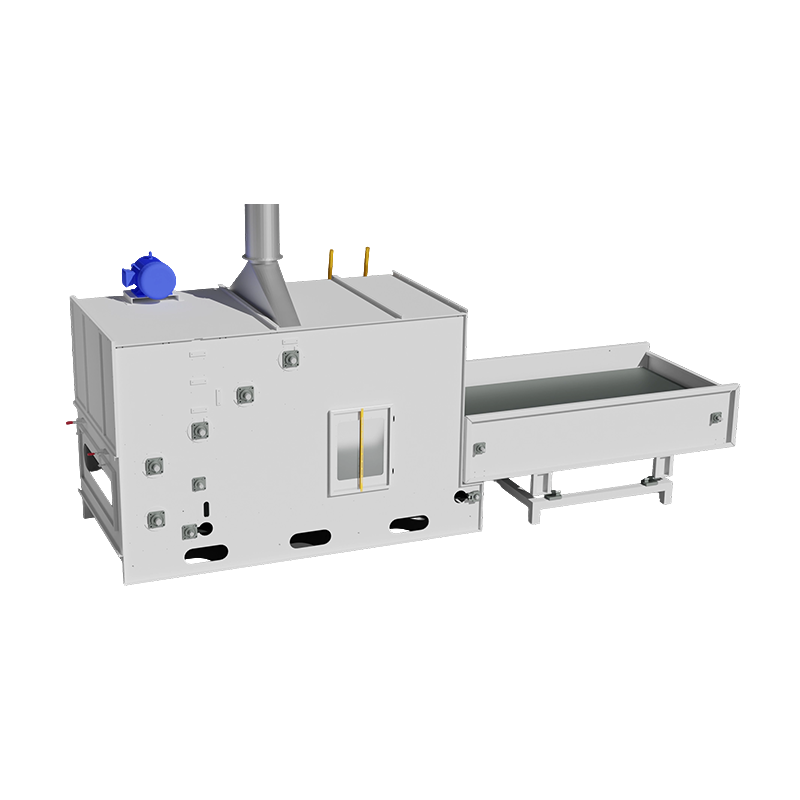
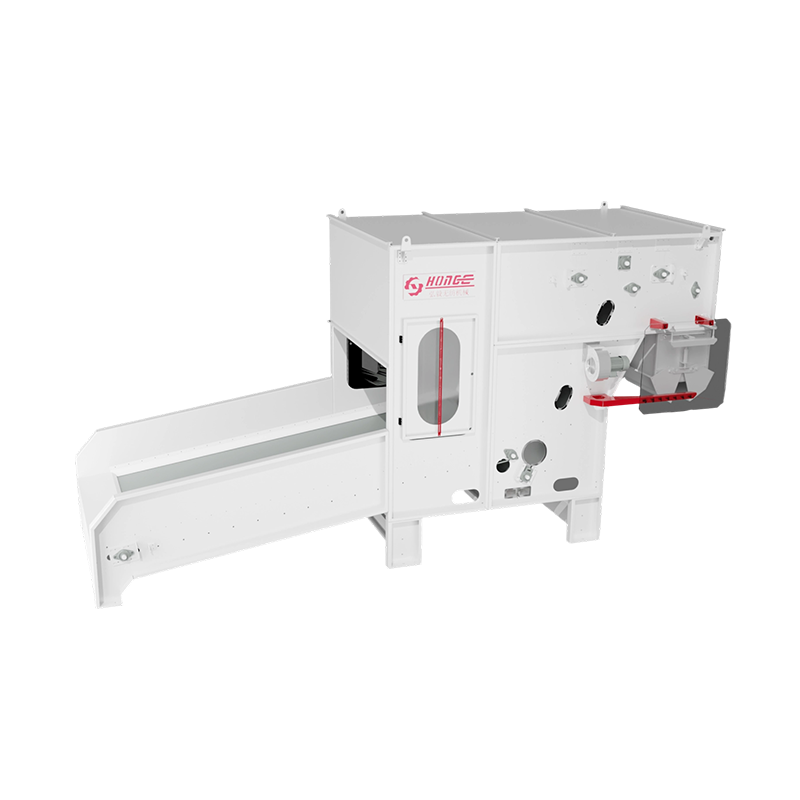
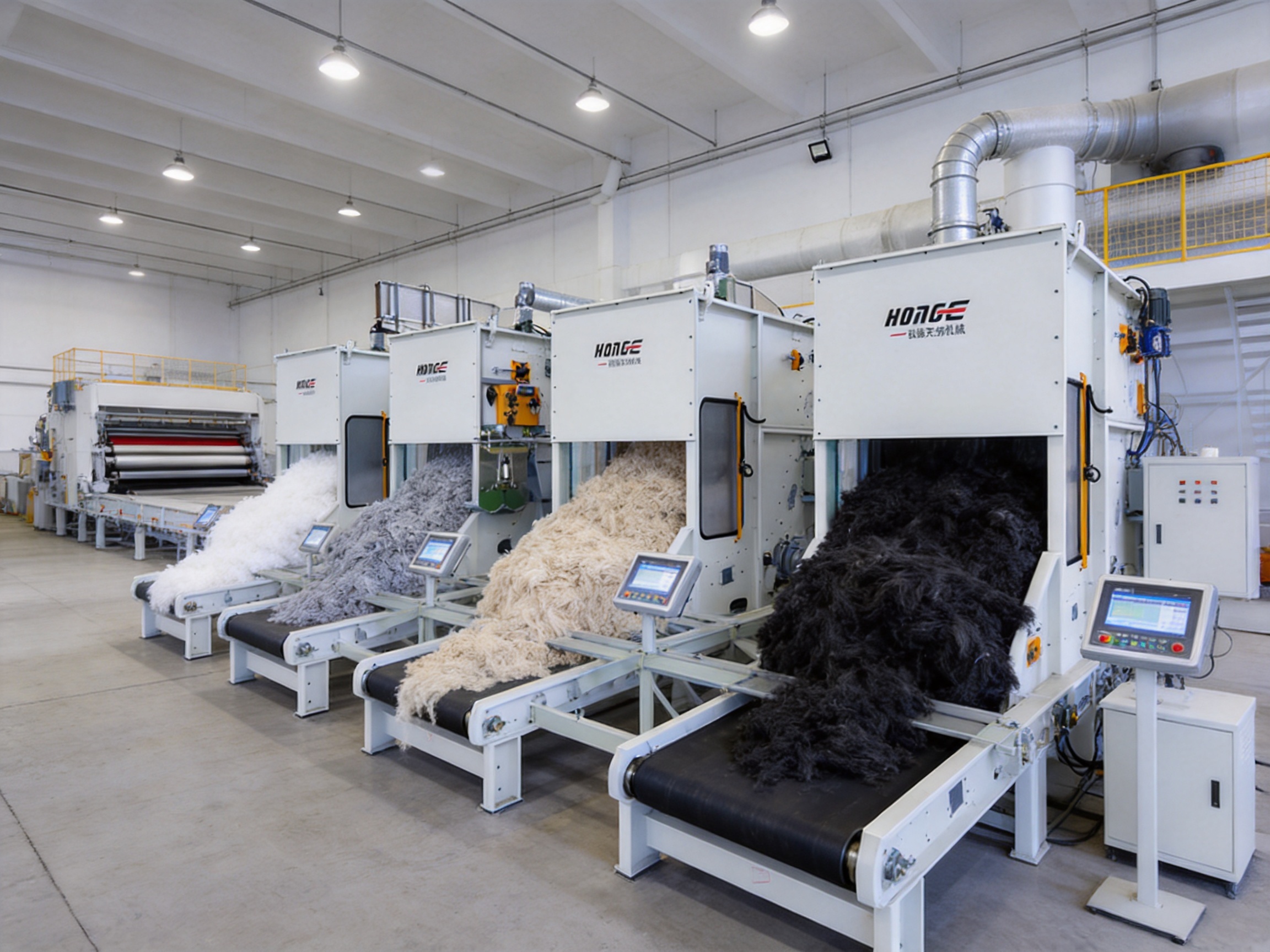
The HYKB Bale Opener is engineered to pre-open different types of fiber from bales and weigh predetermined percentages according to the required blend. Material transfer is performed by a cross conveyor, allowing the machine to cooperate with other opening and blending equipment in a complete production system.
The design is divided into three functional sections:
The front section provides fiber storage. This area receives the fiber removed from the bales and helps maintain a continuous supply for the feeding process.
The middle section performs feeding and pre-opening. Fiber is introduced into the working area in a controlled manner, where it is loosened from its compressed bale condition.
The latter section weighs the fibers according to the required proportions. Electronic weighing supports automatic quota control and allows the operator to establish the desired quantity of each material.
Several sets can be combined when the production recipe includes multiple fiber types. This modular approach allows a manufacturer to expand the number of materials used in a blend without replacing the complete preparation system. It also supports the production of different nonwoven products that require different recipes.
The equipment is intended for automatic operation and can be customized for the voltage and working conditions of the customer’s factory. Available working-width specifications include 1 meter, 1.2 meters, 1.4 meters, 1.6 meters, and 2 meters. Listed capacity options include approximately 200 kilograms per hour and 300 kilograms per hour, subject to the fiber type, configuration, and operating conditions.
HYKB Bale Opener
Three-Stage Functional Structure
1. Fiber Storage Section
The storage section is located at the front of the bale opener. Its purpose is to receive and hold fiber after it has been removed from the bale. A suitable storage arrangement is important because it helps separate the irregular supply created during bale handling from the more controlled feeding process that follows.
When storage is properly coordinated with feeding, operators can load material in an organized way while the machine continues to prepare fiber for the next stage. This contributes to a smoother production rhythm and reduces the need for frequent manual intervention.
The storage section also supports the use of different fiber materials. Since the system can be integrated with several bale opener sets, each set can be assigned to a particular material or component of the recipe. This arrangement is useful when a nonwoven product contains a blend of different fiber types or when the manufacturer changes recipes between production orders.
2. Feeding and Pre-Opening Section
The middle section is responsible for controlled feeding and pre-opening. Fibers in bale form are compact and difficult to mix uniformly. The pre-opening action loosens the material and prepares it for weighing and subsequent blending.
Pre-opening is a critical balance. The material must be sufficiently loosened to support uniform distribution, but the process should remain appropriate for the fiber characteristics and the requirements of the downstream equipment. Different fibers can have different lengths, resilience, moisture conditions, and processing behavior. A configurable machine provides a better basis for handling these variations than a one-size-fits-all manual method.
Controlled feeding also helps prevent sudden surges of material. A stable feed can make the weighing process more predictable and can reduce fluctuations in the material flow delivered to the next unit. In a complete nonwoven line, this type of stability supports the operation of carding, airlay, and web-forming machines.
3. Automatic Weighing Section
The latter section uses an electronic scale to weigh the fiber according to a selected proportion. This function is one of the main advantages of the HYKB Bale Opener. Rather than relying entirely on operator judgment, the machine provides a measurable basis for controlling fiber input.
Automatic weighing is especially valuable when manufacturers use blends with several components. A recipe may require a primary fiber together with smaller quantities of other fibers. Without a weighing system, small errors can accumulate and change the characteristics of the finished material. Electronic weighing helps the operator establish and repeat a target proportion.
Automatic quota control can also simplify production management. Once the required material ratio has been established, the machine can work toward the selected quantity while the operator supervises the process. This reduces repetitive manual measurement and supports more consistent batch preparation.
Fiber Blending Flexibility
One of the strongest features of the HYKB system is the ability to combine several bale opener sets. This permits the use of multiple fiber types in a single operation. The precise recipe and material compatibility should be confirmed during technical planning, but the machine is designed to support flexible fiber preparation rather than a single-material process only.
Multiple-fiber compatibility is important in the nonwoven industry because manufacturers often produce a variety of materials. Different products may require different combinations of polyester, recycled fiber, natural fiber, low-melt fiber, or other suitable inputs. A plant may also need to change the proportion of materials to obtain different softness, bulk, strength, thermal bonding behavior, or cost targets.
With several machine sets working together, each material can be introduced through a controlled route. The combined system can be arranged according to the factory’s available space and the layout of the downstream production line. This makes the bale opener suitable for both a dedicated product line and a more flexible facility producing several categories of nonwoven fabric.
The capacity to combine units also provides a practical path for future expansion. A manufacturer can begin with the number of units required for its current recipe and later add equipment when product requirements change. This is generally more adaptable than building a completely new fiber preparation area for every additional material.
Key Technical Data
The following table summarizes the available product information. Actual performance depends on the fiber type, bale condition, blend recipe, line arrangement, and selected configuration. Customers should confirm final technical parameters before ordering.
| Item | Specification |
|---|---|
| Model | HYKB |
| Machine type | Automatic bale opener for fiber opening and blending |
| Main application | Nonwoven fabric production |
| Working widths | 1 m, 1.2 m, 1.4 m, 1.6 m, or 2 m |
| Listed capacity | Approximately 200 kg/h or 300 kg/h |
| Raw material example | Polyester fiber and other compatible fibers |
| Operating grade | Automatic |
| Weighing method | Electronic scale |
| Material transfer | Cross conveyor |
| Power information | Configuration-dependent; listed data includes 3.75 kW installed power |
| Voltage | 220 V or customized according to the customer’s requirement |
| Certification | CE and ISO9001:2000 listed in the product information |
| Condition | New |
| Customization | Available |
| Warranty | One year or 12 months |
| HS code | 84490090 or 8449009000 as listed in the supplied information |
| Origin | Changshu, Jiangsu, China |
The supplied product information includes both an installed-power figure of 3.75 kW and a separate power entry of 24 W. These figures may refer to different components, control elements, or configurations. Buyers should request a final electrical specification, including motor power, control power, voltage, frequency, and total installed load, before placing an order.
Advantages Compared with Manual or Less Integrated Systems
More Consistent Fiber Proportioning
The automatic electronic weighing system provides a clear advantage over manual proportioning. Operators can work with a defined target instead of estimating the quantity of each fiber. This supports repeatable recipes and helps reduce variation between production batches.
Consistent proportioning is particularly important for products whose performance depends on a narrow material balance. Even when the final fabric is later bonded or needled, the initial fiber composition influences bulk, tensile behavior, surface appearance, thermal response, and processing stability.
Reduced Dependence on Repetitive Manual Work
Bale handling, fiber opening, measuring, and transferring can require substantial labor when performed manually. The HYKB Bale Opener automates key stages of this work. Operators can focus more on loading, inspection, recipe management, and overall line supervision rather than repeatedly opening and weighing small amounts of material.
Reduced manual handling may also help create a cleaner and more organized work area. Although normal housekeeping and dust-control procedures remain necessary, a controlled machine process can reduce unnecessary movement of loose fibers around the production floor.
Flexible Multi-Fiber Operation
Many basic opening systems are designed around a limited number of materials or a single feed route. The HYKB system can combine several sets to accommodate multiple fibers in one operation. This is a competitive advantage for manufacturers that serve several markets or produce fabrics with complex fiber recipes.
The multi-unit arrangement can also support product development. A manufacturer can test new blends, adjust proportions, and create product families without changing the entire preparation concept. The resulting flexibility may improve the utilization of downstream equipment.
Adaptation to Different Working Widths
The availability of 1-meter to 2-meter working widths gives customers a selection that can be matched to their line design. Working width affects the relationship between the bale opener and the feeding, carding, airlay, or web-forming machinery that follows it.
Choosing the correct width helps avoid unnecessary bottlenecks. A narrower machine may be appropriate for a compact or specialized line, while a wider model may be better suited to a higher-throughput installation. Final selection should be based on the required capacity, fiber characteristics, product width, and downstream machine specifications.
Integration with Complete Nonwoven Lines
The bale opener is not limited to use as an isolated machine. It can form part of a complete nonwoven machinery solution. Changshu Hongyi Nonwoven Machinery Co., Ltd. supplies equipment for opening and blending, feeding and carding, web forming and needle punching, thermal bonding and heat setting, airlay production, winding and cutting, and other auxiliary processes.
This broader capability can simplify project coordination. A customer seeking a complete line may work with one manufacturer for equipment selection, process matching, layout discussions, installation support, and commissioning. A customer purchasing only a bale opener can also use the machine as a unit within an existing line, subject to interface confirmation.
Manufacturing Strengths and Engineering Approach
Changshu Hongyi Nonwoven Machinery Co., Ltd. has more than 20 years of experience in the nonwoven machinery field. This experience supports the design and supply of individual machines as well as complete production lines. Its product range includes needle-punched geotextile lines, nonwoven carpet lines, airlaid waste felt lines, automotive interior material lines, needle-punched cleaning cloth lines, wool felt lines, jute felt lines, carding machines, airlay machines, ironing machines, thermal bonding wadding ovens, and related equipment.
This breadth is relevant to the HYKB Bale Opener because fiber preparation must be considered in relation to the complete process. A bale opener that is technically suitable in isolation may still create problems if it does not match the capacity, width, feed height, or material requirements of the next machine. Experience across several nonwoven technologies helps the supplier evaluate the preparation stage as part of a larger production system.
The company emphasizes high efficiency, reliability, quality, advanced technology, precision engineering, automatic control systems, energy-saving capabilities, and customized options. These strengths are reflected in the product’s automatic weighing, modular multi-fiber arrangement, selectable working widths, and configurable electrical requirements.
Manufacturing a reliable bale opener involves more than fabricating a frame. The storage, feeding, pre-opening, weighing, and conveying sections must work together. Mechanical clearances, feed rates, scale response, conveyor timing, controls, and safety provisions all influence the final operating result. A supplier with experience in nonwoven process equipment can use this system-level understanding to reduce integration risks.
The company’s international supply experience is another strength. Its products have been supplied to more than 20 countries, including Mexico, Argentina, Brazil, Turkey, Algeria, Egypt, Bangladesh, Vietnam, Thailand, and other Asian countries. International projects require attention to electrical standards, factory conditions, shipping arrangements, installation practices, spare parts, documentation, and operator training.
For overseas customers, this experience can make project communication more efficient. Technical information can be exchanged before production, and the machine can be prepared according to the customer’s working width, voltage, line arrangement, and raw-material requirements.
How the HYKB Bale Opener Supports Production Quality
Improved Blend Uniformity
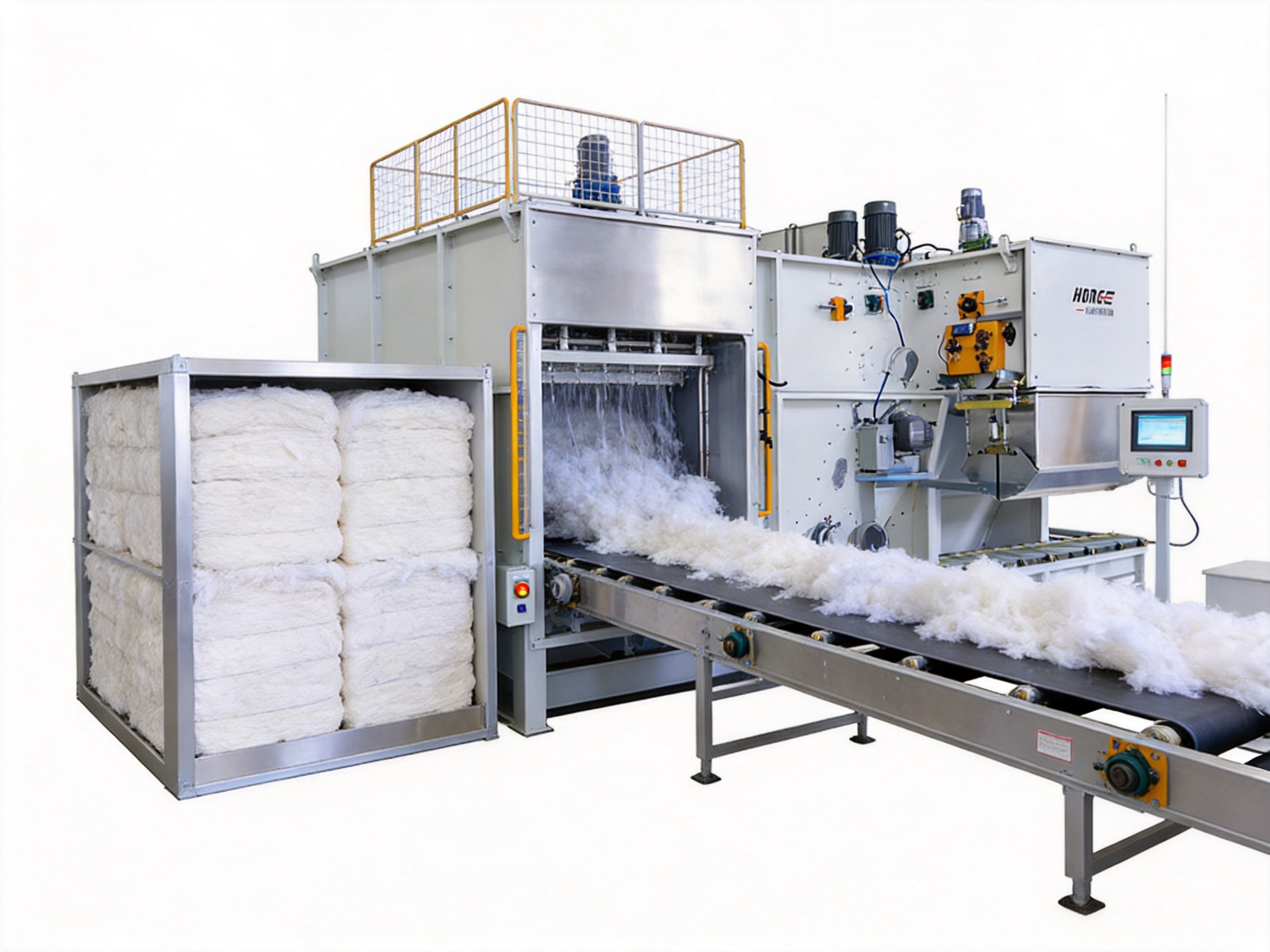
Uniformity begins with a uniform input mixture. If one fiber is supplied in excessive quantity at one point and insufficient quantity at another, the downstream web may show variations in composition. Automatic weighing and coordinated transfer help create a more controlled blend before the material reaches the next opening or carding stage.
Improved blend uniformity can support more consistent fabric characteristics. The effect will depend on the full production line, but stable fiber preparation is a necessary foundation for regular web weight, appearance, and mechanical behavior.
Better Process Repeatability
Repeatability is essential when a manufacturer must produce the same product over multiple shifts or production orders. A manually prepared blend may depend heavily on the individual operator. By contrast, a defined weighing procedure gives the production team a more repeatable reference for each batch or continuous operating period.
Repeatability also helps with troubleshooting. When the material recipe and weighing process are controlled, operators can more easily determine whether a quality issue originates in raw materials, opening, carding, web formation, bonding, needling, heat setting, or finishing.
Support for Efficient Downstream Operation
Carding and web-forming equipment performs best when the incoming fibers are prepared in a stable condition. Large compacted pieces, uneven material surges, or poorly blended fibers can increase the workload on downstream machines. Pre-opening and controlled feeding reduce the likelihood that the next process will receive material in an unsuitable form.
The bale opener does not replace fine opening or carding. Instead, it prepares the material so that the rest of the line can operate more effectively. This distinction is important when planning a complete process: the bale opener is the first preparation stage, while additional equipment may be required for the specific fiber and product.
Applications in Nonwoven Manufacturing
Needle-Punched Nonwoven Fabrics
Needle-punched products require a suitable fiber blend before the material is formed into a web and consolidated by needles. The HYKB Bale Opener can provide controlled fiber preparation for products such as geotextiles, filtration materials, industrial felts, cleaning cloths, carpets, and other needle-punched fabrics.
The appropriate recipe depends on the intended application. A geotextile may require a particular balance of fiber type, denier, and recycled content, while a carpet or cleaning cloth may require different bulk and surface properties. The automatic proportioning function gives manufacturers a practical way to manage these recipes.
Thermally Bonded Wadding
Thermal bonding lines often use blends that include fibers with different melting or softening behavior. The bale opener can help deliver the selected mixture to the subsequent carding and web-forming stages. The final bonding temperature, oven arrangement, and heat-setting conditions must be matched to the fiber composition, but accurate material preparation remains important at the beginning of the process.
Airlaid Materials
Airlaid production relies on controlled fiber preparation and distribution. Depending on the raw material, the bale opener can serve as an upstream unit that loosens and proportions fibers before they enter further opening or airlay equipment.
Airlaid waste felt, absorbent products, and other air-formed materials may require different fiber blends. The ability to work with multiple bale opener sets can be useful where several raw materials must be introduced in a controlled relationship.
Automotive Interior Materials
Automotive interior materials often require attention to weight, resilience, thickness, noise control, and process repeatability. Fiber composition is one of the factors that influence these properties. The HYKB Bale Opener can support the preparation of fiber mixtures for automotive interior material lines when the selected fibers and capacity are compatible with the project.
Wool, Jute, and Other Fiber-Based Felts
Wool felt, jute felt, and related materials may involve fibers with different handling characteristics from standard synthetic fibers. Pre-opening and controlled feeding can help prepare these materials for subsequent web-forming and consolidation. The exact machine configuration should be confirmed through a material test or technical discussion because fiber length, strength, moisture, and bale density affect machine performance.
Installation and Line Integration
Successful installation begins with an accurate review of the production plan. The customer and supplier should confirm the required capacity, working width, number of fiber components, raw-material specifications, downstream machine interface, electrical supply, floor space, and material-flow direction.
The bale opener should be positioned so that operators can load bales safely and inspect the storage and feeding areas. The cross conveyor must align with the receiving equipment. Adequate maintenance access should be maintained around motors, weighing components, guards, control devices, and other service points.
For a complete line, the machine height and transfer point are especially important. If the outlet does not match the inlet of the following opener, card, or conveyor, additional transition equipment may be required. These details should be addressed during layout design rather than after delivery.
The supplier’s after-sales information states that two or three workers can be sent to carry out installation and commissioning at the buyer’s request. The buyer is responsible for round-trip air tickets, accommodation, and an allowance stated as 180 US dollars per person per day. These commercial and service conditions should be confirmed in the final contract, including the number of service personnel, service duration, scope of work, and customer responsibilities.
Video outgoing inspection is listed as provided. An outgoing inspection can help the customer review the machine before shipment and confirm major functions, appearance, control operation, and agreed configuration. For a customized line, customers should request inspection records and confirm that the tested configuration matches the equipment listed in the purchase contract.
Operation and Maintenance Considerations
Operators should inspect the raw material before loading. Bales should be free from foreign objects, excessive moisture, and packaging materials that could interfere with the opening or weighing process. Fiber type, staple length, density, and blend ratio should be recorded as part of normal production control.
The storage area should not be overloaded beyond the designed operating condition. Material should be distributed in a way that allows the feeding section to work consistently. Operators should also monitor whether fiber is being released in an even manner and whether any unusual accumulation is occurring.
The weighing system should be checked regularly. Electronic scales require a stable installation and appropriate calibration procedures. Dust, vibration, mechanical contact, or incorrect zeroing can affect weighing accuracy. A maintenance schedule should include inspection of the weighing platform, sensors, wiring, control settings, and displayed values.
Conveyors and feeding components should be kept clean and inspected for wear. Loose fiber can collect around moving parts and sensors. Regular cleaning can improve visibility, reduce the risk of material contamination, and support safe operation. Any cleaning or maintenance work should follow the machine’s safety procedures and be carried out when moving parts are stopped and isolated from power.
Bearings, drive components, fasteners, guards, and electrical cabinets should be inspected according to the supplier’s maintenance instructions. Replacement parts should be selected according to the original machine configuration. Customers operating in remote locations may benefit from keeping recommended wear parts and electrical components in stock.
Maintenance records are useful for production planning. Recording inspections, calibration, repairs, and changes in material behavior can help identify recurring problems before they lead to extended downtime.
Safety and Workforce Training
Bale opening equipment contains moving feeding, opening, and conveying components. Operators must receive training before using the machine. Training should cover start-up, normal operation, shutdown, emergency stopping, material loading, cleaning, fault response, and safe access restrictions.
Guards and protective devices should remain in place during operation. Operators should never reach into an active feeding or opening area. If a blockage occurs, the equipment should be stopped and isolated according to the approved lockout procedure before the obstruction is removed.
Fiber processing may produce airborne dust or loose fiber, depending on the raw material and plant environment. The customer should evaluate ventilation, housekeeping, personal protective equipment, and fire-prevention requirements. The appropriate safety arrangement depends on the fiber and the overall factory conditions.
Training should also include recipe control. Operators need to understand which bale belongs to each material position, how the blend ratio is entered or adjusted, and how to recognize a weighing deviation. Clear labeling and documented operating procedures can reduce the risk of loading the wrong fiber or changing a recipe unintentionally.
Why Choose a Specialized Nonwoven Machinery Supplier?
A bale opener is most effective when its design is connected to the entire nonwoven process. A supplier that manufactures only general conveying equipment may not fully understand the interaction between fiber opening, blending, carding, airlaying, web formation, needling, thermal bonding, heat setting, winding, and cutting.
Changshu Hongyi Nonwoven Machinery Co., Ltd. focuses specifically on nonwoven machinery. Its portfolio covers both individual machines and complete production lines. This specialization gives customers access to equipment knowledge across several process stages and can support better matching of the bale opener to the final product.
The company’s more than two decades of industry experience is also valuable during project planning. Nonwoven producers often need to consider raw-material variability, product width, basis weight, production speed, automation level, factory space, utilities, and export requirements at the same time. A supplier familiar with these factors can help identify practical specifications before fabrication begins.
Customization is another important strength. The HYKB Bale Opener can be supplied in different working widths, and voltage can be customized. Other project parameters, such as the number of bale opener sets, conveyor arrangement, control requirements, and connection to downstream machines, should be discussed during technical design.
International delivery experience provides additional support for buyers outside China. The company reports supplying equipment to more than 20 countries. This indicates experience with export packaging, overseas installation coordination, and communication with international customers, although every project still requires its own confirmation of standards and responsibilities.
Purchasing Guidance for the HYKB Bale Opener
Before requesting a quotation, buyers should prepare a clear description of the intended application. The supplier will need to know the type and number of fibers, bale dimensions, target blend ratios, required production capacity, finished product width, downstream machine type, and expected operating schedule.
Customers should specify whether the machine will operate as a single unit or as part of a multi-bale-opener blending system. If multiple fibers are required, the desired number of components and the expected proportion of each material should be provided.
Capacity should be evaluated against real production conditions rather than selected only from a nominal figure. Fiber density, length, moisture, bale compression, blend composition, and operating efficiency can affect the actual throughput. A material trial or engineering review may be appropriate for unusual or difficult fibers.
Electrical information should be confirmed in detail. The purchase documents should state voltage, frequency, phase, total installed power, motor ratings, control voltage, cabinet requirements, and any local electrical compliance requirements. This is especially important because the supplied product information includes more than one power-related figure.
Packaging should also be clarified. The listed options include nude packing, PE film, or a wooden case. The best choice depends on the shipping method, route, destination climate, handling requirements, and the customer’s import regulations.
Commercial terms supplied for the product include a 30 percent deposit by telegraphic transfer and the remaining 70 percent before delivery. The listed lead time is approximately 60 working days after receipt of the remaining payment, while another entry states a lead time of two to three months. Buyers should confirm the binding delivery schedule in the contract, including the date from which lead time is calculated and the consequences of changes to specifications.
The stated warranty is 12 months or one year. Customers should confirm what is covered, whether parts and labor are included, how remote technical support is provided, and how warranty claims are handled for overseas installations.
Quality Control from Specification to Delivery
A professional machinery project should include quality control at several stages. The first stage is specification confirmation. The final technical document should define the working width, capacity, materials, weighing method, control functions, conveyor direction, electrical system, safety devices, and interface dimensions.
The second stage is manufacturing inspection. Mechanical components should be checked for dimensional accuracy, assembly quality, alignment, surface condition, and suitable protection. Electrical cabinets and control systems should be inspected for correct wiring, labeling, component installation, and safe operation.
The third stage is functional testing. The machine should be operated under agreed test conditions to verify feeding, pre-opening, weighing, conveying, control response, and emergency-stop functions. If the customer has supplied a sample material, a material-based trial may provide more useful information than an empty-load test.
The fourth stage is outgoing inspection and documentation. The customer should receive the agreed manuals, electrical drawings, spare-parts information, inspection records, and installation requirements. Clear documentation helps the buyer prepare the factory before the machine arrives.
These steps are important for any machinery purchase, but they are especially relevant to automatic blending equipment. A machine may be mechanically sound yet still require adjustment if the fiber recipe, scale calibration, or downstream interface differs from the original assumptions. Early technical communication reduces such risks.
Environmental and Efficiency Considerations
Energy use is an important factor in nonwoven production. The supplier identifies energy-saving capabilities as one of its development focuses. The actual energy performance of the HYKB Bale Opener depends on the installed configuration, operating rate, motors, control method, and connected equipment.
Automatic feeding and weighing can contribute to process efficiency by reducing unnecessary material movement and limiting overfeeding or incorrect proportioning. Better control of the input mixture may also reduce the need to rework batches caused by inconsistent composition.
Material efficiency depends on more than the bale opener alone. Fiber quality, bale preparation, operator practice, downstream settings, dust collection, and finished-product specifications all influence waste. Nevertheless, a controlled first stage gives the production team a stronger basis for monitoring material usage.
Manufacturers should evaluate the complete environmental profile of the installation. This may include electrical consumption, dust control, noise, fiber waste, packaging disposal, maintenance materials, and the use of recycled or renewable fibers. The bale opener can support the processing of different compatible materials, but the customer remains responsible for confirming that each material is suitable for the complete line.
Frequently Asked Questions
What is the main function of the HYKB Bale Opener?
The main function is to pre-open fibers from bales, control the fiber input quantity through automatic weighing, and transfer the prepared material to the next opening, blending, carding, or web-forming stage. It is designed for fiber preparation in nonwoven fabric production.
Can the machine process more than one type of fiber?
Yes. Several bale opener sets can be combined to accommodate multiple fiber types in one operation. The exact number of materials and blend proportions should be confirmed during engineering because performance depends on the raw materials and required recipe.
What working widths are available?
The listed working widths are 1 meter, 1.2 meters, 1.4 meters, 1.6 meters, and 2 meters. The correct width should match the product width, downstream equipment, required capacity, and factory layout.
What is the listed capacity?
The supplied information lists capacities of approximately 200 kilograms per hour and 300 kilograms per hour. Actual capacity can vary according to fiber type, bale condition, blend composition, machine configuration, and operating conditions. A final capacity should be confirmed for the customer’s material.
How does automatic weighing improve production?
Automatic electronic weighing helps measure predetermined quantities and maintain the selected fiber proportions. It reduces dependence on manual estimation and supports more repeatable blending between batches or production periods.
Can the bale opener be added to an existing nonwoven line?
It may be integrated into an existing line if the working width, outlet arrangement, capacity, control signals, electrical supply, and material-transfer height are compatible. A technical review of the existing equipment is recommended before ordering.
What raw materials can be used?
The supplied information identifies polyester fiber and other compatible fibers. Since fiber length, density, moisture, strength, and bale compression can affect performance, buyers should provide complete raw-material information and request confirmation for specialized materials.
Is the machine customizable?
Customization is listed as available. Working width, voltage, multi-unit arrangement, and line-integration details can be discussed according to the customer’s project. Final customization must be defined in the technical agreement.
What electrical information should be confirmed?
Customers should confirm voltage, frequency, phase, total installed power, motor power, control power, and electrical standards. The supplied information includes both 3.75 kW installed power and a 24 W power entry, so the final configuration should be clarified before purchase.
What certification is listed?
The product information lists CE and ISO9001:2000. Buyers should request the applicable certificates and confirm that the delivered configuration is covered by the relevant documentation.
What is the warranty period?
The listed warranty is one year or 12 months. The contract should define the warranty scope, exclusions, response process, spare-parts terms, and responsibilities for installation and operation.
Does the supplier provide installation support?
The after-sales information states that two or three workers can be sent for installation and commissioning at the buyer’s request. The buyer is responsible for travel, accommodation, and the stated daily allowance. These terms should be confirmed in writing for each project.
How long is the delivery period?
The supplied information gives approximately 60 working days after receipt of the remaining payment and also states a lead time of two to three months. The final delivery schedule should be confirmed in the contract and linked to approved technical documents and payment conditions.
What should buyers prepare before installation?
Buyers should prepare the foundation or floor area, electrical supply, lifting and handling arrangements, material storage space, downstream machine interface, ventilation and housekeeping provisions, and trained operating personnel. Layout drawings and utility requirements should be reviewed before shipment.
Conclusion
The HYKB Bale Opener provides an automatic approach to one of the most important stages in nonwoven fabric manufacturing: opening and blending fibers before downstream processing. Its three-part structure combines fiber storage, feeding and pre-opening, and electronic weighing. The cross conveyor transfers prepared material to the next stage, while several machine sets can be combined for multi-fiber recipes.
Compared with manual bale opening and proportioning, the machine offers stronger process repeatability, reduced repetitive labor, more controlled fiber ratios, and greater flexibility for manufacturers using different materials. The availability of several working widths and customized voltage supports integration into different factory environments.
Its value is strengthened by the supplier’s specialization in nonwoven machinery. Changshu Hongyi Nonwoven Machinery Co., Ltd. has more than 20 years of experience in the sector and supplies both unit machines and complete nonwoven production lines. Its international project experience, customization capability, installation support, and broad equipment portfolio provide a foundation for customers seeking coordinated machinery solutions.
Before purchasing, customers should confirm the raw-material specification, required capacity, blend recipe, working width, electrical details, conveyor interface, delivery schedule, warranty conditions, and installation responsibilities. With these points properly defined, the HYKB Bale Opener can serve as a reliable front-end preparation unit for needle-punched, thermally bonded, airlaid, felt, carpet, automotive, cleaning, and other nonwoven production applications.
References
Changshu Hongyi Nonwoven Machinery Co., Ltd. Product information for the HYKB Bale Opener.
Changshu Hongyi Nonwoven Machinery Co., Ltd. Technical and commercial information for nonwoven production machinery.
International Organization for Standardization. Quality management systems: ISO 9001 principles and requirements.
European Commission. General principles for machinery safety and conformity assessment.
Nonwoven fabric engineering references covering fiber opening, blending, carding, web formation, needle punching, thermal bonding, and airlaid production.