

Content
- 1 Understanding Fiber Web Drafting in Nonwoven Production
- 2 How the HYQS Fiber Web Drafting Machine Works
- 3 Main Technical Specifications
- 4 Advantages of Controlled Fiber Web Drafting
- 5 Roller and Drive Design
- 6 Manufacturing Process and Engineering Strengths
- 7 Comparison with Conventional or Less Flexible Drafting Solutions
- 8 Applications in Nonwoven Fabric Production
- 9 Integration with a Complete Production Line
- 10 Operating Guidelines
- 11 Maintenance and Service Considerations
- 12 Quality Control in Manufacturing
- 13 Why Choose an Experienced Nonwoven Machinery Manufacturer
- 14 Energy and Production Efficiency
- 15 Installation and Commissioning
- 16 Purchasing Checklist for Buyers
- 17 Frequently Asked Questions
- 17.1 What is the main function of a fiber web drafting machine?
- 17.2 What fibers can be processed?
- 17.3 What is the maximum draft ratio?
- 17.4 What is the working width?
- 17.5 How are the upper rollers configured?
- 17.6 How are the input and output rollers driven?
- 17.7 What is the drafting roller made from?
- 17.8 Can the machine be integrated into an existing production line?
- 17.9 What products can use this machine?
- 17.10 Does drafting improve final product strength?
- 17.11 What is the line speed?
- 17.12 Is the machine automatic?
- 17.13 What after-sales support is available?
- 18 Conclusion
- 19 References
- 20 Product: HYQS Fiber Web Drafting Machine
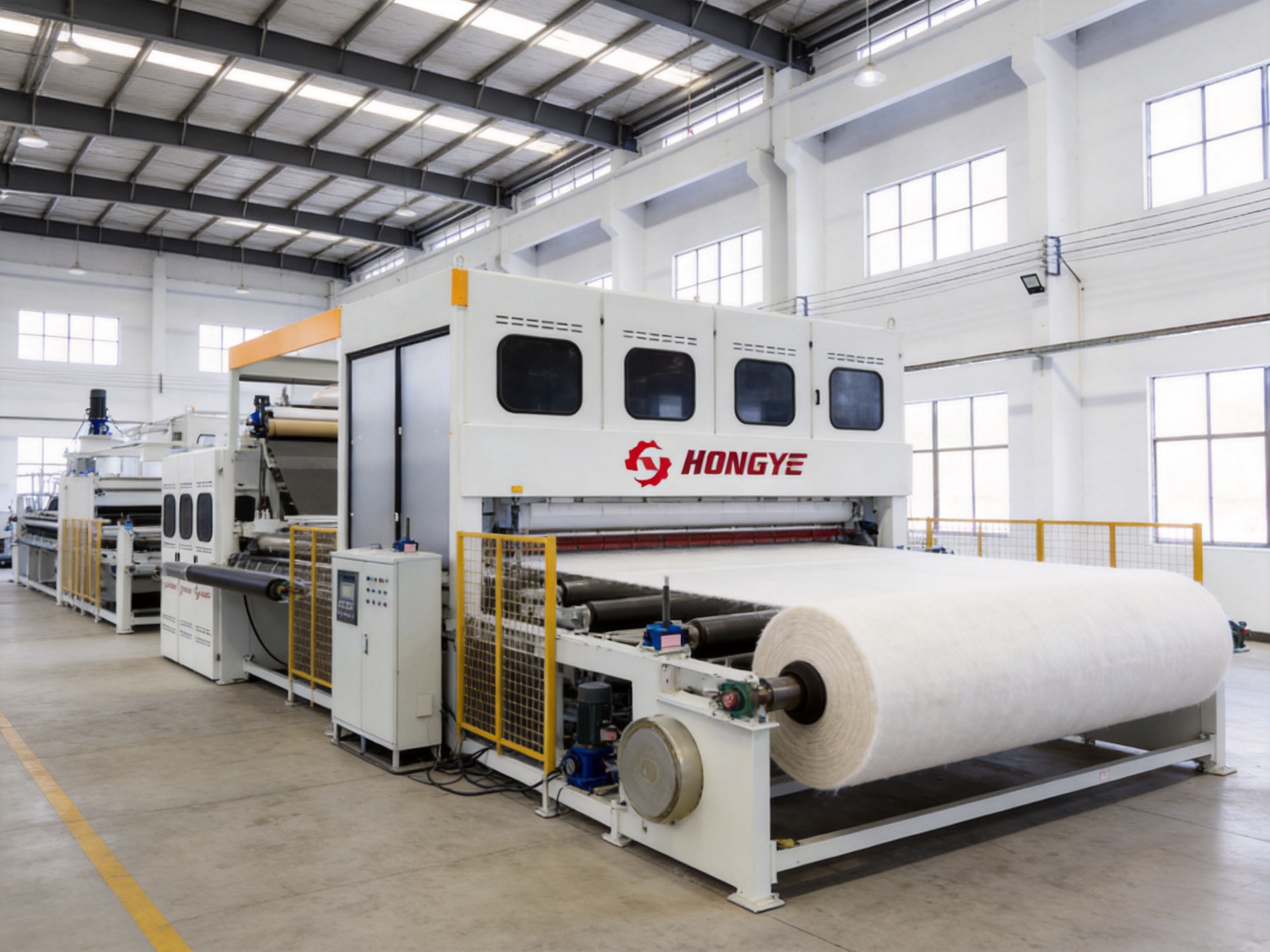
Fiber web drafting is an important preparation step in the production of high-quality nonwoven fabrics. Before a web is bonded, needled, thermally treated, or otherwise consolidated, its internal fiber arrangement has a direct influence on the final product’s thickness, strength, air permeability, appearance, and dimensional stability. A well-designed drafting machine helps control this arrangement by stretching the web in the longitudinal direction and encouraging a more favorable orientation of fibers.
The HYQS Fiber Web Drafting Machine is designed for nonwoven manufacturers that require improved web uniformity, controlled drafting, and dependable integration with a complete production line. It is suitable for polyester fiber, polypropylene staple fiber, and other compatible fiber webs. With a maximum draft ratio of 1:1.5, adjustable roller configuration, independent drive control, and customizable working width, the machine can support a wide range of production requirements.
Manufactured by Changshu Hongyi Nonwoven Machinery Co., Ltd., the machine reflects the company’s long-term experience in nonwoven machinery design and production. The manufacturer supplies individual machines as well as complete nonwoven production lines for geotextiles, carpets, automotive materials, cleaning cloths, felts, airlaid products, and other applications. Its experience in different nonwoven technologies enables the drafting machine to be configured according to the material, production speed, web weight, and downstream bonding process.
Understanding Fiber Web Drafting in Nonwoven Production
A fiber web is a loose arrangement of fibers formed by equipment such as a carding machine, airlay machine, or other web-forming system. At this stage, the fibers are not yet fully bonded. Their orientation may be partially random, partially longitudinal, or uneven across the web width. If the web moves directly to a bonding or needle punching process without sufficient control, variations in fiber distribution can remain in the finished product.
Drafting applies a controlled difference in speed between the input and output sections of the machine. As the web passes through the rollers, it is stretched longitudinally. This controlled stretching can reduce irregularities in the original arrangement and encourage more fibers to align in the machine direction. The result is a web with improved internal consistency and a more predictable structure.
Drafting does not simply mean pulling the web as quickly as possible. Excessive tension may cause web breaks, uneven density, fiber slippage, or undesirable orientation. Effective drafting requires accurate speed coordination, suitable roller pressure, stable mechanical construction, and adjustment capability. The HYQS machine is designed around these requirements, combining dedicated drafting rollers with independently driven input and output rollers.
In a typical production line, the machine is installed after web formation and before a downstream process such as needle punching, thermal bonding, heat setting, or another consolidation method. The actual position may vary according to the line design and the type of nonwoven product being manufactured. Its purpose is to prepare the web so that the following process receives a more stable and consistent material.
How the HYQS Fiber Web Drafting Machine Works
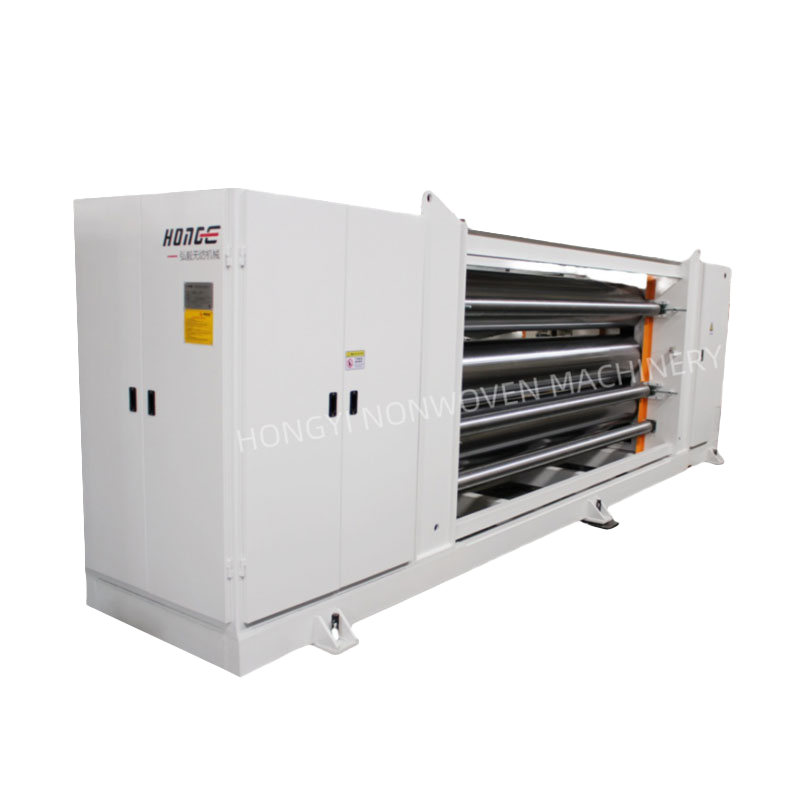
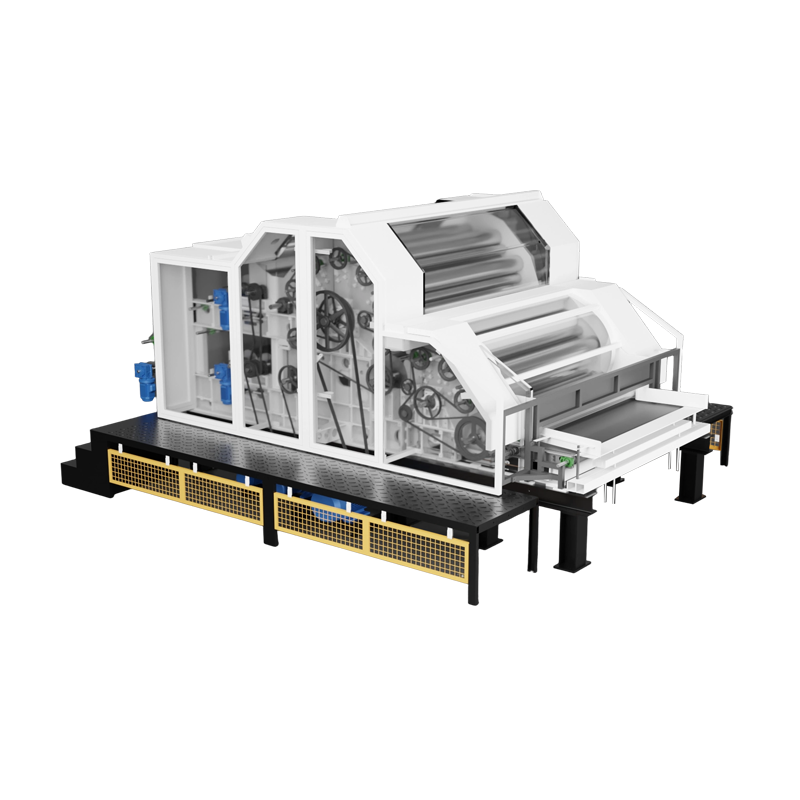
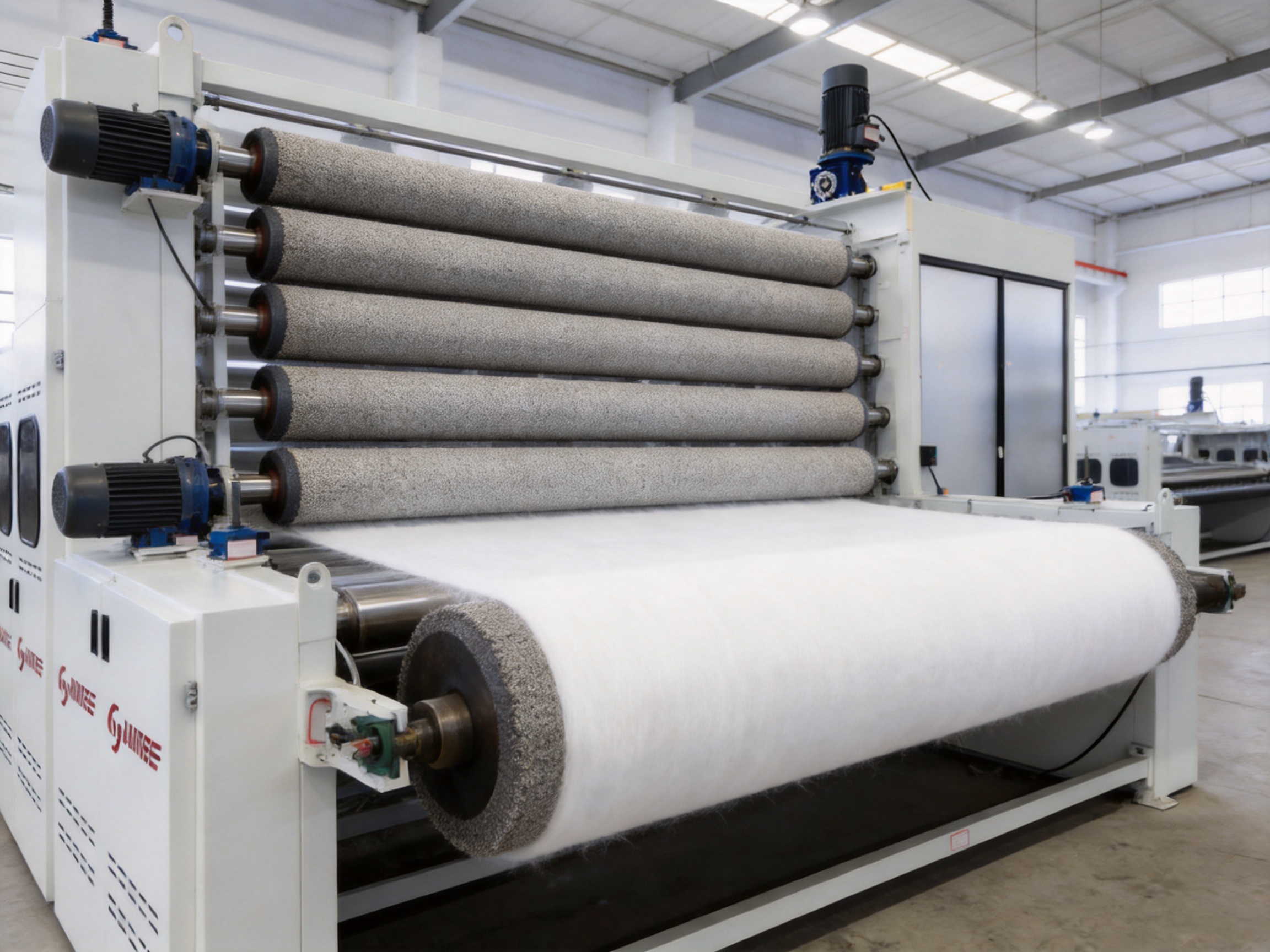
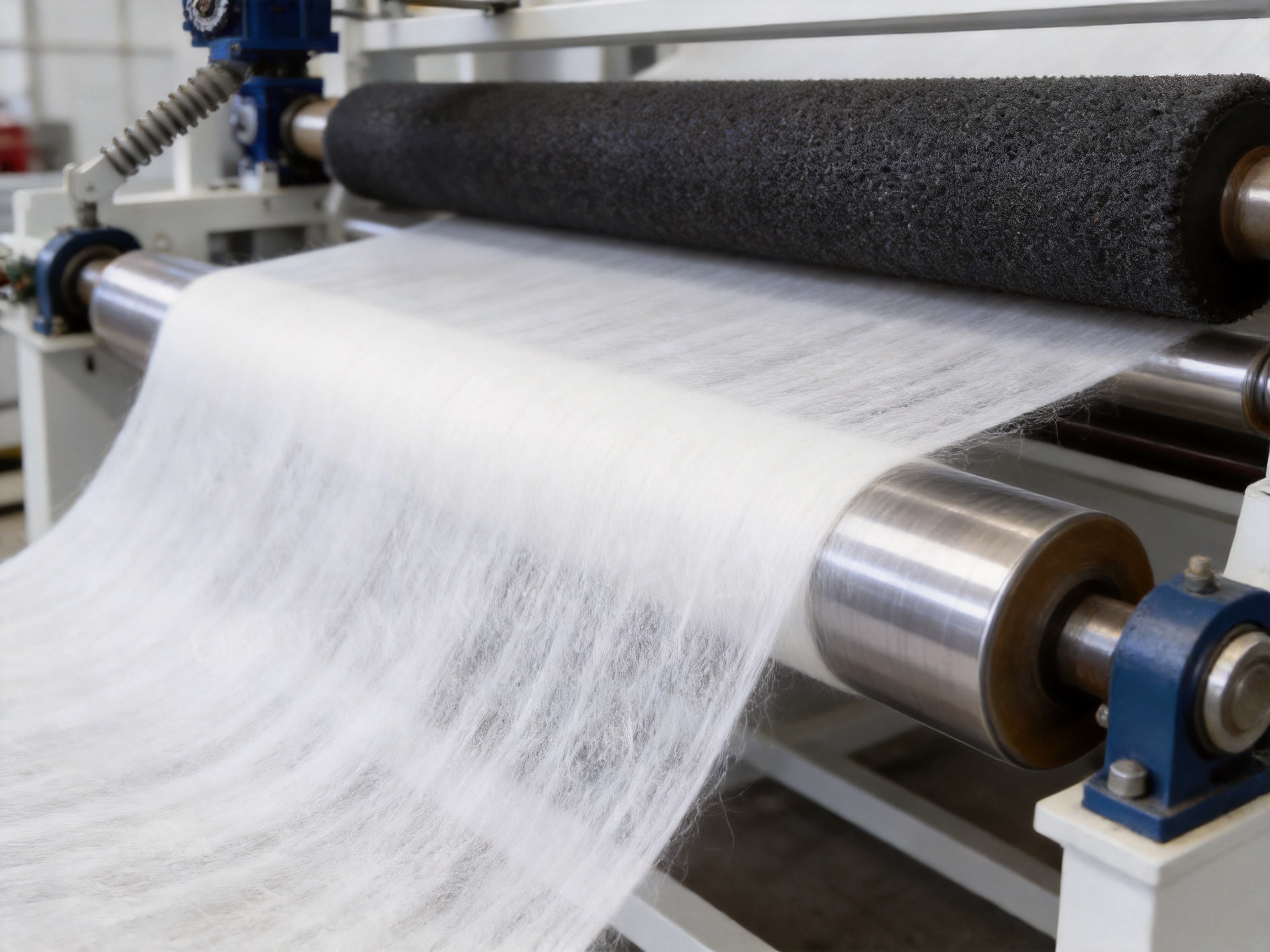
The machine uses a roller arrangement that guides and stretches the fiber web in a controlled direction. It is configured with five upper fixed rollers and two upper movable rollers. The movable rollers can be raised or lowered through an integral electric worm gear system. This arrangement allows operators to adapt the roller contact and web passage conditions to different production requirements.
The upper fixed rollers provide a stable guiding structure, while the movable rollers offer adjustment flexibility. Their position can influence the contact path, tension distribution, and handling of the web. This is especially useful when manufacturers process different fiber types, web weights, or production specifications on the same machine.
The drafting rollers are manufactured from seamless steel pipe. Their surfaces are finely ground and covered with rough rubber. This combination gives the rollers a strong and stable body while providing a suitable gripping surface for web transport. The rubber covering helps reduce uncontrolled slippage and supports consistent traction as the web passes through the drafting zone.
The drafting roller is driven by a separate motor. A dedicated drive allows the drafting function to be controlled independently from other mechanical sections when required. It also supports more precise adjustment of the drafting action and makes it easier to coordinate the drafting roller with the input and output sections.
The machine includes one input roller and one output roller. Both rollers use direct motor-reducer combinations. This drive configuration can operate synchronously according to the required transmission ratio, work independently, or be linked with the overall speed regulation of the production line.
Such flexibility is important because the correct operating speed depends on the characteristics of the web and the requirements of the next process. A lightweight web may require gentler handling, while a dense web may need a different speed relationship and roller setting. The ability to coordinate or separate the drives gives the operator greater control over production conditions.
The maximum draft ratio is 1:1.5. This means the machine can increase the longitudinal speed relationship within the specified design range to achieve controlled web stretching. The actual operating ratio should be selected according to the fiber type, web weight, moisture condition, web strength, and the final product requirements.
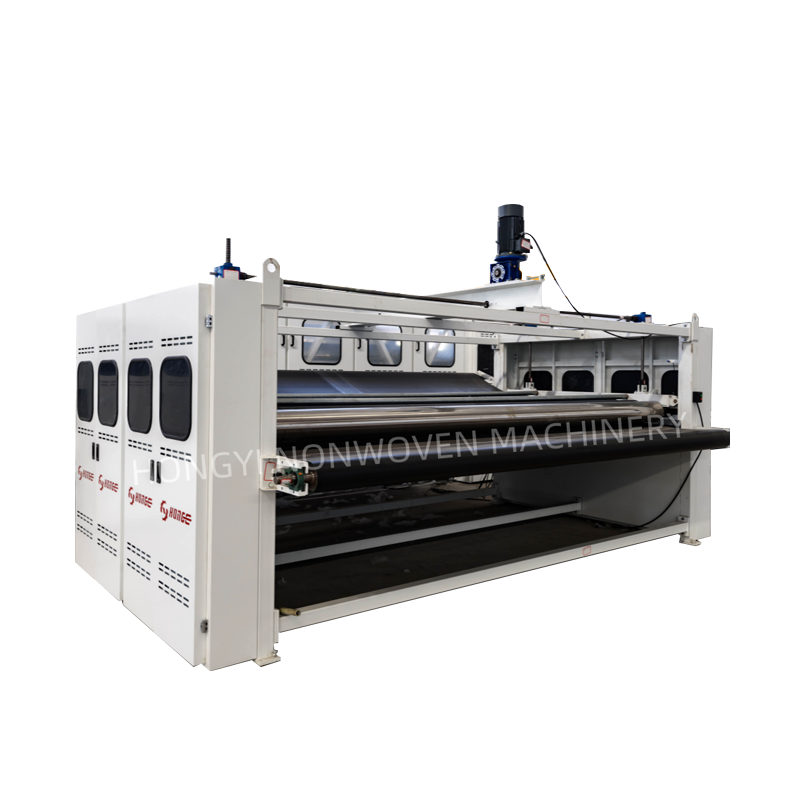
HYQS Fiber Web Drafting Machine
Main Technical Specifications
The HYQS Fiber Web Drafting Machine is available with a working width and configuration selected according to customer requirements. The supplied technical information lists a standard working width of 5600 mm, while the product net width can be customized up to 8500 mm. This makes the equipment suitable for both medium-width and wide-width nonwoven production lines.
| Item | Specification |
| Model | HYQS |
| Machine type | Fiber web drafting machine |
| Application category | Assistant equipment for nonwoven fabric production |
| Suitable raw materials | Polyester fiber or polypropylene staple fiber |
| Product GSM range | 100 to 1500 GSM |
| Maximum product net width | Up to 8500 mm |
| Reference working width | 5600 mm |
| Drafting roller diameter | 200 mm |
| Maximum draft ratio | 1:1.5 |
| Line speed | 0.5 to 8 m/min |
| Installed power | 18.7 kW |
| Production capacity range | Approximately 300 to 700 kg/h |
| Upper roller arrangement | Five fixed rollers and two movable rollers |
| Certification | CE and ISO9001-related quality management certification |
| Automation | Automatic operation with customizable configuration |
The listed GSM range of 100 to 1500 GSM covers a broad selection of nonwoven products. Actual performance depends on the fiber blend, web-forming method, moisture content, web strength, drafting ratio, line speed, and downstream equipment. Customers should confirm the final configuration with the manufacturer before ordering, especially when processing unusual fibers or operating at the upper limit of width and capacity.
The production capacity range of approximately 300 to 700 kg/h provides a useful reference for line planning. Capacity is not determined by the drafting machine alone. It is also influenced by the carding or airlay system, web weight, working width, machine speed, material feed rate, bonding process, and finished product specification.
Advantages of Controlled Fiber Web Drafting
Improved Thickness Uniformity
Thickness uniformity is one of the most important quality indicators for nonwoven fabrics. Variations in fiber distribution can lead to thin and thick areas, inconsistent compression, uneven bonding, and visible surface differences. By stretching and reorganizing the web in a controlled manner, the drafting machine helps reduce some of the irregularity created during the web-forming stage.
A more uniform web can provide a better foundation for downstream bonding. In thermal bonding, a consistent web may help the material receive more even heat exposure. In needle punching, a stable web can support more predictable needle penetration and fiber entanglement. For laminated or coated products, a more even base layer can contribute to improved surface quality and more consistent finished thickness.
Enhanced Longitudinal Fiber Alignment
Drafting encourages fibers to move toward the machine direction. This alignment may improve longitudinal tensile strength and influence the directional behavior of the final nonwoven fabric. The degree of alignment depends on the draft ratio, fiber length, fiber crimp, web density, roller condition, and the bonding process used afterward.
For applications where machine-direction strength is important, controlled drafting can be an effective method of adjusting web structure before consolidation. This may be relevant to geotextiles, industrial felts, filter materials, automotive components, and other products in which directional performance must be managed.
Improved Breathability and Bulk
Fiber distribution and web structure affect the amount of open space inside a nonwoven material. A properly drafted web can support a more stable arrangement of fibers and may help preserve useful bulk before bonding. Depending on the process conditions, the finished fabric may achieve improved air permeability and a more consistent thickness.
These characteristics are valuable in applications such as filtration, insulation, padding, automotive interior materials, bedding products, and household textiles. The exact result depends on the relationship between drafting, bonding temperature, needle density, compression, and the selected fiber.
Better Overall Strength Potential
A nonwoven fabric’s strength is determined by many factors, including fiber strength, fiber length, fiber orientation, web weight, bonding method, and process stability. Drafting contributes by promoting a more favorable orientation and reducing uncontrolled areas of the web. When combined with suitable needle punching or thermal bonding conditions, this can help the finished fabric achieve more consistent mechanical performance.
Drafting is not a substitute for proper bonding, but it can provide a better starting structure for bonding. A uniform web allows the downstream process to work on a more consistent material, which may reduce weak points and improve production repeatability.
Flexible Adjustment for Different Products
The two movable upper rollers are an important part of the machine’s flexibility. Their electric lifting and lowering mechanism enables adjustment of the web passage and roller engagement. Operators can adapt the machine to different web thicknesses and material behaviors without requiring a complete mechanical redesign.
The separate input, output, and drafting drives also make the equipment adaptable. Depending on the production requirement, the drives can be synchronized according to a transmission ratio, operated independently, or connected to the line-wide speed control system. This gives the manufacturer more options during product development and process optimization.
Roller and Drive Design
Roller construction has a direct effect on the stability of web transport. The use of seamless steel pipe provides a strong base for the drafting roller. A finely ground roller surface supports dimensional consistency, while the rough rubber covering is intended to improve contact with the web.
The rubber surface must be maintained properly. It should be inspected for wear, cuts, contamination, hardening, and uneven surface damage. A clean and consistent roller covering helps maintain reliable traction. If the surface becomes excessively worn or contaminated with fiber and oil, web transport may become less stable and the actual draft ratio may vary.
The 200 mm drafting roller diameter provides a substantial contact surface for the web. The appropriate roller diameter can help distribute pressure and reduce sharp changes in the web path. The final effect depends on roller spacing, material tension, web thickness, and the machine’s complete mechanical arrangement.
The direct motor-reducer combination on the input and output rollers is another key design feature. Instead of depending only on a common mechanical transmission, the machine can use controlled drive units to regulate roller speed. This arrangement can simplify speed adjustment and allow the operator to establish a specific relationship between the web entry and exit speeds.
Synchronous operation is useful when the drafting machine is integrated into a complete nonwoven line. Independent operation is useful during testing, commissioning, maintenance, or special product development. Linking the machine to the overall speed regulation system can improve coordination between web formation, drafting, bonding, and winding.
Manufacturing Process and Engineering Strengths
Changshu Hongyi Nonwoven Machinery Co., Ltd. has more than 20 years of experience in the nonwoven machinery field. This experience covers both individual machines and complete production lines. Such a background is important because drafting equipment must work in coordination with upstream and downstream machinery rather than operate as an isolated unit.
The manufacturer’s product range includes opening and blending machines, feeding and carding equipment, web-forming and needle punching machines, thermal bonding and heat-setting equipment, airlay systems, winding and cutting machines, auxiliary machines, and complete nonwoven production lines. This broad product coverage gives the engineering team practical experience with different fiber preparation and web consolidation methods.
A machine supplier with knowledge of the full production process can evaluate more than the drafting section alone. It can consider fiber opening, card feeding, web weight, web formation, needle punching, thermal bonding, heat setting, winding tension, cutting requirements, and final product use. This makes it easier to propose a drafting configuration that supports the complete production objective.
Steel and Mechanical Component Fabrication
The mechanical materials used in the equipment are mainly steel and iron. These materials provide the structural strength required for wide-width nonwoven processing. A rigid frame helps maintain alignment between rollers and reduces unwanted vibration during operation.
Fabrication quality is especially important for wide machines. Small alignment errors can become more significant across a large working width. The manufacturing process therefore requires attention to frame welding, machining, roller installation, bearing positioning, drive alignment, and surface finishing.
Seamless steel pipe is used for the drafting roller body. The roller surface is finely ground before the rough rubber covering is applied. This sequence supports a stable roller geometry and a suitable contact surface. Proper balancing and alignment are also important to minimize vibration and maintain even web handling.
Electrical and Drive Integration
The machine’s drive system is designed to accommodate different operating modes. The input and output rollers can be synchronized according to the selected ratio, controlled independently, or linked with the overall speed control of the production line. This type of control architecture supports process development as well as routine production.
Electrical integration should be matched to the customer’s line control system. Depending on the project, the machine may require coordination with upstream carding equipment, web-forming machinery, needle punching equipment, thermal bonding ovens, or winding systems. The configuration can be customized according to the production line and control requirements.
Good electrical design also supports safer operation. Clearly arranged controls, appropriate protective devices, emergency stopping functions, and accessible inspection points can make operation and maintenance more manageable. The exact control cabinet and automation configuration should be confirmed as part of the technical proposal.
Customization and Project Engineering
Nonwoven manufacturers rarely have identical production requirements. Working width, raw material, GSM, line speed, capacity, product application, factory layout, and automation preferences can all vary. For this reason, the HYQS machine is offered with customizable configuration options.
Working width can be selected according to the product line. The supplied information identifies a reference working width of 5600 mm and a maximum product net width of up to 8500 mm. Customers should provide the required finished width, web width, edge-trim plan, and downstream machine dimensions so that the correct configuration can be prepared.
Color and external finishing can also be customized according to customer needs. Although appearance does not determine production performance, a consistent color system can support factory organization, equipment identification, and customer branding.
Customization may also cover roller arrangement, drive control, electrical interface, safety equipment, auxiliary components, and connection dimensions. The final machine should be selected through a technical discussion that considers the entire line rather than only the nominal machine width.
Comparison with Conventional or Less Flexible Drafting Solutions
Some basic web stretching arrangements rely on fixed mechanical speed relationships and provide limited adjustment of the web path. These systems may be suitable for a narrow range of materials, but they can become less flexible when a manufacturer needs to change GSM, fiber type, web thickness, or finished product structure.
The HYQS machine offers several advantages in this area. Its movable upper rollers provide mechanical adjustment, while the separately driven drafting, input, and output sections provide greater speed-control flexibility. This combination allows the operator to adjust both web handling and speed relationships.
| Evaluation area | Fixed or basic drafting arrangement | HYQS Fiber Web Drafting Machine |
| Upper roller adjustment | Often limited or manually restricted | Two movable upper rollers with electric worm gear lifting and lowering |
| Drafting drive | May depend on common transmission | Separate motor for the drafting roller |
| Input and output control | May operate through a fixed speed relationship | Can be synchronized, independently controlled, or linked to line regulation |
| Roller construction | Configuration varies by supplier | Seamless steel pipe with finely ground surface and rough rubber covering |
| Product range | May be optimized for a narrow specification | Suitable for approximately 100 to 1500 GSM, subject to process conditions |
| Working width | Usually limited to standard dimensions | Reference width of 5600 mm with customization up to 8500 mm |
| Line integration | May require additional adaptation | Designed for integration with complete nonwoven production lines |
| Customization | May be limited | Configuration, color, width, and control options can be customized |
The comparison should be understood as a general equipment-planning guide rather than a universal statement about every competing machine. Different manufacturers use different mechanical and control solutions. The most important advantage of the HYQS design is the combination of adjustable roller positioning, separate drive control, broad width options, and experience in complete nonwoven line engineering.
Applications in Nonwoven Fabric Production
Geotextiles
Needle punched geotextiles require stable web formation and reliable mechanical performance. Drafting can help manage the orientation of fibers before needle punching. The resulting web can provide a more consistent basis for downstream entanglement and may support the required tensile and thickness characteristics.
For geotextile projects, the machine should be selected together with the carding system, cross-lapper or web-forming equipment, needle punching machine, and winding system. The required product weight, width, strength, elongation, and permeability should be considered when establishing the draft ratio and operating speed.
Nonwoven Carpets and Felts
Carpet underlay, industrial felt, wool felt, jute felt, and similar products can benefit from controlled web preparation. A more even web may help reduce visible density changes and improve the consistency of the finished surface. The drafting operation can be coordinated with needle punching and optional heat setting processes.
Different fiber blends behave differently. Wool, jute, polyester, and polypropylene may require different roller pressure, speed, and tension settings. The adjustable configuration of the HYQS machine allows manufacturers to develop suitable settings for different product families.
Automotive Interior Materials
Automotive interior materials often require stable thickness, controlled bulk, good sound absorption, and repeatable mechanical properties. These products may use polyester fibers or blended fibers and may be thermally bonded, needle punched, laminated, or molded.
The drafting machine can prepare the web before bonding or heat treatment. By improving fiber arrangement and thickness consistency, it can support more stable performance in subsequent processes. The exact requirements should be determined through trials using the intended fiber and production recipe.
Cleaning Cloths and Industrial Nonwovens
Cleaning cloths and industrial nonwoven materials may require a balance of absorbency, strength, softness, and dimensional stability. Drafting can influence the direction and density of the web, allowing manufacturers to adjust the structure before needle punching or thermal bonding.
For products that need a uniform appearance and reliable roll quality, consistent web transport is particularly important. The input and output roller drives can be coordinated with the line speed to reduce process variation.
Thermal Bonded Wadding and Padding
Wadding, padding, insulation, and filling materials often depend on bulk, softness, resilience, and thickness uniformity. Drafting can support more controlled fiber distribution before the web enters a thermal bonding oven or heat-setting unit.
The machine may be included in a thermal bonded nonwoven production line, where the web is formed, drafted, heated, bonded, cooled, and wound. The proper relationship between drafting and thermal treatment must be established so that the material retains the required loft without excessive shrinkage or distortion.
Integration with a Complete Production Line
The HYQS Fiber Web Drafting Machine can be used as an independent auxiliary machine or integrated into a complete nonwoven manufacturing system. In an integrated line, the machine may receive a web from a carding and cross-lapping system or another web-forming unit. It then prepares the web for needle punching, thermal bonding, heat setting, laminating, or winding.
Successful integration requires attention to several factors. The upstream machine must deliver the web at a compatible width and speed. The web must enter the drafting machine with suitable tension and without excessive folding or edge damage. The downstream machine must be able to receive the drafted web at the selected output speed.
Control communication is also important. When the input and output rollers are linked to the overall line speed regulation, changes in production speed can be coordinated more effectively. This can reduce the risk of uncontrolled tension changes during acceleration, deceleration, or product changeover.
Mechanical layout should include adequate space for inspection, cleaning, roller replacement, electrical access, and operator movement. Wide-width equipment requires careful planning for installation and maintenance. The factory floor should also be prepared for the machine’s shipping weight and package dimensions.
The listed package size is approximately 3800 mm by 1200 mm by 1500 mm, with a gross package weight of approximately 7500 kg. These values are important for transport planning, unloading, internal movement, foundation preparation, and installation scheduling. Final shipping dimensions may vary according to the selected configuration and packaging method.
Operating Guidelines
Initial Preparation
Before starting the machine, operators should verify that the frame, rollers, guards, drive units, electrical connections, and emergency stopping devices are in suitable condition. The web path should be clear, and no tools or loose materials should remain near moving components.
The roller surfaces should be clean and free from excessive fiber accumulation, oil, or foreign matter. The input and output web paths should be aligned with the upstream and downstream equipment. If the machine is newly installed, alignment and drive direction should be checked carefully during commissioning.
Setting the Draft Ratio
The draft ratio should be selected according to the product recipe. Operators should begin with a moderate setting and observe web behavior before increasing the ratio. A high draft ratio is not always better. The correct setting depends on web strength, fiber length, fiber crimp, GSM, moisture, and the desired directional properties.
If the draft ratio is too low, the desired alignment effect may not be sufficient. If it is too high, the web may become unstable, narrow excessively, develop tension marks, or break. Trial production and quality testing should be used to determine the most suitable operating point.
Adjusting Movable Rollers
The movable upper rollers can be lifted and lowered through the electric worm gear system. Adjustments should be made gradually. Operators should monitor web movement, surface appearance, thickness, edge condition, and motor load after each adjustment.
Both sides of the machine should remain properly coordinated. Uneven roller positioning can create cross-machine tension differences and may cause the web to drift toward one side. Regular inspection of roller parallelism and mechanical alignment is recommended.
Monitoring Production
During operation, operators should observe the web before and after drafting. Useful indicators include web width, edge stability, surface uniformity, tension, visible fiber displacement, and the presence of wrinkles or breaks. Motor current and unusual vibration should also be monitored.
Quality checks may include GSM measurement, thickness measurement, tensile testing in both machine and cross directions, air permeability testing, and visual inspection. Recording these results helps the production team connect machine settings with finished-product performance.
Maintenance and Service Considerations
Regular maintenance helps protect the machine’s performance and service life. The maintenance schedule should include inspection of roller surfaces, bearings, couplings, gear reducers, motors, electrical cabinets, wiring, safety devices, and structural fasteners.
Rubber-covered drafting rollers should be inspected for wear and surface damage. If the covering becomes uneven, hardened, cracked, or excessively smooth, web traction may decline. Replacement or reconditioning should be arranged according to the manufacturer’s recommendations.
Bearings and drive components should be lubricated and inspected according to the operating conditions. Excessive noise, heat, vibration, or abnormal resistance may indicate a problem that requires attention. Early detection can reduce the risk of unplanned downtime.
Fiber accumulation should be removed from accessible machine areas. Loose fibers can affect roller contact, ventilation, sensors, electrical components, and moving mechanisms. Cleaning procedures should be performed only when the machine is stopped and isolated from its power source.
The electric worm gear lifting mechanism should be checked for smooth operation and secure positioning. Input and output drive systems should be inspected to confirm that the selected speed relationship is maintained. Electrical control components should be kept clean and protected from excessive dust and moisture.
The manufacturer provides a one-year warranty according to the supplied product information. Warranty conditions, excluded parts, installation responsibilities, commissioning support, and spare-parts arrangements should be confirmed in the commercial and technical contract before purchase.
Quality Control in Manufacturing
Reliable nonwoven machinery depends on quality control at several stages. Structural components must be fabricated accurately, rollers must be processed and aligned properly, and electrical systems must be assembled according to the agreed design.
For a wide-width drafting machine, dimensional inspection is important. Frame dimensions, roller parallelism, shaft alignment, bearing positions, and working width should be checked before final assembly. Surface treatment and rubber covering should also be inspected for consistency.
Drive testing can confirm that the motors, reducers, couplings, and control system operate correctly. The machine should be checked in both synchronized and independent control modes when these functions are included in the configuration. Emergency stops and protective devices should be tested before shipment or commissioning.
Factory testing may include no-load operation, speed adjustment, roller movement, transmission inspection, electrical testing, and simulated web handling. The exact factory acceptance procedure depends on the customer’s requirements and the project contract.
Changshu Hongyi’s experience with complete nonwoven lines supports a practical approach to machine testing. Equipment is evaluated not only as a mechanical assembly but also as part of a production process. This can help identify interface issues before the machine reaches the customer’s factory.
Why Choose an Experienced Nonwoven Machinery Manufacturer
Purchasing a drafting machine involves more than selecting a roller width and motor capacity. The equipment must match the fiber, web-forming process, finished product, factory layout, control system, and production target. An experienced manufacturer can assist with these technical relationships.
Changshu Hongyi Nonwoven Machinery Co., Ltd. has supplied nonwoven machinery to more than 20 countries, including markets in Latin America, Asia, Africa, and other regions. International project experience can be valuable because export equipment must be prepared for different electrical standards, installation conditions, operator expectations, spare-parts requirements, and transportation arrangements.
The company provides both standard machine concepts and customized solutions. Its product portfolio includes complete lines and individual machines, allowing customers to purchase a single drafting unit, upgrade an existing line, or develop a new production system from fiber opening through winding and cutting.
Its stated focus includes efficiency, reliability, quality, advanced technology, precision engineering, automatic control, energy-saving operation, and customization. These strengths are relevant to drafting equipment because the machine must maintain stable handling while operating continuously and coordinating with other line sections.
A factory-direct supplier can also simplify communication. Technical information, drawings, configuration changes, spare parts, installation questions, and after-sales service can be handled through a more direct relationship. This is particularly useful for customized machines and complete line projects.
Energy and Production Efficiency
The installed power of the reference machine is 18.7 kW. Actual energy consumption depends on operating speed, web load, roller pressure, product GSM, drive efficiency, and the operating condition of the machine. Efficient production is achieved not only by reducing installed power but also by minimizing web waste, avoiding frequent stoppages, and maintaining stable quality.
Independent drive control can contribute to process efficiency by allowing the operator to select the speed relationship that matches the material. Over-drafting, web breaks, and repeated adjustments can create waste and reduce productivity. A controlled and repeatable drafting process can help reduce these losses.
Automation can also support efficient operation. When the machine is linked to line-wide speed regulation, the drafting section can respond more consistently to production changes. This may reduce manual intervention and simplify the management of different product recipes.
Energy efficiency should be evaluated across the entire production line. The drafting machine should be correctly matched with the carding, web-forming, needle punching, thermal bonding, and winding systems. A balanced line avoids bottlenecks and allows the equipment to operate closer to its intended production range.
Installation and Commissioning
Installation begins with a review of the factory layout, foundation, electrical supply, material flow, and line connections. The customer should ensure that the machine can be transported from the unloading area to the installation position. The listed gross package weight of approximately 7500 kg should be considered when selecting lifting and handling equipment.
The machine should be positioned on a suitable foundation or floor with adequate load-bearing capacity. Leveling is important for roller alignment and stable web transport. After positioning, the machine should be connected to the upstream and downstream equipment according to the approved layout drawing.
Electrical installation should be completed by qualified personnel. Motor rotation, control signals, emergency stop circuits, grounding, and communication with the main line control system should be checked before operation. Safety guards must be installed before full-speed testing.
Commissioning should normally proceed in stages. First, the machine can be operated without material to check rotation and mechanical movement. Next, a low-speed web trial can be performed. After confirming web stability, the speed and draft ratio can be increased gradually while product quality is monitored.
Operator training should cover start-up, shutdown, web threading, roller adjustment, speed control, emergency procedures, cleaning, inspection, and basic troubleshooting. Well-trained operators are more likely to recognize early signs of roller wear, web instability, or drive problems.
Purchasing Checklist for Buyers
Before requesting a quotation, buyers should prepare detailed information about the intended product. Important data includes fiber type, fiber length, fiber blend, web-forming method, GSM range, finished width, production capacity, line speed, bonding method, and required machine-direction properties.
The buyer should also specify whether the machine will be installed in a new line or added to an existing system. For an existing line, the supplier needs the upstream and downstream machine dimensions, material height, speed range, control signals, electrical standard, and available floor space.
Questions about customization should be resolved early. These may include working width, roller surface material, control cabinet design, operator interface, safety guards, color, spare parts, installation support, training, and warranty coverage.
Capacity should be discussed in relation to the complete process. A stated capacity range of 300 to 700 kg/h is a useful reference, but the actual output depends on product GSM, web width, line speed, material properties, and the limits of other machines in the line.
Buyers should request technical drawings, utility requirements, foundation information, shipping details, recommended spare parts, maintenance instructions, and acceptance criteria. Clear documentation helps reduce misunderstandings and supports smoother installation.
Frequently Asked Questions
What is the main function of a fiber web drafting machine?
The main function is to stretch a horizontally arranged fiber web in the longitudinal direction. This encourages some fibers to align with the machine direction, improves web uniformity, and prepares the material for a downstream bonding or consolidation process.
What fibers can be processed?
The reference specification identifies polyester fiber and polypropylene staple fiber as suitable raw materials. Other fibers may be possible depending on their length, crimp, strength, friction, and web-forming method. Compatibility should be confirmed with the manufacturer before ordering.
What is the maximum draft ratio?
The maximum draft ratio is 1:1.5. The correct operating ratio may be lower depending on the web structure and finished product requirements. Operators should establish the setting through controlled trials.
What is the working width?
The reference machine has a working width of 5600 mm, while the product net width can be customized up to 8500 mm. The final width should be selected according to the finished product, upstream web-forming equipment, downstream machinery, and factory layout.
How are the upper rollers configured?
The machine includes five upper fixed rollers and two upper movable rollers. The movable rollers can be lifted and lowered through an integral electric worm gear system, providing adjustment flexibility for different web conditions.
How are the input and output rollers driven?
Both the input and output rollers use direct motor-reducer combinations. They can operate synchronously according to the transmission ratio, independently, or in connection with the overall machine speed regulation system.
What is the drafting roller made from?
The drafting roller is made from seamless steel pipe. Its surface is finely ground and covered with rough rubber to support stable contact and traction with the web.
Can the machine be integrated into an existing production line?
Yes, integration is possible when the width, height, speed, control signals, web direction, and mechanical interfaces are compatible. The manufacturer should review the existing line information before confirming the design.
What products can use this machine?
Potential applications include geotextiles, nonwoven carpets, industrial felts, automotive interior materials, cleaning cloths, thermal bonded wadding, insulation, padding, and other nonwoven products requiring controlled web preparation.
Does drafting improve final product strength?
Drafting can encourage longitudinal fiber alignment and improve web consistency, which may support better mechanical performance after bonding. Final strength depends on fiber properties, GSM, draft ratio, bonding method, needle density, thermal conditions, and other process factors.
What is the line speed?
The listed line speed is 0.5 to 8 m/min. Actual operating speed depends on the web, production capacity, drafting ratio, downstream equipment, and required product quality.
Is the machine automatic?
The product information identifies the machine as automatic, with a customizable configuration. The degree of automation and its interface with the complete production line should be confirmed in the technical specification.
What after-sales support is available?
The supplied information lists a one-year warranty. Installation guidance, commissioning, operator training, spare parts, remote assistance, and other service arrangements should be confirmed in the purchase agreement.
Conclusion
The HYQS Fiber Web Drafting Machine provides a practical solution for improving the structure and consistency of fiber webs before bonding or other downstream processing. Its controlled longitudinal drafting action can help improve thickness uniformity, breathability, bulk, fiber alignment, and overall strength potential.
The machine’s five fixed upper rollers and two electrically adjustable movable rollers provide flexible web handling. The seamless steel drafting roller, finely ground surface, and rough rubber covering support stable traction. Separate drive systems for the drafting, input, and output sections allow synchronized, independent, or line-linked operation.
With a maximum draft ratio of 1:1.5, a reference working width of 5600 mm, customizable width up to 8500 mm, a GSM range of approximately 100 to 1500, and a reference capacity of 300 to 700 kg/h, the machine can serve a broad range of nonwoven production requirements.
Its strongest competitive advantages are the combination of mechanical adjustability, drive-control flexibility, wide-width customization, complete-line integration, and support from a manufacturer with more than two decades of nonwoven machinery experience. For manufacturers seeking a stable and adaptable web preparation process, the HYQS machine can be evaluated as an important part of a modern nonwoven production line.
References
1. Changshu Hongyi Nonwoven Machinery Co., Ltd. Product specification for the HYQS Fiber Web Drafting Machine.
2. Changshu Hongyi Nonwoven Machinery Co., Ltd. Technical information on nonwoven machinery and complete production lines.
3. International Organization for Standardization. Quality management system principles and ISO 9001 requirements.
4. European machinery safety and conformity assessment principles applicable to industrial textile machinery.
5. General technical literature on nonwoven web formation, fiber orientation, drafting, needle punching, and thermal bonding.
6. General maintenance practices for industrial rollers, motor-reducer drives, rubber-covered surfaces, and automated production equipment.