

Content
- 1 1. The Role of Airlaid Technology in Nonwoven Manufacturing
- 2 2. HYQL Airlay Machine: Product Overview
- 3 3. Main Technical Specifications
- 4 4. Broad Raw-Material Compatibility
- 5 5. Advantages Compared with Conventional Carding and Cross-Lapping
- 6 6. Advantages Compared with Other Airlay Systems
- 7 7. Formation Process and Working Principle
- 8 8. Product Applications
- 9 9. Manufacturing Strengths of Changshu Hongyi Nonwoven Machinery Co., Ltd.
- 10 10. Control System and Production Management
- 11 11. Dust Collection and Workplace Considerations
- 12 12. Maintenance and Operational Reliability
- 13 13. Energy and Resource Efficiency
- 14 14. Installation and Commissioning
- 15 15. How to Select the Correct Configuration
- 16 16. Quality Control for Airlaid Products
- 17 17. Business Benefits for Manufacturers
- 18 18. Frequently Asked Questions
- 18.1 Q1: What is an airlay machine?
- 18.2 Q2: What materials can the HYQL Airlay Machine process?
- 18.3 Q3: What is the working width?
- 18.4 Q4: What basis-weight range can it produce?
- 18.5 Q5: What is the maximum capacity?
- 18.6 Q6: Can the machine replace a carding machine and cross lapper?
- 18.7 Q7: Is the machine suitable for soft wadding?
- 18.8 Q8: Can it produce stiff wadding?
- 18.9 Q9: What heating methods are available?
- 18.10 Q10: Does the supplier provide complete production lines?
- 18.11 Q11: Is overseas service available?
- 18.12 Q12: What is the warranty period?
- 18.13 Q13: How can buyers verify whether the machine suits their fiber?
- 18.14 Q14: Is dust collection necessary?
- 19 19. Recommended Project Information for a Quotation
- 20 20. Conclusion
- 21 References
- 22 Product: HYQL Airlay Machine
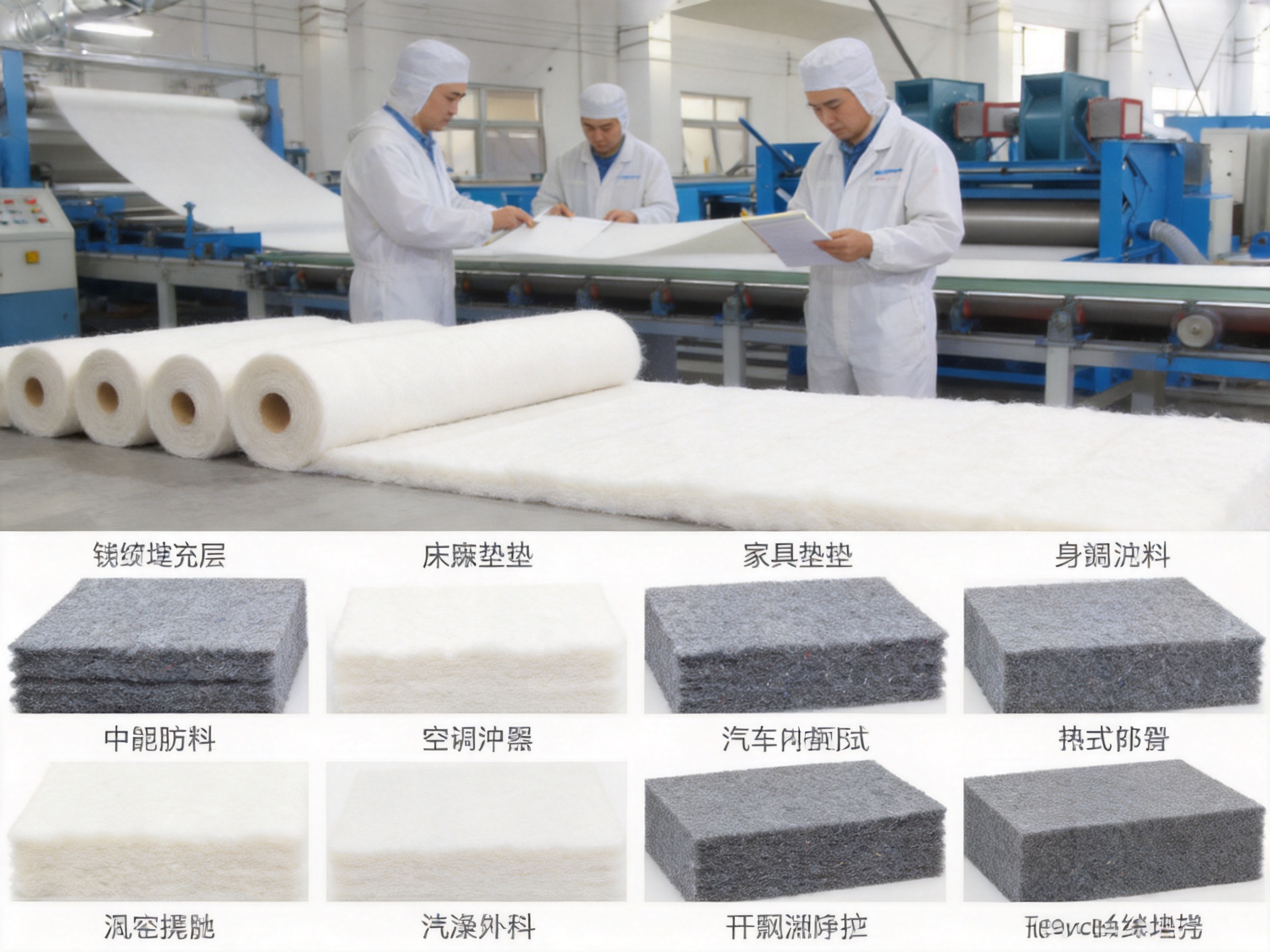
Airlaid technology has become an important solution for manufacturers that need to process difficult fibers, produce heavy or lightweight webs, and simplify the formation stage of nonwoven production. The HYQL Airlay Machine is designed as the core forming unit for thermal-bonded wadding, airlaid felt, insulation materials, padding, mattress components, acoustic products, and other engineered nonwoven applications.
Unlike a conventional carding and cross-lapping arrangement, an airlay system forms a fiber batt through aerodynamic dispersion. Fibers are opened, transported, distributed, and deposited onto a moving forming surface. This process enables manufacturers to work with a broad range of raw materials, including shoddy fiber, waste fiber, crushed sponge, polyester, cotton, wool, low-melt fiber, and blended fibers.
The HYQL machine is developed for customers that require high throughput, consistent web formation, flexible raw-material compatibility, and a production system that can be adapted to different product specifications. With a working width of 2,600 mm, a weight range of approximately 400–7,500 gsm, and a maximum stated capacity of up to 800 kg/h, the machine can support both standard and customized nonwoven production lines.
1. The Role of Airlaid Technology in Nonwoven Manufacturing
In a traditional nonwoven line, carding machines prepare fibers by separating and orienting them into a web. A cross lapper then folds the web back and forth to increase thickness and create the required basis weight. This configuration remains useful for many fiber types, but it can become less efficient when the raw material contains irregular, short, reclaimed, bulky, or non-cardable fibers.
Airlaid technology uses controlled airflow to move and distribute fibers. Instead of depending primarily on mechanical carding and repeated web folding, the system suspends or conveys fibers through an aerodynamic chamber before depositing them on a forming conveyor. The resulting batt can be thick, lofty, dense, soft, or rigid depending on the fiber blend, feed rate, airflow, forming parameters, and downstream bonding conditions.
This method is particularly suitable for applications in which fiber orientation does not need to be highly directional. It is also useful when the manufacturer wants to recycle or reuse fibers that may be difficult to process through conventional carding equipment. Shoddy fibers, reclaimed textile fibers, waste fibers, coconut fibers, jute fibers, and other irregular materials can be considered for airlaid processing after suitable preparation and testing.
The airlaid process can also simplify a production line. Replacing the conventional carding and cross-lapping section with an airlay forming system may reduce the number of mechanical web-forming steps. This can make operation more straightforward and can reduce the maintenance burden associated with complicated carding assemblies and cross-lapper mechanisms.
2. HYQL Airlay Machine: Product Overview
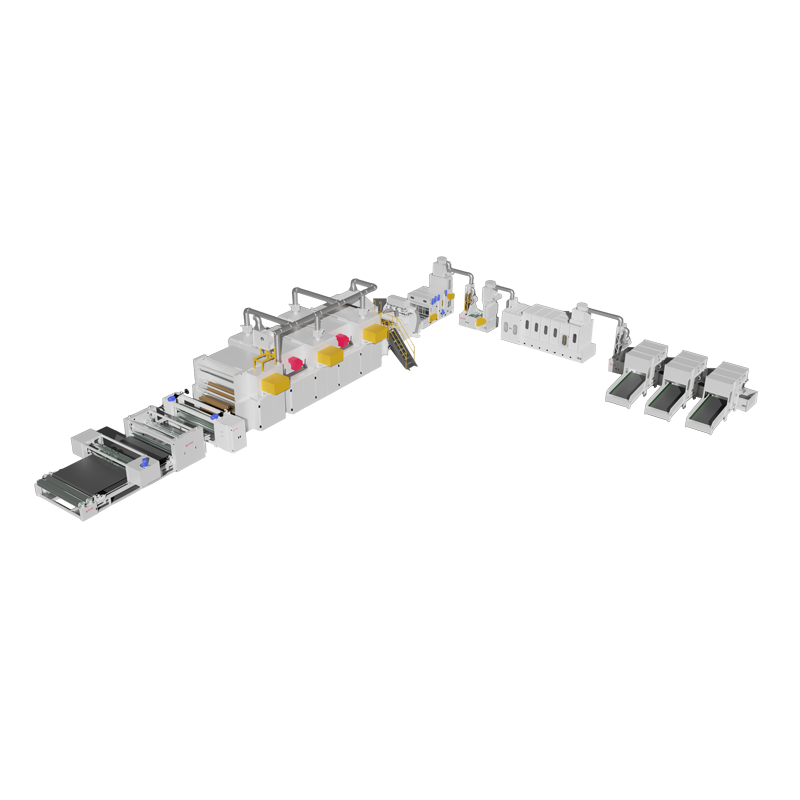
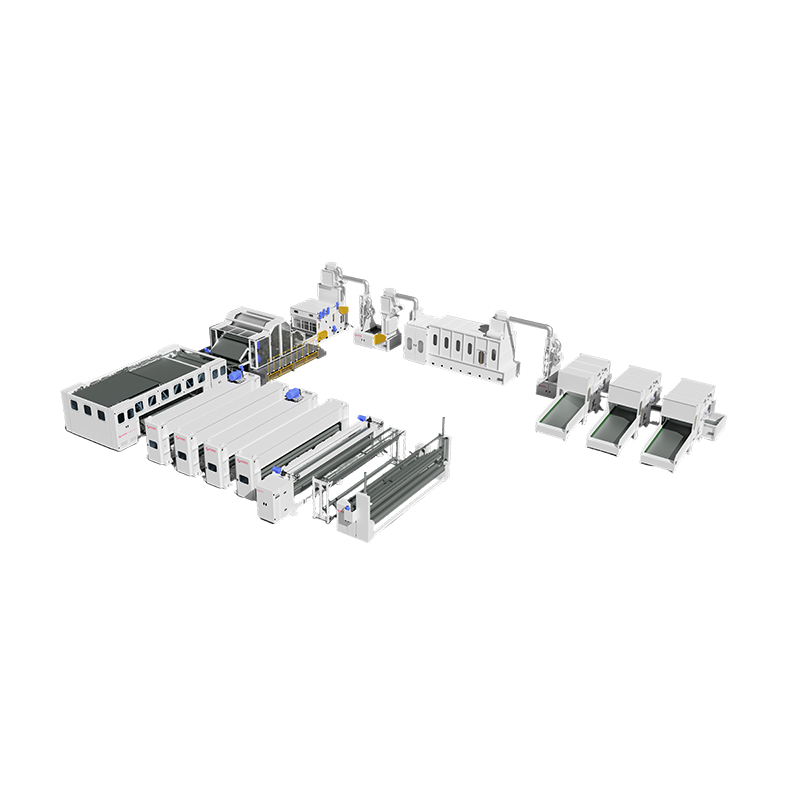
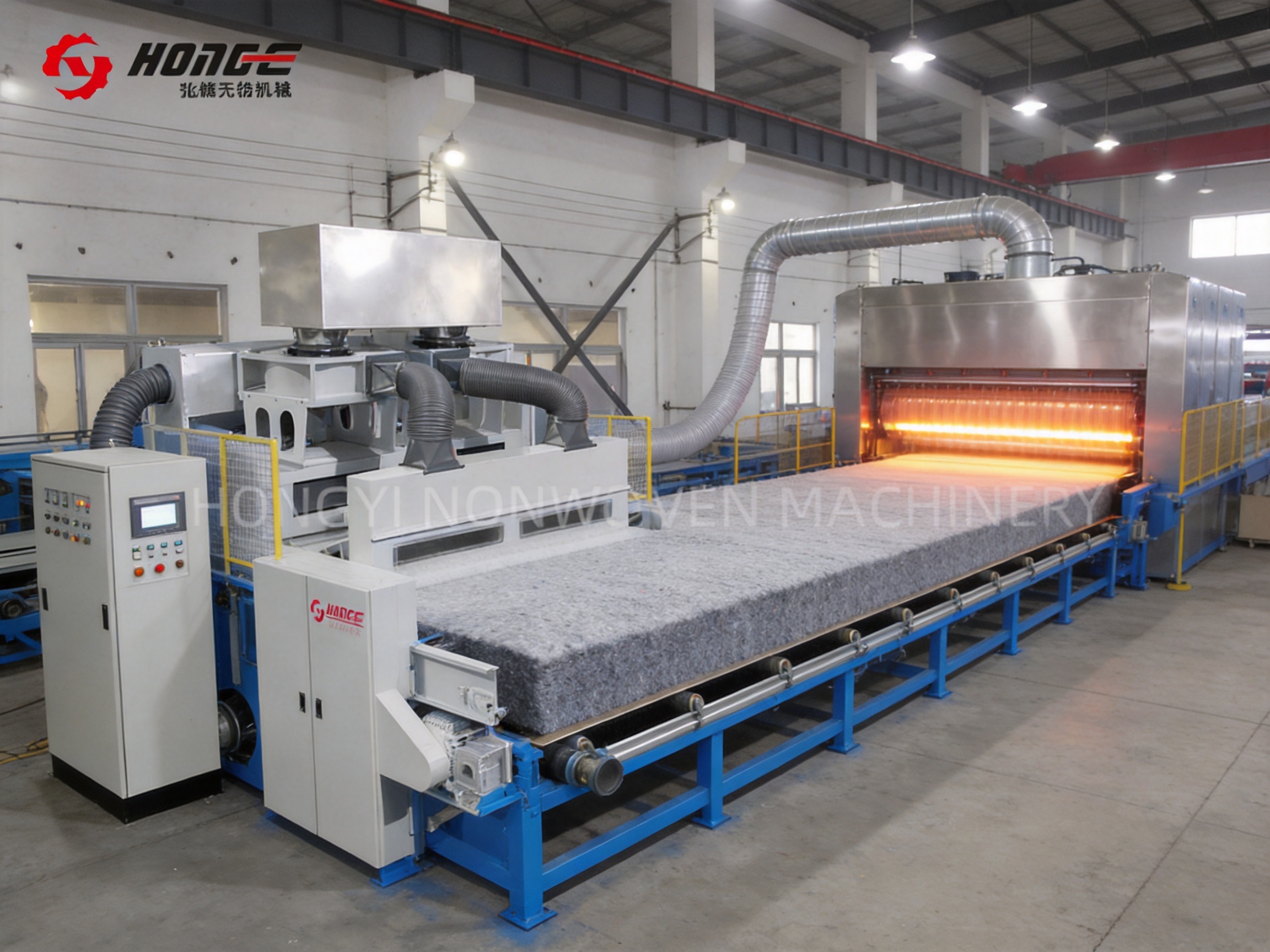
The HYQL Airlay Machine is designed for the continuous formation of nonwoven fiber batts. It is commonly installed as part of a thermal-bonded wadding production line, where the formed batt passes into a thermal oven for consolidation, bonding, compression, or heat setting.
The system can be configured for different product requirements. For stiff wadding, a blend of low-melt or bicomponent fiber with standard polyester fiber can be formed and then thermally bonded. During heating, the bonding component softens and connects the surrounding fibers. After cooling, the web obtains improved structural stability and dimensional integrity.
For soft and lofty products, the forming and oven settings can be adjusted to preserve bulk. Materials below approximately 1,500 gsm are often processed using belt-type oven arrangements that help maintain loft and reduce unnecessary compression. For denser products, a stainless-steel belt or a movable upper compression belt may be used according to the product specification.
The machine is suitable for applications such as:
Thermal-bonded wadding
Airlaid felt
Quilt filling
Cushion and mattress padding
Furniture filling
Automotive interior materials
Acoustic absorption products
Thermal insulation materials
Interlining for garments and home textiles
Toy filling and soft articles
Foam replacement materials
Recycled-fiber nonwovens
Jute, coconut, and other natural-fiber products
The precise production result depends on fiber length, fiber fineness, moisture, blending ratio, opening quality, line speed, airflow, forming configuration, oven temperature, and bonding-fiber content. For this reason, the equipment should be engineered together with the customer’s raw materials and final product specifications.
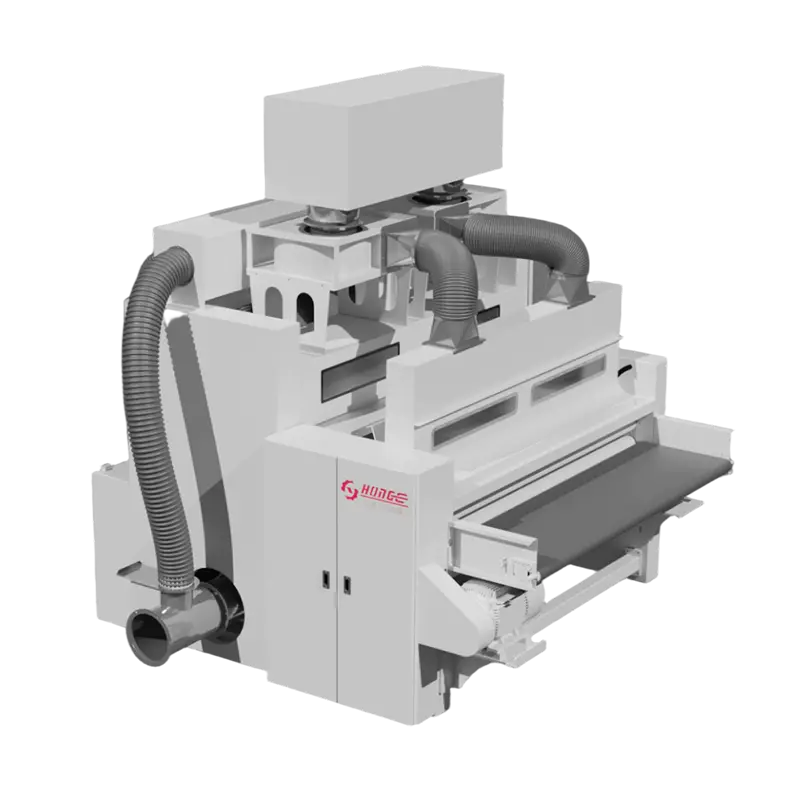
HYQL Airlay Machine
3. Main Technical Specifications
The available product information identifies the HYQL model as an automatic airlaid forming machine with a nominal working width of 2,600 mm. Its designed weight range is approximately 400–7,500 gsm, allowing it to produce both relatively light webs and heavy industrial batts.
| Item | Specification |
|---|---|
| Machine model | HYQL |
| Process technology | Airlaid |
| Working width | 2,600 mm |
| Weight range | Approximately 400–7,500 gsm |
| Maximum stated productivity | Up to 800 kg/h |
| Suitable raw materials | Shoddy fiber, polyester fiber, low-melt fiber, wool, cotton, crushed sponge, and other suitable fibers |
| Typical fiber specification | Approximately 1.5D–15D and 38–51 mm length, depending on material and product |
| Heating options for related lines | Hot-oil circulation or electric heating |
| Automation | Automatic operation with centralized parameter control options |
| Electrical voltage | 220 V/380 V, subject to project requirements |
| Installed power | Configuration dependent; listed equipment information indicates approximately 9–31 kW for relevant units |
| Certification information | CE and ISO9001-related certification information provided |
| Warranty information | One year |
| After-sales support | Engineers available for overseas service |
Actual output should be confirmed during technical design because production capacity is influenced by the material type, basis weight, web thickness, moisture content, blend ratio, and operating speed. A heavy batt made from dense or difficult-to-open fibers will not necessarily achieve the same hourly output as a lighter batt made from clean, uniform polyester.
4. Broad Raw-Material Compatibility
One of the most important advantages of an airlay machine is its ability to accommodate a wider range of fibers than many conventional web-forming systems. The HYQL machine is intended for processing several categories of material.
4.1 Recycled and Shoddy Fibers
Shoddy fiber is commonly obtained from textile waste, garment cutting waste, post-industrial scraps, or other reclaimed sources. Such fibers may vary in length, fineness, color, and cleanliness. They can also contain short fibers or irregular pieces that are not ideal for carding.
An airlaid forming system is well suited to applications that use reclaimed fibers because aerodynamic distribution can create a uniform batt from material with less consistent geometry. Upstream opening, separation, dust removal, and blending remain important, but the forming stage does not require every fiber to pass through the same carding arrangement.
Using reclaimed fibers can support cost reduction and improve resource efficiency. It can also enable manufacturers to develop low-cost felt, insulation, padding, carpet underlay, and filling products. The final application must determine whether additional cleaning, sterilization, color sorting, or contaminant removal is required.
4.2 Polyester and Low-Melt Fibers
Polyester is widely used in thermal-bonded nonwoven products because it offers useful resilience, chemical resistance, dimensional stability, and processing flexibility. Low-melt polyester or bicomponent fibers can be blended with standard polyester to create a thermally bondable structure.
When the blend enters the thermal oven, the low-melt component softens at a lower temperature than the main structural fiber. It then forms bonding points between fibers. Once the web cools, the bonded network provides stiffness and stability without requiring a separate liquid adhesive.
The exact blend ratio depends on the desired hand feel, compression resistance, recovery, density, thickness, and end-use requirements. A soft quilt filling may require a different formula from a rigid acoustic panel or an automotive interior component.
4.3 Natural Fibers
Wool, cotton, jute, and coconut fiber can be considered for airlaid applications. Natural fibers may be used alone or blended with synthetic fibers. Their moisture sensitivity, fiber length, density, and opening behavior should be evaluated before production.
Natural-fiber airlaid products can be used in insulation, sound absorption, furniture padding, horticultural materials, interior products, and specialty felts. The ability to process such materials gives manufacturers additional opportunities beyond standard polyester-based production.
4.4 Crushed Sponge and Foam-Replacement Materials
Crushed sponge and other resilient filling materials can be incorporated into selected airlaid products. These materials may help create bulky, lightweight structures for cushions, mattresses, protective pads, or acoustic applications.
Because foam fragments and fibrous materials behave differently in airflow, the feeding and opening arrangement must be selected carefully. Particle size, density, static electricity, and moisture can affect distribution. A project-specific trial is recommended before finalizing the machine configuration.
5. Advantages Compared with Conventional Carding and Cross-Lapping
The HYQL Airlay Machine is presented as an alternative to a traditional carding machine and cross lapper system. The main difference is the method used to form the batt. Carding relies on mechanical clothing and controlled fiber transfer, while airlaying uses aerodynamic movement and deposition.
| Comparison point | HYQL airlay approach | Traditional carding and cross-lapping approach |
|---|---|---|
| Typical stated capacity | Approximately 600–800 kg/h for suitable configurations | Approximately 200 kg/h in the comparison information |
| Fiber range | Can accommodate shoddy, waste, coconut, jute, and other difficult fibers after preparation | Generally more dependent on cardable fiber characteristics |
| Formation method | Aerodynamic dispersion and deposition | Mechanical carding followed by web folding |
| Maintenance requirement | Described as relatively limited | More frequent attention to carding and lapping components |
| Operation | Designed for centralized and comparatively simple control | May involve more coordinated mechanical settings |
| Basis-weight capability | Approximately 400–7,500 gsm stated range | Often limited by the selected carding and lapping configuration |
| Web formation | Designed for even longitudinal and transverse distribution | Can be affected by lapping and cross-direction variation |
| Dust management | High-performance dust collection system available in the comparison | Dust-control arrangements vary by line |
The comparison does not mean that airlaying eliminates every requirement associated with fiber preparation. Raw material still needs to be opened, fed, and controlled. However, the forming section can be more tolerant of material variability, particularly when the product is designed around random fiber distribution rather than a highly oriented web.
Another advantage is the potential reduction in mechanical complexity. Carding machines contain working rollers, metallic clothing, transfer elements, and adjustment points that require regular inspection. Cross-lappers also include traversing or folding mechanisms that must remain synchronized. An airlay system uses a different arrangement, which may simplify routine operation and reduce maintenance in appropriate applications.
The comparison data supplied for this machine indicates a capacity of 600–800 kg/h, while a conventional carding and cross-lapper arrangement is described at approximately 200 kg/h. Actual production depends on the product and configuration, but the potential throughput advantage can be significant for manufacturers operating high-volume lines.
6. Advantages Compared with Other Airlay Systems
The HYQL system is also described as offering advantages over lower-capacity airlaying systems. The supplied comparison identifies a typical capacity range of 600–800 kg/h for the HYQL configuration, compared with approximately 200 kg/h for other systems in the referenced comparison.
The stated weight range is approximately 400–4,000 g in the comparison table and approximately 400–7,500 gsm in the detailed product information. These figures should be understood as configuration-dependent values and should be confirmed for the specific line design. In either case, the machine is intended to cover a broad range of nonwoven weights.
Another stated advantage is centralized working-parameter control. A centralized control philosophy allows operators to coordinate feeding, airflow, forming speed, and related line functions from a unified interface. This can improve repeatability when changing from one product specification to another.
The equipment is also described as providing evenness in both the longitudinal and transverse directions. Uniformity is especially important for thermal-bonded wadding because uneven areas can lead to inconsistent thickness, variable compression, weak zones, or poor appearance. A well-controlled forming process helps reduce these risks.
Dust collection is another important feature. Processing reclaimed textiles, short fibers, and natural fibers can generate dust and airborne particles. A high-performance collection system can improve the working environment, protect machine components, and reduce the amount of loose material escaping into the production area. Dust control should be integrated with suitable ventilation, filtration, inspection, and workplace safety procedures.
7. Formation Process and Working Principle
7.1 Feeding and Opening
Production begins with the preparation and feeding of the selected fibers. Depending on the raw material, the upstream section may include bale opening, pre-opening, blending, magnetic separation, metal detection, dust removal, and calibrated feeding.
The opening stage separates compressed fiber tufts and creates a more consistent feed. Proper opening is essential because large tufts can lead to uneven deposition, while excessive mechanical action can damage fibers or create too much dust. The optimum opening method depends on whether the material is polyester, shoddy, wool, cotton, coconut, jute, foam, or a blend.
7.2 Aerodynamic Fiber Transport
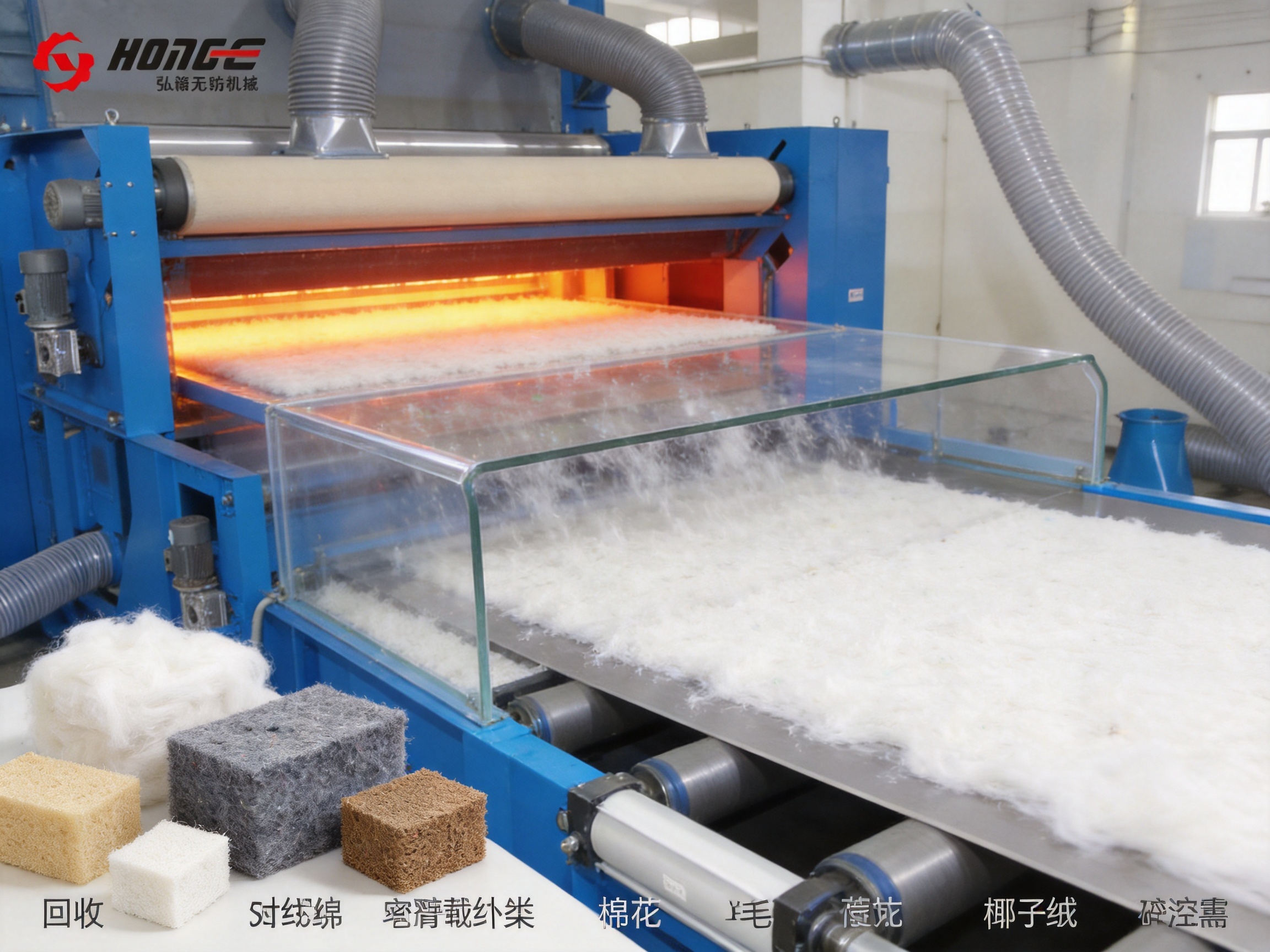
After opening, the fibers are introduced into the airlaying section. Controlled air movement carries and disperses the fibers through the forming chamber. The system is designed to distribute the fibers over the full machine width and deposit them onto a moving conveyor or forming surface.
The relationship between airflow, fiber feed rate, chamber geometry, and conveyor speed determines the amount of material deposited in a given area. Operators can adjust these variables to achieve the target basis weight and web profile.
7.3 Batt Formation
The fibers settle into a random or semi-random structure. This structure can provide balanced properties in the machine and cross-machine directions, which is useful for cushions, insulation, padding, and other products that require consistent performance in multiple directions.
The forming surface transports the newly created batt toward the next stage. Depending on the line design, the batt may pass directly to a thermal oven, a pre-compression unit, a needle-punching unit, or another consolidation process.
7.4 Thermal Bonding and Heat Setting
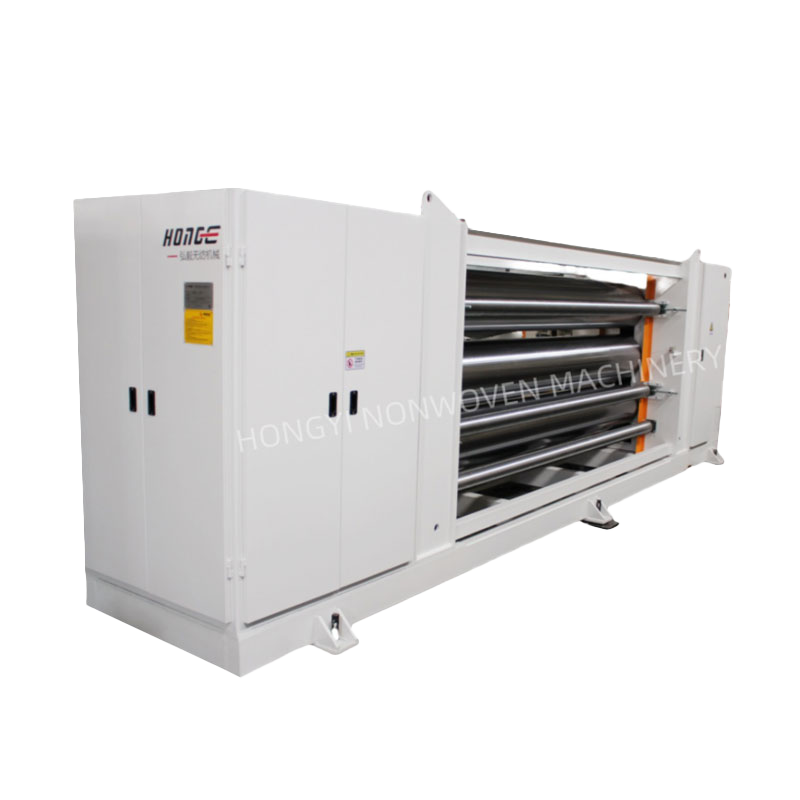
For thermal-bonded products, the batt enters an oven that provides controlled heat. If low-melt or bicomponent fibers are present, the bonding component softens and connects neighboring fibers. The oven may use hot-oil circulation or electric heating, depending on the production line and customer requirements.
Oven temperature, residence time, belt speed, airflow, compression, and cooling conditions must be balanced carefully. Excessive heat can damage fibers, reduce loft, or create an overly rigid product. Insufficient heat may result in weak bonding and poor dimensional stability.
The top belt may be movable to provide compression control. This is valuable when the same line must produce both dense, stiff waddings and soft, lofty materials. For high-loft products below approximately 1,500 gsm, belt arrangements can help preserve the desired thickness and reduce unwanted compression.
7.5 Cooling, Winding, and Cutting
After thermal bonding, the material may be cooled to stabilize its structure. It can then be wound into rolls or cut into sheets, panels, mattress sections, automotive components, or other specified formats.
The airlay machine can therefore serve as part of a broader production system that includes opening, blending, feeding, airlaid formation, thermal bonding, cooling, winding, and cutting. The final arrangement should reflect the customer’s product dimensions, packaging method, production volume, and downstream converting equipment.
8. Product Applications
8.1 Quilts and Bedding
Airlaid thermal-bonded wadding is widely used as filling in quilts, comforters, mattress layers, pillows, and other bedding products. Polyester and low-melt fiber blends can provide a balance of loft, resilience, softness, and shape retention.
Different products require different densities and thicknesses. A lightweight quilt may need a soft, lofty batt, while a mattress support layer may require higher density and improved compression resistance. The broad weight range of the HYQL machine allows manufacturers to consider multiple product categories on one production platform.
8.2 Furniture and Cushion Materials
Furniture manufacturers use nonwoven padding in sofas, chairs, armrests, upholstery layers, and decorative products. Airlaid batts can be engineered for softness, resilience, or firmness. Blending polyester with recycled fibers can reduce cost while maintaining an acceptable filling structure.
Crushed sponge and other reclaimed materials may also be incorporated into selected cushioning products. The material should be tested for odor, cleanliness, recovery, aging, and compatibility with the intended application.
8.3 Acoustic and Thermal Insulation
Fiber batts can absorb sound and reduce heat transfer when designed with the correct thickness, density, and fiber structure. Airlaid materials are suitable for acoustic panels, building insulation, equipment enclosures, vehicle interiors, and industrial sound-control products.
The random fiber network can create internal pathways that contribute to sound absorption. However, acoustic performance depends on more than basis weight alone. Fiber diameter, thickness, density, air permeability, facing material, and installation method all influence the final result.
8.4 Automotive Interior Components
Automotive interior materials often require controlled thickness, low weight, dimensional stability, acoustic performance, and resistance to repeated compression. Airlaid technology can be used to form fiber structures for trunk liners, floor materials, interior padding, door components, headliner-related materials, and other nonwoven parts.
Automotive applications normally require detailed testing for flammability, odor, volatile emissions, compression behavior, temperature resistance, and aging. The machine provides the forming platform, while the raw-material formula and bonding conditions determine the final technical performance.
8.5 Garment and Home-Textile Interlinings
Soft airlaid waddings can be used in garment interlinings, curtains, blankets, decorative fabrics, and home-textile products. These materials may need low stiffness, good drape, uniform thickness, and resistance to repeated handling.
Fine polyester fibers and carefully selected low-melt components can create a soft structure. The forming and oven settings should be adjusted to avoid excessive compression or harsh hand feel.
8.6 Recycled-Fiber and Natural-Fiber Products
The machine’s compatibility with reclaimed and natural fibers supports product development in circular-economy applications. Recycled textile waste, wool, jute, coconut fiber, and other materials can be formed into felts, pads, insulation, underlays, and industrial composites.
Such products can help manufacturers respond to demand for lower-impact materials. Nevertheless, environmental claims should be supported by documented information about recycled content, energy consumption, transport, additives, product life, and end-of-life treatment.
9. Manufacturing Strengths of Changshu Hongyi Nonwoven Machinery Co., Ltd.
Changshu Hongyi Nonwoven Machinery Co., Ltd. is identified as a professional Chinese nonwoven machinery manufacturer and trader with more than 20 years of experience in the nonwoven machinery field. Its product scope includes complete production lines and individual machines for several nonwoven technologies.
The company’s listed equipment includes needle-punched geotextile lines, nonwoven carpet lines, airlaid waste-felt lines, automotive interior-material lines, needle-punching cleaning-cloth lines, wool-felt lines, jute-felt lines, needle-punching machines, carding machines, airlay machines, ironing machines, and thermal-bonding oven machines.
This product range is important because airlaying is rarely an isolated operation in a commercial factory. Customers usually need coordinated equipment for material preparation, web formation, bonding, winding, cutting, dust extraction, and control. A supplier that understands several nonwoven processes can help match the airlay system with the rest of the line.
9.1 Complete-Line Engineering
The company offers both complete nonwoven production lines and individual machines. This allows customers to choose between a full turnkey-style project and a staged upgrade. A customer may purchase an airlay unit for integration with existing equipment or request a complete line designed around a specific product.
Complete-line engineering requires attention to material flow, floor layout, electrical supply, heating method, ventilation, dust collection, operator access, spare parts, and maintenance space. The usefulness of an airlay machine depends not only on its forming chamber but also on how effectively it integrates with upstream and downstream equipment.
9.2 Customization
The supplied product information identifies the HYQL machine as customizable. Configuration options may include working width, feeding arrangement, forming parameters, control system, dust-collection design, heating method, belt arrangement, winding equipment, cutting equipment, and product-specific accessories.
Customization should be based on measurable production requirements. Important design inputs include the raw-material composition, fiber length and fineness, target gsm, finished thickness, line speed, annual production volume, available factory space, voltage, heating source, and preferred packaging method.
Customization is especially valuable for manufacturers processing unusual fibers or producing several product families. A line for high-loft quilt filling will not have the same ideal settings as a line for dense automotive insulation or heavy recycled felt.
9.3 Quality and Certification Orientation
The provided information references ISO9001 and CE certification. Quality-management procedures can support consistent manufacturing, documentation, inspection, and project control. CE-related compliance is relevant to machinery supplied for markets that require conformity with applicable safety and technical requirements.
Customers should request the specific certificates, technical files, safety documentation, electrical diagrams, operating manuals, and conformity information applicable to the delivered configuration. Certification requirements can vary by destination country and by the exact machine combination.
9.4 International Project Experience
The company states that its products have been supplied to more than 20 countries, including Mexico, Argentina, Brazil, Turkey, Algeria, Egypt, Bangladesh, Vietnam, Thailand, and other Asian markets. Experience with international projects can be useful when a line must be adapted to different electrical standards, factory conditions, operating practices, import requirements, and service expectations.
Overseas service support is also identified in the product information, including the availability of engineers for machinery service abroad. Installation, commissioning, operator training, and troubleshooting support can reduce the time required to bring a new line into stable production.
10. Control System and Production Management
A modern airlaid line requires coordination between material feeding, opening, airflow, forming speed, thermal bonding, and winding or cutting. The stated centralized working-parameter control system is intended to make this coordination more practical for operators.
A centralized interface can allow operators to monitor and adjust relevant settings from a common control station. Depending on the final configuration, the control system may include motor control, temperature monitoring, belt-speed adjustment, alarm management, production data, and recipe storage.
Recipe-based operation can be helpful when a factory produces several grades of wadding. An operator may store a setting group for a lightweight quilt product, another for a dense mattress pad, and another for a recycled-fiber acoustic felt. Any recipe should still be checked against current raw-material conditions because fiber moisture and opening quality can change from batch to batch.
Control automation does not remove the need for trained personnel. Operators must understand how the material behaves, how to recognize uneven formation, how to respond to temperature deviations, and how to perform safe cleaning and maintenance. Automation is most effective when combined with clear procedures and regular inspection.
11. Dust Collection and Workplace Considerations
Dust management is an essential part of nonwoven production. Short fibers, reclaimed textile materials, natural fibers, and opening operations can create airborne dust. The HYQL comparison information highlights a high-performance dust collection system as one of the system’s advantages.
A suitable dust-control design should collect particles close to their source and maintain appropriate airflow through the opening, feeding, and forming areas. Filters, ducts, fans, collection chambers, and discharge systems should be selected according to the material and the expected dust load.
Dust collection helps maintain cleaner equipment and can reduce deposits on motors, sensors, bearings, belts, and electrical components. It also contributes to a more comfortable workplace. However, dust-control equipment must be inspected and maintained regularly, and the factory should apply appropriate fire and explosion-prevention measures where combustible fibers or dust are present.
Safety planning should address emergency stops, guards, access doors, hot surfaces, rotating components, electrical isolation, compressed air, fire protection, and operator training. The final safety system must comply with the applicable regulations of the installation country.
12. Maintenance and Operational Reliability
The comparison information describes the airlay system as having extremely limited maintenance compared with the daily maintenance often associated with carding and cross-lapping. While all industrial equipment requires maintenance, the airlay arrangement can reduce the number of card clothing, transfer, and lapping components that require frequent adjustment.
Routine maintenance may include cleaning fiber deposits, inspecting belts, checking bearings, lubricating designated points, examining drive components, checking airflow paths, inspecting filters, verifying sensors, tightening electrical connections, and reviewing safety devices.
Dust and fiber accumulation should not be allowed to build up around hot surfaces, motors, control cabinets, or moving components. Preventive cleaning is generally more effective than waiting for a blockage or overheating event.
The thermal oven requires additional attention. Operators should monitor temperature uniformity, belt tracking, belt tension, airflow, heating medium circulation, insulation, and exhaust conditions. A well-maintained oven helps protect product quality and energy efficiency.
Spare parts planning is also important. Frequently used items such as belts, sensors, bearings, filters, electrical components, and wear parts should be identified before commissioning. Keeping critical spares on site can reduce production interruptions.
13. Energy and Resource Efficiency
Airlay systems can contribute to efficient production by reducing the number of mechanical web-forming stages and by enabling the use of recycled fibers. The total energy consumption of a line depends on the opening equipment, fans, motors, heating system, belt speed, product weight, and operating schedule.
Energy-saving opportunities may include variable-speed drives, optimized airflow, insulation of heated areas, correct oven loading, heat recovery, automatic standby functions, and regular maintenance of filters and ducts. A blocked filter or poorly adjusted airflow system can increase fan power and reduce forming performance.
The use of recycled shoddy fiber can reduce dependence on virgin raw materials in suitable applications. However, material selection should be based on the entire product requirement. A lower-cost fiber blend is only successful if the finished product meets the required strength, thickness, resilience, cleanliness, odor, and durability standards.
Manufacturers should measure energy consumption per kilogram of finished material rather than considering installed power alone. This provides a more useful comparison between products with different basis weights and production speeds.
14. Installation and Commissioning
Before installation, the customer should prepare a factory layout showing the material flow from bale opening through finished-product packaging. Adequate space should be reserved for raw-material storage, operator access, filter maintenance, electrical cabinets, spare parts, and finished rolls or sheets.
Foundation requirements, floor loading, lifting access, ventilation, heating utilities, electrical capacity, compressed air, and dust-collection discharge should be confirmed in advance. The machine may be supplied in sections, so the installation route from the loading area to the production floor should be checked before shipment.
Commissioning normally includes mechanical assembly, electrical connection, sensor verification, control-system testing, safety inspection, dry running, material feeding, and production trials. The first trials should begin with a controlled material blend and a moderate operating speed.
Operators should record the key settings and the resulting product properties. These records can include feed rate, forming speed, airflow, oven temperature, belt pressure, finished weight, thickness, moisture, and visual uniformity. Gradual optimization is preferable to changing several variables at once.
15. How to Select the Correct Configuration
Customers considering an airlaid felt machine should begin by defining the product rather than selecting equipment solely by nominal capacity. The following questions are important:
What fibers will be processed?
Are the fibers virgin, recycled, natural, synthetic, or blended?
What are the fiber length, fineness, moisture, and contamination levels?
What basis-weight range is required?
What finished thickness and density are expected?
Is the product soft, lofty, semi-rigid, or rigid?
Will thermal bonding, needle punching, adhesive bonding, or another consolidation method be used?
What is the required working width?
Is the output required as rolls, sheets, panels, or cut pieces?
What heating source is available?
What dust-collection regulations apply?
What electrical voltage and frequency are available at the factory?
What level of automation and data recording is required?
These answers help the supplier determine whether the standard HYQL configuration is suitable or whether additional feeding, opening, oven, winding, cutting, or control equipment should be added.
16. Quality Control for Airlaid Products
Quality control should begin with incoming-fiber inspection. Important checks may include fiber length, fineness, color, moisture, contamination, bulk density, and blend ratio. Recycled fibers may require additional checks for metal, hard particles, plastic fragments, odor, and other contaminants.
During production, operators should monitor the web profile across the full width. Uneven areas can be caused by inconsistent feeding, blocked air passages, incorrect airflow, unstable belt speed, poor opening, or changes in material moisture.
Finished-product testing may include basis weight, thickness, density, tensile strength, compression recovery, thermal resistance, acoustic performance, air permeability, dimensional stability, flammability, and aging behavior. The applicable tests depend on the final use.
For thermal-bonded wadding, bond strength and compression recovery are particularly important. For acoustic products, airflow resistance and absorption coefficients may be required. For automotive products, odor, emissions, flammability, and temperature-aging tests may be included in customer specifications.
17. Business Benefits for Manufacturers
The HYQL Airlay Machine can provide several business benefits when matched correctly to the customer’s production strategy.
17.1 Higher Potential Throughput
The stated capacity of up to 800 kg/h can support larger production volumes than the approximately 200 kg/h comparison value provided for conventional or lower-capacity systems. Higher throughput can help reduce the equipment cost per kilogram when the line is operated consistently.
17.2 Wider Product Portfolio
The broad weight range and raw-material compatibility allow manufacturers to consider quilts, mattress products, insulation, automotive components, acoustic materials, furniture padding, and recycled-fiber felts on related equipment.
17.3 Reduced Dependence on Cardable Fibers
The airlay process can open opportunities for non-cardable or difficult-to-card materials. This can support the use of lower-cost waste streams and create new products from fibers that might otherwise be discarded.
17.4 Simpler Operation
Centralized control and a relatively direct formation process can make daily production easier to manage. A simpler process may also reduce training time, although qualified technical personnel remain necessary.
17.5 Factory-Direct Customization
Changshu Hongyi’s ability to supply both individual machines and complete production lines allows the customer to develop a solution around actual factory conditions. Customization can improve compatibility between the airlay unit, thermal oven, winding machine, cutting machine, dust collector, and control system.
18. Frequently Asked Questions
Q1: What is an airlay machine?
An airlay machine is a nonwoven web-forming system that uses controlled airflow to distribute fibers onto a moving forming surface. It creates a batt through aerodynamic deposition rather than relying primarily on carding and cross-lapping.
Q2: What materials can the HYQL Airlay Machine process?
The machine is intended for shoddy fiber, recycled or waste fiber, polyester fiber, low-melt fiber, wool, cotton, crushed sponge, and other suitable materials. Coconut, jute, and other natural fibers may also be considered after testing and suitable preparation.
Q3: What is the working width?
The stated working width is 2,600 mm. The final effective production width should be confirmed according to the complete line configuration and the customer’s product requirements.
Q4: What basis-weight range can it produce?
The supplied product information states a range of approximately 400–7,500 gsm. A comparison table also identifies a range of approximately 400–4,000 g. The actual range depends on the material, line speed, forming settings, and final configuration, so it should be confirmed during technical planning.
Q5: What is the maximum capacity?
The listed maximum productivity is up to 800 kg/h. Actual output depends on fiber type, basis weight, thickness, moisture, opening quality, blend ratio, and operating conditions.
Q6: Can the machine replace a carding machine and cross lapper?
For suitable products, the airlay machine can replace the conventional carding and cross-lapping formation section. It is especially useful for bulky, recycled, irregular, or difficult-to-card fibers. The best choice depends on the required fiber orientation and product performance.
Q7: Is the machine suitable for soft wadding?
Yes. The machine can be used for soft, lofty wadding, including materials for quilts, garments, furniture, toys, and home textiles. For lightweight materials below approximately 1,500 gsm, belt arrangements are commonly selected to help preserve loft during thermal bonding.
Q8: Can it produce stiff wadding?
Yes. Low-melt or bicomponent fibers can be blended with normal polyester or other structural fibers to create thermally bonded stiff waddings for insulation, acoustic panels, mattresses, automotive materials, and related products.
Q9: What heating methods are available?
The supplied information identifies hot-oil circulation and electric heating as available heating methods for related thermal-bonding equipment. The appropriate method depends on factory utilities, energy costs, product requirements, and line design.
Q10: Does the supplier provide complete production lines?
Changshu Hongyi Nonwoven Machinery Co., Ltd. provides complete nonwoven production lines as well as individual machines. A complete project may include opening, feeding, airlaid formation, thermal bonding, winding, cutting, dust collection, and control equipment.
Q11: Is overseas service available?
The product information states that engineers are available to service machinery overseas. Customers should confirm installation, commissioning, training, response time, travel arrangements, and spare-parts support in the commercial and technical agreement.
Q12: What is the warranty period?
The listed warranty period is one year. Warranty coverage should be reviewed in the purchase contract, including covered components, exclusions, commissioning conditions, and customer maintenance responsibilities.
Q13: How can buyers verify whether the machine suits their fiber?
Buyers should provide representative raw-material samples and detailed product specifications. A material trial or technical evaluation can help determine the correct opening method, feed system, airflow, forming settings, thermal-bonding conditions, and expected output.
Q14: Is dust collection necessary?
Dust collection is strongly recommended when processing short, reclaimed, natural, or dusty fibers. The final system should be designed according to the material, production volume, local regulations, and fire-safety requirements.
19. Recommended Project Information for a Quotation
To prepare an accurate quotation, the buyer should provide the target product name, raw-material composition, fiber dimensions, moisture level, target gsm, finished thickness, working width, estimated annual output, preferred heating method, voltage, factory location, packaging format, and desired automation level.
Photographs or samples of the raw material can be valuable, particularly when processing shoddy fiber, crushed sponge, jute, coconut fiber, or mixed waste. A finished-product sample or technical drawing can also help the supplier understand the required density, loft, stiffness, and cutting dimensions.
The quotation should identify the equipment scope clearly. It should state whether the offer includes feeding, opening, blending, airlay formation, dust collection, thermal oven, cooling, winding, edge trimming, cutting, electrical control, installation, commissioning, training, and spare parts.
Customers should also request a utility list, layout drawing, foundation information, production assumptions, delivery schedule, warranty conditions, inspection procedure, and documentation package. Clear technical details reduce misunderstandings during installation and production start-up.
20. Conclusion
The HYQL Airlay Machine is designed for manufacturers seeking a flexible and productive alternative to conventional carding and cross-lapping systems. Its aerodynamic forming method can accommodate a broad range of fibers, including shoddy, recycled, polyester, low-melt, wool, cotton, crushed sponge, jute, and coconut materials after suitable preparation.
With a stated working width of 2,600 mm, a broad weight range, and a maximum listed capacity of up to 800 kg/h, the machine can support production of soft wadding, stiff thermal-bonded felt, insulation, acoustic materials, mattress padding, furniture filling, automotive interior products, and other nonwoven structures.
The stated advantages include higher potential throughput, compatibility with difficult fibers, centralized control, even longitudinal and transverse formation, reduced dependence on complex carding and lapping mechanisms, and high-performance dust collection options. These advantages can help manufacturers simplify production and expand their product range.
Changshu Hongyi Nonwoven Machinery Co., Ltd. strengthens the equipment offering through more than 20 years of nonwoven machinery experience, complete-line engineering, customized configurations, international project experience, CE and ISO9001-related certification information, and overseas technical service availability.
As with any industrial nonwoven system, the best performance depends on correct material preparation, suitable machine configuration, proper thermal-bonding conditions, operator training, preventive maintenance, and systematic quality control. A technical evaluation using the customer’s actual fibers and product requirements should be completed before final equipment selection.
References
1. Product specification and technical information supplied for the HYQL Airlay Machine.
2. Technical information concerning airlaid fiber batt formation and thermal-bonded nonwoven production.
3. Comparative performance data supplied for airlay systems and traditional carding and cross-lapping systems.
4. Company information supplied by Changshu Hongyi Nonwoven Machinery Co., Ltd.
5. General principles of nonwoven fiber preparation, aerodynamic web formation, thermal bonding, and industrial dust control.
6. General machinery safety, quality-management, and conformity-assessment practices applicable to nonwoven production equipment.