

Content
- 1 Why Needle Punching Technology Remains Essential
- 2 Product Overview
- 3 Main Technical Specifications
- 4 Mechanical Design for Stable Needling
- 5 Precision Needle Distribution and Surface Control
- 6 Lubrication, Cooling, and Safety Monitoring
- 7 Automatic Control and Frequency Conversion
- 8 Delivery Rollers and Fabric Transport
- 9 Applications Across the Nonwoven Industry
- 10 Advantages Compared with Basic or Less Flexible Needle Looms
- 11 Manufacturing Strengths and Engineering Capability
- 12 Installation and Commissioning Considerations
- 13 Operation and Process Optimization
- 14 Energy Efficiency and Production Economics
- 15 After-Sales Service and Long-Term Support
- 16 How to Select the Correct Configuration
- 17 Quality Control for Finished Needle-Punched Fabric
- 18 Environmental and Material Considerations
- 19 Frequently Asked Questions
- 19.1 What is the primary function of the HYZC Needle Punching Machine?
- 19.2 What working widths are available?
- 19.3 Can the machine process PET and PP fibers?
- 19.4 Is the machine suitable for heavy geotextiles?
- 19.5 Can it produce carpet and felt?
- 19.6 What is the advantage of double-board needling?
- 19.7 How does computerized random needle distribution help?
- 19.8 Does the machine have automatic lubrication?
- 19.9 Can the machine be integrated into a complete production line?
- 19.10 What is the typical lead time?
- 19.11 What warranty is provided?
- 19.12 What should be prepared before installation?
- 19.13 How can the machine’s performance be maintained?
- 20 Conclusion
- 21 References
- 22 Product: HYZC Needle Punching Machine
Needle punching is one of the most versatile mechanical bonding processes in the nonwoven industry. By repeatedly driving barbed needles through a fiber web, the process entangles individual fibers and creates a strong, stable, and flexible fabric structure without relying on chemical binders. The resulting materials can be used in geotextiles, carpets, filtration media, automotive interiors, insulation, furniture padding, interlinings, cleaning cloths, felts, and many other industrial and consumer applications.
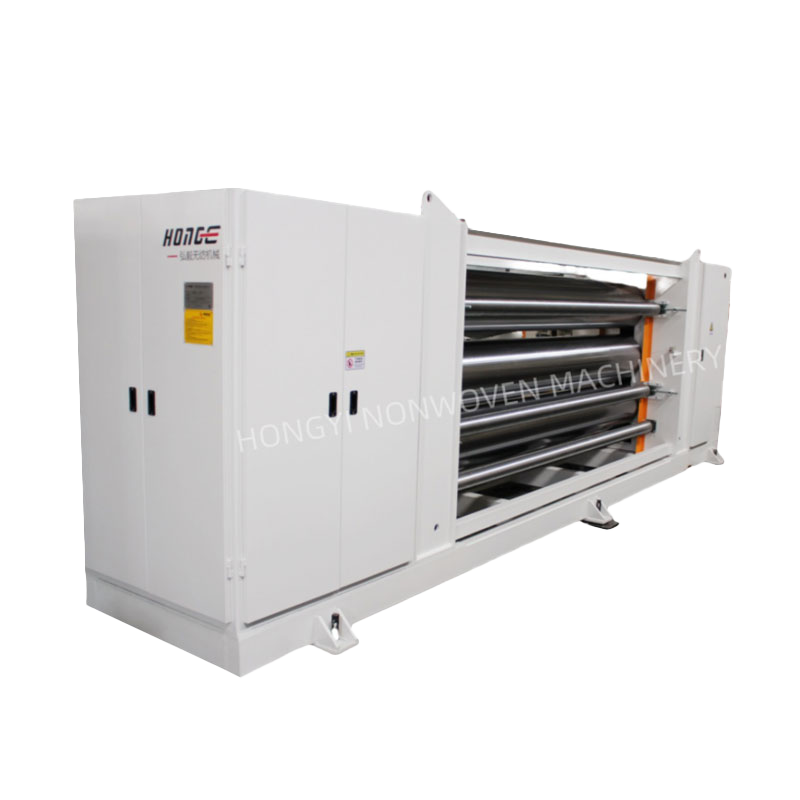
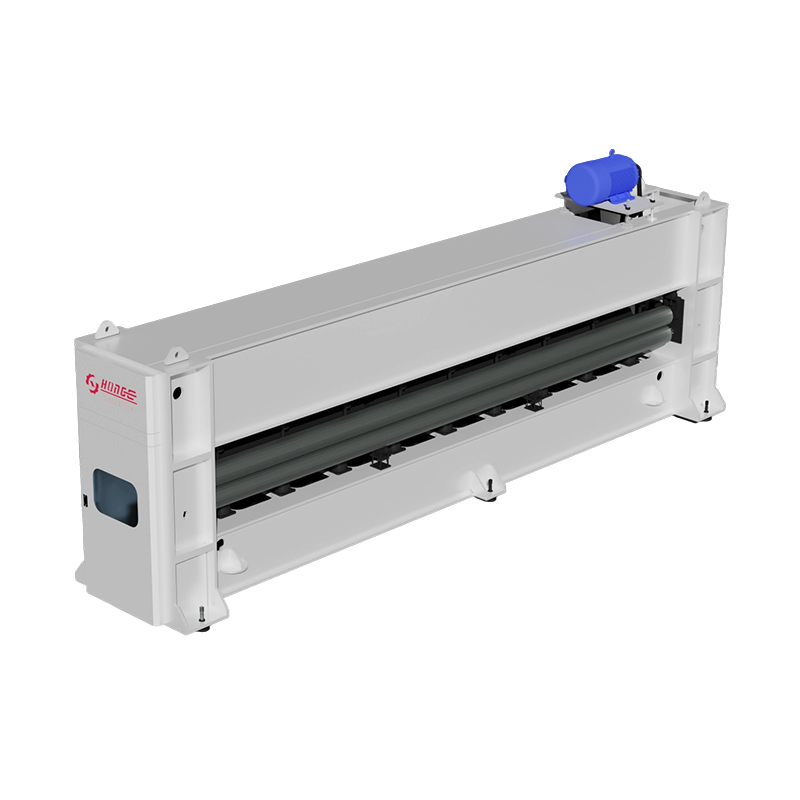
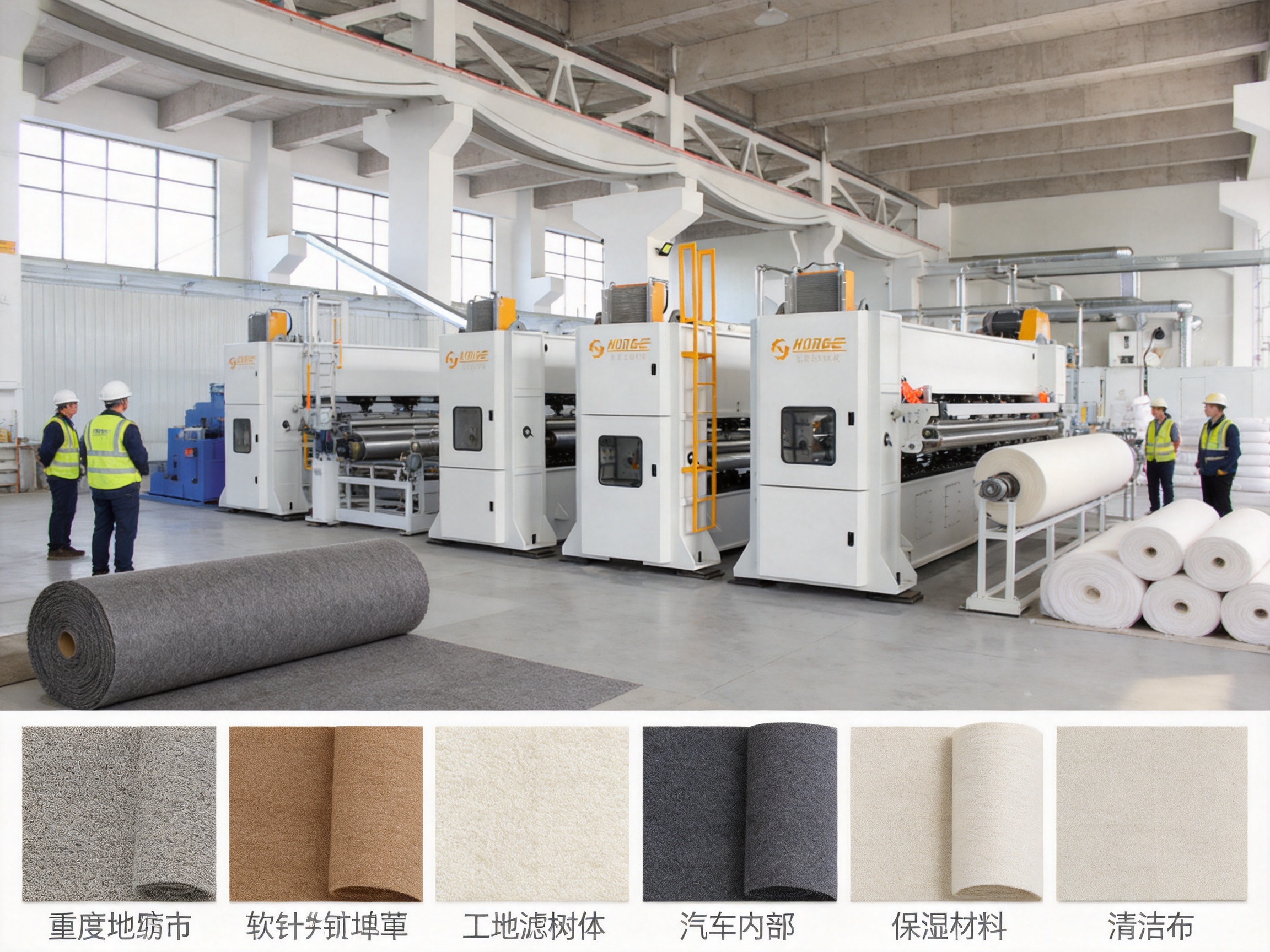
The HYZC Needle Punching Machine is an automatic industrial needle loom designed for reinforcing, consolidating, and surface-finishing nonwoven fabrics. It is available in a broad range of working widths and can be configured with single or double needle boards, up-stroke or down-stroke operation, different needle densities, and medium- or high-speed production settings. This flexibility allows manufacturers to adapt the machine to different fiber types, product weights, surface requirements, and line capacities.
Manufactured by Changshu Hongyi Nonwoven Machinery Co., Ltd., the machine combines a robust mechanical structure, controlled needle movement, centralized lubrication, cooling and alarm systems, programmable needle distribution, and customized production parameters. It is suitable for both individual machine installations and complete nonwoven production lines.
Why Needle Punching Technology Remains Essential
Nonwoven fabrics can be bonded by several methods, including chemical bonding, thermal bonding, hydroentanglement, and mechanical needling. Needle punching is especially valuable when manufacturers require a product with high bulk, good tear resistance, controlled permeability, and a soft or textured surface.
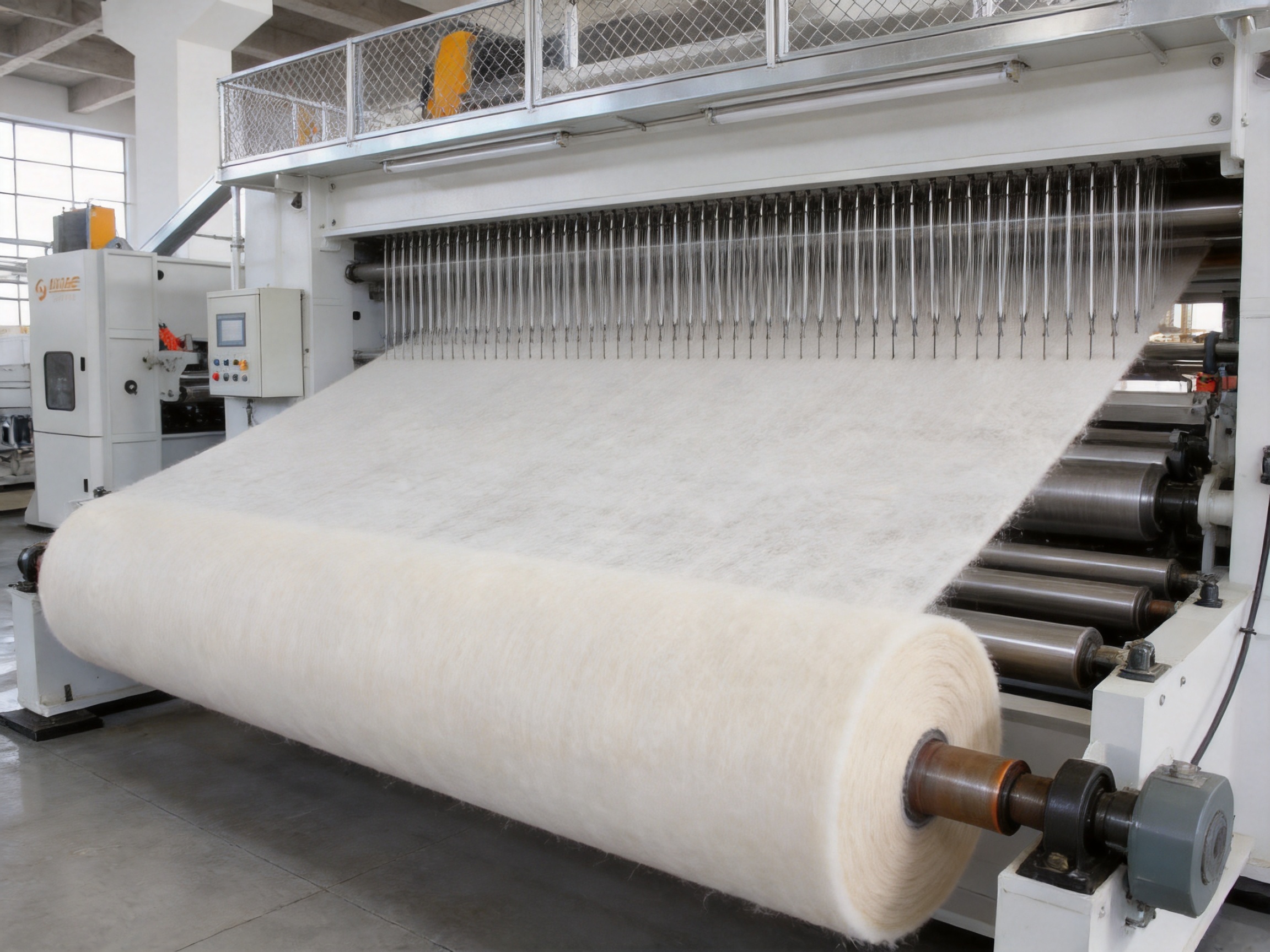
During needling, a loose fiber web passes through a needle board equipped with thousands of specially shaped needles. As the board moves up and down, the needles penetrate the web and carry fibers vertically through its thickness. When the needles withdraw, the fibers remain entangled with surrounding fibers. Repeated penetration gradually converts the loose web into a coherent fabric.
The final characteristics depend on several variables, including fiber type, fiber length, web uniformity, web weight, needle penetration depth, needle density, punching frequency, production speed, and the number of needling stages. An industrial machine must therefore provide more than simple reciprocating motion. It must deliver stable needle movement, accurate synchronization, reliable feeding, controlled fabric transport, and convenient adjustment.
The HYZC machine is designed around these requirements. Its configuration supports precise mechanical needling while allowing the customer to choose a suitable combination of working width, stroke, frequency, board arrangement, and needling pattern.
Product Overview
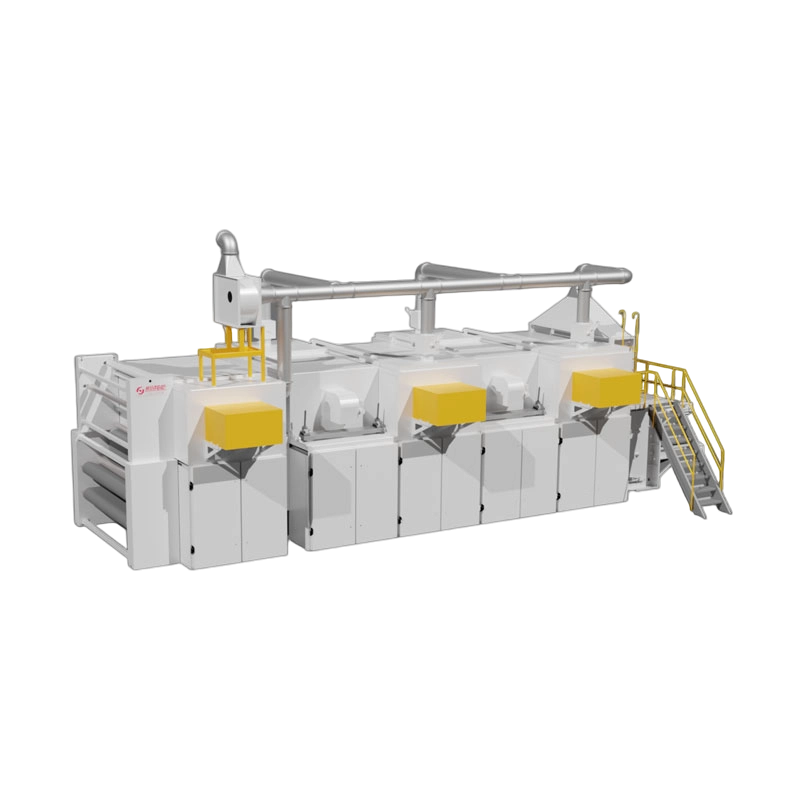
The HYZC Needle Punching Machine is a heavy-duty needle loom for the reinforcement and finishing of nonwoven webs. It can be installed after a carding machine, crosslapper, airlay machine, or other web-forming equipment. Depending on the production line, it may also be combined with pre-needling, main-needling, re-needling, thermal bonding, calendaring, winding, slitting, or cutting equipment.
The machine is engineered for continuous industrial production. Its main frame and crank-case assembly are designed to withstand the repeated dynamic forces generated during high-frequency needle penetration. A vertical balancing system helps reduce vibration and stabilize the reciprocating assembly. This is particularly important when operating at high needle frequencies or when producing wide fabrics.
Available working widths cover small, medium, and very wide industrial applications. General product information identifies configurable widths from approximately 2,000 to 8,500 millimeters, while the broader machine range can be engineered from approximately 1,500 to 8,800 millimeters. Certain standard configurations are listed at 4,000 to 8,500 millimeters. The final width depends on the selected model, production material, layout, and customer requirements.
The machine can be supplied with double boards and up-and-down stroke operation. Other board arrangements, including single-board configurations, can be designed for specific applications. The manufacturer evaluates the web structure, target production speed, finished fabric weight, and required surface appearance before confirming the final configuration.
HYZC Needle Punching Machine
Main Technical Specifications
| Specification | Typical Range or Configuration | Production Significance |
|---|---|---|
| Machine model | HYZC | Industrial needle punching machine and needle loom platform |
| Working width | Approximately 1,500–8,800 mm, depending on configuration | Supports narrow, standard, and wide nonwoven production |
| Common listed width range | 2,000–8,500 mm | Suitable for many felt, carpet, geotextile, and industrial fabric lines |
| Needling frequency | Approximately 800–1,600 strokes per minute | Determines production intensity and output capability |
| Typical listed frequency | 800–1,200 strokes per minute | Suitable for many standard double-board applications |
| Needle stroke | Approximately 25–60 mm | Allows adjustment of penetration and fabric consolidation |
| Typical listed stroke | 25–50 mm or 30–60 mm, according to model | Can be selected for different web thicknesses and product structures |
| Needle density | Approximately 2,000–8,000 needles per meter; selected configurations may reach 5,000–8,000 needles per meter on two boards | Controls bonding intensity and surface uniformity |
| Needling arrangement | Single board or double boards; up-stroke or down-stroke | Provides process flexibility for different products |
| Needle board material | Magnesium alloy and polyurethane combined structure | Balances strength, weight, and dimensional stability |
| Lubrication | Central oil circulation with cooling | Supports stable operation and reduces wear |
| Control | Automatic, with frequency conversion and programmable functions | Improves repeatability and enables process adjustment |
| Raw materials | PET, PP, polyester fiber, and other staple fibers | Suitable for a broad material range |
| Certification | CE and ISO9001:2000 listed | Supports international installation and quality management requirements |
| Warranty | One year | Provides initial equipment support after commissioning |
Specifications are selected according to the final production program. Since fiber composition, web weight, machine speed, and finished product requirements vary substantially, the table should be used as a technical overview rather than a substitute for a project-specific quotation and engineering confirmation.
Mechanical Design for Stable Needling
Crank Case and Vertical Balance System
The crank case is the central mechanical assembly responsible for converting rotary motor movement into the controlled reciprocating movement of the needle boards. Needle punching generates repeated impact and reversing loads, especially when the machine operates at high speed. A rigid crank-case structure is therefore essential for maintaining alignment and preventing excessive vibration.
The HYZC machine incorporates a vertical balance system to improve the stability of the moving components. Proper balancing reduces dynamic stress on the frame, bearings, drive elements, and needle boards. It also helps maintain a more consistent needle penetration pattern across the working width.
For manufacturers, mechanical stability has a direct effect on product quality. Excessive vibration can contribute to uneven needling, premature needle breakage, inconsistent fabric thickness, increased noise, and unplanned downtime. The balanced structure of the machine is intended to support long-term continuous operation under demanding production conditions.
Double-Board Configuration
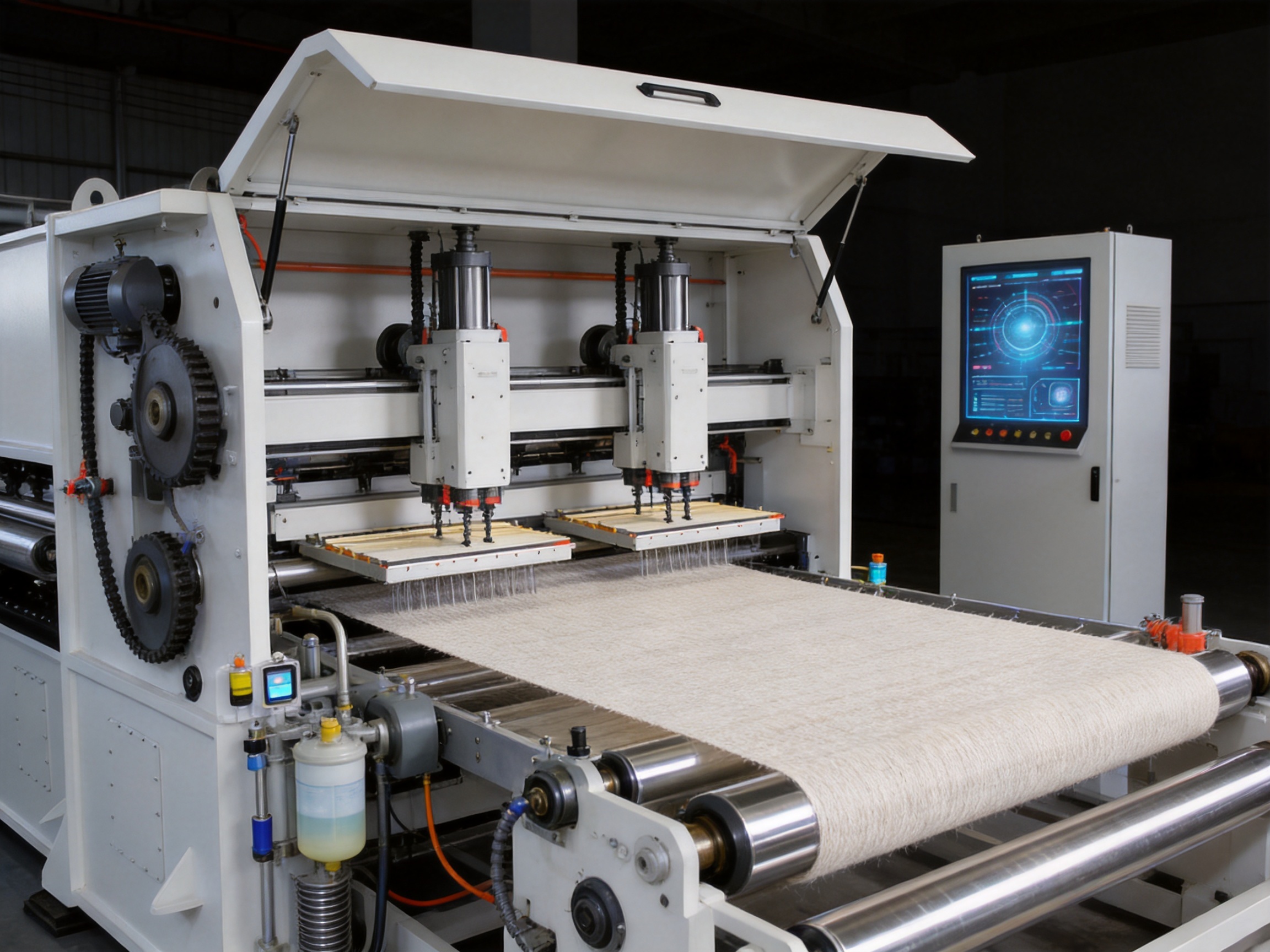
Double-board operation allows the material to receive more intensive or more evenly distributed needling within one machine. The two boards may be arranged to support different process objectives, such as pre-consolidation followed by stronger bonding, balanced treatment from opposing directions, or increased production capacity.
A double-board machine can reduce the number of separate needling units required in some production lines. This may help optimize factory floor space, material transfer, power distribution, and line control. The appropriate arrangement depends on the material and the required fabric structure. A lightweight interlining may require a different setting from a dense geotextile or automotive felt.
Up-Stroke and Down-Stroke Options
The machine can be configured for up-stroke or down-stroke operation. The selection affects how the web is supported, how the needles enter the material, and how the production line is integrated with upstream and downstream equipment. Different product categories may benefit from different stroke arrangements.
Up-stroke and down-stroke configurations also provide flexibility when the customer has specific requirements concerning machine layout, web transport direction, operator access, or integration with existing equipment. This is one of the key advantages of using a configurable machine platform rather than a fixed-purpose needle loom.
Needle Board Construction
The needle board is a critical component because it carries a large number of needles and moves repeatedly at high speed. The machine uses a combined magnesium alloy and polyurethane structure. Magnesium alloy contributes low weight and structural strength, while polyurethane can help support a secure and stable needle arrangement.
The needle board is locked firmly by lock-bolts or an air-tube system, depending on the selected configuration. A secure locking method is essential because any movement of the needle board can affect needle penetration accuracy and create uneven needling across the web.
The combined structure also supports easier maintenance and configuration changes. Needle boards must be inspected regularly for damaged needles, loose fittings, contamination, or deformation. A practical board design makes these tasks more manageable and helps reduce changeover time.
Precision Needle Distribution and Surface Control
Needle density directly influences the cohesion, weight, surface appearance, and mechanical properties of the finished fabric. Low needle density may be appropriate for a soft, bulky product, while high density is often required for geotextiles, dense felts, filtration substrates, and hard-wearing industrial materials.
The HYZC machine supports computerized random needle distribution. Random distribution can reduce the risk of visible repeated patterns and help create a more uniform surface. It may also distribute needling points more evenly over the web, reducing localized stress and improving the appearance of the final material.
Computerized distribution is particularly useful when the product requires a controlled random structure rather than a simple fixed pattern. The operator can adjust the needling program according to the target fabric, subject to the machine configuration and production process.
The available needle density range is broadly identified as approximately 2,000 to 8,000 needles per meter. Some listed double-board configurations specify 5,000 to 8,000 needles per meter across two boards. The correct density depends on the desired fabric weight, thickness, fiber type, and bonding level.
Needle selection is equally important. Different needle gauges, barb arrangements, working lengths, and point styles can influence fiber entanglement, surface smoothness, hole formation, and production life. The machine supplier can help match the needle specification to PET, PP, wool, jute, recycled fiber, or blended materials.
Lubrication, Cooling, and Safety Monitoring
Continuous needle punching produces heat and mechanical friction in the crank mechanism, bearings, drive elements, and other moving parts. Effective lubrication is therefore necessary for stable operation, long service life, and controlled maintenance costs.
The HYZC machine uses a central oil lubrication circulation system. Instead of requiring every lubrication point to be serviced independently during production, the centralized system distributes oil through the relevant mechanical components. This can improve lubrication consistency and simplify routine inspection.
The lubrication system is combined with cooling and pressure and temperature alarm functions. If the oil pressure or temperature moves outside the set operating range, the system can provide an alarm to draw attention to a possible problem. Early warning helps operators investigate before a minor lubrication issue develops into bearing damage, crank-case overheating, or an extended production stoppage.
Separate lubrication and air-cooling arrangements are also identified among the machine features. Air cooling can assist heat dissipation around important mechanical areas. The exact cooling method depends on the final machine design and production conditions.
Operators should still follow a scheduled maintenance program. Automatic lubrication does not eliminate the need to check oil level, oil condition, filters, seals, temperature, pressure, vibration, and abnormal noise. Preventive maintenance is one of the most effective ways to preserve needling accuracy and protect the machine investment.
Automatic Control and Frequency Conversion
The machine is designed for automatic operation and frequency conversion control. Frequency conversion allows the production speed to be adjusted according to the fiber web, material weight, needle configuration, and required output. A lower frequency may be used during startup, product changeover, troubleshooting, or processing of a delicate web. Higher frequencies can be selected when the material and machine settings permit greater production intensity.
Controlled speed adjustment provides several advantages over fixed-speed equipment. It allows the operator to coordinate needle frequency with web feeding and delivery speed, reducing the risk of stretching, tearing, bunching, or uneven consolidation. It also supports more precise development of new products.
Automatic controls can help synchronize the main drive, material transport, lubrication monitoring, safety functions, and machine stopping sequence. The control system may be configured according to the customer’s line architecture and automation requirements.
An auto top-dead-center controlled stop is included among the listed functions. This feature enables the machine to stop at a defined mechanical position. Controlled stopping is important during needle replacement, board inspection, cleaning, maintenance, and troubleshooting because it places the moving assembly in a predictable and safer position.
Modern control also improves repeatability. Once a proven set of operating parameters has been developed, the operator can record and reproduce the settings for future batches. This can help reduce variation between production lots and improve the reliability of quality control.
Delivery Rollers and Fabric Transport
Stable transport is necessary to achieve uniform needling. If the web slips, stretches, wrinkles, or moves laterally while passing through the machine, the needle density and finished fabric structure can become inconsistent.
The machine uses chrome-plated delivery rollers with carved or patterned surfaces. The chrome finish is intended to provide durability and resistance to wear, while the patterned surface can improve contact with the web and support controlled material delivery.
Delivery rollers must be matched to the type of fabric being produced. A soft, lightweight web requires careful handling to avoid compression or marking. A heavy geotextile or dense felt requires sufficient traction and mechanical strength. Roller pressure, speed, alignment, and surface condition should be inspected regularly.
Good transport control also supports fabric width stability. When the web passes through the needling zone at a consistent speed and tension, the machine can deliver more predictable thickness, basis weight, and surface appearance.
Applications Across the Nonwoven Industry
Geotextiles
Needle-punched geotextiles are used for separation, filtration, drainage, reinforcement, and erosion control in civil engineering. They may be installed beneath roads, railways, embankments, drainage systems, landfills, retaining structures, and construction sites.
Geotextile production often requires wide working widths, stable needling, high production reliability, and carefully controlled fabric weight. PET and PP fibers are common raw materials. The HYZC platform can be configured for wide fabrics and intensive needling suitable for heavy industrial products.
The final performance of a geotextile depends on more than machine settings. Fiber properties, web formation, needling density, finishing, winding tension, and quality inspection all contribute to the result. A well-configured needle loom provides the mechanical consolidation needed to achieve the specified tensile strength, puncture resistance, permeability, and dimensional stability.
Nonwoven Carpets and Floor Coverings
Needle-punched carpets can be produced from polyester, polypropylene, recycled fibers, wool, jute, and blended materials. The process can create products for exhibitions, offices, vehicles, residential spaces, entrance areas, and temporary flooring.
Carpet manufacturers may require a controlled surface texture, good dimensional stability, sufficient abrasion resistance, and compatibility with backing or coating processes. Computerized random needle distribution helps reduce repetitive visible patterns and supports a more uniform appearance.
The machine may be integrated with coating, latex application, thermal treatment, drying, backing, trimming, or roll-cutting equipment. The exact line design is selected according to whether the customer produces lightweight carpet, heavy carpet, felt flooring, or specialty floor coverings.
Felt and Industrial Felt
Needle-punched felt is used for polishing, sealing, insulation, sound absorption, filtration, packaging, handicrafts, and industrial components. The material can be produced in different thicknesses, densities, colors, and widths.
For felt production, control of needle stroke and frequency is important. A deeper stroke may be required for a thick web, while a lighter setting may protect a delicate surface or preserve bulk. Multiple needling stages can be used to create a denser core and a smoother surface.
Filtration Media
Needle-punched filtration materials are used for air filtration, dust collection, liquid filtration, industrial separation, and environmental control. The fabric structure must balance permeability, particle capture, pressure drop, strength, and resistance to repeated use.
The needle loom contributes to the formation of the three-dimensional fiber structure. The final filtration performance may then be enhanced through singeing, calendaring, coating, chemical treatment, membrane lamination, or other finishing operations. Accurate machine control is important because variation in fabric density can influence filtration consistency.
Automotive Interior Materials
Automotive manufacturers use nonwoven materials for trunk liners, floor coverings, headliners, door components, acoustic insulation, wheel-arch liners, and other interior or semi-structural applications. These products may require low weight, good sound absorption, dimensional stability, and resistance to handling and abrasion.
The HYZC machine can form part of an automotive interior materials production line. Its configurable width, needle density, board design, and automation support the production of different grades of automotive felt. Additional thermal bonding, heat setting, laminating, molding, or cutting equipment can be added downstream.
Interlining and Apparel Materials
Needle-punched interlinings provide body, resilience, insulation, or reinforcement in garments, footwear, bags, and technical textiles. These products often require a soft hand, controlled thickness, and a clean surface.
Compared with heavier geotextile applications, interlining production may require lower needling intensity and more delicate web handling. Variable frequency control and suitable needle selection can help manufacturers adjust the process to lighter fiber structures.
Cleaning Cloths and Specialty Fabrics
Needle-punched cleaning cloths can be manufactured from polyester, polypropylene, viscose, recycled fibers, or blended materials. Their performance may depend on absorbency, lint generation, softness, strength, and surface texture.
Specialized needling patterns can be developed for products requiring a raised surface, controlled roughness, or enhanced fiber anchoring. The machine’s programmable distribution function provides a useful basis for product development, although the final result must be validated through laboratory and production testing.
Advantages Compared with Basic or Less Flexible Needle Looms
Broader Configuration Flexibility
One of the main advantages of the HYZC machine is its configurable architecture. Basic needle punching machines may be limited to one working width, one stroke arrangement, or one needle board design. The HYZC platform can be engineered with different widths, board configurations, stroke directions, needle densities, and speed ranges.
This flexibility allows the same manufacturer to serve several markets. A company may use one machine configuration for carpet and felt while selecting another for geotextile or filtration production. The equipment can also be designed around the customer’s existing line rather than forcing the factory to rebuild its entire process.
Designed for Wide Working Widths
Wide nonwoven fabrics require careful control of alignment, vibration, needle board rigidity, web transport, and heat dissipation. The HYZC range supports wide working widths up to approximately 8,500 millimeters in commonly listed configurations, with the broader platform identified up to approximately 8,800 millimeters.
Wide-width capability can improve production efficiency by reducing the number of parallel machines needed for large-volume products. It can also reduce cutting waste when the finished fabric is intended for large construction, automotive, insulation, or filtration applications.
Improved Operational Stability
The combination of a rigid crank case, vertical balance system, centralized lubrication, cooling, and controlled stopping contributes to stable operation. These features distinguish a production-oriented machine from a simple reciprocating needle device.
Operational stability can improve fabric consistency and reduce the risk of unplanned downtime. It may also lower maintenance requirements over the life of the equipment by reducing stress on critical moving parts.
Programmable Random Needling
Computerized random needle distribution offers greater process flexibility than a fixed pattern. Manufacturers can develop surfaces with less obvious repetition and more uniform fiber entanglement. This is valuable in visible products such as carpets, automotive fabrics, and decorative felts, as well as in technical products where consistent structure is important.
Integration with Complete Production Lines
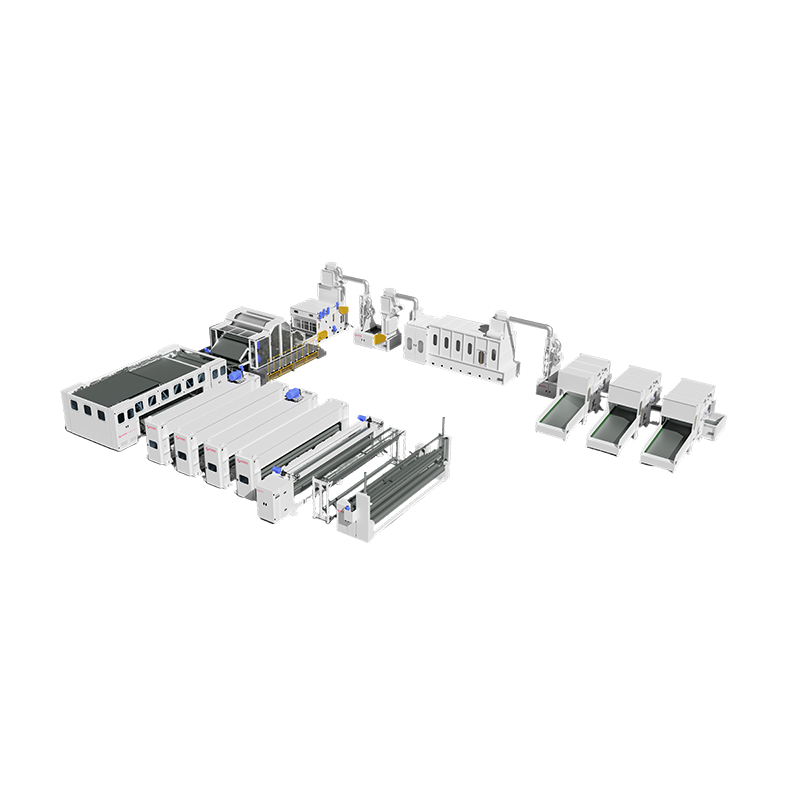
The machine can be supplied as a standalone unit or as part of a complete nonwoven production line. The manufacturer’s broader equipment capability includes opening and blending equipment, feeding and carding equipment, web-forming systems, thermal bonding and heat-setting equipment, airlay machinery, winding and cutting machines, and assistant equipment.
Purchasing from a supplier able to provide several sections of the line can simplify engineering coordination. Feeding speeds, web widths, electrical controls, machine heights, transfer points, and safety systems can be considered as one integrated project.
Manufacturing Strengths and Engineering Capability
Changshu Hongyi Nonwoven Machinery Co., Ltd. has more than 20 years of experience in the nonwoven machinery field. Its product range covers both complete production lines and individual machines. This experience is valuable because needle punching performance depends on the interaction between the needle loom and the upstream web-forming equipment.
A needle loom cannot compensate for every weakness in web formation. If the carded or airlaid web has uneven weight, poor fiber distribution, excessive tension, or inconsistent width, the finished fabric may remain irregular even when the needle machine is correctly adjusted. A supplier with experience in opening, blending, feeding, carding, airlaying, and needling can analyze the full process rather than treating the needle loom as an isolated machine.
The company provides equipment for needle-punched geotextile lines, nonwoven carpet lines, airlaid waste felt lines, automotive interior material lines, needle-punched cleaning cloth lines, wool felt lines, and jute felt lines. This cross-application experience supports the development of machine configurations for different fiber types and finished products.
Customized Engineering
Customization is a central part of the equipment offering. Working width, needle board configuration, stroke type, needle density, electrical voltage, machine color, control functions, and line arrangement can be adapted according to customer needs.
Customization does not simply mean changing external dimensions. A properly engineered solution considers the intended product weight, fiber blend, production speed, installation space, operator access, material transfer height, downstream finishing, power supply, and local operating conditions.
Before production, the customer should provide technical information such as raw material composition, fiber length, target fabric width, fabric weight, thickness, production capacity, needling intensity, and finished roll dimensions. These details allow the manufacturer to recommend a practical configuration and identify any required auxiliary equipment.
Quality Management and Inspection
The equipment is listed with ISO9001:2000 and CE certification. Quality management systems help organize design review, component purchasing, assembly, testing, documentation, and after-sales service. CE-related compliance supports the preparation of machinery for markets that require conformity with applicable safety and technical standards.
Video outgoing inspection is provided as part of the product information. In addition to documentation, a professional equipment project should include mechanical inspection, electrical testing, control-system verification, safety-function testing, lubrication checks, and trial operation before shipment.
Factory acceptance procedures may include checking needle board movement, machine vibration, frequency conversion, emergency stops, alarm signals, oil pressure, oil temperature, delivery rollers, and the controlled stopping position. If the machine is part of a complete line, interface testing between individual machines is also important.
International Supply Experience
The company has supplied machinery to more than 20 countries, including markets in Latin America, the Middle East, Africa, Southeast Asia, and other regions. International project experience can help with export packing, technical communication, installation planning, spare parts, electrical requirements, and remote support.
Equipment may be transported in nude packing or protected with polyethylene film, depending on the shipment arrangement and customer requirements. The normal stated lead time is approximately two to three months, although the actual schedule depends on machine specifications, production planning, inspection, customization, and shipping arrangements.
Installation and Commissioning Considerations
A needle punching machine is a precision production system and should be installed on a suitable foundation. The floor must support the machine weight and dynamic loads without excessive movement. The installation area should also provide enough space for material handling, needle board access, electrical cabinets, lubrication service, cleaning, and future maintenance.
Before delivery, the customer should confirm the building dimensions, entry route, lifting capacity, floor level, power supply, compressed air requirements if an air-tube board locking system is used, ventilation, lighting, and emergency access.
Alignment is important during installation. The machine frame, delivery rollers, upstream web-forming equipment, and downstream equipment must be positioned correctly. Poor alignment can cause web drift, uneven tension, edge damage, and inconsistent needle penetration.
Commissioning normally begins with mechanical inspection and slow-speed operation. Operators should verify the direction of rotation, lubrication pressure, oil temperature, safety circuits, emergency stops, alarm functions, needle board clearance, and delivery roller movement. Production speed and needle frequency should be increased gradually while the fabric is inspected.
Initial trial production should use a known fiber blend and a controlled web. Operators can then adjust needle stroke, frequency, production speed, needle density, and roller settings while recording the results. The objective is to establish a stable process window rather than simply reaching the highest possible speed.
Operation and Process Optimization
Preparing the Fiber Web
The needle loom performs best when the incoming web has a consistent basis weight, width, moisture condition, and fiber distribution. Opening and blending equipment should separate fiber tufts effectively, while carding or airlaying equipment should create a uniform web with suitable orientation and bulk.
Crosslapping may be used when a more isotropic structure is required. The number of layers, crosslapper speed, and web tension influence the final strength in the machine and cross-machine directions. For heavy products, several needling stages may be required to gradually consolidate the web.
Selecting Needle Stroke
Needle stroke determines how far the needles travel through the web. A longer stroke can provide deeper fiber entanglement and stronger consolidation, but it may also increase mechanical load, surface disturbance, and needle wear. A shorter stroke may be appropriate for light or delicate fabrics.
The suitable stroke is determined through trials. Operators should consider web thickness, fiber length, target density, surface appearance, and required mechanical strength. The listed machine range of approximately 25 to 60 millimeters provides a useful adjustment range for different products.
Adjusting Needling Frequency
Needling frequency affects the number of needle penetrations delivered over a given production length. Higher frequency can increase consolidation and output, provided that the web feed speed, needle density, and machine limits are suitable.
Excessive frequency may increase heat, vibration, needle breakage, and energy consumption. It can also damage the web or create an overly dense surface. Frequency conversion control allows the operator to establish a balance between productivity and fabric quality.
Balancing Needle Density and Line Speed
Needle density and line speed must be considered together. If the machine runs faster while the needle frequency remains unchanged, the number of penetrations per unit length decreases. If line speed is reduced, the same needle frequency may create a denser structure.
Manufacturers should establish production recipes that define needle frequency, line speed, stroke, board arrangement, and web weight. These recipes can be stored and used as a starting point for repeat orders, followed by normal quality checks.
Managing Needles and Maintenance
Needles are wear parts. They can become bent, blunt, contaminated, or broken during production. Damaged needles may create holes, lines, surface defects, or weak points in the fabric. Regular inspection is essential, especially when processing recycled fiber, abrasive fiber, mineral-loaded fiber, or heavily contaminated material.
Needle replacement should be performed with the machine stopped at the controlled top-dead-center position and with all relevant safety procedures followed. Replacement needles should match the specified gauge, length, barb arrangement, and board installation requirements.
Maintenance personnel should also inspect the needle board locking system, crank mechanism, bearings, oil circulation, cooling equipment, delivery rollers, drive belts, fasteners, electrical cabinets, sensors, and alarm functions.
Energy Efficiency and Production Economics
Production economics depend on output, product value, energy consumption, labor, maintenance, downtime, raw materials, and finished-product quality. A machine with a higher purchase price may provide a lower total cost of ownership if it offers better uptime, more stable quality, longer component life, and easier maintenance.
The HYZC machine’s centralized lubrication, frequency conversion, automated controls, balanced mechanical design, and configurable production width are relevant to operating efficiency. Frequency conversion can reduce unnecessary speed during startup, changeover, and low-intensity production. Proper lubrication can reduce friction and extend the service life of mechanical components.
Wide working widths may increase output per machine and reduce the number of machines required for large-scale production. Automated monitoring can also reduce the need for constant manual adjustment, allowing operators to focus on quality inspection, material preparation, and preventive maintenance.
Energy consumption should be evaluated according to the complete line rather than the needle loom alone. Opening, carding, crosslapping, needling, thermal treatment, winding, cutting, and ventilation all contribute to the factory’s total energy profile. A coordinated line design can reduce unnecessary transfer losses and improve production flow.
After-Sales Service and Long-Term Support
The listed warranty period is one year. Warranty coverage should be reviewed in the commercial agreement, including the scope of covered components, commissioning responsibilities, response procedures, excluded conditions, and spare-parts arrangements.
Long-term support is particularly important for machinery that operates continuously and uses specialized mechanical components. Customers should request recommended spare-parts lists for needles, sensors, seals, bearings, fasteners, lubrication components, electrical items, and other wear parts.
Technical documentation should include installation instructions, operating procedures, electrical diagrams, lubrication schedules, maintenance recommendations, safety information, and troubleshooting guidance. Clear documentation helps local maintenance teams respond quickly and reduces dependence on emergency overseas support.
Remote assistance may be provided through photographs, videos, operating data, alarm records, and live communication. For larger projects, on-site installation, commissioning, operator training, and production optimization can be arranged according to the contract.
How to Select the Correct Configuration
The correct machine should be selected from the product specification rather than from width alone. A customer should first define the finished product and then identify the process conditions required to manufacture it.
Important questions include:
What fibers will be used, and are they virgin, recycled, natural, synthetic, or blended?
What are the target fabric width, basis weight, thickness, density, strength, and surface appearance?
Will the machine be used for pre-needling, main needling, re-needling, or surface finishing?
Is single-board or double-board operation more appropriate?
Should the machine use up-stroke, down-stroke, or a combination within the complete line?
What needle frequency and stroke are required?
What level of automation and data recording is needed?
How will the machine connect to the carding machine, crosslapper, airlay unit, thermal oven, winder, or cutter?
What are the local voltage, frequency, safety, foundation, and building requirements?
Will the product be sold in rolls, sheets, tiles, molded components, or cut parts?
Answering these questions enables the supplier to prepare a technically suitable proposal instead of offering a generic machine specification.
Quality Control for Finished Needle-Punched Fabric
Finished fabric should be tested according to the intended application. Common quality checks include basis weight, thickness, width, tensile strength, elongation, tear strength, puncture resistance, air permeability, water permeability, surface appearance, roll hardness, and dimensional stability.
For geotextiles, filtration and mechanical tests are particularly important. For carpets, surface appearance, abrasion resistance, tuft or fiber retention, and backing compatibility may be evaluated. For automotive materials, acoustic performance, flammability, odor, fogging, compression recovery, and dimensional behavior may be required.
Quality control should be performed at several points. Incoming fibers should be checked for composition, moisture, contamination, and staple length. The web should be checked before needling for uniformity and width. The needle-punched fabric should be inspected during production and again after winding or cutting.
Process data should be recorded with each production lot. Useful information includes machine speed, needle frequency, stroke, needle density, raw-material blend, web weight, production date, operator, and maintenance status. This information supports traceability and makes it easier to identify the cause of variation.
Environmental and Material Considerations
Needle punching is a mechanical bonding process and can produce fabrics without chemical binders. This may simplify the material structure and support recycling or reprocessing strategies, depending on the fiber composition and downstream finishes.
PET and PP are widely used because they provide useful combinations of strength, durability, moisture resistance, and processability. Recycled polyester and recycled polypropylene can also be considered when the required product performance and contamination control are suitable.
Natural fibers such as wool and jute can be processed for particular applications, although their moisture behavior, fiber length, cleanliness, and elasticity must be considered during web formation and needling. Mixed-fiber products may provide a balance of cost, performance, softness, bulk, and sustainability.
Manufacturers should evaluate the entire product life cycle. A fabric that contains several incompatible materials may be more difficult to recycle, while a single-polymer product may simplify recovery. The machine itself does not determine recyclability, but its ability to process different fiber blends gives manufacturers more options when developing sustainable products.
Frequently Asked Questions
What is the primary function of the HYZC Needle Punching Machine?
The machine reinforces and surface-finishes nonwoven fabrics by mechanically entangling fibers with barbed needles. It converts a loose web into a stronger, more cohesive fabric suitable for products such as geotextiles, carpets, felts, filtration media, interlinings, and automotive materials.
What working widths are available?
The available width depends on the final engineering configuration. Listed information covers approximately 1,500 to 8,800 millimeters across the broader range, with commonly specified configurations from approximately 2,000 to 8,500 millimeters. A final working width should be confirmed according to the customer’s material, output, and line layout.
Can the machine process PET and PP fibers?
Yes. The machine is identified as suitable for PET, PP, polyester fiber, and other staple fibers. Natural fibers and blends may also be possible after confirming fiber properties and selecting appropriate web-forming and needling parameters.
Is the machine suitable for heavy geotextiles?
Yes. Its wide-width options, double-board configurations, adjustable needle density, and configurable stroke make it suitable for many geotextile applications. The final specification should be selected according to the target basis weight, strength, permeability, thickness, and production speed.
Can it produce carpet and felt?
Yes. Needle-punched carpet, industrial felt, wool felt, jute felt, and related products are among the intended applications. Surface requirements and material composition determine the appropriate needle type, density, stroke, and production speed.
What is the advantage of double-board needling?
Double-board operation can provide more intensive consolidation, improved process flexibility, or two-stage treatment within one machine. It may reduce the number of separate needle looms required, although the best arrangement depends on the product and complete line design.
How does computerized random needle distribution help?
It distributes needling points in a controlled random pattern. This can reduce repetitive visible patterns, improve surface uniformity, and support more consistent fiber entanglement. The practical benefit depends on the product, needle configuration, and process settings.
Does the machine have automatic lubrication?
The machine is equipped with a central oil lubrication circulation and cooling system. Pressure and temperature alarm functions are included in the listed configuration. Operators must still inspect oil condition, filters, seals, temperature, pressure, and other maintenance points.
Can the machine be integrated into a complete production line?
Yes. It can be installed after carding, crosslapping, or airlaying equipment and connected to thermal bonding, heat setting, winding, cutting, or other finishing machinery. The manufacturer also supplies equipment for complete nonwoven production lines.
What is the typical lead time?
The listed lead time is approximately two to three months. The actual schedule depends on the selected width, board configuration, automation, customization, component availability, inspection, and shipping arrangements.
What warranty is provided?
The listed after-sales service includes a one-year warranty. Customers should confirm the detailed warranty terms, commissioning scope, spare-parts responsibilities, and service response procedures in the purchase contract.
What should be prepared before installation?
The customer should prepare a suitable foundation, sufficient building space, lifting and handling access, electrical power, ventilation, operator access, safety provisions, and connections to upstream and downstream equipment. Installation drawings and utility requirements should be confirmed before shipment.
How can the machine’s performance be maintained?
Performance is maintained through regular needle inspection, correct lubrication, oil and filter service, vibration monitoring, delivery-roller alignment, safety-system testing, cleaning, fastener inspection, and the use of approved operating parameters. Preventive maintenance is preferable to waiting for a breakdown.
Conclusion
The HYZC Needle Punching Machine is a flexible industrial solution for manufacturers seeking reliable mechanical bonding, wide working widths, adjustable production parameters, and integration with complete nonwoven lines. Its double-board and up-and-down stroke options, programmable random needle distribution, balanced crank-case design, centralized lubrication, cooling system, automatic controls, and controlled stopping function address the main requirements of modern needle-punched fabric production.
Its suitability extends across geotextiles, carpets, felts, filtration media, automotive interiors, interlinings, cleaning cloths, insulation, and specialty nonwoven fabrics. The broad configuration range allows the machine to be specified for different fiber blends, fabric weights, widths, surface structures, and production capacities.
The equipment is supported by the manufacturing experience of Changshu Hongyi Nonwoven Machinery Co., Ltd., a supplier with more than two decades of involvement in nonwoven machinery and international equipment projects. The company’s ability to provide individual machines as well as complete production lines offers advantages during process design, integration, commissioning, and long-term technical support.
For the best result, customers should define the finished product, raw materials, target capacity, fabric structure, and factory conditions before selecting the final machine configuration. With appropriate engineering, installation, operator training, and preventive maintenance, the HYZC platform can provide a dependable foundation for efficient and scalable nonwoven fabric production.
References
1. Product technical information for the HYZC Needle Punching Machine, including working width, needle density, stroke, frequency, board configuration, lubrication, and control functions.
2. Technical descriptions of needle-punched nonwoven manufacturing processes and mechanical fiber entanglement principles.
3. Industrial guidance on nonwoven web formation, carding, crosslapping, airlaying, and needle loom process integration.
4. General engineering practices for machinery lubrication, vibration control, preventive maintenance, and production-line commissioning.
5. International quality-management and machinery-safety principles associated with ISO9001 and CE-related equipment conformity.
6. Application requirements for needle-punched geotextiles, carpets, felts, filtration media, automotive nonwovens, and industrial fabrics.