

Content
- 1 Introduction
- 2 What Is a Weighing Belt for Nonwoven Production?
- 3 Operating Principle
- 4 Main Product Advantages
- 5 Comparison with Conventional Feeding Methods
- 6 Technical Specifications
- 7 Advantages of the Manufacturing and Engineering Approach
- 8 Applications in Nonwoven Fabric Production
- 9 Production and Cost Benefits
- 10 Installation and Integration Considerations
- 11 Operation and Maintenance
- 12 Why Choose a Specialized Nonwoven Machinery Supplier?
- 13 Purchasing Guidance
- 14 Frequently Asked Questions
- 14.1 What is the main function of the HYYZY weighing belt?
- 14.2 Is the machine suitable for polyester and polypropylene fibers?
- 14.3 What web-weight range can the system control?
- 14.4 What is the standard working width?
- 14.5 Does the system require manual adjustment during production?
- 14.6 Can the weighing belt be installed in an existing production line?
- 14.7 How does the equipment reduce longitudinal gram deviation?
- 14.8 What power supplies are specified?
- 14.9 Is PLC control included?
- 14.10 What warranty is provided?
- 14.11 Can the machine color and configuration be customized?
- 14.12 What support can an international customer request?
- 15 Conclusion
- 16 References
- 17 Product: HYYZY Weighing Belt For Nonwoven Fabric Production
Introduction
Consistent web weight is one of the most important quality requirements in nonwoven fabric manufacturing. Whether the finished material is used for geotextiles, automotive interiors, filtration media, carpets, cleaning cloths, insulation, wadding, or other technical applications, variations in fiber mass can affect thickness, strength, appearance, absorbency, air permeability, and downstream processing performance. For this reason, accurate control of the fiber batt before and during carding is essential.
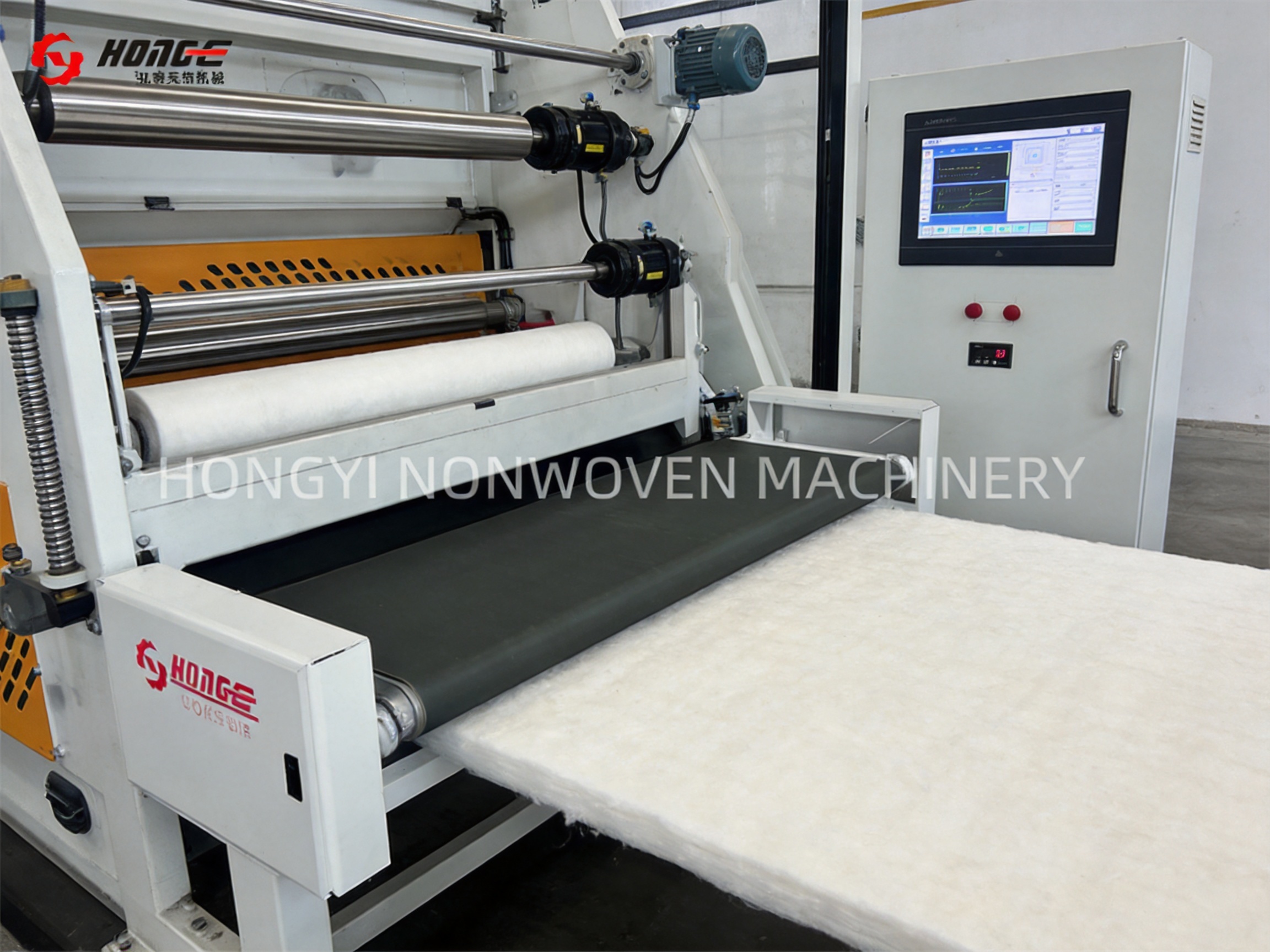
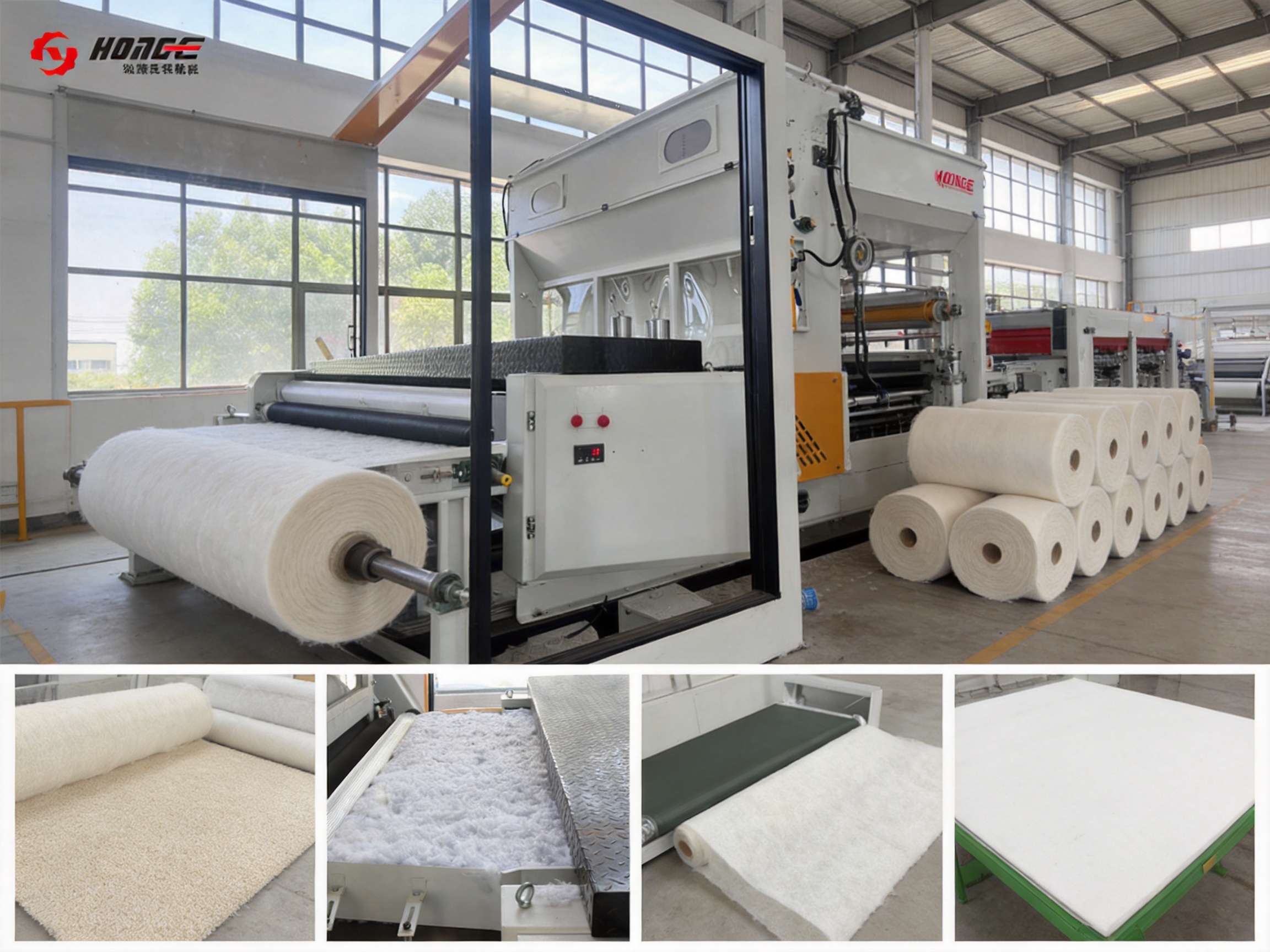
The HYYZY weighing belt for nonwoven fabric production is designed to monitor the actual batt weight of fibers passing over a load-cell-controlled apron. The system uses measured weight information to make automatic feed-roll adjustments, helping maintain a stable and uniform web weight at the carding machine doffers. It functions as an automatic leveling and feedback-control unit positioned between the feeding equipment and the carding machine.
By combining a precision weighing structure, inverter speed control, digital microcomputer processing, online dynamic regulation, PLC control, and touch-screen operation, the system helps nonwoven producers reduce longitudinal gram-weight deviation and improve production consistency. It is suitable for production lines using materials such as polyester fiber, polypropylene staple fiber, and other compatible textile fibers.
With a standard working width of 2800 mm, control capability for web layer weights from 200 to 5000 gsm, and customizable configurations ranging from approximately 2000 mm to 7600 mm, the equipment can be adapted to different production capacities and product specifications. It is supplied by Changshu Hongyi Nonwoven Machinery Co., Ltd., a Chinese manufacturer and supplier with more than 20 years of experience in nonwoven machinery and complete production-line engineering.
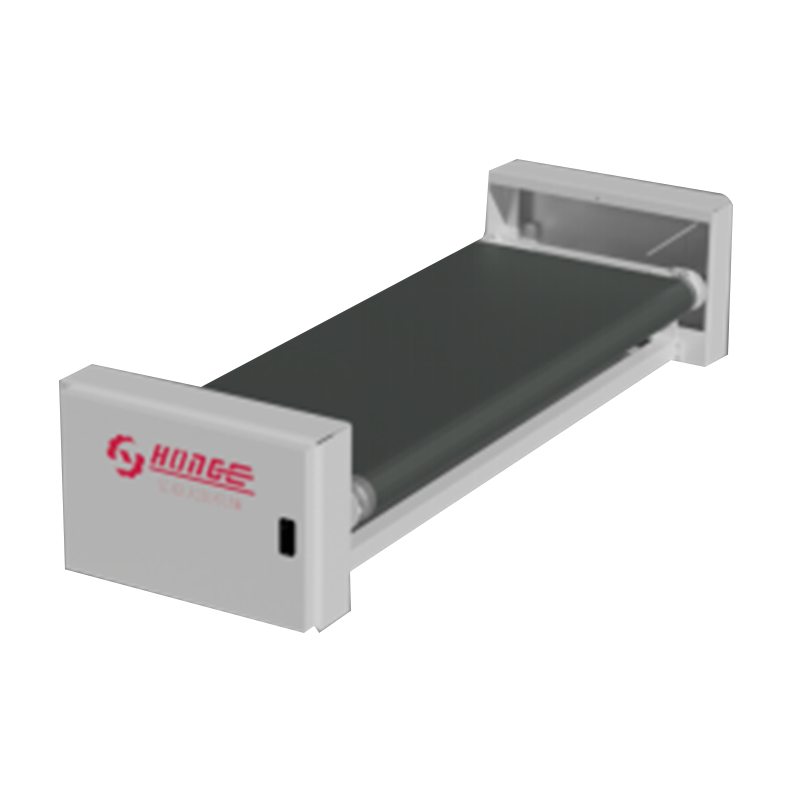
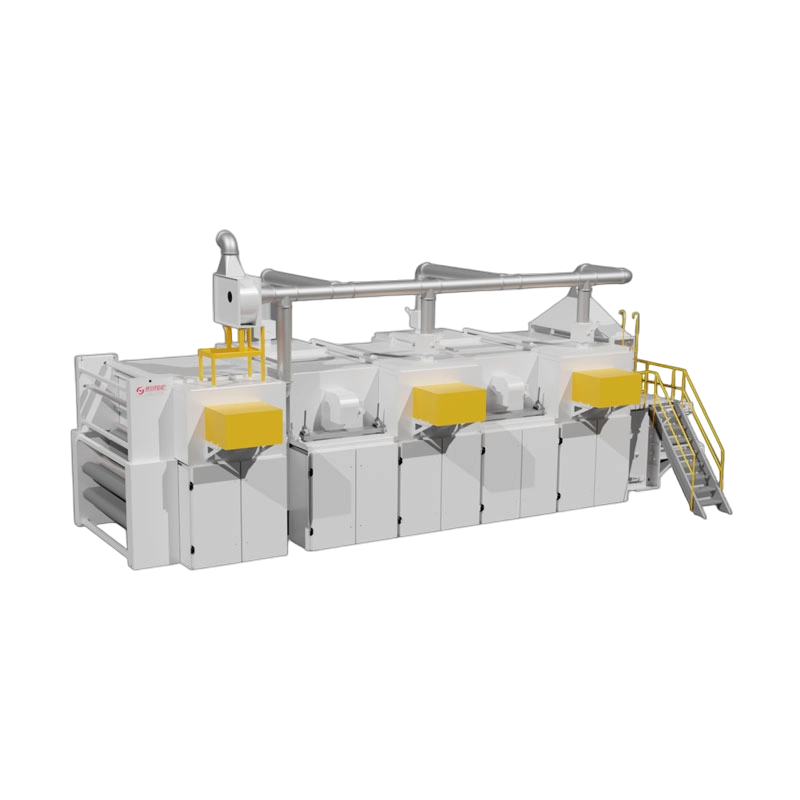
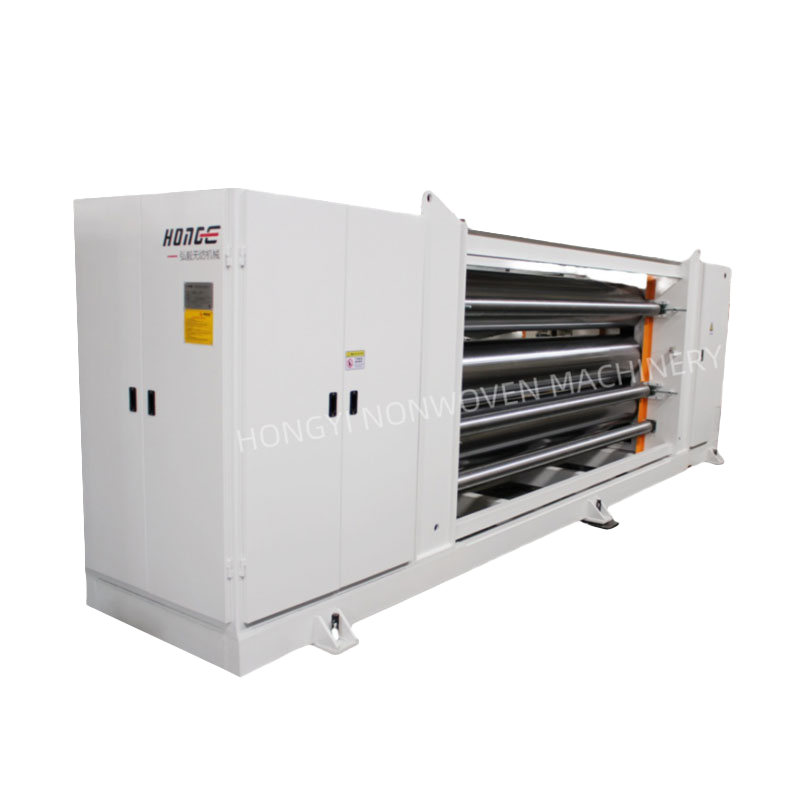
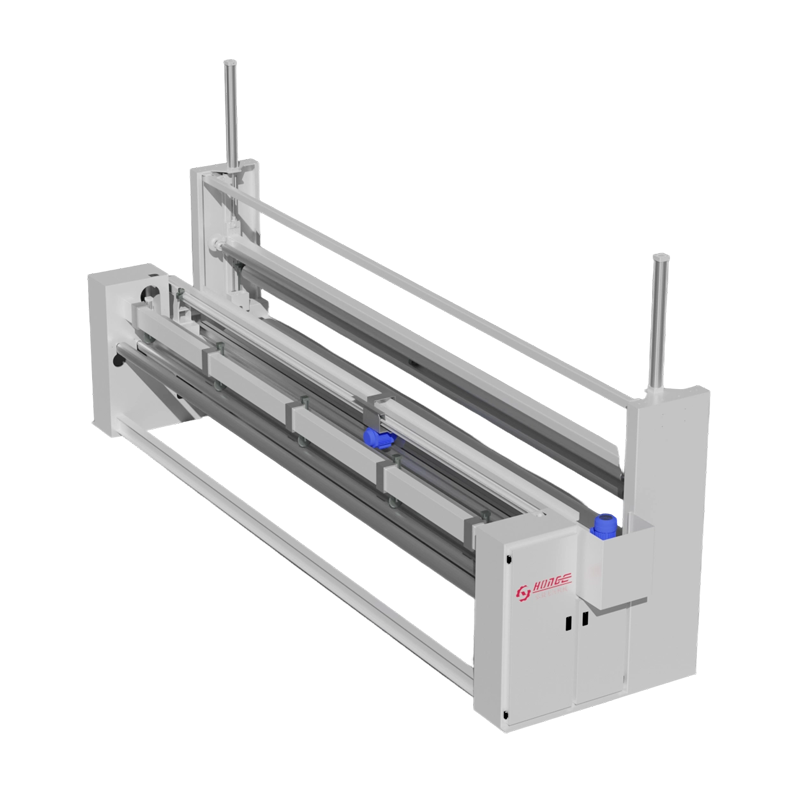
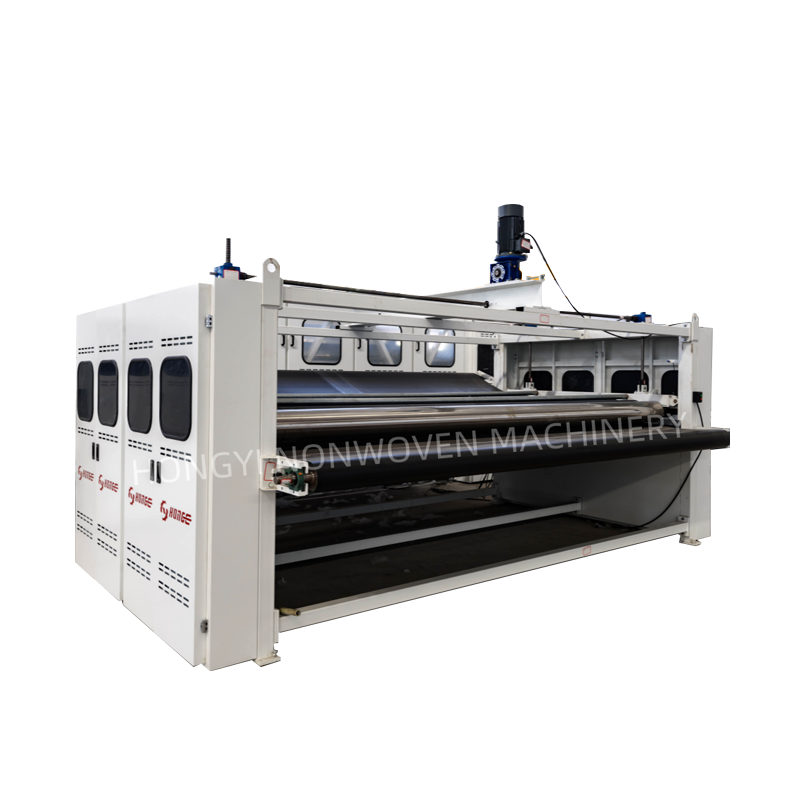
HYYZY Weighing Belt For Nonwoven Fabric Production
What Is a Weighing Belt for Nonwoven Production?
A weighing belt is an automatic measurement and correction device installed in a nonwoven fiber preparation or carding line. Its primary task is to determine the mass of the fiber batt as it moves across a controlled apron or conveyor section. The measured result is then compared with the target value established by the operator or production recipe.
If the actual batt becomes heavier or lighter than the target, the control system changes the speed of the relevant feed rolls. This adjustment modifies the quantity of fiber supplied to the carding machine. In this way, the equipment continuously compensates for fluctuations in the incoming batt and supports a more stable web weight at the card doffers.
Traditional production lines may depend heavily on manual setting, operator experience, and periodic sampling. Although these methods can be useful for basic production, they may not react quickly enough to short-term fluctuations in fiber flow. Changes in fiber opening, blending, feed density, moisture, material properties, or upstream conveyor loading can create weight differences before an operator has time to respond.
The HYYZY system applies online dynamic measurement. Instead of waiting for an end-of-roll inspection or laboratory test, the equipment continuously receives weight information during operation. The control system can then make timely corrections while the line is running. This closed-loop method is particularly valuable when a stable basis weight is required over long production periods.
The weighing belt is not simply a conveyor with a scale. It is an integrated process-control unit that connects mechanical conveying, load-cell measurement, drive regulation, electronic processing, and operator control. Its value lies in the coordination of these functions. The result is a more responsive and automated system for managing the relationship between the feeding machine and the carding machine.
Operating Principle
Fiber Batt Conveyance
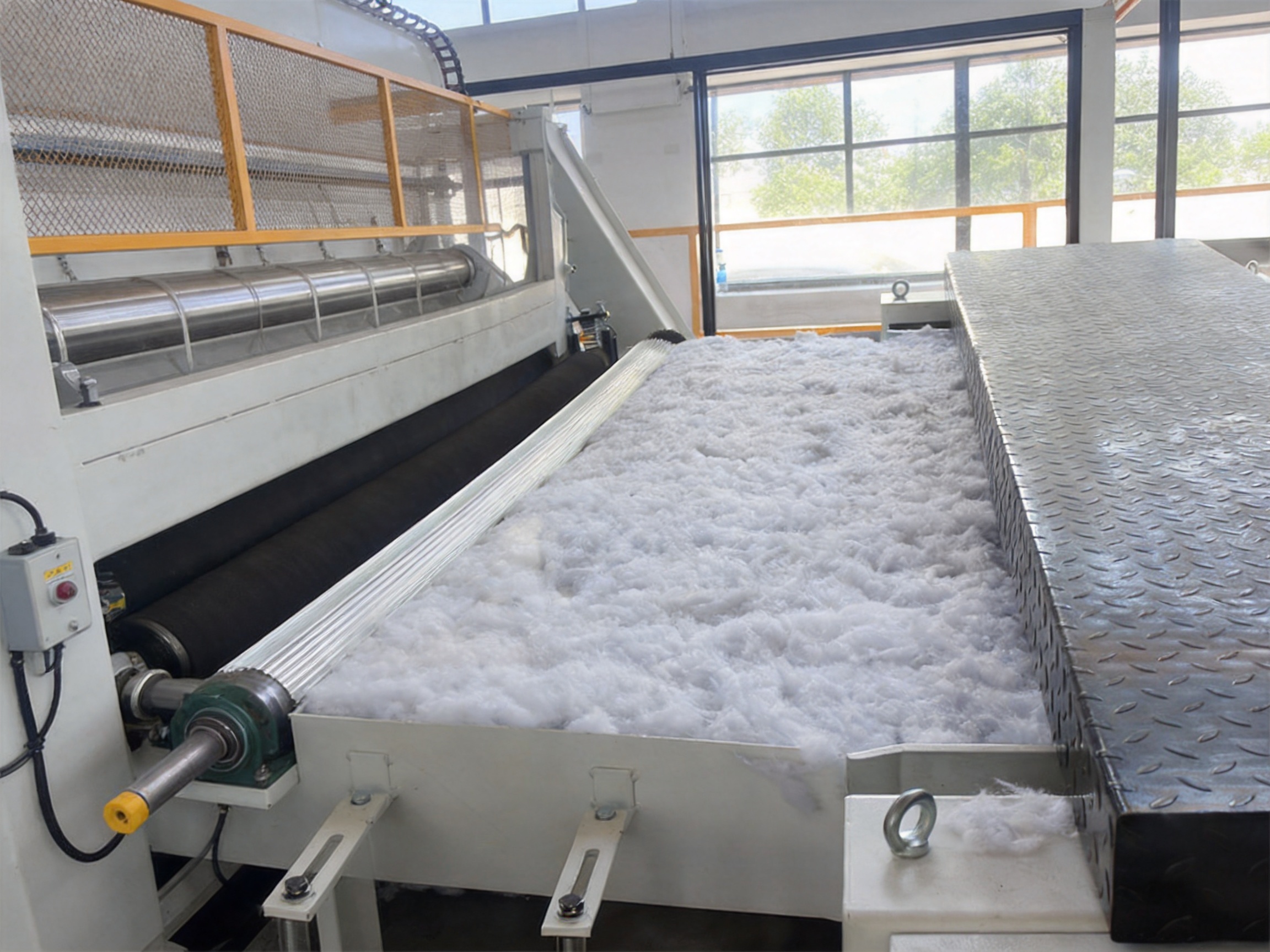
The fiber batt is transported over an apron or belt section designed to pass the material through the weighing zone. Mechanical construction must provide stable movement and minimize unnecessary vibration because vibration can influence measurement accuracy. The system is designed to maintain a controlled and repeatable conveying condition while the fiber mass is measured.
Load-Cell Measurement
Load cells detect the force generated by the fiber batt and the moving support structure. The weighing signal is converted into usable digital information by the control system. The objective is to determine whether the actual fiber quantity corresponds to the target production value.
Digital Signal Processing
The digital microcomputer processing system receives and processes the weighing signal. It can compare actual measurements with preset values, identify deviations, and generate corrective instructions. Digital processing supports stable operation and makes it possible to integrate the weighing belt into an automated production line.
Feed-Roll Adjustment
When a deviation is detected, inverter speed control changes the operating speed of the card feed rolls or related feeding components. If the incoming batt is below the desired weight, the system can increase material feeding within the permitted process range. If the batt is above the desired weight, the control system can reduce feeding. The exact response depends on the production recipe, machine settings, and the control strategy selected for the line.
Continuous Web-Weight Regulation
The purpose of the correction is to deliver a more uniform fiber quantity to the carding machine. More consistent feeding allows the carding section to produce a more stable web at the doffers. This helps reduce longitudinal gram deviation, meaning the difference in basis weight from one section of the roll to another along the production direction.
Because the system measures and corrects during production, it can help reduce the influence of normal upstream fluctuations. It does not eliminate the need for proper fiber opening, blending, maintenance, and machine adjustment, but it provides an important additional control layer for the production line.
Main Product Advantages
1. Accurate Batt-Weight Monitoring
The first major advantage is direct monitoring of the batt weight. A weighing belt provides measurable process data rather than relying only on visual inspection or manual sampling. This makes it easier to identify changes in fiber loading and maintain the desired production target.
Accurate measurement is especially useful when the product specification is strict. A small basis-weight difference may affect material cost, tensile strength, thickness, density, and customer acceptance. By identifying deviations at an early stage, the system helps the producer react before a large quantity of off-specification material is manufactured.
2. Automatic Compensation
Measurement alone does not improve production unless it is connected to an adjustment mechanism. The HYYZY system links measurement data with inverter-controlled feed-roll regulation. This allows the line to compensate automatically instead of requiring the operator to make every correction manually.
Automatic compensation can reduce operator workload and help keep production stable during long shifts. It also supports repeatable operation between different operators and production teams. Once the production parameters have been properly established, the control system can maintain the target more consistently than a process that depends only on manual intervention.
3. Improved Longitudinal Gram Uniformity
Longitudinal gram deviation is a common concern in nonwoven manufacturing. If the fiber batt entering the card fluctuates, the finished web may show heavier and lighter areas along the roll. Such variations can cause problems during needling, thermal bonding, laminating, coating, cutting, and final conversion.
The automatic leveling function helps regulate the quantity of fiber entering the carding machine. By reducing variation before the web is formed, the system supports better consistency in the machine direction. This can contribute to more uniform downstream processing and a more stable finished product.
4. Online Dynamic Control
The digital microcomputer control system enables online dynamic adjustment. The word “dynamic” is important because the equipment is designed to respond to changing process conditions during production rather than applying only a fixed setting.
Fiber characteristics can vary from batch to batch. Recycled fibers, short fibers, crimped fibers, blends, and different deniers may not behave identically during feeding. A dynamic control system provides a way to respond to these changes within the permitted operating range of the production line.
5. Integration with PLC and Touch-Screen Control
PLC and touch-screen control provide a practical interface between the equipment and the operator. Operators can monitor production information, enter target values, adjust settings, and observe system status from a centralized control screen. PLC-based architecture also supports communication with other production-line equipment when the complete line is designed for integrated automation.
Compared with purely mechanical or manually adjusted systems, PLC control provides better flexibility for recipe management, troubleshooting, alarm handling, and future expansion. The exact functions available depend on the final configuration and the customer’s requirements.
6. Wide Basis-Weight Control Range
The stated control range is 200 to 5000 gsm for the web layer between the feeding machine and the carding machine, with a panel width of 2800 mm. This broad range allows the equipment to serve different nonwoven products and production conditions.
Lightweight materials, medium-weight webs, and heavy technical fabrics may require different feed rates and control parameters. A wide operating range gives manufacturers more flexibility when producing multiple product grades on the same line. For special projects, working width and configuration can be customized according to the customer’s product requirements.
7. Compatibility with Different Fibers
The equipment is designed for use in nonwoven production involving polyester fiber, polypropylene staple fiber, and other suitable raw materials. This makes it relevant to a variety of applications, including needle-punched products, thermal-bonded products, automotive materials, filtration fabrics, insulation, carpets, and industrial textiles.
Material compatibility should always be confirmed during technical discussion because fiber length, fineness, crimp, moisture, blend ratio, and bulk density can affect feeding behavior. A professional machinery supplier can recommend the appropriate configuration after reviewing the fiber type and final product specification.
Comparison with Conventional Feeding Methods
| Item | Manual or Fixed-Speed Feeding | Automatic Weighing-Belt Control |
|---|---|---|
| Measurement method | Periodic sampling or visual observation | Continuous online batt-weight monitoring |
| Correction method | Manual adjustment by an operator | Automatic feed-roll adjustment through inverter control |
| Response to fluctuations | Delayed until a deviation is noticed | Dynamic response during production |
| Longitudinal weight stability | Dependent on operator skill and fixed settings | Supported by closed-loop control |
| Production data | Limited process information | Digital information available through the control system |
| Changeover flexibility | Manual reset of multiple parameters | Recipe-based settings can simplify adjustment |
| Automation level | Low to medium | High, depending on the complete line configuration |
The comparison does not mean that every fixed-speed or manually adjusted system is unsuitable. Many conventional lines can produce acceptable material when operated by experienced personnel. However, automatic weighing and leveling provide a stronger basis for consistent production, especially when output volume is high or basis-weight tolerance is narrow.
Compared with equipment that only displays a measurement value, the HYYZY design offers an additional advantage because it is intended to connect measurement with automatic correction. Compared with a basic conveyor scale, it provides a more complete production function by combining conveying, weighing, digital processing, and feed-roll control.
Technical Specifications
| Product name | HYYZY Weighing Belt for Nonwoven Fabric Production |
| Primary function | Online batt-weight monitoring and automatic feed adjustment |
| Application | Nonwoven fabric production and carding lines |
| Standard working width | 2800 mm |
| Available specification range | Approximately 2000 mm to 7600 mm, subject to configuration |
| Web layer control range | 200 to 5000 gsm |
| Host power supply | 220 V |
| Monitor power supply | DC 24 V |
| Control method | PLC and touch screen |
| Automatic grade | Automatic |
| Typical raw materials | Polyester fiber, PP staple fiber, and other suitable fibers |
| Certification information | CE and ISO9001:2000 listed for the supplied configuration |
| Warranty information | One-year warranty |
| Customization | Configuration, color, voltage, and other options can be discussed |
Technical values should be confirmed during the engineering stage because the final machine configuration may change according to working width, line speed, fiber properties, target gsm, control architecture, and customer installation conditions. The listed specifications provide a reference for initial equipment selection.
Advantages of the Manufacturing and Engineering Approach
Experience in Nonwoven Machinery
Changshu Hongyi Nonwoven Machinery Co., Ltd. has more than 20 years of experience in the nonwoven machinery field. This experience is important because nonwoven production equipment must be designed as part of a process, not as an isolated machine. The performance of a weighing belt depends on its relationship with opening equipment, feeding equipment, cards, crosslappers, needle looms, thermal bonding ovens, winding units, and cutting systems.
A supplier with broad nonwoven experience can evaluate the equipment according to the full production objective. For example, the correct control response for a needle-punched geotextile line may differ from that required for a lightweight automotive fabric or a thermal-bonded wadding line. Understanding these differences helps the manufacturer propose a more suitable configuration.
Complete Production-Line Capability
The company supplies both individual machines and complete nonwoven production lines. Its product scope includes needle-punched geotextile lines, nonwoven carpet lines, airlaid waste-felt lines, automotive interior-material lines, needle-punching cleaning-cloth lines, wool-felt lines, jute-felt lines, carding machines, airlaid machines, ironing machines, and thermal-bonding wadding ovens.
This broad range supports better system coordination. A weighing belt can be engineered to fit the material flow, control philosophy, and production capacity of the surrounding equipment. When one supplier manages multiple sections of a line, it may be easier to define interfaces, control signals, machine spacing, and commissioning responsibilities.
Customized Engineering
Nonwoven manufacturers do not all produce the same width, basis weight, fiber blend, or output. A standard machine may be suitable for one factory but inadequate for another. The HYYZY system offers customization options, including working-width configurations, voltage arrangements, color, and other machine details according to customer needs.
Customization can also involve the connection between the weighing belt and the customer’s existing carding or feeding machine. Before manufacturing, the supplier can review line drawings, material information, target capacity, and available electrical interfaces. This engineering process helps reduce installation difficulties and improves the chance of smooth commissioning.
PLC-Based Manufacturing and Control Integration
The use of PLC and touch-screen control reflects a modern approach to machinery manufacturing. Electrical panels, sensors, inverters, monitoring units, and mechanical drives must be coordinated carefully. Proper wiring, signal testing, software configuration, and safety checks are essential for reliable operation.
Digital control also provides a foundation for future improvements. A customer may later request additional monitoring, communication with a central line-control system, recipe storage, or production-data collection. While these functions depend on the final design, PLC-based architecture generally offers more expansion potential than a system built only around manual switches and fixed mechanical settings.
Quality Management and Certification
The product information identifies CE and ISO9001:2000 certification. Certification and quality-management systems provide a framework for production control, documentation, inspection, and process consistency. They do not replace proper application engineering, but they demonstrate that the supplier follows recognized approaches to manufacturing and quality management.
For international customers, documented inspection and certification information can support purchasing evaluation, factory acceptance, customs preparation, and installation planning. Video outgoing inspection is also listed as available, allowing customers to review machine operation before shipment when arranged with the supplier.
International Supply Experience
The company has supplied nonwoven machinery to more than 20 countries, including markets in Latin America, the Middle East, Africa, South Asia, and Southeast Asia. International project experience can help a machinery supplier understand different electrical standards, installation practices, shipping requirements, production expectations, and communication needs.
Export experience is particularly valuable for complete lines because overseas installations require more than equipment fabrication. Packing, transport protection, technical documents, remote support, commissioning assistance, spare parts, and operator training may all influence the success of a project.
Applications in Nonwoven Fabric Production
Needle-Punched Geotextiles
Geotextiles often require stable basis weight and uniform thickness over a wide working width. Variations in the incoming batt can influence needle-punching density, tensile performance, elongation, puncture resistance, and permeability. A weighing belt can support more consistent feeding before the card and thereby improve the stability of the web entering the needle-punching section.
Nonwoven Carpets
Carpet substrates and felt-based flooring materials may require a consistent fiber distribution to achieve a stable surface and predictable thickness. Automatic leveling can help reduce light and heavy areas that might otherwise become visible after needling, coating, backing, or cutting.
Automotive Interior Materials
Automotive interior fabrics are often subject to strict requirements for weight, thickness, acoustic performance, bonding behavior, and dimensional stability. A stable web can provide a more consistent base for thermal bonding, lamination, compression molding, or other conversion steps. The weighing belt is therefore useful as part of a broader process-control strategy for automotive material production.
Thermal-Bonded Wadding
Thermal-bonded wadding depends on a controlled fiber layer entering the heating and bonding section. If the layer weight changes, the finished material may show differences in loft, stiffness, thickness, thermal insulation, or bonding quality. The HYYZY system can help prepare a more stable fiber feed for thermal-bonding lines.
Cleaning Cloths and Industrial Felts
Needle-punched cleaning cloths, wool felts, jute felts, and other industrial materials may be manufactured from different fiber blends and basis-weight ranges. Automatic monitoring supports repeatability when the producer changes from one product grade to another. It can also help reduce the amount of material that must be downgraded because of inconsistent mass distribution.
Airlaid and Blended Fiber Processes
Airlaid materials and blended-fiber products can be sensitive to variations in bulk density and fiber distribution. Although the weighing belt must be selected according to the specific process arrangement, online weight control can provide useful information for managing the transition between fiber preparation and web formation.
Production and Cost Benefits
Reduced Material Waste
Off-specification web is costly because the fiber, energy, labor, and machine time have already been consumed. Automatic control can reduce the duration and severity of weight deviations. This may lower waste during startup, steady production, and product changeover.
The actual savings depend on line speed, product value, target tolerance, fiber cost, and operating discipline. However, even a modest reduction in waste can produce meaningful annual benefits in a continuous production plant.
More Stable Product Quality
Uniform web weight supports consistent downstream properties. A stable web is easier to needle, heat-bond, laminate, wind, slit, and cut. Customers may also experience fewer variations when converting the finished nonwoven into mattresses, filters, insulation panels, carpets, automotive components, or construction materials.
Improved Production Efficiency
Operators can spend less time making repeated manual adjustments when the line has automatic feedback control. The touch-screen interface also makes it easier to monitor the process and identify abnormal conditions. Improved efficiency does not mean that skilled personnel are unnecessary; rather, their time can be directed toward process optimization, maintenance, quality analysis, and production planning.
Better Repeatability Between Orders
Nonwoven producers often manufacture the same product grade repeatedly. Digital control makes it easier to use consistent settings for similar orders. When the production recipe, material blend, working width, and target gsm are documented, the operator can reproduce the process more reliably than when settings are maintained only through handwritten notes or personal experience.
Support for Higher Automation Goals
The weighing belt can form part of a broader automated production line. When combined with automatic opening, blending, feeding, carding, crosslapping, needle punching, thermal bonding, winding, and cutting equipment, it contributes to a more integrated production environment. This can help manufacturers pursue better traceability, production monitoring, and quality control.
Installation and Integration Considerations
Correct installation is essential for obtaining the best performance from any weighing system. The machine should be placed on a stable foundation and aligned correctly with the upstream feeding equipment and downstream carding machine. Uneven support, excessive vibration, or mechanical interference can influence conveying and weighing behavior.
Electrical installation should follow the approved technical documents. The host power supply is listed as 220 V, while the monitor power supply is DC 24 V. Actual voltage requirements should be verified before shipment because customized electrical configurations may be available. The customer should also confirm local power frequency, grounding requirements, control-panel location, and safety standards.
The weighing belt must be connected correctly to the card feed-roll control system. Signal direction, inverter parameters, speed limits, correction response, and alarm logic should be tested during commissioning. The target basis weight and acceptable deviation should be established through trial production and verified using appropriate weighing and quality-control procedures.
Fiber conditions should also be considered. Excessive moisture, contamination, uneven opening, foreign objects, or unstable blending may create fluctuations that no automatic leveler can fully correct. The weighing belt is most effective when the surrounding equipment is properly maintained and the fiber preparation process is stable.
For new production lines, the weighing belt should be included during the overall engineering stage. For existing lines, the supplier should receive information about the current carding machine, feeding capacity, available space, control voltage, line speed, working width, and communication interface. This information helps determine the correct mechanical and electrical configuration.
Operation and Maintenance
Daily Inspection
Operators should inspect the belt or apron, guards, fasteners, sensor connections, and visible electrical components before operation. The weighing area should be kept free of accumulated fibers and foreign material. Any unusual noise, vibration, belt tracking problem, or unstable display should be investigated before full-speed production.
Cleaning
Fiber dust and loose material can accumulate around conveyors, sensors, rollers, and control cabinets. Regular cleaning helps protect measurement stability and mechanical components. Cleaning procedures should follow the supplier’s instructions, especially around load cells, electrical devices, and sensitive connectors.
Calibration and Verification
Periodic weighing verification is important for maintaining confidence in the measurement system. The frequency depends on operating conditions, production hours, material type, and the customer’s quality-management system. Verification should be documented, and any significant change in measurement behavior should be reported to maintenance personnel or the supplier.
Drive and Mechanical Checks
Belts, rollers, bearings, drives, and fasteners should be inspected according to a preventive-maintenance schedule. Mechanical wear may cause vibration or unstable movement, which can affect both conveying and measurement. Timely replacement of worn parts helps protect the overall control performance.
Control-System Monitoring
Operators should observe alarms, speed values, target values, actual readings, and correction behavior through the touch screen. If the system repeatedly reaches its correction limit, the cause may be upstream fiber instability, an incorrect setting, a sensor issue, or a mechanical problem. Automatic control should not be used to conceal a serious fault elsewhere in the production line.
Why Choose a Specialized Nonwoven Machinery Supplier?
A weighing belt is closely connected to the behavior of fibers and the operation of the carding machine. A supplier that specializes in nonwoven equipment can better understand how card feed rates, fiber opening, web formation, needle punching, thermal bonding, and winding influence one another.
Changshu Hongyi Nonwoven Machinery Co., Ltd. focuses specifically on nonwoven machinery rather than serving only as a general industrial equipment vendor. Its product range covers major sections of nonwoven production, from opening and blending through feeding, carding, web forming, needle punching, thermal bonding, airlay, winding, cutting, auxiliary systems, and complete production lines.
This specialization enables the company to provide both individual equipment and complete customized solutions. A customer purchasing a weighing belt may also require technical assistance with the feeding machine, carding line, control system, downstream web-forming equipment, or production-line layout. A supplier familiar with these systems can help coordinate the project more effectively.
The company’s manufacturing approach emphasizes efficiency, reliability, advanced technology, precision engineering, energy-saving capabilities, automatic control, and customization. These strengths are relevant to customers seeking not merely a conveyor, but a dependable process-control unit that can support stable production over many years.
Purchasing Guidance
Before ordering a weighing belt, buyers should define the intended production conditions. Important information includes the fiber type, fiber blend, target gsm, working width, line speed, carding-machine model, feeding-machine type, desired control accuracy, electrical standard, available installation space, and downstream process.
The buyer should also clarify whether the equipment will be installed in a new line or retrofitted into an existing line. A new line allows the weighing belt to be integrated into the overall control architecture from the beginning. A retrofit project may require additional interface work, mechanical adaptation, communication testing, or control-panel modification.
Questions about factory acceptance testing should be discussed before production. Customers may request inspection records, video outgoing inspection, trial operation, control-system testing, documentation, spare parts, installation guidance, and operator training. These arrangements can help both parties establish clear expectations before shipment.
Packaging and transportation should also be considered. The listed transport package is nude packing or PE film, depending on the final arrangement. Customers should confirm the appropriate method according to shipping distance, container type, climate, port handling, and local import requirements.
Lead time is listed as approximately two to three months. Actual delivery time may change according to customization, production schedule, component availability, inspection requirements, and the scope of the complete project. Early technical communication is recommended for customers with a fixed installation or commissioning date.
Frequently Asked Questions
What is the main function of the HYYZY weighing belt?
Its main function is to monitor the actual weight of the fiber batt passing over a controlled apron and use the measurement to adjust feed-roll speed. This helps maintain a more constant web weight at the carding-machine doffers.
Is the machine suitable for polyester and polypropylene fibers?
Yes. Polyester fiber and PP staple fiber are listed as typical raw materials. Other fiber types may also be suitable, but the supplier should confirm compatibility after reviewing fiber length, fineness, blend ratio, moisture, and production conditions.
What web-weight range can the system control?
The stated control range is 200 to 5000 gsm for the web layer between the feeding machine and carding machine. The practical operating range depends on fiber properties, line speed, working width, and the configuration of the complete production line.
What is the standard working width?
The standard technical parameter lists a working width of 2800 mm. Customized specifications are available, with a listed range of approximately 2000 mm to 7600 mm, subject to engineering confirmation.
Does the system require manual adjustment during production?
The system is designed for automatic operation using load-cell measurement, digital processing, inverter speed control, PLC control, and a touch screen. Operators still need to set production parameters, monitor the process, perform inspections, and respond to alarms or abnormal conditions.
Can the weighing belt be installed in an existing production line?
It may be possible to install the equipment in an existing line. The supplier must review the current feeding and carding machines, mechanical layout, available space, line speed, electrical supply, and control interfaces before confirming the retrofit design.
How does the equipment reduce longitudinal gram deviation?
It measures the fiber batt continuously and compares the actual value with the target. When a deviation is detected, the system changes feed-roll speed to compensate for the difference. This helps regulate the amount of fiber entering the card and supports more uniform web weight in the production direction.
What power supplies are specified?
The listed technical parameters specify a 220 V host power supply and a DC 24 V monitor power supply. Voltage and electrical details should be confirmed for the customer’s country and customized machine configuration.
Is PLC control included?
PLC and touch-screen control are listed as the controlling method. The detailed functions, communication interfaces, alarms, recipes, and data-display features should be confirmed in the technical proposal.
What warranty is provided?
The product information lists a one-year warranty. Warranty coverage, exclusions, response procedures, and spare-parts arrangements should be reviewed in the commercial contract.
Can the machine color and configuration be customized?
Yes. The product information states that color and configuration can be customized according to customer needs. Other options, including voltage and working width, should be discussed during technical specification confirmation.
What support can an international customer request?
Customers may discuss technical documents, outgoing inspection, installation guidance, commissioning support, operator training, spare parts, and remote assistance. The exact scope depends on the project and should be defined before shipment.
Conclusion
The HYYZY weighing belt for nonwoven fabric production is an automatic leveling and process-control system designed to improve fiber-batt consistency before carding. Its load-cell measurement, inverter-controlled feed rolls, digital microcomputer processing, online dynamic control, PLC, and touch-screen interface provide a practical solution for manufacturers seeking more stable web weight and lower longitudinal gram deviation.
Its stated capability of 200 to 5000 gsm, standard 2800 mm working width, and customizable specifications make it suitable for a broad range of nonwoven applications. The equipment can support production involving polyester, PP staple fiber, and other compatible materials used in geotextiles, carpets, automotive interiors, thermal-bonded wadding, cleaning cloths, felts, insulation, and industrial fabrics.
The product’s value is strengthened by the manufacturer’s long-term specialization in nonwoven machinery, complete production-line capability, international supply experience, PLC-based automation, customization services, quality-management approach, and focus on precision engineering. Rather than functioning as a standalone weighing device, the system is intended to work as part of an integrated nonwoven production process.
For manufacturers that need improved basis-weight repeatability, lower manual intervention, better production efficiency, and stronger control over fiber feeding, an automatic weighing belt can be an important upgrade. Proper technical selection, installation, calibration, maintenance, and integration with the carding line are essential to achieving the expected results.
References
1. Product technical information for the HYYZY Weighing Belt for Nonwoven Fabric Production.
2. Manufacturer-provided specifications for working width, power supply, control range, automation, customization, and warranty.
3. Manufacturer company profile and nonwoven machinery product portfolio.
4. General principles of nonwoven web formation, fiber feeding, carding, basis-weight control, and process automation.
5. General quality-control practices for continuous textile and nonwoven production lines.