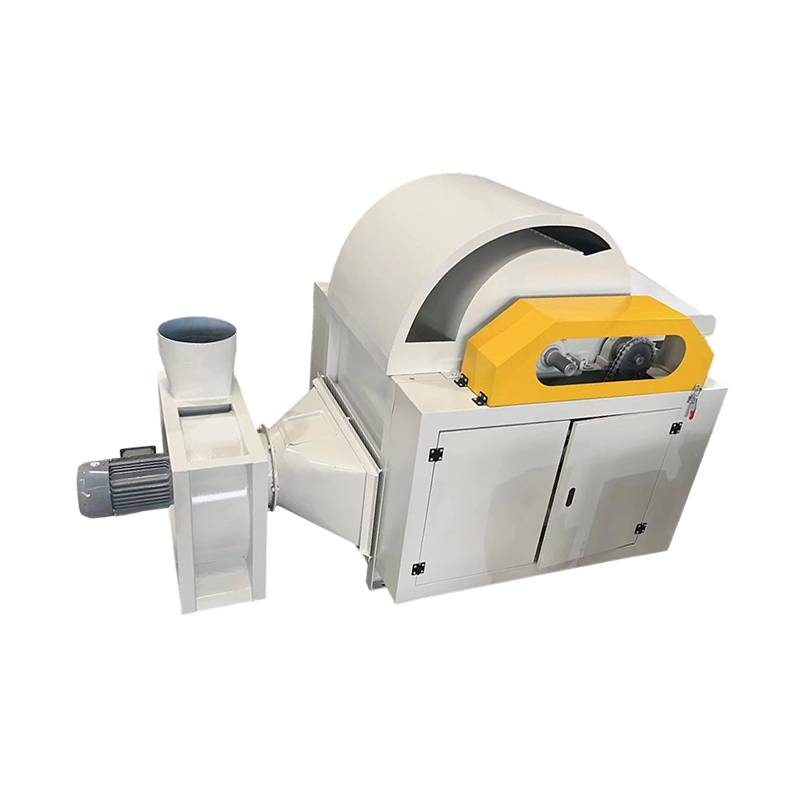


Content
- 1 Introduction
- 2 The Role of Edge Preparation in Nonwoven Manufacturing
- 3 Product Overview
- 4 Core Product Advantages
- 5 Advantages Compared with Less Specialized Alternatives
- 6 Material Compatibility and Application Scope
- 7 Integration into a Complete Production Line
- 8 Manufacturing Strengths of the Supplier
- 9 Manufacturing and Quality Considerations
- 10 Operational Benefits for Manufacturers
- 11 Installation, Commissioning, and Maintenance
- 12 Purchasing and Customization Guidance
- 13 Recommended Evaluation Questions
- 14 Quality and Performance Monitoring
- 15 Why a Complete Machinery Supplier Matters
- 16 Q&A
- 16.1 What is a nonwoven fabric pre-edge cutting device?
- 16.2 What is the standard working width of the HYYQ device?
- 16.3 What materials can the machine process?
- 16.4 What is the working speed?
- 16.5 How is the machine controlled?
- 16.6 Can the device be integrated into an existing nonwoven line?
- 16.7 Can the working width be customized?
- 16.8 What is the installed power?
- 16.9 How long is the lead time?
- 16.10 Does the machine include after-sales support?
- 16.11 Why is edge consistency important in nonwoven production?
- 16.12 How often should the cutting tools be replaced?
- 16.13 Is the device suitable for high-volume production?
- 16.14 What should a buyer provide when requesting a quotation?
- 17 Conclusion
- 18 References
- 19 Product: HYYQ Nonwoven Fabric Machinery Pre-Edge Cutting Device
Introduction
Edge quality is a decisive factor in nonwoven fabric manufacturing. Before a web enters a needle punching machine, thermal bonding oven, winding unit, slitting machine, or other downstream equipment, its edges must be prepared with a high degree of accuracy. Uneven, unstable, or poorly defined edges can lead to width variation, web distortion, material waste, machine stoppages, and inconsistent final products. For this reason, a reliable pre-edge cutting device is an important part of an efficient nonwoven production line.
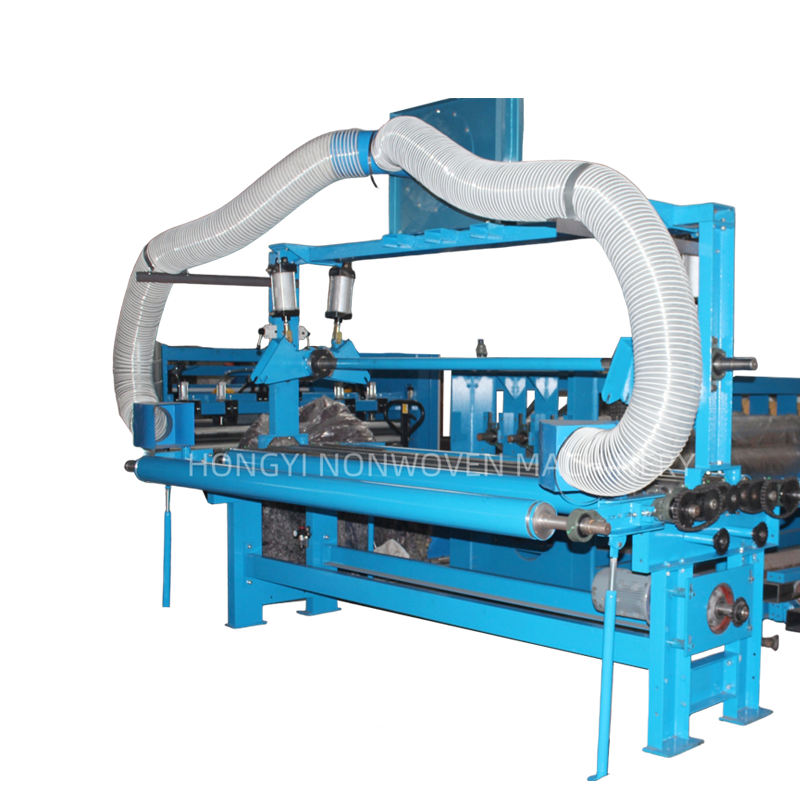
The HYYQ Nonwoven Fabric Machinery Pre-Edge Cutting Device is designed to perform controlled edge pre-processing on fiber webs. It uses an independent cutting process to trim or pre-cut the edges of a moving web according to preset production data. By creating a cleaner and more consistent web profile before the next processing stage, the device helps manufacturers improve production stability and product uniformity.
Developed by Changshu Hongyi Nonwoven Machinery Co., Ltd., the HYYQ device is intended for use with a wide range of nonwoven raw materials, including polyester fiber, polypropylene staple fiber, and similar fiber products. Its working width, control method, speed range, modular construction, and integration capabilities make it suitable for customized nonwoven manufacturing systems.
This article explains the operating value, technical characteristics, application benefits, manufacturing strengths, and purchasing considerations associated with the pre-edge cutting device. It also examines how a purpose-built edge preparation machine can provide advantages over basic manual trimming or less specialized cutting arrangements.
HYYQ Nonwoven Fabric Machinery Pre-Edge Cutting Device
The Role of Edge Preparation in Nonwoven Manufacturing
Nonwoven webs are produced by arranging fibers into a continuous layer or batt. Depending on the production process, the web may be formed by carding, airlaying, crosslapping, or another fiber-forming technique. At this stage, the web can be relatively loose, soft, and sensitive to tension. Its edges may not yet have the dimensional stability required for subsequent processing.
When an untreated or irregular web enters the next machine, several problems may occur. The web may wander from side to side, the actual width may vary along the production direction, and loose fibers may accumulate around rollers or working elements. In needle punching, inconsistent edges can influence punching density and finished fabric geometry. In thermal bonding, uneven edges may result in irregular heating zones or nonuniform finished widths. During winding and cutting, unstable edges can produce telescoping rolls, uneven selvages, or excessive trim waste.
Pre-edge cutting addresses these risks before they affect later stages. The machine establishes a more controlled web profile by processing the edges independently and consistently. This does not replace the main cutting, slitting, or finishing equipment; instead, it prepares the material so that downstream machines can work under more stable conditions.
A dedicated edge preparation unit is particularly valuable when the production line operates continuously. Manual operators may be able to correct occasional edge problems on a small or intermittent line, but manual intervention becomes increasingly difficult as speed, width, and output rise. An automatic pre-edge cutting device offers repeatable operation and reduces dependence on constant manual adjustment.
Product Overview
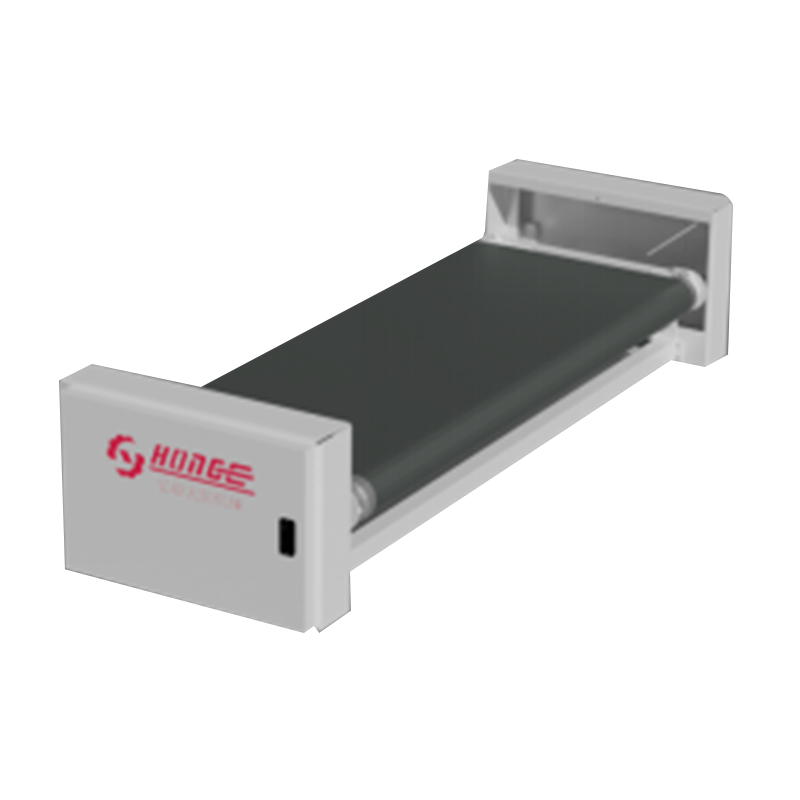
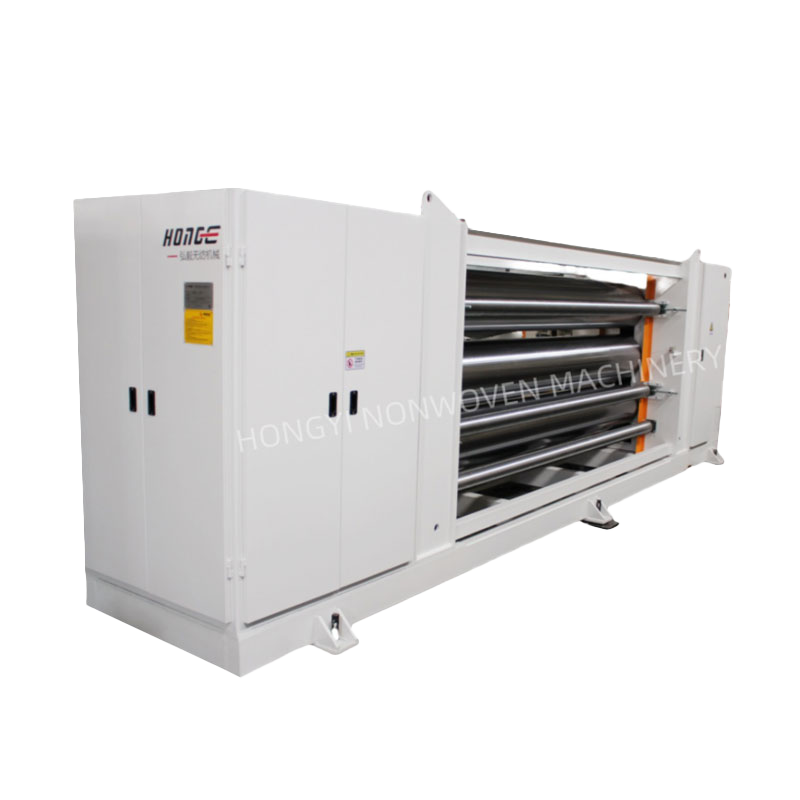
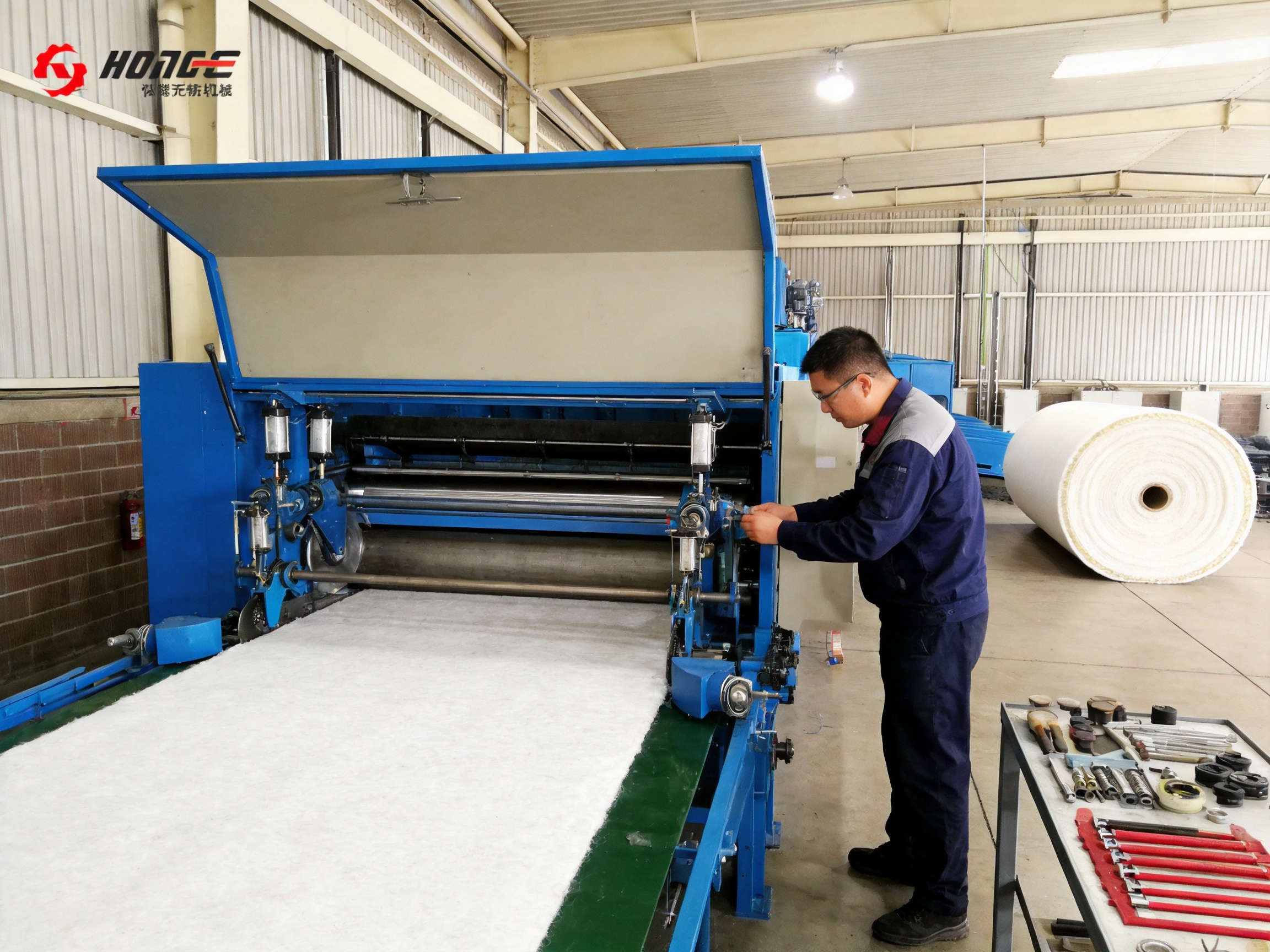
The HYYQ Pre-Edge Cutting Device is a specialized assistant machine for nonwoven fabric production. It is installed as part of a broader production system and performs edge pre-cutting on fiber webs. The machine is configured to operate with automatic control and can be adapted to different production requirements.
Its standard technical information specifies a working width of 2500 mm and a working speed range of 0.5 to 15 meters per minute. The broader specification range is listed as approximately 2000 mm to 7600 mm, indicating that the equipment can be customized for different line widths. The installed power is listed as 5.2 kW, while a separate data field gives 24 W under “Power(W).” Because these entries may refer to different electrical components or configuration fields, buyers should confirm the final electrical schedule, motor rating, control voltage, and total connected load in the technical offer before ordering.
The control system uses a PLC and touch screen. This arrangement allows operating parameters to be managed through a clear interface and supports integration with an automated production line. The machine can be supplied in a customized configuration, including color, equipment arrangement, and selected functions.
| Item | Available Information | Production Significance |
|---|---|---|
| Product type | Pre-edge cutting device for nonwoven fiber webs | Prepares web edges before downstream processing |
| Model | HYYQ | Identifies the standard equipment configuration |
| Standard working width | 2500 mm | Suitable for medium-width nonwoven production systems |
| Specification range | Approximately 2000–7600 mm | Supports customized line widths |
| Working speed | 0.5–15 m/min | Allows adjustment for different web conditions |
| Installed power | 5.2 kW | Provides the stated power reference for the complete configuration |
| Control method | PLC and touch screen | Supports automatic operation and parameter management |
| Raw materials | Polyester fiber, PP staple fiber, and similar materials | Suitable for multiple nonwoven production applications |
| Certification | CE and ISO9001:2000 listed | Provides documented quality and conformity references |
| Warranty | One year | Provides initial after-sales support |
| Lead time | Approximately 2–3 months | Allows planning for customized equipment production |
Core Product Advantages
Dedicated Edge Pre-Processing
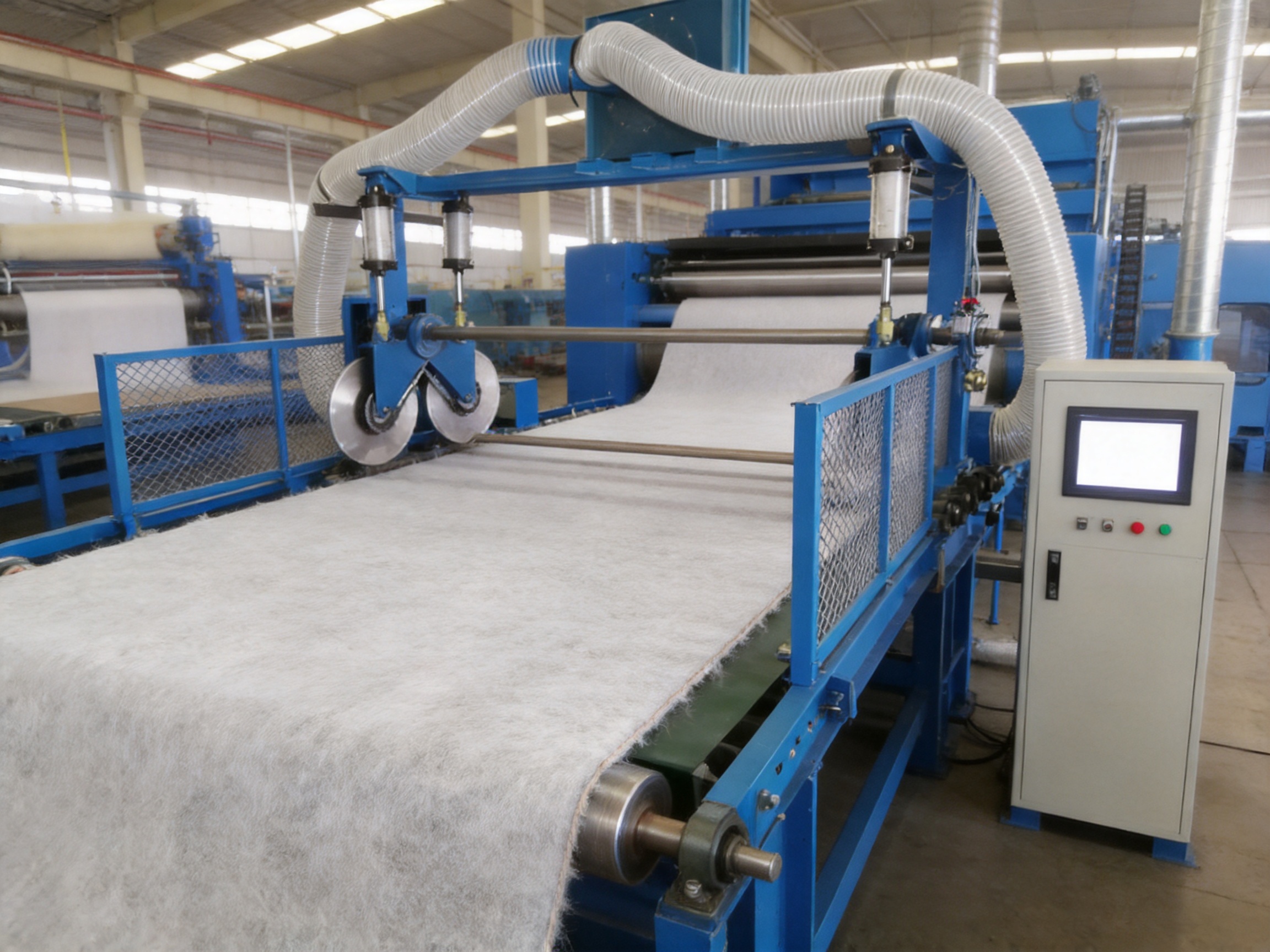
The first major advantage of the HYYQ device is its dedicated purpose. It is not a general-purpose cutter adapted for occasional web trimming. Its design is focused on the specific requirements of fiber-web edge preparation. This makes it easier to establish a repeatable cutting method and to coordinate the unit with other nonwoven machinery.
A dedicated unit can be positioned and configured around the physical characteristics of the web, including its width, thickness, fiber composition, density, and movement speed. The edge preparation process can therefore be managed as a defined production step rather than as an improvised correction. This approach is valuable for factories seeking more consistent quality from one production batch to another.
Improved Edge Flatness and Consistency
In nonwoven production, edge quality is not simply an appearance issue. A flat and consistent edge can improve web guidance, reduce loose fiber accumulation, and support more reliable downstream processing. The optimized cutting process of the HYYQ machine is intended to improve the regularity of the edge profile along the length of the web.
Compared with manual trimming, an automatic cutting process provides more consistent positioning and timing. Manual work may be affected by operator fatigue, differences in technique, lighting, access, and production speed. An automatic device can maintain a defined operating condition for a longer period, helping reduce variation between shifts and production lots.
PLC and Touch-Screen Control
The PLC-based control system provides a structured method for operating the machine. A touch-screen interface allows operators to view and adjust production parameters without relying entirely on mechanical adjustments. Depending on the final configuration, the control system may be used to manage speed coordination, start and stop functions, cutting operation, alarms, and other machine conditions.
PLC control also supports communication and synchronization within an automated production line. The exact communication protocol and interface should be confirmed during engineering, but the PLC architecture provides a practical foundation for integration. It can help reduce unnecessary manual intervention and improve the repeatability of machine settings.
Wide Range of Customization
The listed specification range of approximately 2000 mm to 7600 mm allows the equipment to be considered for different nonwoven line sizes. A manufacturer may require a relatively narrow unit for a specialized product or a much wider device for industrial felt, geotextile, carpet base, filtration media, or automotive interior material production.
Customization may also cover the frame layout, cutting arrangement, electrical configuration, color, control functions, and connection points. These options are important because nonwoven production lines are rarely identical. The available floor space, web direction, upstream machine height, downstream equipment, material behavior, and required finished width can all influence the correct design.
Modular Construction for Maintenance
The modular design is intended to simplify daily maintenance and tool replacement. A modular structure can make it easier for technicians to inspect the cutting area, access wear parts, replace tools, and restore the equipment to operating condition. This is especially important in continuous production, where extended downtime can affect the entire line.
Maintenance efficiency also contributes to long-term operating cost. A machine that is difficult to access may encourage delayed inspection or improper adjustment. By contrast, a well-organized modular unit allows maintenance tasks to be planned and performed more systematically. Buyers should request a recommended spare-parts list, maintenance schedule, cutting-tool specifications, and adjustment instructions before commissioning.
Stable Mechanical Structure
The machine is described as having a rugged structure for long-term stable operation. A strong frame is important because cutting performance depends on maintaining the relative position of the web, guides, cutting elements, and supporting components. Any unwanted vibration, deflection, or movement may influence edge quality.
Structural stability is also important when the device is connected to other machines. A stable frame helps maintain alignment during continuous production and reduces the risk that minor mechanical movement will affect the web path. The final foundation requirements, leveling method, anchoring details, and connection dimensions should be confirmed with the supplier for each project.
Advantages Compared with Less Specialized Alternatives
Compared with Manual Edge Trimming
Manual trimming may appear economical for low-volume production, but it can become inefficient as output increases. It requires personnel to remain close to the moving web and may expose the process to inconsistent cutting pressure, changing operator decisions, and production interruptions. Manual trimming also makes it more difficult to record or reproduce precise settings.
An automatic pre-edge cutting device offers a more repeatable alternative. Once the machine has been adjusted and the production parameters have been confirmed, the process can continue with reduced direct intervention. This may improve labor utilization and allow operators to focus on monitoring the overall line rather than repeatedly correcting web edges.
Compared with General-Purpose Cutting Equipment
General-purpose cutting equipment may not be designed for the soft, fibrous, and sometimes unstable characteristics of nonwoven webs. A cutter intended for rigid sheet materials, film, or standard textile fabrics may require extensive modification before it can deliver suitable results on a loose fiber web.
The HYYQ device is developed specifically for nonwoven production environments. Its application focus, speed range, width options, control system, and integration concept are more closely aligned with fiber-web handling. This can reduce the risk of using equipment that performs adequately on one material but poorly on another.
Compared with Basic Mechanical Edge Guides
Edge guides can help position a web, but guidance and cutting are different functions. A guide may push or redirect a material without removing irregular fibers or creating a controlled edge. If the original edge is uneven, a guide alone cannot necessarily solve the problem.
A pre-edge cutting device combines edge processing with controlled production movement. It can therefore address the physical edge condition rather than only its position. In a complete line, edge guides and pre-edge cutting equipment may be used together, with each component performing its intended role.
Compared with Non-Integrated Stand-Alone Cutters
A stand-alone cutter may require separate manual coordination, independent speed adjustment, and additional monitoring. If it is not properly synchronized with the upstream and downstream machines, it can introduce tension fluctuations or cause the web to accumulate or stretch.
The HYYQ device is designed for integration into automated production lines. Its PLC and touch-screen arrangement creates a basis for coordinated operation. Integration details remain project-specific, but the equipment concept is more suitable for a factory that wants to build a connected and controllable production process.
Material Compatibility and Application Scope
The device is intended for nonwoven fiber webs made from materials such as polyester fiber and PP staple fiber. These materials are widely used in industrial and consumer nonwoven products. The actual suitability of any material should be confirmed through technical review or testing because fiber length, crimp, blend ratio, web density, moisture, binder content, and temperature can all influence cutting behavior.
Polyester fiber is commonly selected for products requiring strength, resilience, dimensional stability, or resistance to environmental conditions. PP staple fiber is valued for its low density, chemical resistance, and broad application range. A machine that can work with both materials provides manufacturers with greater production flexibility.
Potential applications include needle-punched geotextiles, nonwoven carpets, automotive interior materials, filtration products, cleaning cloths, insulation materials, felt, agricultural fabrics, and other fiber-based products. In each application, the purpose of edge pre-cutting may differ. One factory may use it to prepare the web for needle punching, while another may use it to improve the winding edge or reduce irregular trim before thermal bonding.
For specialized materials, buyers should provide samples or detailed material information to the manufacturer. This allows the cutting arrangement, operating speed, tool type, and web-support method to be evaluated before final production.
Integration into a Complete Production Line
The HYYQ device can be positioned between web-forming equipment and a downstream processing machine. The exact location depends on the process layout. In a carding and needle punching line, it may be installed after web formation or crosslapping and before the web enters the needle punching section. In an airlay line, it may be placed after the airlay forming system and before thermal bonding or winding.
Integration requires more than simply placing one machine next to another. Mechanical alignment, web height, electrical supply, signal exchange, speed matching, access for maintenance, safety guarding, and emergency-stop coordination should all be considered during engineering.
Speed synchronization is especially important. The stated working speed range is 0.5 to 15 meters per minute, but the ideal setting depends on the upstream web-forming speed and the material characteristics. If the cutting unit operates too slowly, web accumulation may occur. If it operates too quickly, the web may experience unwanted tension or insufficient cutting control. A properly configured PLC system can help coordinate the unit with line speed.
Electrical requirements should also be confirmed in advance. The available information lists 220 V or a customized voltage. International projects may require different voltage, frequency, control cabinet standards, or safety components. The supplier and buyer should agree on the complete electrical specification before manufacturing begins.
Important Integration Considerations
The first consideration is web alignment. The centerline and working width of the pre-edge cutter must correspond with the upstream and downstream machines. Incorrect alignment can create uneven trimming or force the web into an undesirable path.
The second consideration is access. Operators and maintenance personnel need safe access to the cutting area, adjustment components, control cabinet, and inspection points. A compact layout should not prevent routine service.
The third consideration is safety. Cutting equipment should be equipped and operated in accordance with applicable safety requirements. Guards, emergency stops, warning signs, safe access procedures, and lockout practices should be included in the factory installation plan.
The fourth consideration is waste handling. Edge trimming produces waste fibers or strips. The production line should provide a practical method for collecting, conveying, or removing this material. Effective waste management helps prevent accumulation around moving components and keeps the working area cleaner.
The fifth consideration is commissioning. After installation, the machine should be tested under actual or representative material conditions. The test should verify cutting quality, width accuracy, speed response, control functions, emergency stops, and communication with adjacent equipment.
Manufacturing Strengths of the Supplier
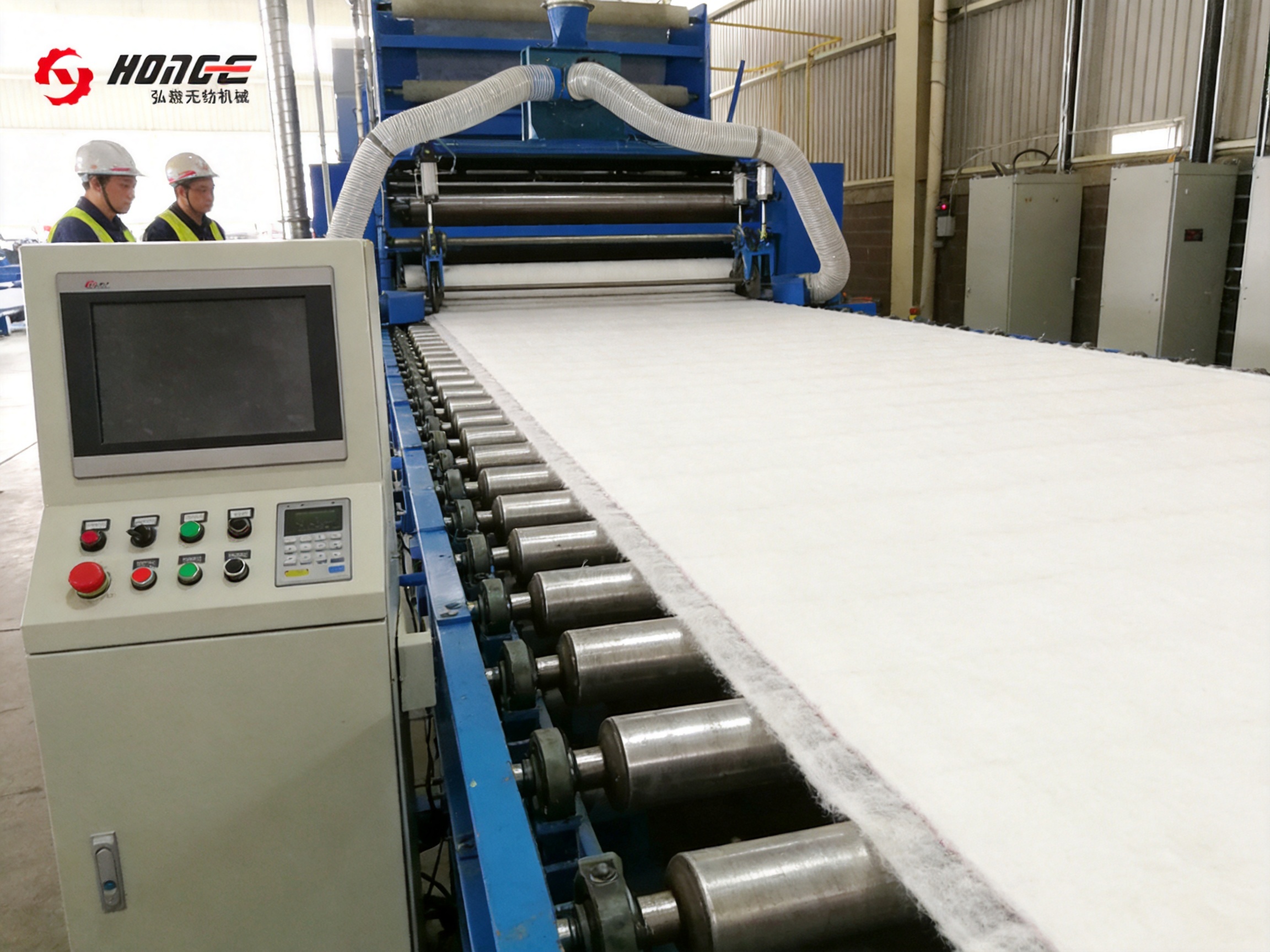
Changshu Hongyi Nonwoven Machinery Co., Ltd. is presented as a professional nonwoven machinery manufacturer and trader with more than 20 years of experience in the nonwoven machinery field. This industry experience is relevant because nonwoven equipment requires knowledge of fiber behavior, web formation, tension control, punching, thermal treatment, winding, and line integration.
The company supplies both complete production lines and individual machines. Its product range includes needle-punched geotextile production lines, nonwoven carpet production lines, airlaid waste felt production lines, automotive interior material lines, needle-punching cleaning cloth lines, wool felt and jute felt lines, needle punching machines, carding machines, airlay machines, ironing machines, and thermal bonding wadding oven machines.
This broad product portfolio can be an advantage for customers purchasing an assistant machine. A supplier that understands carding, airlaying, needle punching, thermal bonding, and winding is better positioned to consider how an edge cutting device will function within a complete process. It can evaluate upstream and downstream requirements rather than treating the machine as an isolated component.
The company reports that its products have been supplied to more than 20 countries, including markets in Latin America, the Middle East, Africa, South Asia, and Southeast Asia. International project experience can help a manufacturer understand different electrical standards, shipping arrangements, documentation expectations, installation conditions, and customer communication requirements.
The company also emphasizes automatic control systems, energy-saving capabilities, precision engineering, reliability, and customization. These characteristics are directly relevant to the HYYQ device. A pre-edge cutting unit must be accurately built, but it must also be adaptable to the customer's line, material, production speed, and factory conditions.
Manufacturing and Quality Considerations
Engineering and Configuration
Manufacturing quality begins before fabrication. The supplier must understand the customer's web width, material type, production speed, line layout, electrical environment, and expected edge result. A clear technical specification reduces the possibility of mismatch between the equipment and the customer's production system.
For customized equipment, engineering drawings and interface information should be reviewed before production. These may include overall dimensions, working height, web direction, foundation requirements, electrical load, control cabinet location, connection points, and maintenance clearances.
Mechanical Fabrication
The frame and supporting structure must be manufactured with sufficient rigidity and dimensional accuracy. Welding, machining, drilling, and assembly quality can influence alignment and operating stability. Components that support or guide the web should be installed with appropriate accuracy to help maintain a consistent material path.
Surface treatment and protective finishing also affect service life. The listed equipment color can be customized according to customer needs. More important than appearance, however, is the quality of the protective coating, preparation of metal surfaces, resistance to the factory environment, and accessibility of areas that may require future touch-up.
Electrical and Control Assembly
The PLC and touch-screen system should be assembled in a clean and organized control cabinet. Wiring should be identified clearly, protected against damage, and documented for future maintenance. The control interface should present operating conditions and alarms in a manner that operators can understand.
During factory testing, control functions should be checked systematically. This may include start and stop commands, speed adjustment, manual and automatic modes, sensor response, alarm behavior, emergency-stop functions, and communication with adjacent equipment. The final scope depends on the customer's requirements and the selected configuration.
Factory Testing and Inspection
Video outgoing inspection is listed as available. Remote or recorded inspection can help overseas customers review machine operation before shipment. A more complete factory acceptance process may include dimensional checks, no-load testing, material trials, control verification, and review of documentation.
Customers should ask for a factory acceptance checklist that identifies the tested functions and acceptance criteria. For an edge cutting device, useful criteria may include working width, speed range, edge appearance, cutting consistency, adjustment repeatability, safety functions, and compatibility with the specified material.
Operational Benefits for Manufacturers
Improved Product Uniformity
A controlled edge can contribute to more consistent final widths and improved appearance. Although edge cutting alone cannot correct every web-forming problem, it can remove or reduce irregular edge conditions before they continue through the line.
Product uniformity is important in applications such as geotextiles, carpet substrates, automotive materials, insulation, filtration media, and industrial felt. Customers in these sectors may specify strict width tolerances, stable roll geometry, and clean edges. A reliable pre-processing step supports those objectives.
Reduced Material Waste
Uncontrolled edge defects may require excessive trimming later in the process. If the web is not prepared properly, a manufacturer may remove more material than necessary to achieve an acceptable final edge. Pre-edge cutting can help establish a defined trim position earlier, potentially reducing avoidable waste.
Waste reduction depends on the material, cut width, product specification, and operating discipline. It should be measured during production trials rather than assumed. Nevertheless, accurate edge preparation creates a better basis for monitoring and optimizing trim loss.
More Stable Continuous Operation
Continuous lines benefit from equipment that performs the same function consistently over an extended period. An automatic pre-edge cutter reduces the need for frequent manual correction and can help prevent minor edge problems from becoming larger production interruptions.
Stable operation is also valuable when the factory runs multiple shifts. A defined control system and documented settings make it easier to transfer production from one operator or shift to another. This supports more predictable output and simplifies training.
Better Use of Labor
Automation does not eliminate the need for skilled operators, maintenance technicians, or process engineers. Instead, it changes how their time is used. Rather than repeatedly trimming or repositioning the web, personnel can monitor process conditions, inspect product quality, manage material supply, and respond to meaningful alarms.
For factories facing labor shortages or seeking higher productivity, this change can be significant. The economic benefit should be evaluated together with output, product quality, waste reduction, maintenance requirements, and the cost of integrating the machine into the existing line.
Installation, Commissioning, and Maintenance
Installation should be carried out according to the supplier's drawings and technical instructions. The foundation or support structure must be level and strong enough for the equipment. Alignment with adjacent machinery should be checked carefully before the web is introduced.
During commissioning, the machine should first be tested without material where appropriate. Operators can verify movement, controls, sensors, emergency stops, and abnormal noise. The next step is usually a low-speed material test using the intended fiber web. Cutting performance can then be evaluated at gradually increasing speeds.
Operators should record the initial settings for different materials and widths. A production parameter sheet may include web type, nominal width, speed, cutting position, tension condition, tool setting, and inspection result. These records can reduce setup time when the same product is manufactured again.
Routine maintenance should include cleaning fiber accumulation, checking cutting components, inspecting fasteners, verifying alignment, examining electrical connections, and reviewing the condition of guides and support surfaces. The frequency depends on operating hours, material shedding, production speed, and factory environment.
Cutting tools are wear components. They should be replaced or serviced when the edge becomes irregular, fibers are pulled instead of cut, the required force increases, or the cutting result changes. Continuing to use a worn tool may increase waste and place unnecessary stress on other components.
Because the machine has a modular design, maintenance personnel should be able to follow a structured replacement procedure. Spare tools and critical electrical components should be identified during the purchase process. International customers may benefit from keeping a recommended service kit on site, especially when production interruptions would be costly.
Purchasing and Customization Guidance
Before requesting a quotation, customers should prepare complete technical information. This should include the desired working width, actual material width, fiber composition, web density, thickness, production speed, upstream machine type, downstream machine type, voltage, frequency, factory conditions, and required control interface.
Customers should also describe the desired edge result. “Pre-edge cutting” may mean different things in different factories. One customer may require removal of a narrow irregular strip, while another may need a specific final width or edge profile. Clear samples, drawings, photographs, or dimensional targets can help the supplier design the correct arrangement.
The listed lead time is approximately two to three months. Customized projects may require additional time for engineering approval, component procurement, fabrication, testing, and shipment preparation. The final schedule should be agreed in the contract, including drawing approval, inspection, packing, delivery, installation support, and warranty terms.
Packaging is listed as nude packing or PE film. The appropriate method depends on transport distance, container arrangement, weather exposure, lifting requirements, and the sensitivity of electrical or precision components. Buyers should confirm whether additional export packaging, wooden cases, moisture protection, or corrosion protection is needed for their shipping route.
The machine is listed with CE and ISO9001:2000 certification information. Buyers should request the applicable certificates and technical documents for the actual supplied configuration. They should also confirm whether local regulations require additional electrical, guarding, or safety documentation.
Recommended Evaluation Questions
A serious equipment evaluation should consider more than the purchase price. The following questions can help a buyer compare proposals:
What is the guaranteed working width and what adjustment range is available?
What edge quality can be achieved on the customer's actual fiber web?
Which components are included in the standard machine and which are optional?
How does the device synchronize with the upstream and downstream line?
What is the actual total installed power for the proposed configuration?
What voltage, frequency, compressed air, or other utilities are required?
How are cutting tools replaced and adjusted?
Which wear parts should be stocked locally?
What factory acceptance tests will be completed before shipment?
What installation, commissioning, operator training, and after-sales support are included?
How will customized dimensions and control functions be documented?
These questions help ensure that the machine is evaluated as part of a production solution rather than as an isolated piece of hardware.
Quality and Performance Monitoring
After commissioning, the factory should establish performance indicators for the pre-edge cutting device. Useful indicators include edge width variation, number of edge-related stoppages, trim waste, cutting-tool service life, operator interventions, and product rejection associated with edge defects.
Measurements should be taken under comparable production conditions. A change in fiber blend, web density, line speed, or moisture may influence results. Keeping process records allows engineers to distinguish equipment issues from material or upstream web-forming issues.
Visual inspection remains useful, but dimensional measurement provides more reliable information. Depending on the product requirement, the factory may measure width at regular intervals, inspect the edge under magnification, or compare roll geometry before and after installation of the device.
Performance monitoring also supports preventive maintenance. If edge consistency gradually decreases, the factory can inspect the cutting tool, alignment, web tension, guides, and control settings before a major failure occurs.
Why a Complete Machinery Supplier Matters
Nonwoven production is an interconnected process. Fiber opening, blending, feeding, carding, web forming, needle punching, thermal bonding, winding, and cutting all influence the final product. A problem in one stage may appear as a defect in another. For example, an unstable web edge may be caused partly by web formation, tension, or material distribution, not only by the cutting unit.
A supplier with experience in several nonwoven technologies can take a broader view. Changshu Hongyi Nonwoven Machinery Co., Ltd. offers equipment across opening and blending, feeding and carding, web forming and needle punching, thermal bonding and heat setting, airlaying, winding and cutting, and assistant equipment. Its complete-line experience provides a useful foundation for understanding where a pre-edge cutting device fits within a customer's process.
This broader capability can also support future expansion. A factory may initially purchase an assistant machine and later require a complete line, additional web-forming equipment, or a replacement unit. Working with a supplier familiar with the original process can simplify technical continuity and communication.
Q&A
What is a nonwoven fabric pre-edge cutting device?
It is a machine that pre-processes the edges of a moving nonwoven fiber web before the material enters the next production stage. It performs controlled edge cutting or trimming according to the configured production requirements.
What is the standard working width of the HYYQ device?
The listed standard working width is 2500 mm. The available specification range is approximately 2000 mm to 7600 mm, subject to project customization and final technical confirmation.
What materials can the machine process?
The listed raw materials include polyester fiber, PP staple fiber, and similar nonwoven fiber products. The actual material suitability should be confirmed through technical review or sample testing because fiber properties and web conditions affect cutting performance.
What is the working speed?
The stated working speed range is 0.5 to 15 meters per minute. The correct operating speed depends on the web structure, material type, required edge result, and speed of the connected production line.
How is the machine controlled?
The machine uses PLC and touch-screen control. This supports automatic operation, parameter adjustment, monitoring, and possible synchronization with other line equipment. The exact communication functions should be agreed during project engineering.
Can the device be integrated into an existing nonwoven line?
Yes, it is designed for integration into automated production lines. The customer should provide line drawings, working height, web direction, speed information, electrical details, and connection requirements so that the machine can be configured correctly.
Can the working width be customized?
Yes. The listed specification range indicates that customized widths are available. The final design should be based on the customer's actual material width, desired trim allowance, line layout, and production requirements.
What is the installed power?
The technical information lists installed power of 5.2 kW. It also lists 24 W in a separate power field. Because these entries may relate to different parts of the configuration, the buyer should request a detailed electrical load list for the final machine.
How long is the lead time?
The listed lead time is approximately two to three months. The actual schedule may vary depending on customization, drawing approval, component availability, testing, and shipping arrangements.
Does the machine include after-sales support?
The listed after-sales service includes a one-year warranty. Customers should confirm the specific warranty scope, exclusions, remote support, spare-parts policy, installation assistance, and operator training before placing an order.
Why is edge consistency important in nonwoven production?
Consistent edges can improve web guidance, reduce irregular trim, support stable downstream processing, improve roll formation, and contribute to more uniform final product dimensions. Edge preparation is particularly useful in continuous production lines.
How often should the cutting tools be replaced?
Replacement frequency depends on material type, production hours, speed, fiber shedding, and the required edge quality. The tools should be inspected regularly and replaced or serviced when the edge becomes irregular or fibers are pulled rather than cleanly cut.
Is the device suitable for high-volume production?
The automatic control system, continuous operating concept, rugged structure, and line-integration capability make it suitable for industrial production environments. Actual suitability should be confirmed based on the customer's throughput, material, and required operating schedule.
What should a buyer provide when requesting a quotation?
The buyer should provide working width, material composition, web thickness and density, speed, desired edge result, line drawings, electrical requirements, downstream equipment information, factory conditions, and any special safety or control requirements.
Conclusion
The HYYQ Nonwoven Fabric Machinery Pre-Edge Cutting Device provides a dedicated solution for improving the condition and consistency of fiber-web edges before further processing. Its main strengths include specialized edge pre-processing, a stated working width of 2500 mm, a speed range of 0.5 to 15 meters per minute, PLC and touch-screen control, modular maintenance features, customized width options, and a structure intended for stable long-term operation.
Compared with manual trimming, general-purpose cutting, basic edge guidance, or poorly integrated stand-alone equipment, a dedicated pre-edge cutting unit can offer more repeatable operation and better compatibility with automated nonwoven production. Its value is greatest when it is correctly matched to the material, line speed, working width, and downstream process.
Changshu Hongyi Nonwoven Machinery Co., Ltd. strengthens the product offering through more than 20 years of nonwoven machinery experience, a broad product portfolio, complete-line knowledge, international supply experience, customization capability, and a focus on automation and precision engineering. These strengths can help customers evaluate the edge cutting device as part of a complete manufacturing solution.
For the best result, buyers should complete a detailed technical review, confirm the actual electrical configuration, test representative materials, define acceptance criteria, and plan installation and maintenance in advance. When properly engineered and operated, the pre-edge cutting device can support improved web stability, reduced manual intervention, more consistent production, and better preparation for the next stage of nonwoven fabric manufacturing.
References
1. Changshu Hongyi Nonwoven Machinery Co., Ltd., HYYQ Nonwoven Fabric Machinery Pre-Edge Cutting Device Technical Data.
2. Changshu Hongyi Nonwoven Machinery Co., Ltd., Nonwoven Machinery Product and Company Information.
3. International Organization for Standardization, Quality Management Systems—Requirements, ISO 9001 reference principles.
4. European machinery safety and conformity assessment principles applicable to industrial production equipment.
5. General engineering practices for nonwoven web formation, edge control, cutting, winding, and continuous-line integration.