

Content
- 1 Why Bale Opening Matters in Nonwoven Manufacturing
- 2 Integrated Three-Part Machine Structure
- 3 Continuous Material Transfer Through a Cross Conveyor
- 4 Key Advantages of the HYKB Bale Opener
- 5 Application Areas in Nonwoven Fabric Production
- 6 Technical Specification Overview
- 7 Manufacturing Strengths and Engineering Capabilities
- 8 How the Bale Opener Compares with Basic Feeding Systems
- 9 Recommended Project Planning Process
- 10 Installation, Commissioning, and After-Sales Support
- 11 Maintenance and Operational Best Practices
- 12 Benefits for Production Efficiency and Product Quality
- 13 Quality Control from Raw Material to Finished Web
- 14 Purchasing Considerations for International Buyers
- 15 Frequently Asked Questions
- 15.1 What is the main function of the HYKB Bale Opener?
- 15.2 Can the bale opener process more than one fiber type?
- 15.3 How does automatic weighing improve production?
- 15.4 What working widths are available?
- 15.5 What is the expected capacity?
- 15.6 Can the machine be customized?
- 15.7 What types of nonwoven products can use this machine?
- 15.8 Is the machine suitable for recycled fibers?
- 15.9 What electrical voltage is available?
- 15.10 What warranty is provided?
- 15.11 Does the supplier provide installation support?
- 15.12 How should the weighing system be maintained?
- 15.13 How long is the delivery period?
- 16 Conclusion
- 17 References
- 18 Product: HYKB Bale Opener
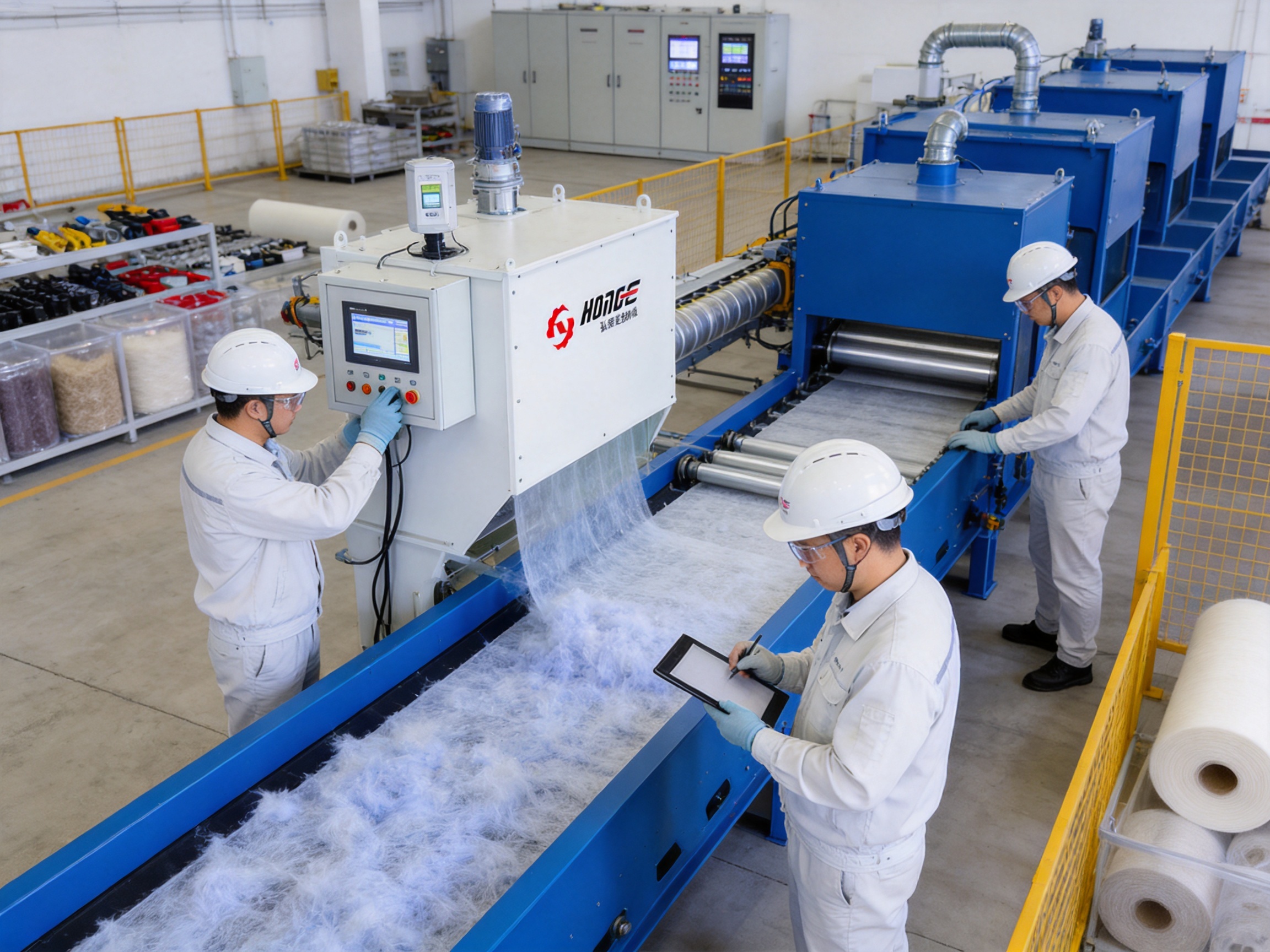
Modern nonwoven fabric production depends on stable fiber preparation. Before fibers can be carded, airlaid, cross-lapped, needle punched, thermally bonded, or processed through another web-forming technology, compressed bale material must be opened, metered, and blended in a controlled way. Inadequate opening can leave dense fiber clusters, while inaccurate proportioning can produce inconsistent web weight, uneven product performance, and unnecessary production waste.
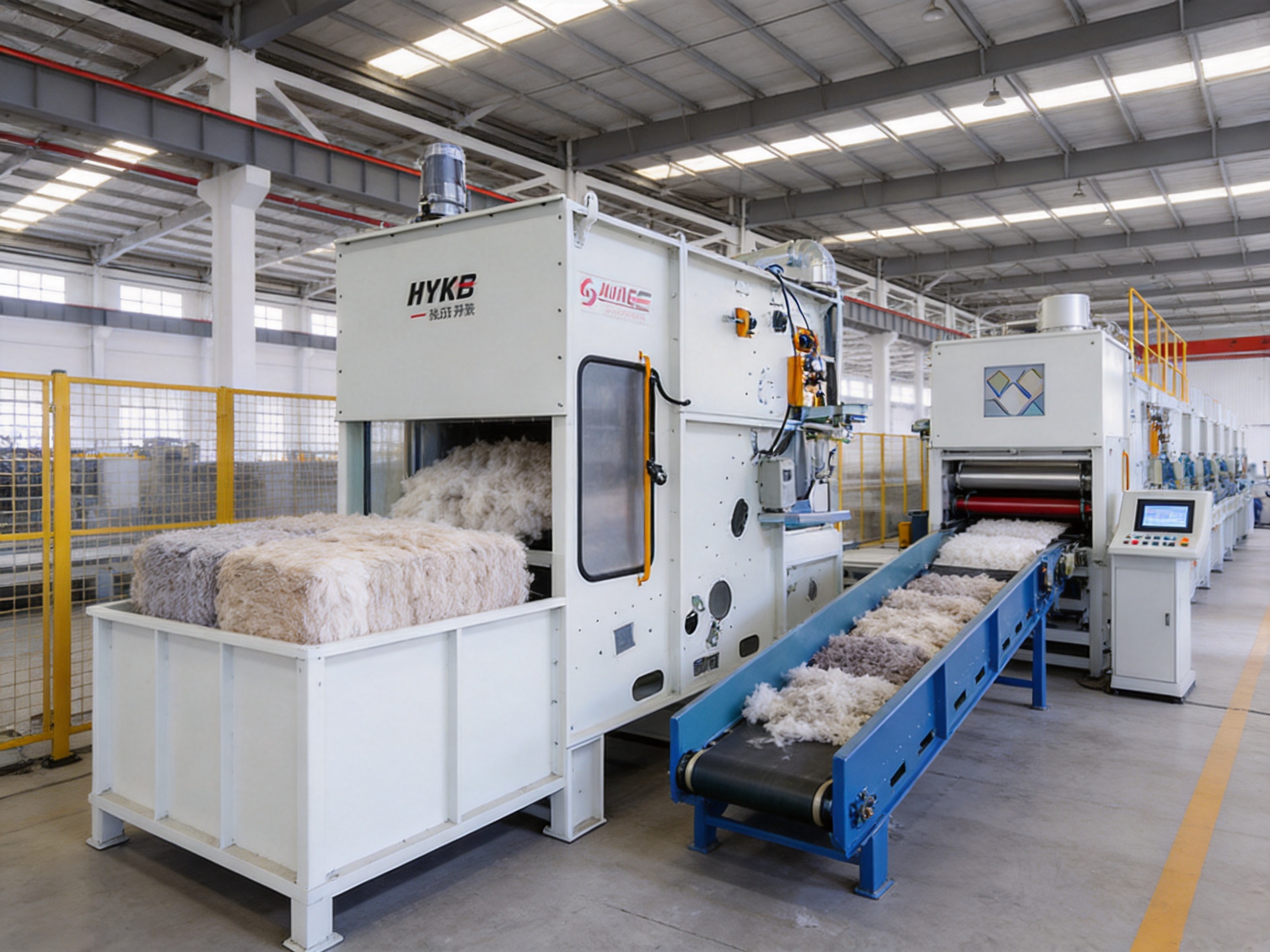
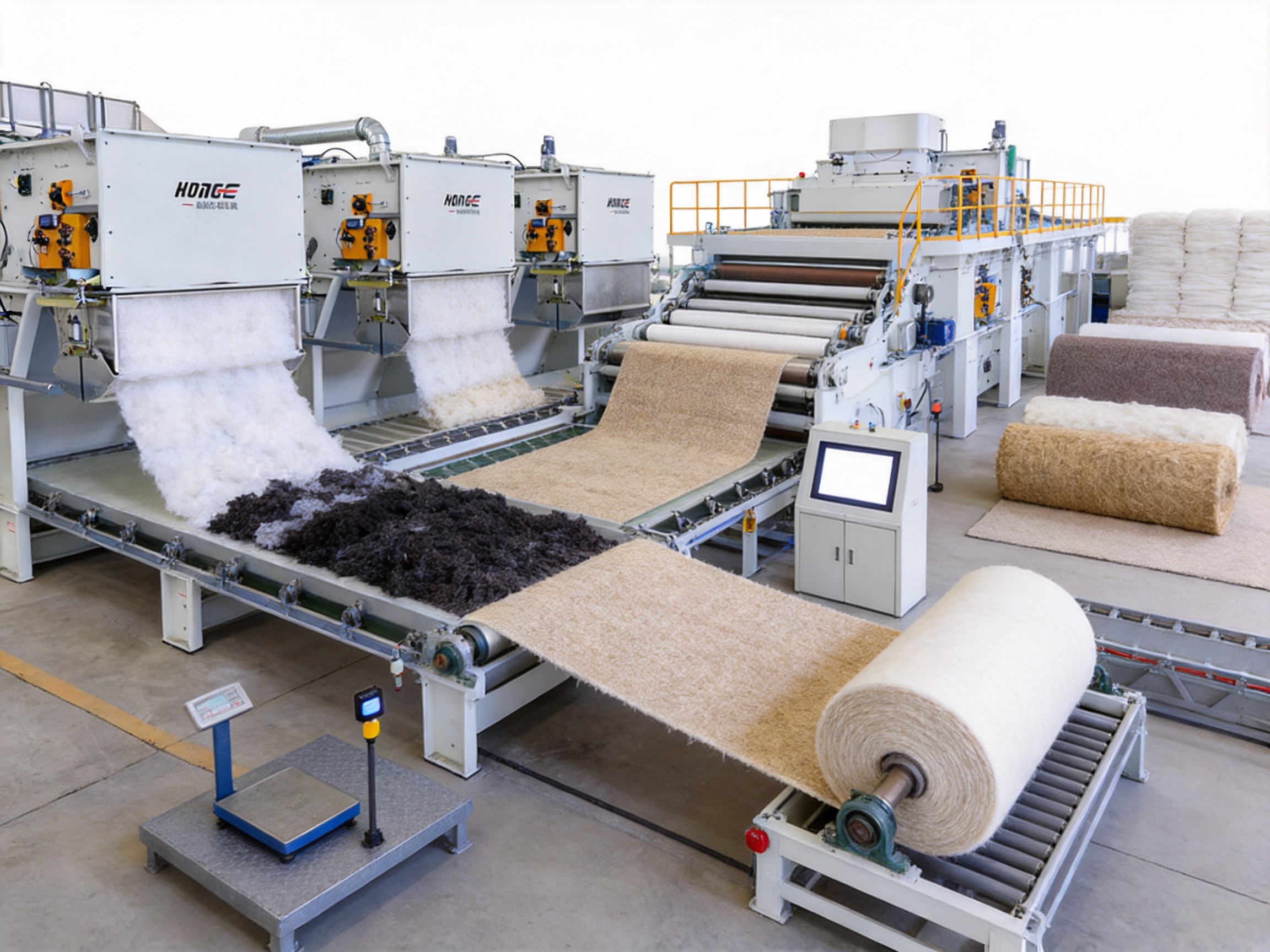
The HYKB Bale Opener is designed to address these requirements in one integrated preparation system. It pre-opens fibers from bales, regulates the feed quantity, weighs material according to predetermined percentages, and transfers the prepared blend through a cross conveyor toward the next stage of production. The equipment is suitable for a broad range of fiber types and can be combined with multiple units when a production line needs to process several raw materials in one operation.
Manufactured by Changshu Hongyi Nonwoven Machinery Co., Ltd., the bale opener is positioned as a practical solution for nonwoven factories that require repeatable fiber preparation, flexible raw-material management, and efficient integration with downstream machinery. Its design combines storage, feeding, pre-opening, weighing, and transfer functions, helping manufacturers reduce manual handling and establish a more consistent production process.
For producers of geotextiles, carpets, filtration materials, automotive interior products, thermal-bonded wadding, cleaning cloths, wool felt, jute felt, and other nonwoven materials, the quality of the opening and blending stage can directly influence final product quality. A reliable bale opener therefore provides more than simple conveying: it becomes an important part of process control and production efficiency.
Why Bale Opening Matters in Nonwoven Manufacturing
Most synthetic and natural fibers arrive at a nonwoven factory in compressed bales. Compression is necessary for transportation and storage, but it means that fibers are compacted into dense blocks. If the material is sent directly to a carding machine, airlay unit, or other forming equipment without sufficient preparation, the downstream machine may receive irregular slugs of fiber rather than a stable and evenly distributed feed.
Pre-opening separates the compressed material into smaller, more manageable tufts. This process helps expose individual fibers, loosen compacted sections, and create a more uniform feed for later opening and web formation. A well-prepared fiber blend can support more stable carding, improve blending uniformity, and reduce the risk of localized heavy or light areas in the finished web.
Blending is equally important. Many nonwoven products are manufactured from combinations of different fibers rather than a single raw material. A producer may combine polyester with recycled fiber, low-melt fiber with structural fiber, or different grades and colors of synthetic material. Other applications may require the controlled addition of natural fibers, reclaimed fibers, or specialty fibers with specific thermal, mechanical, or absorbency characteristics.
When these components are added manually, the actual proportion can vary from batch to batch. Variations may be caused by inconsistent weighing, operator fatigue, differences in bale density, or uneven feeding. The HYKB Bale Opener uses an electronic weighing system to help regulate the quantity of material entering the blend. This supports more repeatable raw-material ratios and gives operators a more systematic method of managing production recipes.
Accurate blending does not replace good process management, but it provides a stronger foundation for it. By improving the consistency of the input material, the bale opener can help downstream equipment operate under more stable conditions. This may contribute to more uniform web formation, more predictable bonding behavior, and improved control of product weight and thickness.
Integrated Three-Part Machine Structure
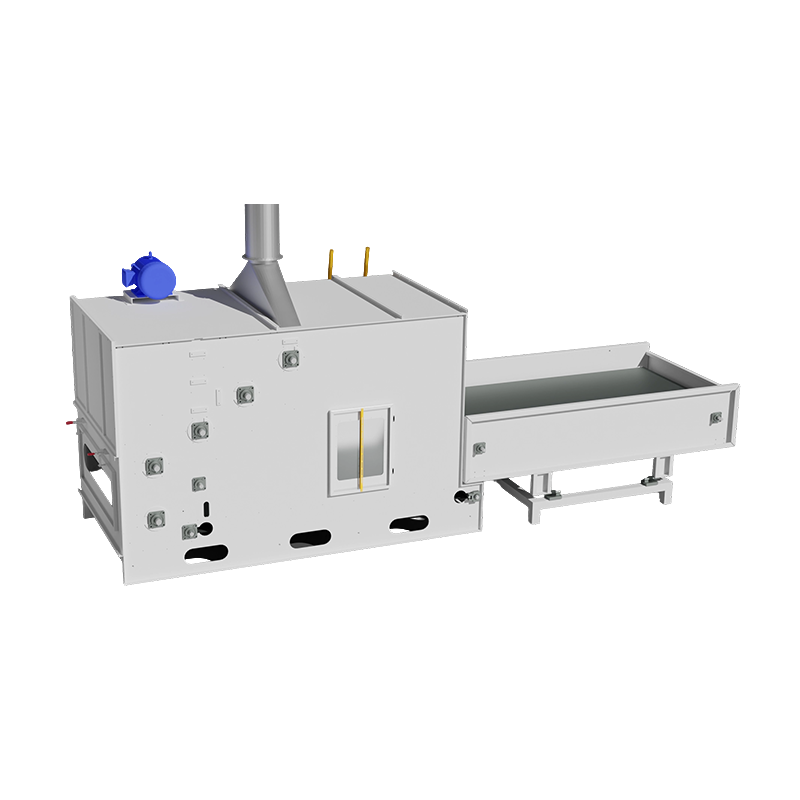
The bale opener is composed of three primary functional sections. Each section contributes to a different stage of material preparation, and the arrangement allows the complete process to be carried out in a continuous sequence.
Front Section: Fiber Storage
The front section provides a holding area for bale-opened material. This storage function allows the machine to receive and temporarily retain fiber while the feeding and weighing stages regulate the material flow. A suitable storage area is important because raw material may not enter the opening zone at a perfectly constant rate, particularly when bales vary in density or when operators are loading different fiber types.
By creating a controlled reserve of material, the front section can help reduce interruptions between bale loading and subsequent processing. It also gives the operator a practical area in which to organize the material supply before it is metered into the next stage.
For factories handling several fiber types, the storage arrangement can support orderly material preparation. Operators can plan the placement of different raw materials according to the required blend and production sequence. The exact loading procedure should be established during commissioning and adjusted according to fiber characteristics, bale dimensions, and the selected production recipe.
Middle Section: Feeding and Pre-Opening
The middle section performs the feeding and pre-opening functions. Its task is to take compacted or partially opened fiber and prepare it for weighing and transfer. The pre-opening stage is especially important for fibers that remain compressed after bale removal.
Effective pre-opening helps break down large clumps and improves the distribution of material before it reaches the electronic weighing stage. The objective is not necessarily to complete the entire opening process in one machine. Instead, the bale opener prepares the raw material so that downstream machines, such as fine openers, carding machines, or airlay systems, can perform their own functions more effectively.
Different fibers respond differently to mechanical opening. Polyester, recycled fibers, short fibers, and other materials may vary in length, cohesion, moisture, and tendency to form clusters. A versatile pre-opening machine should therefore be operated with suitable speed, loading, and maintenance settings for the specific raw material. The HYKB system is intended for use with multiple types of fibers, including PET fiber and other materials used in nonwoven production.
Rear Section: Electronic Weighing and Proportioning
The latter section is responsible for weighing the fibers according to predetermined proportions. Electronic weighing provides a measurable basis for blending rather than relying only on visual estimation or manual loading. Production personnel can establish a target ratio for each fiber component and use the machine to regulate the input quantity.
For example, a product recipe may require one principal fiber together with a smaller percentage of a bonding fiber, recycled component, or performance-enhancing additive fiber. The machine concept allows each component to be managed according to a planned proportion. When several bale openers are used together, multiple fiber streams can be coordinated to create a more complex blend.
The weighing stage is a key advantage for manufacturers that produce different products on the same line. Instead of using a fixed raw-material combination, the factory can adjust the recipe for different product grades, densities, colors, or performance requirements. This flexibility can be valuable for custom production and for factories serving several end-use sectors.
Continuous Material Transfer Through a Cross Conveyor
After pre-opening and weighing, material is transferred by a cross conveyor toward the opener or the next stage of the line. This transfer arrangement helps connect the bale preparation section with downstream equipment while maintaining a defined material path.
A cross conveyor can also support the combination of multiple bale opener units. Where a production recipe contains several fiber types, each unit may be assigned to a specific material. The individual streams can then be brought together in a coordinated sequence before the blend moves forward for further opening, carding, airlaying, or web formation.
The transfer process should be designed around the capacity of the complete line. If the bale opener feeds a carding machine, for example, the conveying rate should be matched to the carding line’s demand. If it feeds an airlay system, the material flow should be coordinated with the airlay’s opening and distribution requirements. Proper integration helps reduce material accumulation, starvation, and unnecessary recirculation.
The cross-conveyor concept also helps reduce manual movement of fiber between separate processing areas. Less manual transfer can support cleaner plant organization, improve labor efficiency, and reduce the risk of accidental mixing between different recipes. The final layout depends on the number of fiber types, the available factory space, the downstream equipment, and the desired production capacity.
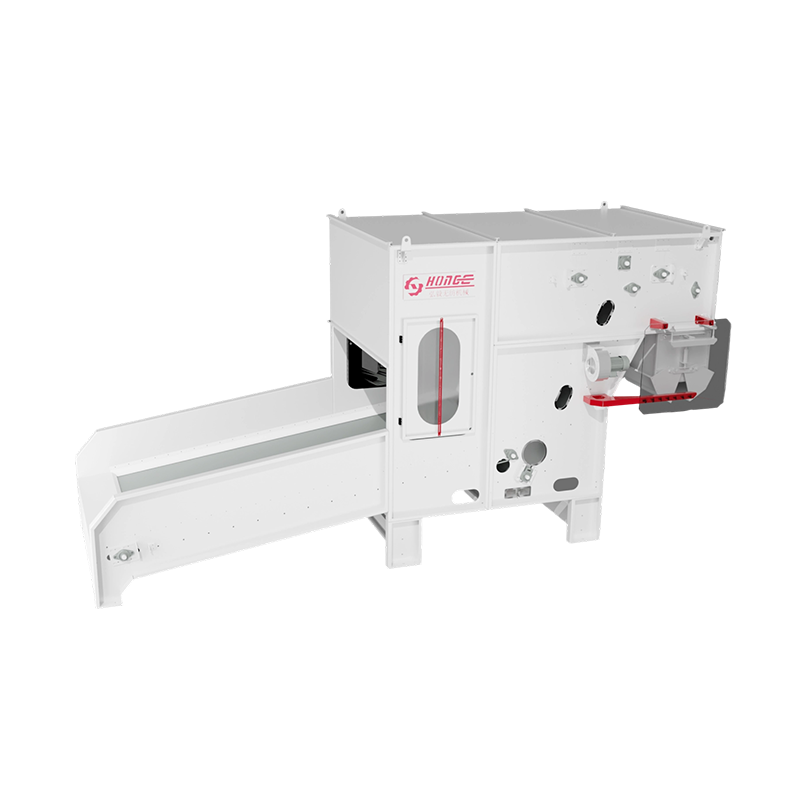
HYKB Bale Opener
Key Advantages of the HYKB Bale Opener
Automated Weighing for More Consistent Blending
One of the most important advantages of the machine is its automatic weighing function. Fiber blending is often highly sensitive to proportion. A small change in the ratio between structural and bonding fibers can affect bonding strength, softness, bulk, thermal response, and the overall cost of the finished product.
Manual weighing can be slow and difficult to maintain at high production volumes. It may also introduce differences between shifts or operators. By using an electronic scale, the bale opener provides a more systematic approach. The target amount can be determined in advance, and the machine can feed material according to the required proportion.
Automatic weighing also makes production documentation easier. Operators can record the planned recipe, compare material consumption with production output, and identify unusual variations. While the machine still requires proper calibration, inspection, and supervision, electronic measurement offers a stronger foundation for repeatable production than visual estimation alone.
Compatibility with Multiple Fiber Types
The HYKB Bale Opener is intended for the preparation of different fiber materials used in nonwoven production. The supplied information identifies PET fiber and other raw materials as applicable materials. Depending on the final configuration and process conditions, the equipment may be incorporated into production systems handling synthetic, recycled, blended, or selected natural fibers.
Multi-fiber compatibility is valuable because nonwoven manufacturers often need to change recipes. A factory may produce one product with a high percentage of polyester, another with recycled content, and a third with a thermal bonding component. A machine designed around a flexible blending concept can support these changes more effectively than equipment intended for only one fixed material.
Material compatibility should always be confirmed during technical planning. Fiber length, denier, crimp, moisture, contamination level, bale density, and cohesion can affect opening performance. Hongyi’s engineering team can use the customer’s raw-material information and product requirements to determine the appropriate machine arrangement and supporting equipment.
Expandable Multi-Unit Configuration
The system allows several sets to be combined to accommodate multiple fiber types in a single operation. This is a significant advantage for factories that need more than a simple single-fiber feed. A multi-unit arrangement can provide separate feeding control for each component and enable the production team to adjust the recipe more precisely.
In comparison with a basic single-hopper system, a multi-unit bale-opening arrangement can offer greater flexibility for complex blends. It can also help organize the production line around defined material streams. Each bale opener can be assigned to a particular fiber, while the downstream transfer system brings the streams together according to the production plan.
The number of units required depends on the recipe, capacity, factory layout, and level of automation. A simple product may require only one machine, while a multi-layer or performance-oriented nonwoven product may benefit from several coordinated units.
Improved Downstream Stability
Downstream machinery performs more consistently when the incoming material is sufficiently opened and supplied at a stable rate. The bale opener helps prepare the fiber before it enters the more precise stages of the production line.
A more uniform feed can reduce sudden surges and interruptions. It may also help carding machines receive a more consistent quantity of material, allowing operators to control web weight and fiber orientation more effectively. In airlay production, a well-prepared feed can support more even dispersion and reduce the formation of large fiber clusters.
The bale opener is therefore not an isolated machine. Its value is measured partly by how well it supports the complete nonwoven line. An efficient opening and blending stage can improve the utilization of carding, airlay, needle punching, thermal bonding, and winding equipment.
Flexible Working Widths
The available working widths are listed as 1 meter, 1.2 meters, 1.4 meters, 1.6 meters, and 2 meters. This range allows the equipment to be selected according to the planned production width and the dimensions of the downstream line.
Working width affects factory layout, material distribution, production capacity, and compatibility with other machinery. A compact line may use a narrower width to reduce installation space, while a larger geotextile or industrial-felt line may require a wider arrangement. Selecting a suitable width at the planning stage helps reduce the need for later modifications.
Width selection should be evaluated together with the fiber type, target output, line speed, and downstream machine configuration. The widest model is not automatically the best choice; the correct model is the one that provides balanced capacity and reliable integration within the complete line.
Automatic Operation with Customizable Configuration
The equipment is identified as automatic and customizable. Automatic operation can reduce repetitive manual tasks and support more consistent control of feeding and weighing. Customization allows the equipment to be adapted to the customer’s raw materials, production capacity, available space, voltage requirements, and downstream machinery.
Customization may involve working width, number of units, conveyor arrangement, control configuration, electrical specifications, and connection points. The final engineering design should be established before production so that the machine can be manufactured and tested according to the customer’s actual process requirements.
For international buyers, electrical voltage and frequency must be confirmed in advance. The product information lists 220 V or customized voltage. The final electrical design should correspond to the installation country and the customer’s plant power system.
Application Areas in Nonwoven Fabric Production
Needle-Punched Geotextiles
Geotextile production commonly requires high-throughput fiber preparation and a stable blend. The final products may be used for drainage, filtration, separation, reinforcement, erosion control, or road construction. A bale opener can prepare synthetic or blended fibers before carding and cross-lapping, helping the line maintain a more consistent input.
For geotextiles, recipe control may affect tensile strength, elongation, puncture resistance, thickness, and mass per unit area. Automatic weighing is useful when manufacturers need to combine different grades of polyester, polypropylene, recycled fiber, or other components.
Nonwoven Carpets and Floor Coverings
Carpet and floor-covering production may require specific blends to achieve the desired bulk, surface appearance, resilience, and dimensional stability. Different fibers can be added in controlled percentages to balance cost and performance.
A multi-unit bale opener arrangement can help manufacturers handle several fiber colors or grades. This is particularly useful for plants producing different carpet constructions or changing designs frequently. The bale opener can serve as the first controlled stage in a line that later includes carding, needling, backing, bonding, and cutting.
Automotive Interior Materials
Automotive interior products often require careful control of thickness, weight, acoustic performance, thermal behavior, and mechanical strength. Production may involve polyester fibers, recycled fibers, low-melt fibers, and other specialized components.
The bale opener supports this sector by helping operators establish repeatable raw-material recipes. Stable blending can contribute to consistent web formation and bonding. The exact process depends on whether the finished product is used for roof lining, trunk trim, door panels, wheel-arch liners, insulation, or another interior application.
Thermal-Bonded Wadding
Thermal-bonded wadding frequently uses a combination of structural fibers and low-melting fibers. The ratio between these components must be controlled because it influences the bonding response in the thermal oven or heat-setting equipment.
The bale opener can weigh and combine the required components before the material is opened further and formed into a web. A more stable blend can help the line achieve more consistent bonding, bulk, recovery, and softness, provided that the downstream temperature, residence time, and airflow are correctly set.
Cleaning Cloths and Industrial Felts
Cleaning cloths, wiping materials, polishing products, and industrial felts may use a variety of recycled or virgin fibers. The desired properties can include absorbency, durability, softness, lint control, filtration, or abrasion resistance.
By supporting controlled blending, the bale opener can help manufacturers adjust material properties for different applications. Recycled fibers may be combined with stronger virgin fibers, or different fiber lengths may be managed to achieve the required balance between processing performance and product cost.
Wool Felt and Jute Felt
Natural fibers such as wool and jute require careful handling because their physical characteristics differ from those of synthetic fibers. Fiber moisture, length, cohesion, and contamination can influence opening behavior. When properly configured, a bale-opening system can assist with the initial preparation and proportioning of these materials.
Natural-fiber processing should be evaluated through testing before full-scale production. The machine settings and feeding method should be matched to the material so that excessive fiber damage, uneven feeding, or contamination is minimized.
Technical Specification Overview
| Product name | HYKB Bale Opener |
| Primary application | Nonwoven fabric production |
| Main function | Fiber pre-opening, automatic weighing, proportioning, and transfer |
| Working widths | 1 m, 1.2 m, 1.4 m, 1.6 m, and 2 m |
| Indicative capacity | 200 kg/h or 300 kg/h |
| Installed power listed | 3.75 kW |
| Electrical specification | 220 V or customized |
| Automation level | Automatic |
| Raw materials | PET fiber and other suitable fibers |
| Certification information | CE and ISO9001:2000 listed in the supplied specifications |
| Condition | New |
| Customization | Available according to production requirements |
| Warranty | One year or 12 months |
| Approximate lead time | Two to three months, subject to final configuration |
| Production location | Changshu, Jiangsu, China |
| HS code information | 84490090 or 8449009000 as listed in the supplied documentation |
The supplied product information contains both a 3.75 kW installed-power entry and a separate 24 W power entry. These values may refer to different electrical components or data fields in different specification systems. Buyers should confirm the complete electrical load, motor configuration, control-system requirements, and power consumption with the manufacturer before placing an order.
Capacity is also influenced by fiber type, bale density, blend ratio, working width, operating speed, and the configuration of the complete line. The stated 200 kg/h and 300 kg/h figures should therefore be treated as indicative values until the raw materials and process conditions have been reviewed.
Manufacturing Strengths and Engineering Capabilities
Changshu Hongyi Nonwoven Machinery Co., Ltd. has more than 20 years of experience in the nonwoven machinery field. The company operates as a manufacturer and trader, providing individual machines as well as complete nonwoven production lines. This combination of product knowledge and line-integration experience is important when a bale opener must work with carding, airlay, needle punching, thermal bonding, winding, cutting, or auxiliary equipment.
A machine supplier that understands only one unit may have difficulty resolving problems that occur at the interface between machines. By contrast, a company experienced in complete production lines can evaluate the opening, blending, feeding, forming, bonding, and finishing stages as one process. This broader perspective can help customers select equipment that is better balanced with their production objectives.
Complete Nonwoven Line Experience
The company’s product range includes needle-punched geotextile production lines, nonwoven carpet lines, airlaid waste-felt lines, automotive interior-material lines, needle-punching cleaning-cloth lines, wool-felt lines, and jute-felt lines. Its individual machines include bale openers, carding machines, airlay machines, ironing machines, needle punching machines, and thermal-bonding wadding ovens.
This range demonstrates that the bale opener can be considered within a broader process rather than as a stand-alone piece of equipment. The company can use its understanding of downstream requirements to help define the feeding capacity, working width, conveyor path, and control arrangement.
Engineering for Different Markets
Hongyi equipment has been supplied to customers in more than 20 countries, including Mexico, Argentina, Brazil, Turkey, Algeria, Egypt, Bangladesh, Vietnam, and Thailand. International supply experience requires attention to electrical standards, factory conditions, installation procedures, documentation, spare parts, and communication across different operating environments.
Export experience can also support more practical project planning. Customers may need assistance with layout drawings, utility requirements, shipping arrangements, commissioning, operator training, and production testing. These elements are especially important for a bale opener because its performance depends on proper connection to the rest of the nonwoven line.
Focus on Automation and Energy Awareness
The company emphasizes automatic control systems, energy-saving capabilities, reliability, quality, advanced technology, and precision engineering. For a fiber-opening machine, automation can help regulate material flow and reduce the amount of repetitive manual intervention required during normal operation.
Energy performance depends on motor selection, operating speed, material throughput, maintenance condition, and the complete line configuration. A machine that is correctly matched to its capacity can avoid unnecessary overloading or underutilization. Buyers should request a final power list and operating-cost estimate based on their specific configuration.
Factory-Direct Customization
Customized machinery is particularly useful in nonwoven production because raw materials and product specifications vary widely. A line designed for a lightweight thermal-bonded wadding may differ significantly from a line for heavy geotextile or dense industrial felt.
Customization can address working width, number of bale opener units, fiber recipe, conveyor direction, layout, control interface, voltage, safety configuration, and downstream connection. Factory-direct communication can reduce the number of intermediaries involved in technical confirmation and make it easier to coordinate changes before manufacturing begins.
How the Bale Opener Compares with Basic Feeding Systems
Basic feeding systems may perform only one function, such as moving material from one location to another. They may not include integrated pre-opening, electronic weighing, or multi-fiber coordination. Such systems can be suitable for simple production processes, but they may provide limited control when a factory uses complex blends or needs repeatable recipes.
The HYKB Bale Opener combines several important preparation functions. It stores fiber, feeds and pre-opens the material, weighs it according to predetermined proportions, and transfers the prepared material to the next stage. This integrated design can reduce the need for separate manual operations and simplify the raw-material path.
Compared with a manual weighing process, the electronic weighing arrangement can improve repeatability and make recipe management more systematic. Compared with a single-material feeder, the multi-unit concept can provide greater flexibility for blended production. Compared with a simple bale breaker, the combination of pre-opening and controlled transfer can offer a more complete connection to the downstream nonwoven line.
These advantages should not be understood as a guarantee that the machine will automatically solve every fiber-processing problem. The final result depends on correct machine selection, raw-material preparation, operating settings, maintenance, and the performance of the complete production system. However, the integrated design gives manufacturers more process-control options than a basic conveying unit.
Recommended Project Planning Process
Step One: Define the Product and Recipe
The first step is to identify the final product, target basis weight, thickness, width, strength, softness, bonding method, and intended application. The customer should also provide the planned percentage of each fiber in the blend.
Different product requirements can lead to different bale-opener configurations. A product made from one fiber may need a simple arrangement, while a high-performance composite may require several units and a more advanced control system.
Step Two: Provide Detailed Raw-Material Information
Technical planning should include fiber type, fiber length, denier, crimp, moisture, bale size, bale density, recycled content, contamination level, and any special handling requirements. Samples may be requested for testing or evaluation.
Raw-material information is important because fibers with different cohesion and lengths may require different opening conditions. It also helps the manufacturer estimate actual capacity and determine whether additional opening or filtration equipment is necessary.
Step Three: Match the Working Width and Capacity
The working width should match the width of the carding machine, airlay machine, cross lapper, or other downstream equipment. Capacity should be calculated from the required production output rather than selected only from a nominal machine rating.
When the bale opener is too small for the downstream line, the entire production system may be limited by material preparation. When it is unnecessarily large, the investment and energy consumption may not be optimized. A balanced design is generally more effective than selecting individual machines without considering the complete line.
Step Four: Confirm Layout and Utilities
The factory layout should allow space for bale storage, operator access, cleaning, inspection, maintenance, and material flow. The location of electrical panels, conveyors, control cabinets, compressed air systems if required, and downstream machines should be reviewed before production begins.
Utility requirements should include electrical voltage, frequency, installed power, grounding, lighting, ventilation, and any dust-control provisions. The customer should also confirm whether the machine will be installed in a new facility or added to an existing production line.
Step Five: Approve the Technical Specification
Before ordering, the customer and supplier should confirm the working width, capacity target, number of units, raw materials, blend ratios, control method, safety devices, voltage, delivery scope, packaging, spare parts, warranty, and installation responsibilities.
Any inconsistent data in preliminary specifications should be clarified at this stage. In particular, the final motor power and total electrical load should be documented clearly. A signed technical specification provides a useful reference for manufacturing, factory acceptance, installation, and after-sales service.
Installation, Commissioning, and After-Sales Support
The supplied trade information states that the equipment includes a one-year warranty or 12-month warranty. It also states that the manufacturer can send two or three workers for installation and commissioning at the buyer’s request. The buyer is responsible for round-trip air tickets, accommodation, and an allowance listed as 180 USD per person per day.
Installation should be carried out on a suitable foundation with adequate access around the machine. The bale opener should be leveled and aligned with the connected conveyor and downstream equipment. Electrical wiring, control signals, emergency stops, guards, and grounding should be checked before trial operation.
Commissioning should begin with an empty-machine inspection. Operators can verify conveyor direction, motor rotation, sensor response, weighing-system operation, emergency-stop function, and control-panel signals. Material testing should then be performed with the actual fiber types and a controlled quantity of raw material.
During production testing, the team should check opening quality, material flow, weighing accuracy, blend consistency, conveyor transfer, noise, vibration, dust generation, and the condition of fibers after processing. Adjustments should be documented so that operators have a clear reference for normal operation.
Training should cover safe loading, recipe setting, start-up and shutdown procedures, cleaning, inspection, weighing-system calibration, troubleshooting, and preventive maintenance. Operators should understand that the bale opener is part of an interconnected production line. Changes in downstream speed can affect the required feeding rate, and changes in raw material can affect opening behavior.
Maintenance and Operational Best Practices
Regular cleaning is essential in fiber-processing machinery. Accumulated lint and dust can affect sensors, moving parts, conveyors, electrical components, and weighing accuracy. Cleaning intervals should be based on the fiber type, production hours, dust level, and factory conditions.
Operators should inspect conveyor surfaces, drive components, bearings, guards, fasteners, and fiber-contact areas. Any abnormal noise, vibration, overheating, material accumulation, or irregular feeding should be investigated promptly.
The electronic weighing system should be checked and calibrated according to the manufacturer’s instructions. If the scale is not level, if material builds up around the weighing area, or if sensors are obstructed, the measured quantity may not represent the actual fiber flow.
Recipe changes should be recorded. A production log can include the fiber type, blend percentage, working width, operating speed, output, and observed quality. This information helps operators reproduce successful settings and identify the cause of variation when a problem occurs.
Maintenance personnel should follow lockout and isolation procedures before entering the machine or removing guards. Fiber-opening equipment contains moving parts that can cause serious injury if accessed while running. Safety training and documented procedures are essential for every shift.
Benefits for Production Efficiency and Product Quality
The bale opener can support production efficiency by reducing manual material handling, organizing the raw-material path, and automating the weighing stage. These benefits may be especially noticeable in factories that use several fiber components or frequently change production recipes.
More consistent raw-material preparation can also help reduce quality variation. If the blend is stable, downstream operators may have better control of web weight, thickness, bonding, strength, and appearance. The extent of the improvement depends on the complete line, but the bale opener provides an important starting point for process stability.
Material waste may be reduced when the line receives a more predictable feed and when operators can control the recipe more accurately. Waste reduction also depends on bale quality, fiber cleanliness, line settings, operator training, and the handling of production changeovers.
The machine can contribute to labor efficiency by reducing repeated weighing and manual transfer. Workers can focus more on monitoring the process, checking quality, loading bales, and carrying out scheduled maintenance. Automation does not eliminate the need for skilled operators; instead, it allows their time to be used more effectively.
Quality Control from Raw Material to Finished Web
A bale opener should be included in the factory’s overall quality-control system. Incoming bales should be checked for fiber type, color, moisture, contamination, packaging damage, and traceability. Incorrect or contaminated material can affect the blend and may cause problems in opening, carding, bonding, or final product performance.
During bale opening, operators should monitor the condition of the fiber. Excessive fiber damage, large unopened clumps, or irregular transfer may indicate an unsuitable setting or a mechanical issue. The material should be sampled periodically to confirm that the blend is visually and quantitatively consistent.
At the downstream stage, the production team can compare basis weight, thickness, tensile strength, elongation, tear resistance, absorbency, thermal behavior, or other product properties against the target specification. If variation is detected, the investigation should consider the bale opener, weighing system, carding or airlay equipment, web-forming process, bonding conditions, and finishing equipment.
Quality control is strongest when information is shared across the complete production line. A stable bale-opener output can support reliable processing, but every later stage must also be correctly adjusted and maintained.
Purchasing Considerations for International Buyers
International buyers should request a complete technical proposal that includes machine dimensions, working width, output range, installed power, electrical requirements, control-system details, spare parts, packaging method, and installation scope. The supplied information lists nude packing or wooden-case packaging in one section and nude packing or PE film in another. The final packaging method should be confirmed according to the shipping route and buyer’s requirements.
Trade terms should also be documented clearly. The supplied payment condition is 30 percent deposit by telegraphic transfer, with the remaining 70 percent payable before delivery. The indicated delivery period is approximately 60 working days after receipt of the remaining payment in one entry, while another entry states a two-to-three-month lead time. Buyers should confirm the applicable schedule in the commercial contract.
Shipping documents, packing lists, electrical drawings, operation manuals, spare-parts lists, inspection records, and certificates should be agreed before dispatch. For a complete line, the buyer should also confirm whether the supplier is responsible for layout design, installation, commissioning, operator training, and performance testing.
The manufacturer’s address is No. 52, Jinxiu Avenue, Zhitang Town, Changshu City, Suzhou City, Jiangsu Province, China. Contact can be arranged through the company’s sales and technical departments using the supplied telephone and email information.
Frequently Asked Questions
What is the main function of the HYKB Bale Opener?
The machine pre-opens fiber from bales, feeds and weighs material according to predetermined proportions, and transfers the prepared material to the next stage through a cross conveyor. It is designed for fiber preparation and blending in nonwoven production lines.
Can the bale opener process more than one fiber type?
Yes. The system is designed to work with multiple fiber types, including PET fiber and other suitable materials. Several bale opener units can be combined so that different fibers are handled in one coordinated blending operation.
How does automatic weighing improve production?
Automatic weighing provides a measurable method for controlling the amount of each fiber component. It can reduce dependence on manual estimation and help manufacturers maintain more consistent recipes between batches and production shifts.
What working widths are available?
The listed working widths are 1 meter, 1.2 meters, 1.4 meters, 1.6 meters, and 2 meters. The correct width should be selected according to the downstream line, factory layout, target output, and required web width.
What is the expected capacity?
The supplied specification lists 200 kg/h and 300 kg/h. Actual capacity depends on the fiber type, bale density, blend ratio, working width, operating conditions, and complete line configuration. A final capacity should be confirmed after reviewing the customer’s raw materials and process requirements.
Can the machine be customized?
Yes. The product information identifies the machine as customizable. Possible customization areas include working width, number of units, conveyor arrangement, electrical voltage, control configuration, layout, and connection with downstream equipment.
What types of nonwoven products can use this machine?
The bale opener can be used as part of lines for geotextiles, nonwoven carpets, automotive interior materials, thermal-bonded wadding, airlaid felt, cleaning cloths, wool felt, jute felt, and other nonwoven products that require controlled fiber preparation.
Is the machine suitable for recycled fibers?
It may be suitable for recycled fibers, provided that the fiber properties and contamination level are compatible with the machine and the complete production line. Testing and technical confirmation are recommended because recycled materials can vary in length, cohesion, moisture, and cleanliness.
What electrical voltage is available?
The supplied information lists 220 V or customized voltage. The buyer should provide the local electrical standard and confirm the final voltage, frequency, motor rating, control-system requirements, and total installed power before production.
What warranty is provided?
The supplied information states a one-year or 12-month warranty. The commercial contract should define the warranty scope, excluded parts, response procedure, spare-parts policy, and customer responsibilities.
Does the supplier provide installation support?
According to the supplied trade information, the supplier can send two or three workers for installation and commissioning at the buyer’s request. The buyer is responsible for travel tickets, accommodation, and the listed daily allowance.
How should the weighing system be maintained?
The weighing area should be kept clean, level, and free from fiber accumulation. Sensors and related components should be inspected regularly, and calibration should be performed according to the manufacturer’s instructions. Any unusual variation in blend ratio should be investigated promptly.
How long is the delivery period?
The supplied information gives approximately 60 working days after receipt of the remaining payment in one section and two to three months in another. The final delivery schedule should be confirmed in the order contract after the technical configuration is approved.
Conclusion
The HYKB Bale Opener provides an integrated approach to one of the most important early stages in nonwoven production. By combining fiber storage, feeding, pre-opening, electronic weighing, proportioning, and cross-conveyor transfer, it helps manufacturers establish a more organized and controllable raw-material process.
Its main advantages include automatic weighing, compatibility with multiple fiber types, expandable multi-unit operation, flexible working widths, customized configuration, and suitability for integration with carding, airlay, needle-punching, thermal-bonding, winding, and cutting equipment. These functions can help improve blending repeatability, reduce manual handling, and support more stable downstream production.
Changshu Hongyi Nonwoven Machinery Co., Ltd. adds value through more than two decades of nonwoven machinery experience, complete production-line capability, international project experience, and a product range covering both individual machines and complete systems. Its manufacturing and engineering approach is intended to support practical, reliable, and customized nonwoven production solutions.
For buyers evaluating a bale opener, the best selection should be based on the full production requirement rather than on capacity alone. Raw materials, blend ratios, working width, downstream equipment, electrical conditions, factory layout, installation, maintenance, and after-sales service should all be reviewed together. With a properly engineered configuration, the bale opener can become a valuable foundation for consistent, efficient, and flexible nonwoven fabric production.
References
1. Product specification and trade information supplied for the HYKB Bale Opener.
2. Changshu Hongyi Nonwoven Machinery Co., Ltd. company information and nonwoven machinery product portfolio.
3. General principles of fiber opening, blending, carding, web formation, and bonding in nonwoven manufacturing.
4. General industrial practices for electronic weighing, conveyor integration, machinery commissioning, and preventive maintenance.
5. General quality-control principles for synthetic, recycled, and natural fibers used in nonwoven fabric production.