

Content
- 1 1. The Role of Edge Preparation in Nonwoven Manufacturing
- 2 2. Product Overview
- 3 3. Main Advantages of the Pre-Edge Cutting Device
- 3.1 3.1 Dedicated Edge-Processing Function
- 3.2 3.2 Improved Edge Flatness and Consistency
- 3.3 3.3 Programmable Control
- 3.4 3.4 Wide Working-Width Options
- 3.5 3.5 Compatibility with Different Fiber Materials
- 3.6 3.6 Easy Integration into Automated Lines
- 3.7 3.7 Modular Maintenance and Tool Replacement
- 3.8 3.8 Rugged Construction
- 4 4. Advantages Compared with Less Specialized Solutions
- 5 5. Manufacturing Strengths Behind the Equipment
- 6 6. How the Device Works within a Production Line
- 7 7. Applications in Different Nonwoven Products
- 8 8. Operation, Maintenance, and Safety
- 9 9. Purchasing and Project Planning Considerations
- 10 10. Installation and Commissioning Support
- 11 11. Quality and Productivity Benefits
- 12 12. Why Supplier Capability Matters
- 13 13. Frequently Asked Questions
- 13.1 Q1: What is the main purpose of the HYYQ Pre-Edge Cutting Device?
- 13.2 Q2: What is the standard working width?
- 13.3 Q3: What is the operating-speed range?
- 13.4 Q4: Which materials can be processed?
- 13.5 Q5: Is the machine automatic?
- 13.6 Q6: Can the voltage be customized?
- 13.7 Q7: Can the device be added to an existing line?
- 13.8 Q8: How does the device improve production quality?
- 13.9 Q9: What maintenance is required?
- 13.10 Q10: Is factory inspection available?
- 13.11 Q11: What is the lead time?
- 13.12 Q12: What warranty is offered?
- 13.13 Q13: Can the machine color and configuration be customized?
- 13.14 Q14: Does the supplier provide complete nonwoven production lines?
- 13.15 Q15: What information should be provided for a quotation?
- 14 14. Conclusion
- 15 References
- 16 Product: HYYQ Nonwoven Fabric Machinery Pre-Edge Cutting Device
Nonwoven fabric production depends on the stable handling of fiber webs at every stage of the manufacturing process. Before a web enters a needle punching machine, thermal bonding unit, winding system, slitting station, laminating machine, or other downstream equipment, its width and edge condition must be carefully controlled. Uneven edges, excessive fringe, irregular width, and uncontrolled fiber migration can affect product appearance, running stability, material utilization, and final quality.
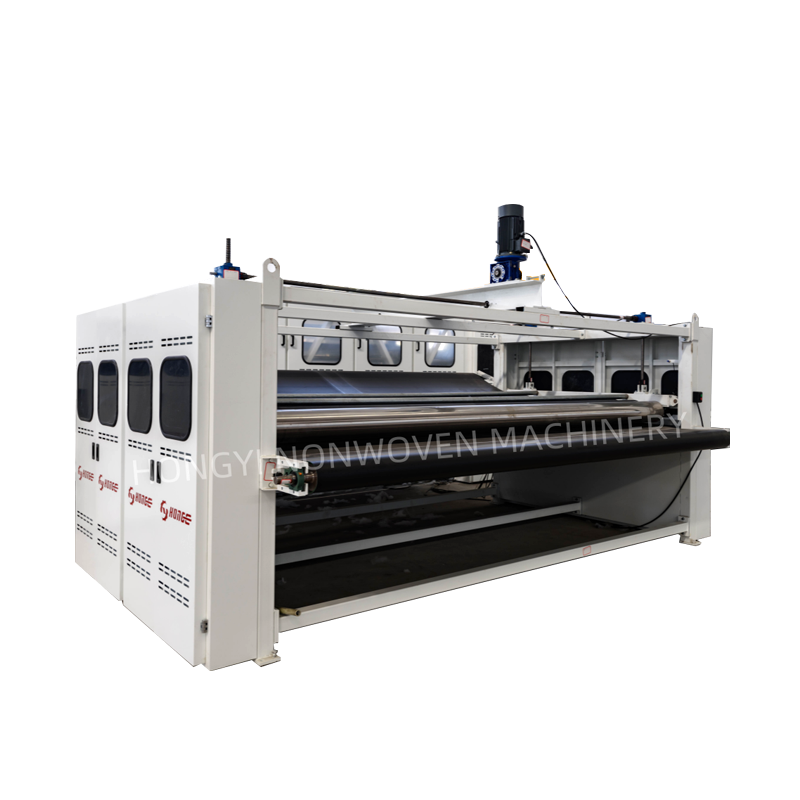
The HYYQ Nonwoven Fabric Machinery Pre-Edge Cutting Device is designed to solve this important preparation problem. It provides a dedicated, independent process for pre-cutting the edges of fiber webs before the next production stage. By working according to preset operating data, the device helps create a more consistent web width and a flatter, cleaner edge. It can be integrated into automated nonwoven production lines and configured for different production requirements, raw materials, working widths, and control preferences.
Although edge cutting may appear to be a relatively simple operation, it has a direct influence on the overall performance of a nonwoven line. A web that enters the next process with unstable or damaged edges can cause tracking problems, uneven bonding, wrinkling, edge folding, waste accumulation, and inconsistent product dimensions. A dedicated pre-edge cutting device allows manufacturers to address these risks at an early stage rather than attempting to correct them later.
Manufactured by Changshu Hongyi Nonwoven Machinery Co., Ltd., the HYYQ device reflects the company’s experience in nonwoven machinery design, production, system integration, and international service. The company develops individual machines as well as complete production lines for needle-punched geotextiles, carpets, airlaid materials, automotive interior materials, cleaning cloths, wool felt, jute felt, and other nonwoven products.
This article explains the operating purpose, technical characteristics, manufacturing value, application advantages, integration possibilities, and purchasing considerations associated with the HYYQ Pre-Edge Cutting Device.
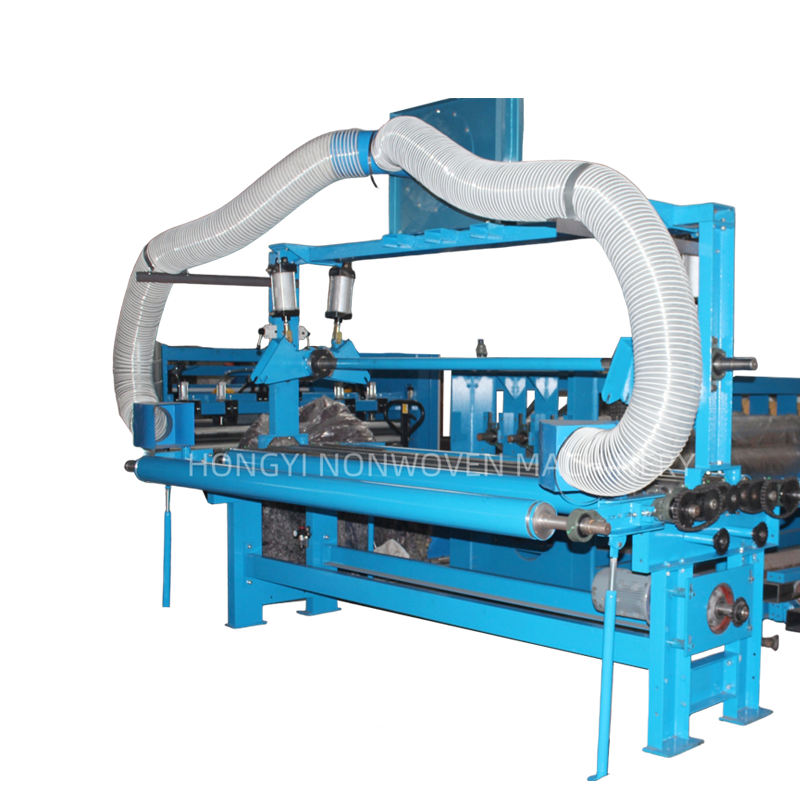
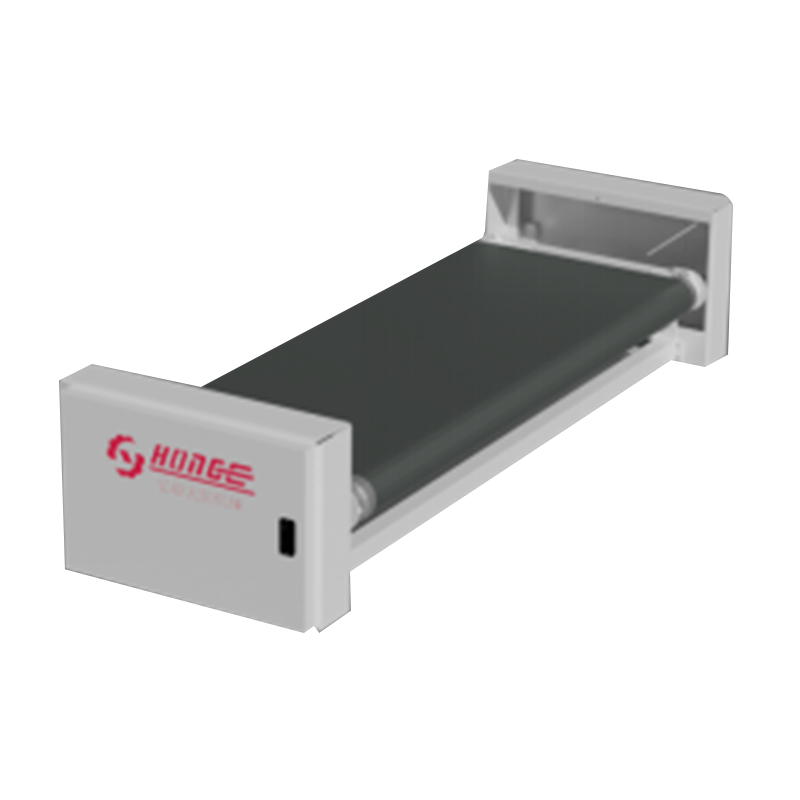
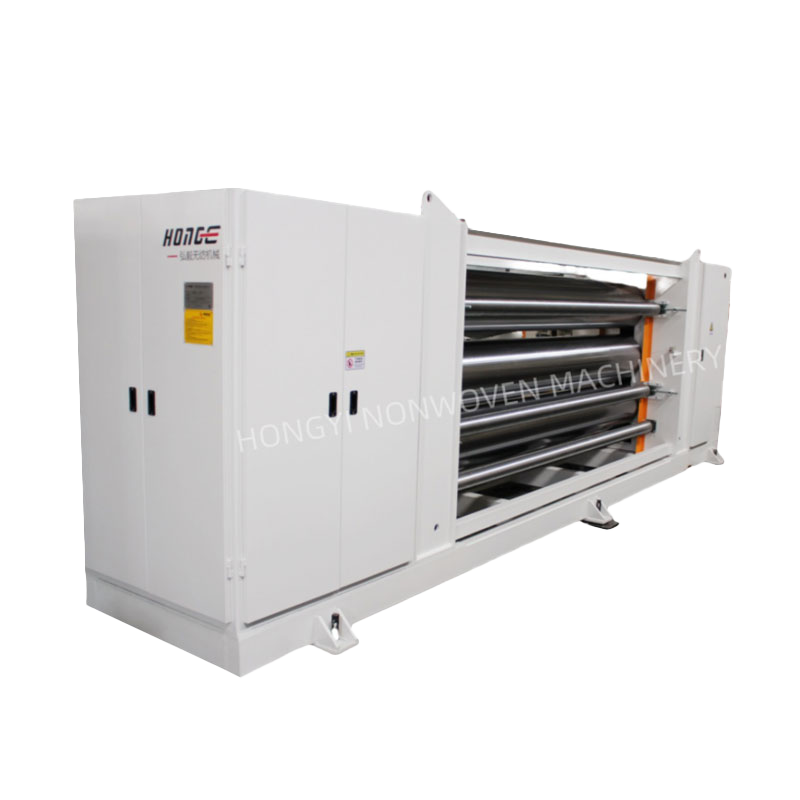
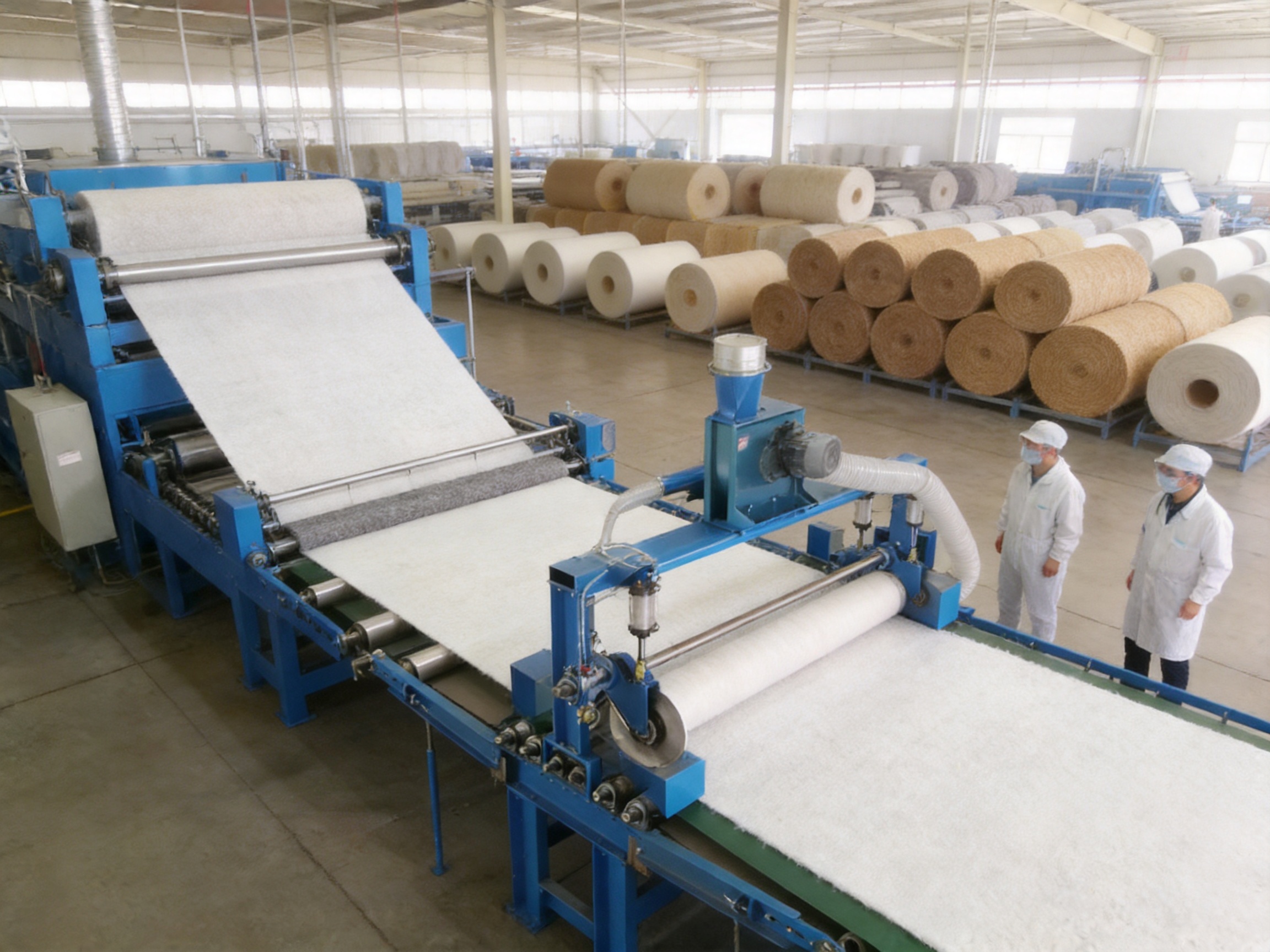
HYYQ Nonwoven Fabric Machinery Pre-Edge Cutting Device
1. The Role of Edge Preparation in Nonwoven Manufacturing
Nonwoven webs are made by arranging fibers into a loose or semi-formed structure. Depending on the production method, the web may be created by carding, airlaying, crosslapping, thermal forming, or another fiber-opening and web-forming process. At this stage, the material may have a variable edge profile. Fibers can extend beyond the intended width, and the edge may not yet be suitable for precise downstream processing.
When a web moves continuously through a production line, even a small edge irregularity can become a larger operating issue. Loose fibers may catch on machine components, contact guide rollers, or interfere with a bonding surface. A web that is slightly wider on one side can also develop tension differences across its width. Over time, these differences may lead to diagonal movement, folds, creases, or uneven thickness.
Pre-edge cutting provides a controlled method for removing unwanted edge material before the web reaches a more sensitive operation. The purpose is not simply to reduce width. It is to prepare the web with a defined and repeatable edge condition that matches the requirements of the next process.
Typical objectives of pre-edge cutting include:
• Establishing a more uniform working width.
• Removing irregular fiber projections from both sides of the web.
• Improving web tracking and guiding stability.
• Reducing the possibility of edge folding or entanglement.
• Preparing the material for needle punching, thermal bonding, winding, slitting, or cutting.
• Supporting consistent product dimensions during continuous production.
• Improving the appearance and usability of the finished material.
For manufacturers producing geotextiles, filtration materials, carpets, automotive textiles, insulation products, cleaning fabrics, and other nonwoven goods, controlled edge preparation can be an important part of quality management.
2. Product Overview
The HYYQ Pre-Edge Cutting Device is an automatic auxiliary machine for nonwoven fabric production. It is intended to process the edges of fiber webs before a subsequent production step. The machine uses a dedicated cutting arrangement and a control system that allows operating parameters to be set according to the required material width and production conditions.
The standard working width is 2500 mm, while the broader specification range is listed as approximately 2000 mm to 7600 mm. This range allows the equipment to serve both medium-width and wider nonwoven production systems, subject to project-specific design and configuration.
The working speed is listed as 0.5 to 15 meters per minute. This range provides flexibility for different fiber web structures, line speeds, cutting requirements, and downstream process conditions. Some webs may require slower operation to maintain careful control, while more stable materials can be processed at a higher speed.
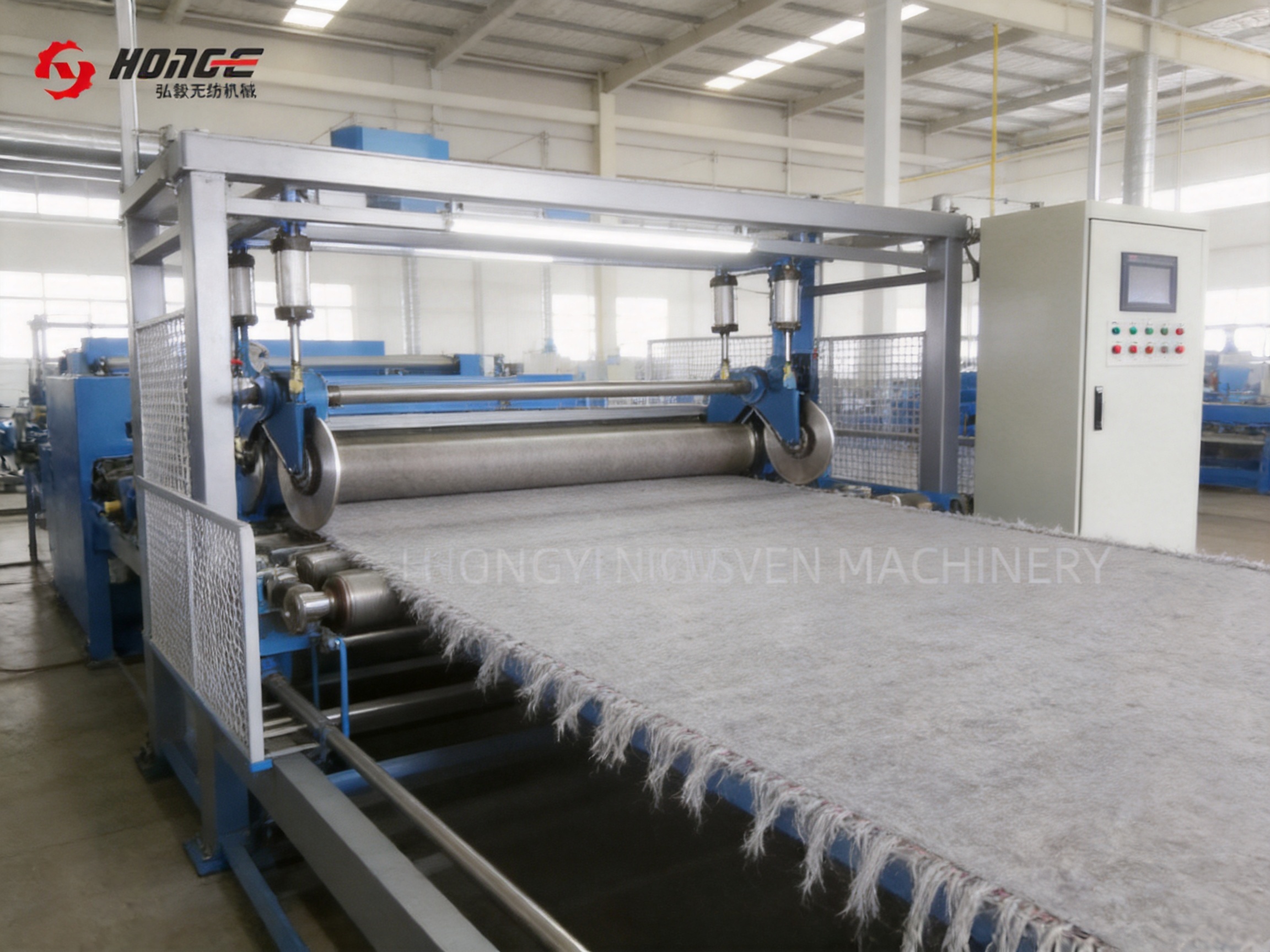
The device uses PLC and touch-screen control. This combination provides a practical interface for operation, parameter setting, status monitoring, and adjustment. The PLC manages the programmed operating logic, while the touch screen gives operators a clear method of interacting with the equipment.
The installed power is listed as 5.2 kW. Actual project configuration may vary depending on working width, cutting arrangement, drive configuration, safety devices, electrical standards, and additional customer requirements. The power requirement is therefore best considered together with the complete production-line design rather than in isolation.
The equipment is supplied as new machinery and can be manufactured with customized voltage, color, configuration, and other project details. CE and ISO9001:2000-related certification information is provided for the product and manufacturing system. Video outgoing inspection is also available before shipment, giving customers an opportunity to review the operating condition of the completed equipment.
Basic Technical Data
| Item | Specification |
|---|---|
| Model | HYYQ |
| Equipment type | Nonwoven fabric pre-edge cutting device |
| Standard working width | 2500 mm |
| Specification range | Approximately 2000 mm to 7600 mm |
| Working speed | 0.5–15 m/min |
| Installed power | 5.2 kW |
| Control method | PLC and touch screen |
| Automatic grade | Automatic |
| Voltage | 220 V or customized |
| Raw materials | Polyester fiber, PP staple fiber, and similar materials |
| Certification information | CE and ISO9001:2000 |
| Warranty | One year |
| Production capacity | Approximately 100 sets per year |
| Origin | China |
3. Main Advantages of the Pre-Edge Cutting Device
3.1 Dedicated Edge-Processing Function
One of the principal advantages of the HYYQ device is that it is designed specifically for pre-processing the edges of fiber webs. A dedicated machine can perform this function with greater consistency than an improvised cutting arrangement attached to unrelated equipment.
When edge preparation is treated as a separate process, the manufacturer can control the cutting position, operating speed, web movement, and maintenance access more systematically. The device can also be positioned at the most suitable point in the line, allowing the web to be prepared before it reaches a needle punch, bonding oven, winding machine, or other downstream unit.
3.2 Improved Edge Flatness and Consistency
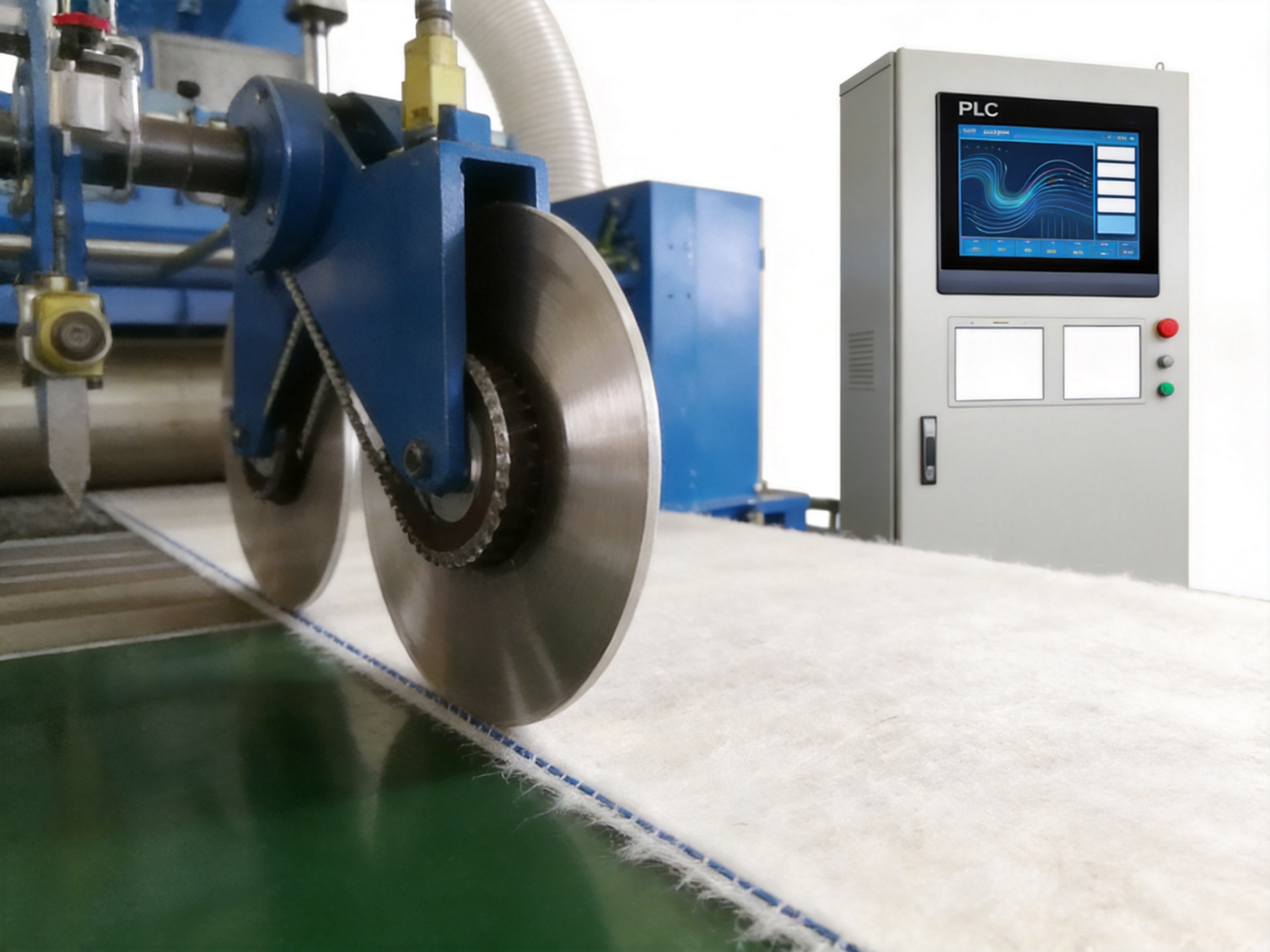
Irregular fiber edges can create visual and mechanical defects. The optimized cutting process of the HYYQ device is intended to improve edge flatness and consistency. This helps the web maintain a more stable shape as it travels through subsequent equipment.
Consistent edges are especially valuable when the final product must meet a defined width tolerance. They can also simplify the work of downstream slitting, winding, laminating, calendaring, cutting, or packaging equipment. A cleaner edge may reduce the need for repeated trimming and can contribute to improved material utilization.
3.3 Programmable Control
The PLC and touch-screen system provides a modern control method for a continuously operating machine. Operators can set production data and manage the machine through an interface designed for industrial use. The control architecture also supports communication with other automatic units, depending on the overall line design.
Compared with purely manual adjustment, programmable control can improve repeatability between production batches. Once suitable parameters have been established for a particular fiber type and web width, they can be used as a reference for later production. This reduces dependence on individual operator judgment and supports more standardized manufacturing procedures.
3.4 Wide Working-Width Options
The standard working width of 2500 mm covers many common nonwoven applications. At the same time, the listed specification range of approximately 2000 mm to 7600 mm allows the machine to be considered for different plant layouts and product dimensions.
Wide equipment requires careful mechanical design because the structure must remain stable across the full web width. The machine frame, cutting arrangement, transmission components, guides, and control system must work together to maintain reliable operation. The availability of customized widths is therefore an important advantage for manufacturers that are building or upgrading a specific production line.
3.5 Compatibility with Different Fiber Materials
The device is suitable for various raw-material fiber products, including polyester fiber and PP staple fiber. These materials can differ in fiber length, fineness, friction, flexibility, bulk, and web-forming behavior. A flexible machine configuration allows users to adapt the process to their actual production materials.
Material compatibility should always be evaluated during the technical design stage. The appropriate cutting tools, operating speed, web tension, edge position, and cleaning arrangements may depend on the fiber blend and web structure. The manufacturer can use customer-provided material information and samples to confirm a suitable configuration.
3.6 Easy Integration into Automated Lines
The HYYQ device is designed to be integrated into automated nonwoven production lines. This is important because edge cutting rarely operates as an isolated activity. It normally forms part of a connected process involving feeding, opening, carding, web forming, needling, bonding, drying, winding, or cutting.
A properly integrated unit can operate continuously with the surrounding machines. The goal is to maintain a stable material flow rather than requiring frequent manual intervention. Integration may include mechanical connection, electrical control coordination, line-speed matching, emergency-stop communication, material-guiding arrangements, and space planning.
3.7 Modular Maintenance and Tool Replacement
The modular design simplifies routine maintenance and cutting-tool replacement. In a production environment, maintenance time has a direct influence on productivity. If access to wear parts is difficult, even a small adjustment can cause excessive downtime.
A modular arrangement allows maintenance personnel to inspect, clean, adjust, or replace relevant components in a more organized manner. It also supports the use of planned maintenance schedules. Regular inspection is particularly important when processing fiber materials because airborne lint and loose fibers can accumulate around moving parts and cutting areas.
3.8 Rugged Construction
Nonwoven machinery often operates for extended periods in demanding industrial conditions. The machine must tolerate continuous movement, vibration, fiber dust, repeated adjustment, and changing production loads. The rugged structure of the HYYQ device is intended to support stable long-term operation.
Durability is not limited to the main frame. It also depends on the quality of fabrication, alignment, electrical installation, drive components, protective devices, and assembly procedures. A well-built machine can help reduce unexpected stoppages and provide a more predictable ownership experience.
4. Advantages Compared with Less Specialized Solutions
Some manufacturers attempt to manage web edges through manual trimming or by adding a basic cutting arrangement to another machine. Such methods may appear inexpensive at the beginning, but they can introduce limitations when production volume increases or when tighter quality standards are required.
Manual trimming is dependent on operator skill and attention. It may produce variations from one roll or batch to another. It can also expose personnel to unnecessary handling work and may be difficult to maintain at higher line speeds.
A non-specialized cutting arrangement may not provide adequate control over web alignment, cutting position, speed matching, or maintenance access. It may also lack a suitable PLC interface for connection with the main line. These limitations can become more serious when the web is wide, lightweight, highly elastic, or prone to edge fraying.
The HYYQ device offers a more complete approach by combining dedicated mechanical design, automatic control, customizable working width, and integration support. Its value is not simply the presence of a cutting blade. The greater benefit is the repeatable management of a critical web-preparation step.
Compared with basic or manually operated alternatives, the device can provide the following practical improvements:
• More repeatable edge dimensions.
• Better suitability for continuous automatic operation.
• Easier adjustment through PLC and touch-screen control.
• More organized maintenance and cutting-tool replacement.
• Greater compatibility with complete nonwoven production lines.
• Better potential for customized width and electrical configurations.
• More stable processing of polyester, PP staple fiber, and related materials.
• Improved consistency between production orders.
These advantages should be evaluated against the complete cost of production, including labor, waste, downtime, rework, maintenance, and product quality. A specialized auxiliary machine may deliver value not only through direct cutting performance but also through improved line stability.
5. Manufacturing Strengths Behind the Equipment
5.1 More Than Two Decades of Industry Experience
Changshu Hongyi Nonwoven Machinery Co., Ltd. has more than 20 years of experience in the nonwoven machinery field. Long-term experience is valuable because nonwoven equipment must be designed around actual fiber behavior, production conditions, and customer applications. Theoretical machine design alone is not sufficient; reliable equipment also requires an understanding of how webs form, move, bond, stretch, shrink, and respond to different mechanical conditions.
The company’s product range includes opening and blending equipment, feeding and carding equipment, web-forming and needle-punching equipment, thermal bonding and heat-setting equipment, airlay and winding systems, cutting machinery, auxiliary equipment, and complete nonwoven production lines. This broad range gives the manufacturer a wider view of how an individual pre-edge cutting device must operate within a complete production system.
5.2 Complete-Line and Individual-Machine Capability
Some customers require a single auxiliary machine, while others need a complete production line. A supplier capable of handling both types of project can evaluate the pre-edge cutting device from two perspectives. It can be designed as an independent unit, or it can be developed as part of a coordinated line solution.
Complete-line experience is especially useful when the device must interact with web-forming machines, needle looms, thermal ovens, winding systems, or automatic cutting units. The supplier can consider line speed, web width, control signals, safety functions, operator access, and plant layout during the design process.
5.3 Precision Engineering and Customization
The HYYQ device can be customized according to customer requirements. Potential customization areas include working width, voltage, machine color, configuration, control details, and integration arrangements. Customization allows the equipment to match local electrical standards, existing line conditions, and product specifications.
Precision engineering is particularly important for wide machines. A difference in alignment or cutting position can become more noticeable over a long working width. Proper fabrication, assembly, inspection, and commissioning procedures help ensure that the machine performs consistently across the web.
5.4 Quality and Process Management
The company identifies quality, reliability, efficiency, advanced technology, and precision engineering as important development priorities. ISO9001:2000-related certification information indicates a focus on structured quality-management practices. Such practices may include controlled purchasing, production inspection, assembly checks, documentation, and final testing.
CE-related compliance information is also provided for the equipment. Customers should confirm the specific compliance documentation required for their destination market and project conditions. Proper attention to electrical safety, guarding, emergency stopping, control panels, and operating instructions is essential for responsible industrial equipment supply.
5.5 Factory Testing and Video Inspection
Video outgoing inspection is available for the HYYQ device. A pre-shipment video can help customers review the appearance, operation, control interface, and general condition of the equipment before delivery. This is particularly useful for international projects where the customer cannot easily visit the factory during final assembly.
Factory testing may include checking drive operation, control response, cutting movement, emergency-stop functions, sensor performance, machine noise, and communication with related line components. The exact test items should be agreed during the technical confirmation stage.
5.6 International Project Experience
The company has supplied products to more than 20 countries, including Mexico, Argentina, Brazil, Turkey, Algeria, Egypt, Bangladesh, Vietnam, Thailand, and other Asian markets. International experience can help a machinery supplier understand different shipping requirements, electrical standards, documentation practices, language needs, plant conditions, and customer expectations.
Export experience is also relevant to after-sales service. A machine may need to be installed in a location far from the manufacturer, making clear manuals, remote communication, spare-parts planning, and technical support important parts of the overall project.
6. How the Device Works within a Production Line
A typical process begins when a fiber web is delivered from a carding machine, crosslapper, airlay system, or another web-forming unit. The web is guided toward the pre-edge cutting device at a controlled speed. The machine identifies or maintains the intended cutting position and trims excess material from the edges according to the configured production data.
After edge preparation, the web continues toward the next processing stage. Depending on the product, this may be a needle-punching machine, thermal bonding oven, heat-setting unit, laminating section, winding machine, or cutting system. The pre-cut edge can help the web enter that process with more stable geometry.
The exact arrangement depends on the customer’s production line. Some users may require cutting on both sides of the web, while others may need a specific edge allowance or a special arrangement for a single-sided process. The machine layout, web direction, line height, roller positions, and control communication should be confirmed before manufacturing.
Important Integration Factors
Working width must be selected according to both the incoming web and the required finished width. The machine should provide enough adjustment range for normal production variation without creating unnecessary unused space.
Line-speed coordination is also important. The listed operating speed of 0.5 to 15 m/min provides a working range, but the actual setting should match the capacity of the upstream and downstream machines. Sudden speed differences can cause web accumulation, stretching, tension changes, or material breaks.
Web tension should be reviewed during commissioning. Excessive tension may narrow or distort a lightweight web, while insufficient tension may cause folds or unstable tracking. The cutting process should be established under realistic operating conditions rather than tested only with a stationary or unusually dense material.
Electrical and control communication should be planned in advance. The PLC may need to receive or transmit start, stop, speed, alarm, and emergency signals. If the pre-edge cutting device is installed in an existing line, the customer should provide information about the current control system, voltage, communication protocol, and safety arrangement.
Operator access and maintenance space must also be considered. Even an automatic machine requires cleaning, inspection, tool replacement, and troubleshooting. The equipment should be positioned so that operators can safely reach relevant components without interfering with adjacent machinery.
7. Applications in Different Nonwoven Products
7.1 Needle-Punched Geotextiles
Geotextile production often requires stable web width and reliable continuous operation. The HYYQ device can prepare the web before needle punching, helping reduce irregular edge material that might interfere with the punching process. Consistent edges can also support more uniform roll formation and finishing.
7.2 Nonwoven Carpets
Carpet substrates and felt-like materials may be produced from polyester, polypropylene, recycled fibers, or blends. Edge appearance and width are important when the material is later cut, coated, laminated, or installed. Pre-edge cutting can support a cleaner and more uniform substrate profile.
7.3 Automotive Interior Materials
Automotive interior nonwovens often require controlled thickness, width, weight, and surface quality. Materials may be used for trunk liners, insulation, floor coverings, headliners, or other interior components. Stable edge preparation can simplify downstream forming, laminating, cutting, and assembly processes.
7.4 Cleaning Cloths and Industrial Wipes
Cleaning cloth production may involve needle punching, thermal bonding, impregnation, or cutting into standard formats. Edge irregularity can affect the dimensions of finished cloths and increase trimming waste. A controlled pre-edge operation can help create more consistent input material for later cutting.
7.5 Wool Felt and Jute Felt
Natural fibers and coarse fibers may produce more visible edge projections than some synthetic materials. A dedicated cutting system can help manage these projections before bonding, needling, winding, or final conversion. The appropriate speed and cutting arrangement should be selected according to fiber behavior.
7.6 Thermal-Bonded Wadding
Thermal-bonded wadding and insulation materials are often lightweight and bulky. Their edges may be easily disturbed by air movement or mechanical contact. Controlled pre-edge cutting before heat setting or winding can help stabilize the web shape and improve roll handling.
8. Operation, Maintenance, and Safety
Correct operation begins with proper installation and commissioning. The machine should be placed on a stable foundation, aligned with the incoming and outgoing web path, and connected according to the approved electrical drawings. Before production begins, operators should understand the touch-screen interface, emergency-stop functions, alarm indications, and safe access procedures.
During operation, personnel should observe the web edge, cutting position, machine noise, vibration, and accumulation of loose fibers. Any sudden change in edge quality may indicate a problem with alignment, material condition, cutting-tool wear, web tension, or control settings.
Routine cleaning is important in fiber-processing environments. Loose fibers and dust should not be allowed to accumulate around drive components, sensors, electrical enclosures, cutting areas, or ventilation openings. Cleaning intervals depend on the material and production schedule, but daily visual inspection is a practical starting point.
Cutting tools and related components should be checked for wear, damage, looseness, or contamination. A worn tool may produce a rough edge and increase fiber pulling rather than making a clean cut. Tool replacement should be completed with the machine stopped, isolated from energy sources, and secured against accidental startup.
Bearings, guide components, transmission parts, and fastening elements should be inspected according to the manufacturer’s maintenance recommendations. Lubrication, where required, should use the correct product and quantity. Excessive lubricant can attract fiber dust, while insufficient lubrication can accelerate wear.
Safety guards should remain in place during normal operation. Operators should never reach into a moving cutting area or attempt to remove trapped material while the machine is running. Lockout and isolation procedures should be followed during maintenance and troubleshooting.
9. Purchasing and Project Planning Considerations
Before ordering the HYYQ device, customers should provide detailed information about their production requirements. This information allows the manufacturer to confirm the correct mechanical and electrical configuration.
Important technical data includes the incoming web width, desired finished width, web thickness, basis weight, fiber type, fiber blend, moisture condition, production speed, upstream machine, downstream machine, and expected daily operating hours.
Customers should also explain whether the device is for a new line or a retrofit project. A new line normally provides greater flexibility for positioning and control integration. A retrofit project may require special attention to existing machine height, roller locations, floor space, electrical cabinets, line direction, and communication signals.
The required voltage and frequency should be confirmed before production. The standard information lists 220 V or customized voltage, but international customers may require different electrical specifications. The control cabinet, motors, sensors, and safety components must be matched to the destination market.
Packaging and shipment should also be discussed. The listed transport package is nude packing or PE film, depending on the project. Customers should consider whether export crates, moisture protection, corrosion protection, lifting points, and special container arrangements are needed for long-distance transportation.
The stated lead time is approximately two to three months. The actual schedule may depend on the final technical design, customization level, material availability, production workload, inspection requirements, and shipping arrangements. A detailed project schedule should be confirmed in the commercial contract.
10. Installation and Commissioning Support
Installation quality affects machine performance. The equipment should be leveled and aligned carefully so that the web path remains stable. Incorrect alignment may cause one side of the web to contact components differently from the other side, producing uneven edge results.
Commissioning should begin at a low speed. The operator can first confirm the direction of movement, web tracking, cutting position, emergency stops, and control response. Speed can then be increased gradually while monitoring edge quality and machine behavior.
Material testing is an important part of commissioning. Polyester fiber, PP staple fiber, recycled material, and natural fibers may respond differently. The best operating parameters for one material may not be suitable for another. Production settings should therefore be documented by material type and product specification.
After commissioning, operators should receive practical instruction on startup, shutdown, parameter adjustment, cleaning, inspection, cutting-tool replacement, alarm response, and emergency procedures. Clear operator training can improve safety and reduce avoidable downtime.
11. Quality and Productivity Benefits
The most direct quality benefit of pre-edge cutting is improved dimensional consistency. If the web enters later processes with a more stable width, finished rolls and sheets may be easier to control. This is valuable when customers require repeatable dimensions or when the product is converted by automatic equipment.
The device may also help reduce edge waste. It does not eliminate all waste because some edge material must be removed to achieve the target width, but controlled cutting can make the waste more predictable. Predictable waste supports production planning and material-cost analysis.
Improved web tracking can reduce interruptions caused by edge folding, fiber accumulation, or misalignment. Fewer interruptions can increase effective operating time and reduce the need for manual correction. The benefit is particularly meaningful on production lines where a problem in one unit can require the entire line to stop.
Automatic control can also support production records. Operators may document settings for different products, helping the factory develop standardized process instructions. Over time, this can improve repeatability between shifts and reduce the learning period for new operators.
12. Why Supplier Capability Matters
A pre-edge cutting device must be judged as both a machine and a component of a larger manufacturing system. Supplier capability therefore matters as much as the individual technical specification.
A manufacturer with experience in opening, carding, web forming, needle punching, thermal bonding, airlaying, winding, and cutting can better understand how edge preparation affects the complete line. It can also help customers identify possible bottlenecks before the machine is built.
Changshu Hongyi Nonwoven Machinery Co., Ltd. provides individual units and complete nonwoven machinery solutions. Its experience across different product categories supports a broader engineering approach. The company’s export history also demonstrates experience in serving customers outside the domestic market.
Factory-direct supply can simplify communication between the customer and the technical team. Instead of coordinating separate suppliers for the machine frame, control system, cutting unit, and line integration, the customer can discuss the project with one machinery manufacturer. This may help reduce misunderstandings during design and commissioning.
Customization is another important strength. Nonwoven plants differ in raw material, product width, factory layout, control preference, and local regulations. A standard machine may not fit every project. The ability to customize width, voltage, color, configuration, and integration details allows the equipment to be adapted more closely to the actual application.
13. Frequently Asked Questions
Q1: What is the main purpose of the HYYQ Pre-Edge Cutting Device?
The main purpose is to pre-cut and prepare the edges of fiber webs before they enter the next stage of nonwoven production. It helps establish a more consistent web width and cleaner edge condition for processes such as needle punching, thermal bonding, winding, slitting, or cutting.
Q2: What is the standard working width?
The standard working width is 2500 mm. The listed specification range is approximately 2000 mm to 7600 mm, allowing the equipment to be customized for different production requirements.
Q3: What is the operating-speed range?
The listed working speed is 0.5 to 15 meters per minute. The appropriate setting depends on the fiber type, web structure, web tension, cutting requirement, and speed of the connected production line.
Q4: Which materials can be processed?
The machine is suitable for various fiber products, including polyester fiber and PP staple fiber. Other materials may also be considered after technical evaluation and, where appropriate, sample testing.
Q5: Is the machine automatic?
Yes. The equipment is listed as automatic and uses PLC and touch-screen control. It can be integrated into an automated production line, subject to the specific electrical and mechanical design.
Q6: Can the voltage be customized?
Yes. The listed voltage is 220 V or customized. Customers should confirm the required voltage, frequency, control-cabinet specification, and electrical standards before the machine is manufactured.
Q7: Can the device be added to an existing line?
It may be added to an existing line if the machine dimensions, web path, line speed, control signals, electrical supply, and available installation space are compatible. A technical review is recommended for every retrofit project.
Q8: How does the device improve production quality?
It provides a more controlled edge-preparation process, which can improve edge flatness, width consistency, web tracking, and downstream processing stability. These improvements may help reduce rework, interruptions, and irregular finished-product dimensions.
Q9: What maintenance is required?
Routine maintenance includes cleaning fiber accumulation, inspecting cutting tools, checking fasteners and guides, monitoring drive components, reviewing sensors and controls, and replacing worn parts when necessary. Maintenance must always be performed under safe isolation procedures.
Q10: Is factory inspection available?
Video outgoing inspection is provided. Customers can discuss the inspection scope with the manufacturer, including machine operation, control functions, appearance, safety components, and integration-related checks.
Q11: What is the lead time?
The stated lead time is approximately two to three months. The final schedule depends on technical confirmation, customization, production planning, inspection, and shipping arrangements.
Q12: What warranty is offered?
The listed after-sales service includes a one-year warranty. Warranty terms, exclusions, spare-parts responsibilities, and service procedures should be confirmed in the purchase agreement.
Q13: Can the machine color and configuration be customized?
Yes. The color and configuration can be customized according to customer needs, subject to technical and commercial confirmation.
Q14: Does the supplier provide complete nonwoven production lines?
Yes. The supplier provides complete nonwoven production lines as well as individual machines, including equipment for opening, blending, carding, web forming, needle punching, thermal bonding, airlaying, winding, and cutting.
Q15: What information should be provided for a quotation?
Customers should provide the required working width, finished width, web material, basis weight, thickness, production speed, upstream and downstream machines, voltage, factory layout, automation requirements, destination country, and any special safety or certification requirements.
14. Conclusion
The HYYQ Nonwoven Fabric Machinery Pre-Edge Cutting Device is a specialized solution for controlling the edges of fiber webs before further processing. Its dedicated design, automatic PLC and touch-screen control, adjustable working width, customizable configuration, modular maintenance arrangement, and suitability for continuous production make it a valuable auxiliary machine for modern nonwoven factories.
By preparing the web before needle punching, thermal bonding, winding, slitting, or other downstream operations, the device can contribute to improved edge flatness, more consistent width, better web tracking, reduced manual intervention, and more stable production. Its value is especially clear when manufacturers are working with wide webs, high production requirements, multiple fiber types, or automated lines.
The machine is supported by a supplier with more than two decades of experience in nonwoven machinery. Changshu Hongyi Nonwoven Machinery Co., Ltd. offers both individual equipment and complete production-line solutions, with experience in international supply, customization, factory inspection, and technical coordination.
For customers planning a new production line or upgrading an existing system, the most important step is to evaluate the pre-edge cutting device as part of the entire web-processing process. When working width, speed, material, control communication, safety, maintenance access, and downstream requirements are considered together, the equipment can be configured to provide reliable and practical long-term service.
References
1. Changshu Hongyi Nonwoven Machinery Co., Ltd. Product Technical Data for the HYYQ Nonwoven Fabric Machinery Pre-Edge Cutting Device.
2. Changshu Hongyi Nonwoven Machinery Co., Ltd. Company Information and Nonwoven Machinery Product Portfolio.
3. General principles of nonwoven web formation, web handling, fiber processing, and continuous production-line integration.
4. General industrial guidance concerning PLC-controlled machinery, machine guarding, maintenance planning, and safe operation of cutting equipment.
5. General technical practices for quality control and process standardization in nonwoven fabric manufacturing.