

Content
- 1 The Role of Fiber Mixing in Nonwoven Manufacturing
- 2 Operating Principle of the HYHM Fiber Mixing Machine
- 3 Key Advantages of Proportional Weighing
- 4 Mechanical Construction and Manufacturing Quality
- 5 Control and Automation Features
- 6 Advantages Compared with Less Integrated Mixing Methods
- 7 Applications in Nonwoven Fabric Production
- 8 Integration with Complete Nonwoven Production Lines
- 9 Customization for Different Factory Requirements
- 10 Manufacturing and Quality Assurance Strengths
- 11 Installation, Operation, and Maintenance Considerations
- 12 How the Machine Supports Production Efficiency
- 13 Recommended Selection Process for Buyers
- 14 Why Supplier Experience Matters
- 15 Q&A: Fiber Mixing Machine Selection and Use
- 15.1 What is the main function of the HYHM Fiber Mixing Machine?
- 15.2 Which raw materials can be processed?
- 15.3 How does the machine control the blend ratio?
- 15.4 Is the machine suitable for a carding line?
- 15.5 What is the listed production capacity?
- 15.6 What working widths are available?
- 15.7 Does the machine require constant manual feeding?
- 15.8 Can the machine be customized?
- 15.9 What certifications and inspection services are listed?
- 15.10 What is the warranty period?
- 15.11 How long is the delivery period?
- 15.12 How should the machine be maintained?
- 15.13 Can the machine be used in a complete nonwoven production line?
- 16 Practical Benefits for Different Customer Types
- 17 Conclusion
- 18 References
- 19 Product: HYHM Fiber Mixing Machine
In nonwoven manufacturing, the quality of the finished fabric is strongly influenced by what happens before carding, web formation, needle punching, thermal bonding, or other downstream processes begin. Fiber opening and blending are not simply preliminary operations. They determine whether different raw materials are distributed evenly, whether the production line receives a stable feed, and whether the final fabric can achieve consistent weight, thickness, strength, softness, and appearance.
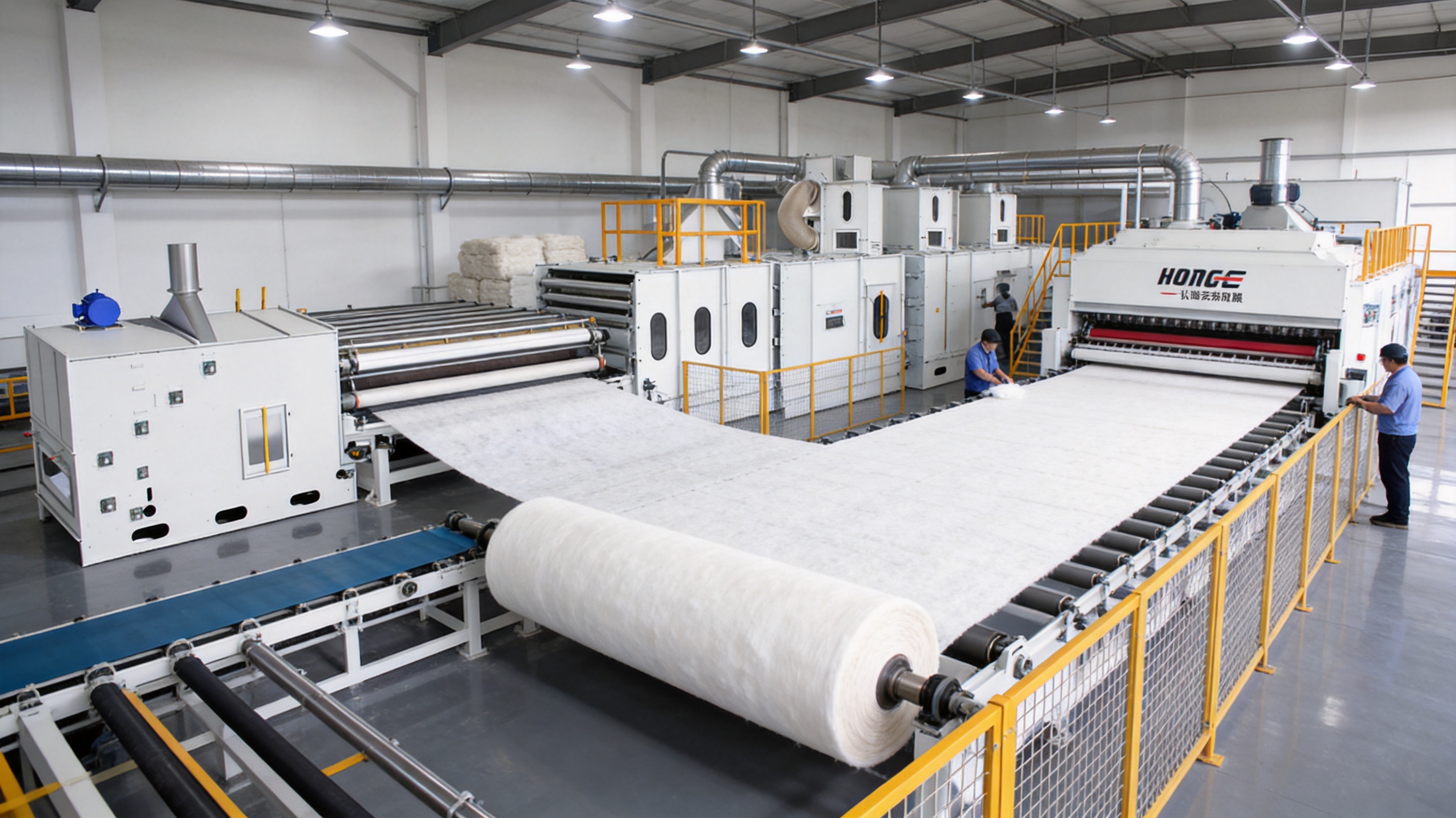
The HYHM Fiber Mixing Machine is designed for this important stage of production. It pre-opens fibers from bales, weighs predetermined percentages, blends the materials, and transfers the prepared mixture to the next process. A separate storage and feeding section allows the blended fiber to remain available for continuous production. By combining mechanical opening, proportional weighing, electronic control, conveying, and storage in one integrated unit, the machine provides a practical solution for manufacturers producing nonwoven fabrics from several types of fiber.
The machine is suitable for polyester fiber, polypropylene staple fiber, wool, cotton, coir fiber, jute fiber, ES fiber, and other compatible materials. It can be configured for different working widths and production requirements, making it suitable for nonwoven fabric factories, felt producers, automotive interior material manufacturers, carpet producers, geotextile manufacturers, and other users that require dependable fiber preparation.
The Role of Fiber Mixing in Nonwoven Manufacturing
Fiber blending has a direct effect on the performance of a nonwoven fabric. When several materials are used in one product, each component contributes different characteristics. Polyester can provide strength and dimensional stability. Polypropylene can offer low moisture absorption and chemical resistance. Wool can contribute warmth and resilience. Cotton can improve softness and absorbency. Jute and coir may be selected for natural-fiber applications, while ES fiber can support thermal bonding in suitable formulations.
These benefits can only be achieved when the fibers are blended according to a controlled formulation. If one raw material is supplied in excessive quantity, the fabric may become too stiff, too soft, too weak, or inconsistent in density. Irregular feeding can also produce streaks, uneven color, variable basis weight, and fluctuations in bonding behavior. In needle-punched materials, uneven fiber distribution may affect punching resistance, thickness, tensile strength, and surface quality.
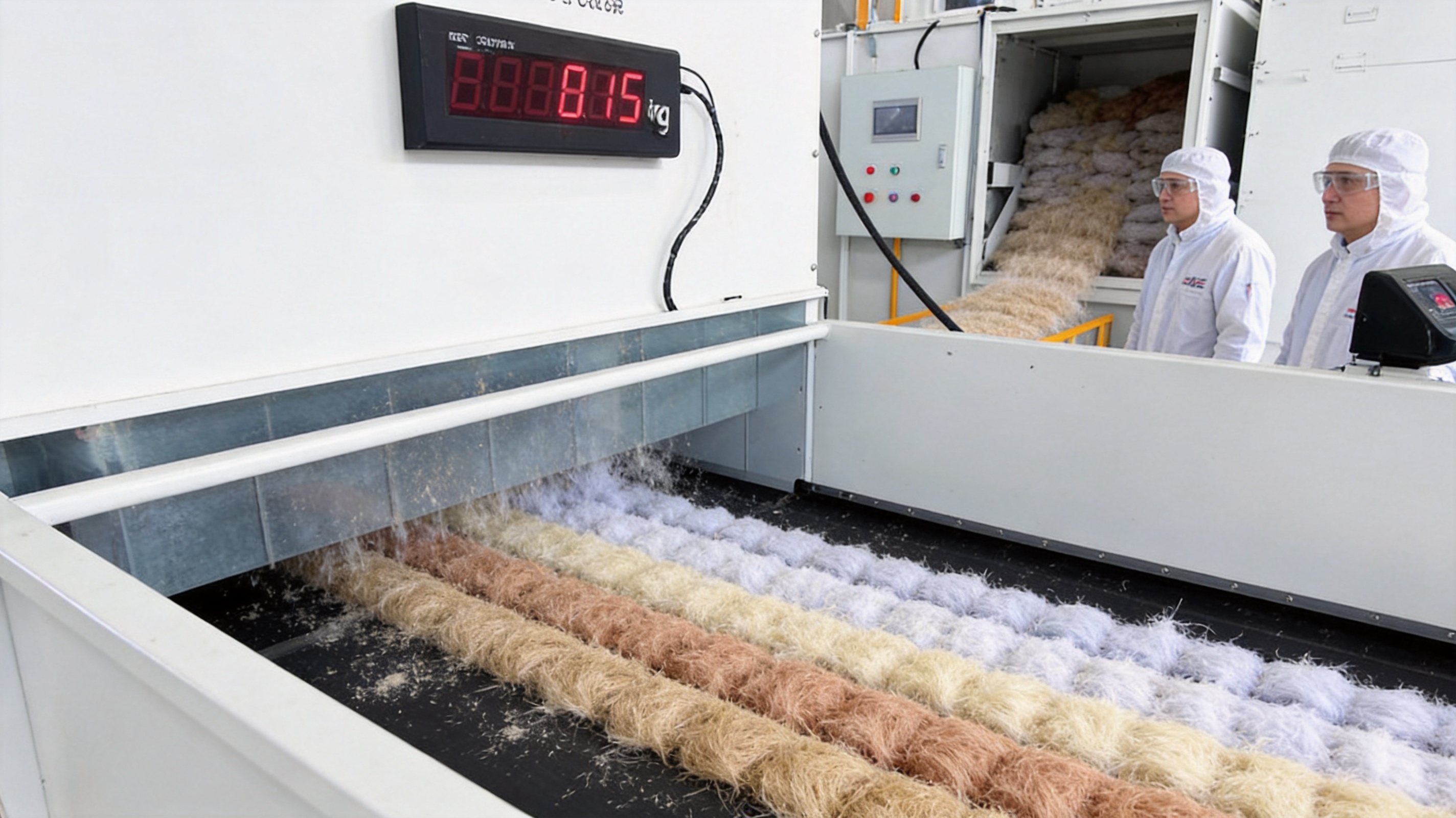
The HYHM Fiber Mixing Machine addresses these challenges through proportional weighing and controlled material transfer. Instead of relying entirely on manual measurement or uncontrolled batch feeding, the machine uses an electronic weighing system to measure the required amount of each fiber. The prepared material is then transferred by a cross conveyor toward the next process. This arrangement supports a more repeatable blend and reduces the possibility of human weighing errors.
The machine also provides a storage function. After fibers are opened and mixed, the blend can be held in the cabinet before being supplied to the carding or other downstream equipment. This helps separate the blending stage from the immediate demand of the next machine. As a result, operators can maintain a more stable material flow and reduce interruptions caused by short-term variations in bale preparation or manual feeding.
Operating Principle of the HYHM Fiber Mixing Machine
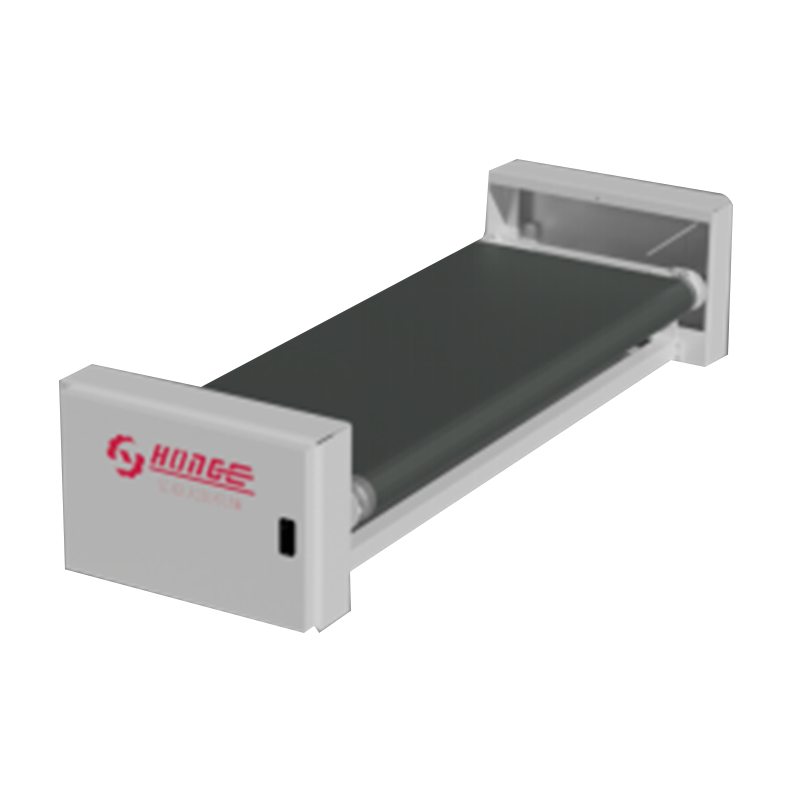
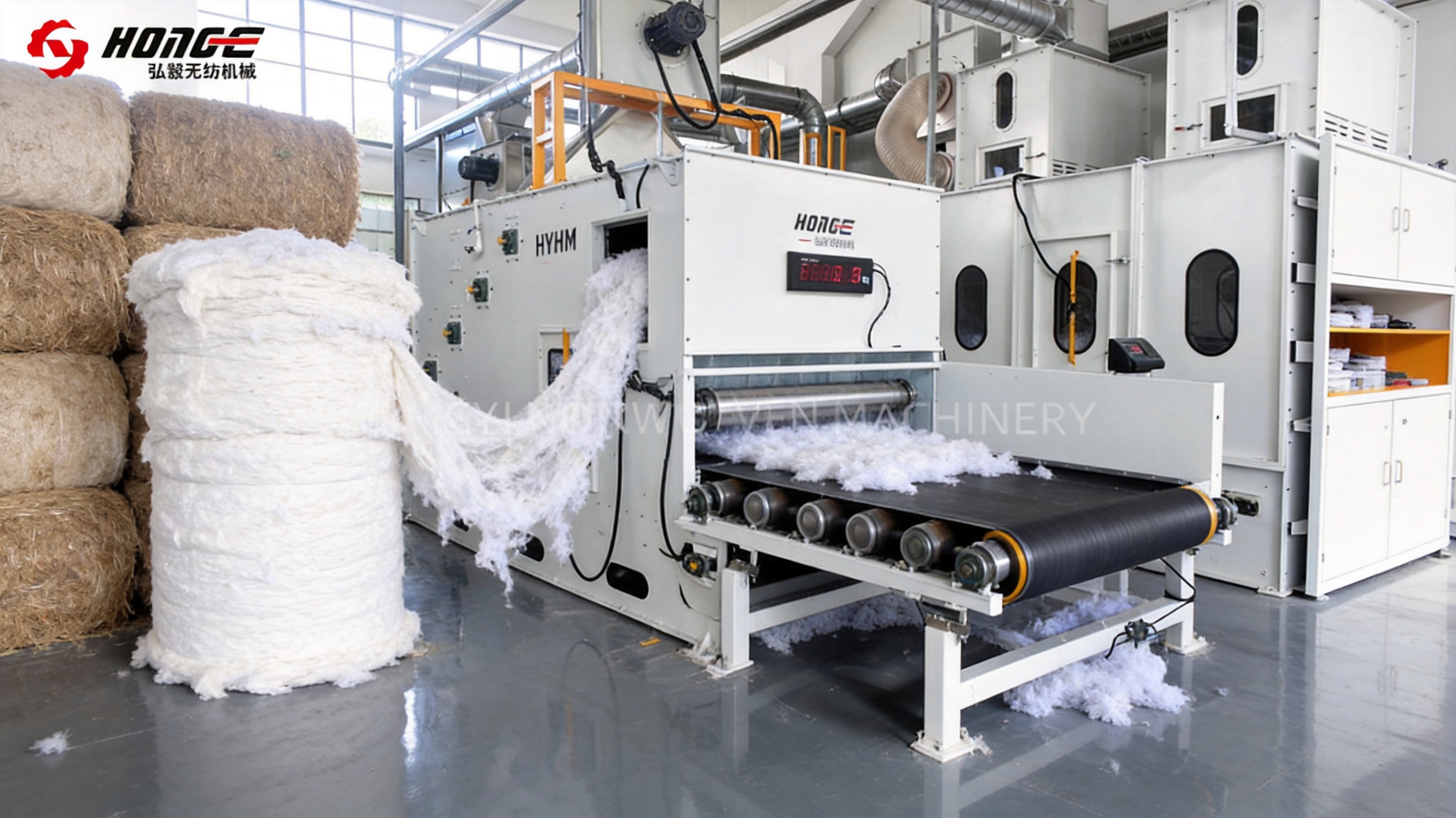
The operating process begins with the introduction of fiber from bales or prepared fiber packages. The feeding section receives the raw materials and moves them through the opening and leveling area. Beating devices help loosen compacted fiber and remove excessive clumps. The machine then measures the required amount through a belt electronic scale.
For a multi-component blend, each material is supplied according to the selected percentage. The weighing system supports quantitative feeding, while the control system coordinates the feeding and transfer actions. Once the predetermined material quantity has been reached, the prepared fibers are moved by the cross conveyor. The blend can then be stored in the rear cabinet and supplied to the next production stage.
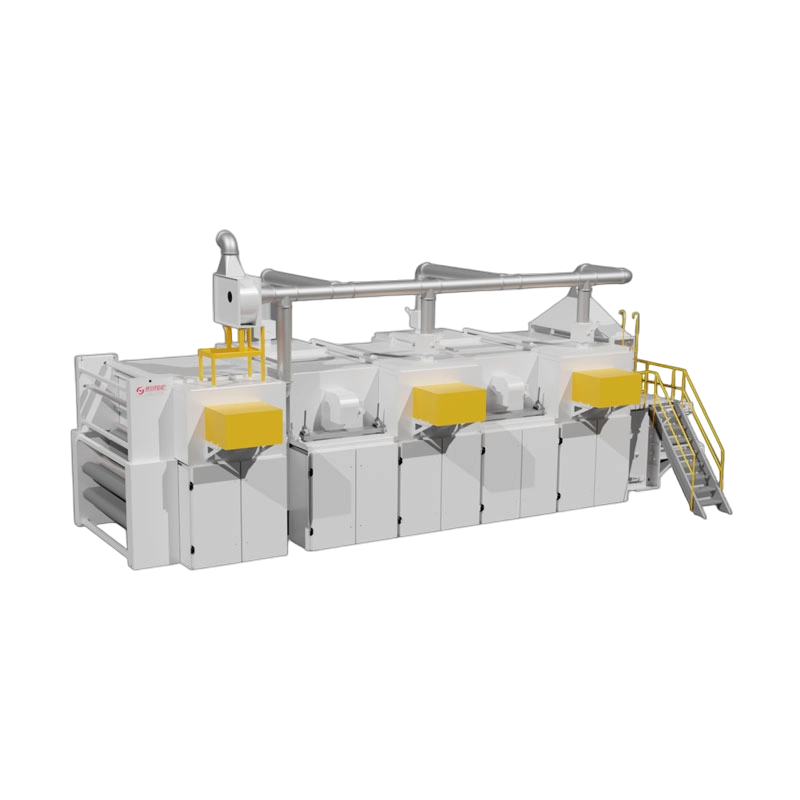
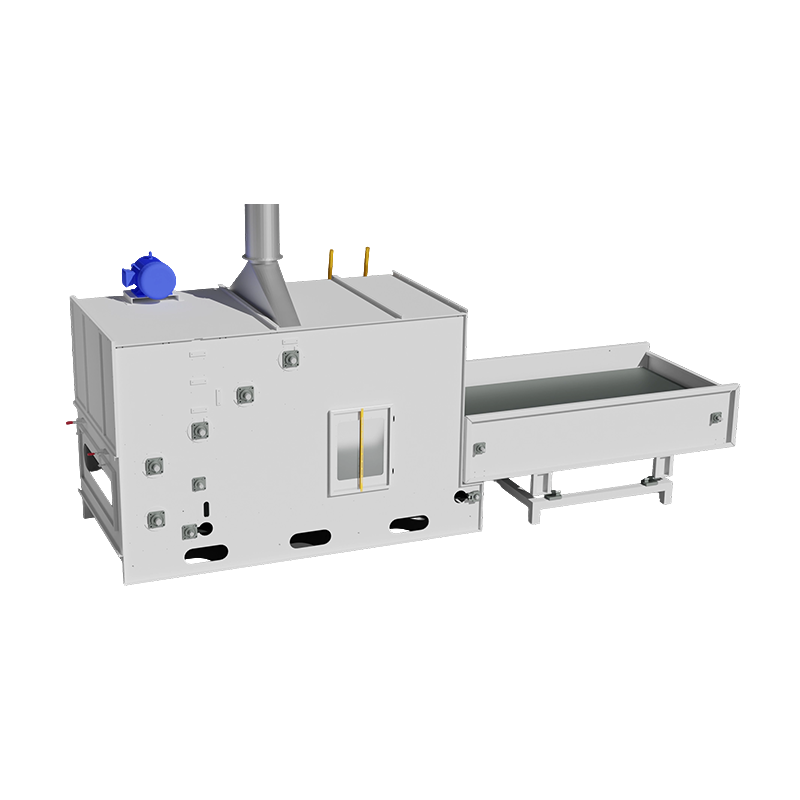
This front-and-rear arrangement is an important feature of the machine. The front section is dedicated primarily to weighing and mixing, while the rear section is used for storage and feeding. Such a layout creates a logical material path and helps prevent unnecessary handling between operations. It also makes the equipment easier to integrate with carding machines, airlay systems, or complete nonwoven production lines.
During operation, photoelectric control technology assists with material detection and process coordination. The system can monitor the presence and movement of fiber at relevant positions, helping the machine respond to changing material conditions. This supports automatic operation and can reduce the need for constant manual intervention.
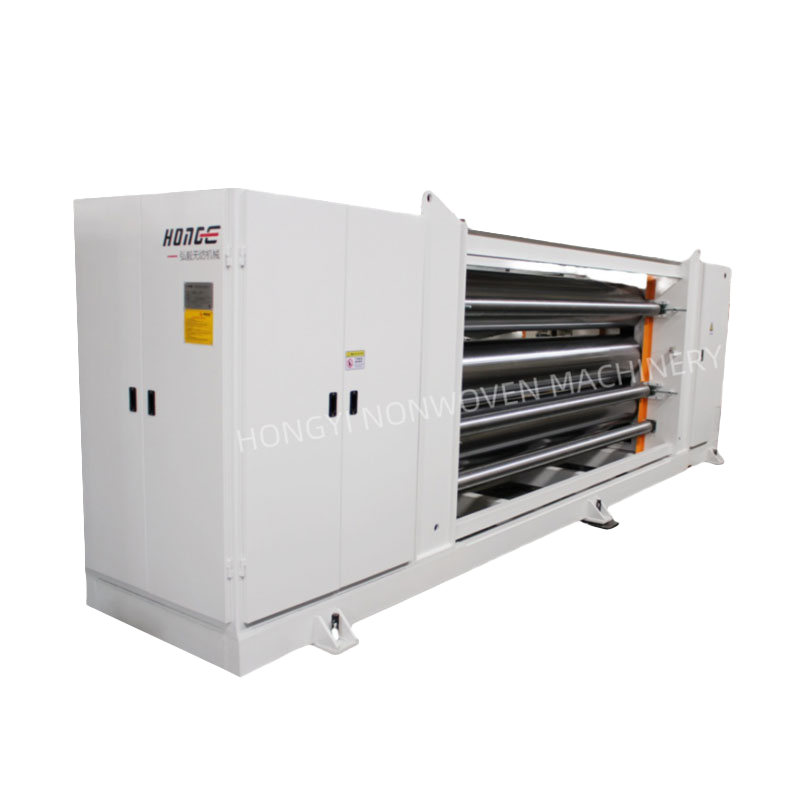
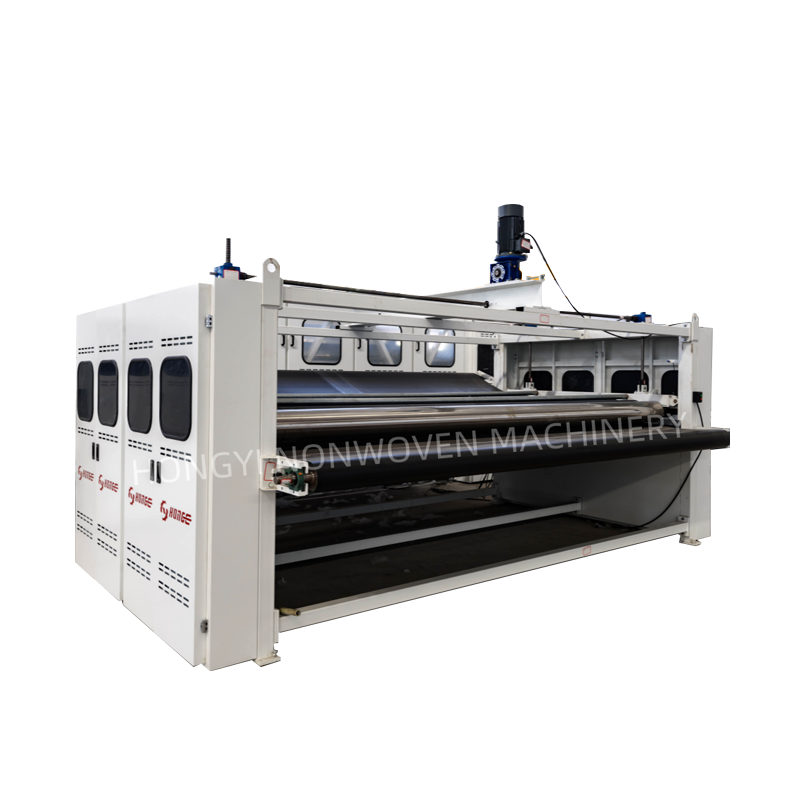
The machine’s main body uses a welded steel plate structure. This construction provides a stable foundation for the weighing, beating, conveying, and storage assemblies. A rigid frame can help reduce unwanted vibration and maintain alignment during long production periods. It also provides a suitable base for customization according to the customer’s plant layout, working width, and production requirements.
HYHM Fiber Mixing Machine
Key Advantages of Proportional Weighing
Improved Blend Accuracy
The primary advantage of proportional weighing is the ability to follow a defined fiber recipe. Each component can be introduced according to a planned percentage instead of being estimated by visual inspection or operator experience alone. This is especially important when the blend contains expensive fibers, low-dose functional additives, or materials with significantly different densities.
Accurate weighing helps manufacturers maintain similar raw-material proportions from one batch or production period to another. It supports more predictable product performance and makes it easier to investigate any quality variation. When the final fabric does not meet the target specification, a controlled weighing record provides a more reliable starting point for process analysis.
Stable Material Feeding
Nonwoven lines operate best when the downstream machines receive a consistent supply of fiber. A sudden increase or decrease in feed can influence web weight, web uniformity, and the loading of carding or airlay equipment. The HYHM machine combines weighing with conveyor transfer and rear storage to create a buffer between fiber preparation and subsequent processes.
This buffer can be particularly useful when production conditions change. Operators may need to replace bales, adjust the blend, inspect equipment, or respond to a short stoppage. The storage cabinet provides a prepared supply that can help the line resume operation more smoothly after a temporary interruption.
Lower Dependence on Manual Handling
Manual opening and blending can be labor-intensive, particularly when several fiber types must be measured repeatedly throughout a shift. Manual methods can also expose workers to more fiber dust and create variations caused by fatigue, inconsistent measurement, or differences in working habits.
By automating the main weighing and transfer operations, the HYHM machine reduces repetitive manual work. Operators can focus more closely on recipe management, material inspection, equipment monitoring, and quality control. The machine is not intended to eliminate the need for trained personnel, but it can make their work more organized and productive.
Compatibility with Various Raw Materials
A flexible fiber blender is valuable because nonwoven manufacturers often produce more than one product. The HYHM Fiber Mixing Machine can be used with a broad selection of fibers, including polyester, polypropylene staple fiber, wool, cotton, coir, jute, and ES fiber. This material compatibility allows one machine platform to support applications ranging from synthetic technical fabrics to natural-fiber felt and thermal-bonded products.
Actual performance depends on fiber length, crimp, fineness, moisture, bale density, and other material characteristics. For this reason, the machine should be evaluated and configured according to the customer’s actual raw materials and production recipe. The manufacturer can provide customized solutions for working width, feeding arrangement, electrical configuration, and line integration.
Mechanical Construction and Manufacturing Quality
The long-term reliability of a fiber mixing machine depends not only on its control system but also on the quality of its mechanical construction. Fiber production equipment is exposed to vibration, dust, repeated loading, and continuous movement. Weak frames, poor alignment, or insufficiently supported components can lead to maintenance problems and unstable operation.
The HYHM machine uses a steel plate welded main body. This structure is designed to provide strength and rigidity across the equipment. Welding allows the frame to be manufactured as a unified assembly rather than relying only on multiple detachable joints. Proper fabrication, dimensional checking, and surface treatment are important to ensure that the frame remains stable and that the moving components can be installed accurately.
The feeding section includes a PVC conveyor belt, a supporting frame, and related components. The conveyor is responsible for transporting opened fiber through the process. Its construction is selected to support regular operation while maintaining a suitable contact surface for the material. Correct belt tension, tracking, and cleaning are essential for maintaining reliable performance.
The beating devices for cotton leveling and cotton removal use steel rollers. These rollers help break up compacted portions and distribute the fiber more evenly before weighing or transfer. Their design must balance opening effectiveness with gentle handling. Excessive mechanical action can damage certain fibers, while insufficient action may leave large clumps that influence weighing and downstream web formation.
Manufacturing a dependable machine requires coordinated work across design, fabrication, machining, electrical assembly, inspection, and commissioning. Changshu Hongyi Nonwoven Machinery Co., Ltd. has more than 20 years of experience in the nonwoven machinery field. Its product range includes individual machines and complete production lines for needle-punched geotextiles, nonwoven carpets, airlaid waste felt, automotive interior materials, cleaning cloth, wool felt, jute felt, and other nonwoven products.
This experience is important because fiber mixing equipment does not operate in isolation. The best configuration depends on the carding machine, web former, needle-punching machine, thermal bonding oven, winding system, and final product requirements. A manufacturer with experience in complete nonwoven lines can evaluate the relationship between each stage and recommend a more practical material preparation solution.
Control and Automation Features
The HYHM Fiber Mixing Machine is described as an automatic machine with integrated photoelectric control technology. Automation supports the coordination of fiber feeding, weighing, transfer, and storage. It can also help operators maintain more consistent operating conditions than purely manual systems.
Electronic weighing is central to the machine’s control concept. The belt electronic scale measures the fiber as it is conveyed. The weighing method is therefore connected directly to material movement, allowing the machine to control the quantity being delivered to the blend. The stated product parameters specify a working width of 2,000 millimeters, a capacity of approximately 350 kilograms per hour, and installed power of 16.25 kilowatts.
These figures provide a reference for equipment selection, but the actual output may vary according to the type of fiber, blend ratio, bale condition, moisture content, opening requirements, and operating schedule. A customer should confirm the final technical configuration before ordering, especially when the machine will be connected to an existing production line.
Photoelectric sensing can assist with detecting fiber levels and material movement. Sensors may help coordinate feeding and prevent the system from continuing under unsuitable conditions. The control cabinet and electrical components can be customized according to local voltage requirements and the customer’s preferred automation arrangement.
The standard information lists a voltage of 220 volts or a customized option. Electrical details should be confirmed according to the destination country, factory power supply, motor requirements, safety standards, and complete-line controls. For export projects, the manufacturer can work with the purchaser to clarify wiring, documentation, inspection, commissioning, and operator training requirements.
Advantages Compared with Less Integrated Mixing Methods
Compared with Manual Blending
Manual blending may be acceptable for very small production volumes or laboratory trials, but it becomes difficult to control when the same recipe must be repeated over many hours or across multiple shifts. Operators must weigh, open, combine, and transfer the material by hand. This approach consumes labor and can produce inconsistent results when the material is difficult to handle.
The HYHM machine offers a more organized alternative. It combines weighing, opening, conveying, and storage in a single system. The process is easier to standardize, and the operator has fewer repetitive handling tasks. The machine is also better suited to industrial production where stable output and repeatable formulations are important.
Compared with Simple Conveying Equipment
A basic conveyor can move fiber from one point to another, but it does not necessarily provide proportional weighing or effective opening. If the raw material remains in large clumps, the downstream carding machine may receive an uneven feed. If the quantity is not measured, the blend may drift from the intended formulation.
The HYHM equipment combines conveying with a weighing system and beating devices. This integrated design provides more process control than a simple transfer conveyor. It is particularly beneficial when the product specification depends on the ratio of two or more fibers.
Compared with Separate Stand-Alone Machines
Using separate opening, weighing, mixing, and storage machines can offer flexibility, but it may also require more floor space, additional conveyors, more transfer points, and a more complicated control system. Each transfer point can create opportunities for fiber loss, contamination, or inconsistent feeding.
An integrated fiber mixing machine reduces the number of independent interfaces. Its front weighing and mixing section is connected to the rear storage and feeding section in a coordinated layout. This can simplify installation and operation, particularly for factories that want to improve an existing preparation area without redesigning the entire plant.
Integrated equipment does not mean that every application should use one identical configuration. Different fibers and products require different opening intensity, feeding rates, storage capacities, and control arrangements. The advantage lies in having a coordinated machine platform that can be customized rather than assembling unrelated units without a unified process design.
Applications in Nonwoven Fabric Production
Polyester and Polypropylene Nonwovens
Polyester and polypropylene staple fibers are widely used in nonwoven products. They may be processed into needle-punched fabrics, automotive materials, filtration substrates, construction materials, furniture padding, carpet underlay, and other products. A controlled blend can help manufacturers adjust strength, cost, softness, thermal behavior, and resistance to moisture or chemicals.
The machine can pre-open these fibers and weigh them according to the desired recipe. The resulting blend can then be supplied to a carding machine or airlay system. Uniform preparation is valuable because synthetic fibers may have different physical properties and may not distribute evenly if they are introduced without sufficient opening and mixing.
Wool, Cotton, Jute, and Coir Fibers
Natural fibers are often selected for products requiring a particular feel, appearance, acoustic performance, insulation effect, or environmental positioning. Wool and cotton may be combined with synthetic fibers to balance comfort and strength. Jute and coir can be used in mats, felts, interior materials, and other applications where natural fiber characteristics are desired.
Natural fibers can vary in length, moisture, cleanliness, and bale density. The opening and leveling function is therefore important. The machine helps prepare the fiber before it reaches the next process, while the weighing system supports the planned blend ratio. Operators should still inspect incoming materials and adjust settings when raw-material conditions change.
ES Fiber and Thermal Bonding Applications
ES fiber is commonly used in products that are bonded through heat. When blended with other staple fibers, it can contribute a bonding function during thermal processing. The selected ratio influences the final fabric’s strength, loft, recovery, and surface characteristics.
A controlled mixing process helps ensure that the bonding fiber is distributed throughout the blend. If the ES fiber is concentrated in certain areas, the finished material may show uneven bonding or inconsistent hardness. Proportional weighing and effective pre-opening can support a more uniform feed to the carding and web-forming stages.
Felt, Carpet, and Automotive Materials
Needle-punched felt and carpet products often require specific combinations of fiber types to achieve the desired thickness, resilience, abrasion resistance, and surface appearance. Automotive interior materials may require a balance of low weight, dimensional stability, sound absorption, thermal performance, and processability.
In these applications, fiber preparation affects both productivity and finished-product consistency. The HYHM machine can be used as part of a larger line that includes carding, cross-lapping, web forming, needle punching, thermal bonding, cutting, and winding. Its ability to prepare and store a blend makes it a useful upstream component for a variety of nonwoven product lines.
Integration with Complete Nonwoven Production Lines
Changshu Hongyi Nonwoven Machinery Co., Ltd. supplies both individual nonwoven machines and complete production-line solutions. This capability allows the HYHM Fiber Mixing Machine to be planned as part of a larger process rather than treated as an isolated purchase.
A typical needle-punched nonwoven line may include bale opening, fiber mixing, carding, cross-lapping or airlay web formation, pre-needling, main needling, edge trimming, winding, and cutting. A thermal-bonded line may include fiber blending, carding, web forming, oven bonding, cooling, winding, and cutting. The correct upstream blending arrangement depends on the line speed, product width, target basis weight, raw-material ratio, and final product application.
When the mixing machine is integrated into a complete line, the manufacturer can consider transfer height, conveyor direction, control communication, storage volume, operator access, safety guarding, and maintenance space. This helps prevent common installation problems, such as unsuitable discharge height, inadequate access to cleaning points, or a mismatch between the blender’s capacity and the carding machine’s demand.
Complete-line experience also supports more effective commissioning. The performance of the blender should be verified together with the equipment that receives its output. A blend that appears uniform in the storage cabinet must also produce a stable web under actual operating conditions. Testing across the entire process provides a more meaningful evaluation than inspecting the machine alone.
The company’s product portfolio includes opening and blending equipment, feeding and carding equipment, web-forming and needle-punching equipment, thermal bonding and heat-setting equipment, airlay and winding or cutting machines, auxiliary equipment, and complete nonwoven production lines. This broad range gives customers access to coordinated machinery and technical communication from one experienced supplier.
Customization for Different Factory Requirements
Nonwoven manufacturers differ in raw materials, product widths, production targets, factory layouts, electrical standards, and automation expectations. A standard machine specification may not be suitable for every project. Customization is therefore an important part of equipment selection.
The HYHM machine is available with working widths of 1.6 meters or 2 meters, while the listed product parameters specify a working width of 2,000 millimeters. The final width should be selected according to the effective width of the carding machine and the required finished fabric width. A compatible width reduces unnecessary edge loss and helps maintain a smooth material path.
Customers may also need customized feeding arrangements, storage dimensions, conveyor lengths, discharge heights, electrical voltage, control interfaces, or protective structures. The machine can be adapted to suit a new production line or connected to existing equipment, subject to technical evaluation.
Customized design should consider more than physical dimensions. Fiber properties, blend recipes, capacity, cleaning requirements, environmental conditions, and operator practices all influence the final configuration. A detailed technical discussion before manufacturing helps ensure that the equipment meets the intended application.
The machine is listed as customized and automatic, with a one-year warranty and video outgoing inspection provided. Such services are useful for international customers who need to review the completed equipment before shipment. Factory testing can help confirm key functions, appearance, electrical operation, and compliance with the agreed technical specification.
Manufacturing and Quality Assurance Strengths
Experienced Nonwoven Machinery Manufacturer
With more than two decades of experience in nonwoven machinery, Changshu Hongyi Nonwoven Machinery Co., Ltd. combines manufacturing knowledge with application experience. The company operates from Changshu, Jiangsu Province, a region with a strong industrial base and access to engineering, metalworking, electrical, and machinery supply chains.
Experience in different nonwoven applications helps the manufacturer understand the practical differences between products. A geotextile line, a carpet line, a cleaning cloth line, and an automotive interior line may all use fiber preparation equipment, but they do not have identical requirements. Product width, material type, target weight, punching depth, bonding temperature, and line speed can vary substantially.
Design Linked to Application Requirements
A strong equipment supplier does not simply provide a machine catalog. It should connect the customer’s raw materials and product goals with an appropriate process configuration. The HYHM machine is designed around the actual needs of fiber weighing, opening, mixing, storage, and feeding. Its application can be discussed in relation to the rest of the production line.
This application-oriented approach is especially valuable for customers developing a new nonwoven product. The supplier can help determine whether the selected fiber blend is suitable for carding, airlay formation, needle punching, or thermal bonding. It can also help identify whether additional opening, dust removal, storage, or feeding equipment is required.
Inspection and Export Support
The product information lists CE and ISO9001:2000 certification, along with a video outgoing inspection. Certification and inspection documentation can support international procurement and project management. Customers should request the applicable documents and confirm that the final machine configuration matches the certification and purchase agreement.
The machine can be shipped with nude packing or PE film, depending on the project requirements. The listed package size is approximately 380 centimeters by 120 centimeters by 150 centimeters, with a gross weight of approximately 8,000 kilograms. Packaging and transport planning should be reviewed in advance because the final dimensions may change with customization.
The company has supplied machinery to customers in more than 20 countries, including markets in Latin America, the Middle East, Africa, South Asia, Southeast Asia, and other regions. International experience can assist with export documentation, communication across time zones, installation coordination, spare parts planning, and after-sales service.
Installation, Operation, and Maintenance Considerations
Proper installation is necessary for stable weighing and conveying. The machine should be placed on a suitable foundation with adequate space for operation, inspection, cleaning, and maintenance. The floor should be level, and the equipment should be aligned with the connected carding or feeding machine.
Electrical installation must be performed by qualified personnel. The power supply, grounding, motor protection, emergency stop circuits, sensor connections, and control cabinet should be checked before commissioning. The stated installed power is 16.25 kilowatts for the listed configuration, but the final electrical load should be confirmed from the approved technical documentation.
Operators should inspect the raw material before feeding it into the machine. Excessive moisture, foreign objects, metal contamination, or unusually compacted bales can influence performance. A suitable bale-opening procedure and clean material-handling area help protect the machine and improve blend quality.
Routine maintenance should include inspection of the conveyor belt, rollers, bearings, drive components, sensors, weighing system, electrical connections, protective guards, and storage cabinet. Fiber accumulation should be removed according to a planned cleaning schedule. Dust and loose fiber should not be allowed to build up around motors, control cabinets, or moving parts.
The electronic scale should be checked and calibrated at suitable intervals. Weighing accuracy can be influenced by mechanical friction, belt tension, vibration, material buildup, and sensor condition. Regular verification helps ensure that the machine continues to follow the intended recipe.
Operators should also monitor the condition of the beating rollers. Worn or damaged components may affect opening performance and fiber distribution. Maintenance intervals depend on the material type, production hours, operating speed, and environmental conditions.
How the Machine Supports Production Efficiency
Production efficiency is not defined only by maximum capacity. It also includes stable operation, reduced waste, predictable product quality, manageable labor requirements, and easy coordination with downstream equipment. The HYHM Fiber Mixing Machine contributes to these areas through integrated weighing, opening, conveying, and storage.
Accurate fiber measurement can reduce recipe-related waste. If a costly fiber is added beyond the required percentage, the material cost increases without necessarily improving the product. If the wrong component is underfed, the product may fail quality testing. Controlled feeding helps manufacturers use raw materials more efficiently.
Stable blending can also reduce downstream adjustments. Carding operators may spend less time compensating for uneven fiber clumps or changing feed settings. A consistent blend can support smoother web formation and reduce the likelihood of localized defects. Although every production line requires process optimization, good fiber preparation provides a stronger foundation.
The storage cabinet helps maintain continuity between preparation and feeding. When material is available in a controlled storage area, the next process can receive a more regular supply. This is useful in factories where several machines are connected and an interruption at one point can affect the whole line.
Automation may also improve labor utilization. Instead of assigning several workers to repeated manual weighing and transfer, a smaller operating team can supervise the automated system and perform quality and maintenance duties. The actual labor benefit depends on plant layout, operating hours, and the extent of automation included in the complete line.
Recommended Selection Process for Buyers
Before purchasing a fiber mixing machine, buyers should prepare clear technical information. The supplier should know the fiber types, average fiber length, fiber fineness, bale condition, moisture range, blend ratios, required capacity, working width, and intended downstream process.
The target products should also be identified. A machine for lightweight thermal-bonded wadding may require a different feeding strategy from a machine for heavy needle-punched geotextiles. The required output should be based on the entire production line rather than the mixer alone.
Factory layout is another important consideration. Buyers should provide available floor space, ceiling height, material-flow direction, equipment connection points, and transport access. This information helps the manufacturer design a practical arrangement and avoid unnecessary modifications during installation.
Customers should ask for a complete list of included components. This may cover the main frame, weighing system, conveyor, rollers, motors, sensors, control cabinet, safety guards, storage cabinet, spare parts, manuals, and commissioning support. Clear documentation prevents misunderstandings regarding the scope of supply.
For export projects, buyers should confirm voltage, frequency, language of electrical labels, packing method, shipping dimensions, delivery schedule, warranty terms, remote support, installation assistance, and availability of replacement parts. The listed lead time is two to three months, but the final schedule should be confirmed after technical approval and order placement.
| Item | Listed Specification | Importance to Project Planning |
| Machine model | HYHM | Identifies the fiber mixing machine configuration |
| Working width | 1.6 meters or 2,000 millimeters listed | Should match the connected production line |
| Weighing method | Belt electronic scale | Supports proportional and quantitative feeding |
| Capacity | Approximately 350 kilograms per hour | Must be compared with downstream machine demand |
| Installed power | 16.25 kilowatts listed for product parameters | Used for electrical and energy planning |
| Automation | Automatic with photoelectric control | Supports coordinated operation and material detection |
| Compatible materials | Polyester, polypropylene, wool, cotton, coir, jute, ES fiber, and others | Requires confirmation through application testing |
| Warranty | One year | Provides a defined after-sales protection period |
| Inspection | Video outgoing inspection provided | Allows review before shipment |
| Lead time | Two to three months listed | Should be coordinated with the overall project schedule |
Why Supplier Experience Matters
The purchase of fiber preparation equipment is a long-term investment. A machine may remain in service for many years, and its value depends on more than the initial purchase price. Design suitability, manufacturing quality, spare parts access, technical support, and the supplier’s understanding of nonwoven production all influence the total cost of ownership.
A supplier experienced in complete nonwoven machinery can help the customer avoid a common problem: selecting an isolated machine that cannot operate efficiently with the existing line. For example, a blender may have a suitable nominal capacity but an unsuitable discharge height. It may be mechanically sound but lack the control signals needed by the carding machine. It may also require a different storage arrangement because of the selected fiber type.
Changshu Hongyi’s product range covers many stages of nonwoven production. This enables technical discussions to include opening, blending, carding, web formation, needle punching, thermal bonding, heat setting, winding, cutting, and auxiliary equipment. Such broad experience supports more complete planning and can simplify communication during a project.
The company’s stated focus includes efficiency, reliability, quality, advanced technology, precision engineering, automatic control, energy-saving features, and customization. These objectives are relevant to customers seeking factory-direct equipment for domestic or international production.
Its location in Changshu, Jiangsu Province, also provides access to China’s established machinery manufacturing ecosystem. Metal fabrication, machining, electrical assembly, industrial automation, and logistics resources can support the production of customized nonwoven equipment.
Q&A: Fiber Mixing Machine Selection and Use
What is the main function of the HYHM Fiber Mixing Machine?
The machine pre-opens fiber from bales, weighs different materials according to predetermined percentages, mixes the fibers, and transfers them to the next process. It also includes a storage and feeding section for holding the prepared blend.
Which raw materials can be processed?
The machine can be used with polyester fiber, polypropylene staple fiber, wool, cotton, coir fiber, jute fiber, ES fiber, and other compatible fibers. The final suitability depends on fiber characteristics and the required blend. Customers should provide raw-material details for technical confirmation.
How does the machine control the blend ratio?
The machine uses a belt electronic scale for proportional weighing. The desired percentages are established according to the production recipe, and the feeding system supplies the components quantitatively before transferring the prepared blend.
Is the machine suitable for a carding line?
Yes. The prepared blend can be stored and fed to the next procedure, including carding. The exact connection arrangement should be designed according to the carding machine’s height, capacity, feeding direction, and control requirements.
What is the listed production capacity?
The listed product parameters specify a capacity of approximately 350 kilograms per hour. Actual output may change according to fiber type, blend ratio, bale condition, moisture, opening requirements, and operating settings.
What working widths are available?
The product information lists 1.6 meters and 2 meters as working-width options, with a product parameter of 2,000 millimeters. The final width should be confirmed according to the connected production line and the customer’s product requirements.
Does the machine require constant manual feeding?
The machine is designed for automatic operation and uses photoelectric control technology. Operators are still needed to load and inspect raw materials, monitor the process, manage recipes, perform cleaning, and conduct maintenance. The machine reduces repetitive manual weighing and transfer work rather than removing the need for skilled supervision.
Can the machine be customized?
Yes. The product information identifies the machine as customizable. Possible customization areas may include working width, conveyor arrangement, storage dimensions, voltage, control interfaces, discharge height, and integration with existing equipment. The final design should be agreed through a technical specification.
What certifications and inspection services are listed?
The machine is listed with CE and ISO9001:2000 certification information. A video outgoing inspection is also provided. Customers should request the applicable certification and inspection documents for the final configuration before shipment.
What is the warranty period?
The listed after-sales service is a one-year warranty. Warranty coverage, exclusions, installation conditions, and spare-parts responsibilities should be confirmed in the commercial contract.
How long is the delivery period?
The listed lead time is two to three months. The final delivery schedule depends on technical confirmation, customization, production workload, inspection, packing, and shipping arrangements.
How should the machine be maintained?
Routine maintenance should include cleaning fiber accumulation, checking the conveyor belt, inspecting rollers and bearings, verifying sensor operation, examining electrical connections, and checking the electronic weighing system. The exact maintenance schedule should follow the manufacturer’s manual and the operating conditions of the plant.
Can the machine be used in a complete nonwoven production line?
Yes. It can serve as an opening and blending unit in lines for needle-punched, thermal-bonded, airlaid, felt, carpet, automotive, cleaning cloth, and other nonwoven products. The configuration should be coordinated with carding, web-forming, bonding, needle-punching, winding, cutting, and auxiliary equipment.
Practical Benefits for Different Customer Types
For a new nonwoven factory, the machine provides a structured starting point for fiber preparation. Instead of developing a manual blending system that may need to be replaced as production grows, the customer can begin with automated weighing and storage. Integration planning can be carried out together with the rest of the production line.
For an established factory, the machine can improve an existing blending area. It may help reduce labor requirements, standardize recipes, and create a more stable feed to older carding equipment. In some cases, the unit can also be used for a new product line while the original production line continues operating.
For manufacturers producing several product grades, the machine supports recipe changes through controlled proportions and organized material handling. Different blends can be prepared for different fabric weights, softness levels, strength targets, or bonding requirements. Proper cleaning between formulations remains important when color or fiber contamination must be avoided.
For international buyers, factory-direct communication can simplify customization and export coordination. The manufacturer’s experience with overseas customers can assist with technical documents, packing, inspection, shipment preparation, and after-sales discussions.
Conclusion
The HYHM Fiber Mixing Machine is designed to improve one of the most important stages in nonwoven production: the preparation of a uniform, accurately proportioned fiber blend. Its combination of pre-opening, electronic weighing, cross-conveying, photoelectric control, and cabinet storage provides a more integrated solution than manual blending or simple material transfer.
The machine can process a wide range of synthetic and natural fibers, including polyester, polypropylene, wool, cotton, coir, jute, and ES fiber. Its welded steel plate body, steel beating rollers, PVC conveyor belt, automatic control arrangement, and customizable configuration support industrial use in different nonwoven applications.
The listed parameters include a 2,000-millimeter working width, belt electronic weighing, approximately 350 kilograms per hour capacity, and 16.25 kilowatts of installed power. These specifications should be verified against the customer’s materials and complete-line requirements before ordering.
Changshu Hongyi Nonwoven Machinery Co., Ltd. adds value through more than 20 years of experience, a broad range of nonwoven equipment, complete production-line capabilities, export experience, customization, inspection support, and after-sales service. By connecting the fiber mixer with carding, web formation, needle punching, thermal bonding, winding, cutting, and auxiliary systems, the company can help customers develop a more coordinated nonwoven manufacturing solution.
For producers seeking better blend consistency, lower manual handling, more stable material feeding, and a scalable foundation for nonwoven production, the HYHM Fiber Mixing Machine is a practical equipment option. Its greatest value is achieved when the machine is selected according to the complete process, tested with the intended raw materials, and operated under a clear maintenance and quality-control program.
References
1. Changshu Hongyi Nonwoven Machinery Co., Ltd., HYHM Fiber Mixing Machine product specifications and technical description.
2. Changshu Hongyi Nonwoven Machinery Co., Ltd., Nonwoven machinery product range and company information.
3. Product parameters supplied for the HYHM model, including working width, weighing method, capacity, and installed power.
4. General principles of fiber opening, blending, carding, web formation, needle punching, and thermal bonding in nonwoven manufacturing.
5. General industrial practices for machinery installation, electronic weighing verification, conveyor maintenance, and nonwoven production-line commissioning.