

Content
- 1 The Role of a Cross Lapper in Nonwoven Fabric Production
- 2 Product Overview
- 3 Key Technical Specifications
- 4 Structural Design for High-Speed and Stable Operation
- 5 Precision Web Laying and Reciprocating Motion Control
- 6 High Uniformity and Smooth Surface Quality
- 7 Automatic Detection, Alarms, and Operator-Friendly Control
- 8 Advantages Over Common Competing Cross Lappers
- 9 Applications in Nonwoven Product Manufacturing
- 10 Manufacturing Strength of Changshu Hongyi Nonwoven Machinery Co., Ltd.
- 11 Advanced Manufacturing and Quality Control
- 12 Customization and Engineering Support
- 13 Process Benefits for Production Managers
- 14 Importance of Servo and Frequency Conversion Drive
- 15 Anti-Static and High-Strength Curtain Advantages
- 16 Integration with Needle Punching and Thermal Bonding
- 17 Reliability, Maintenance, and Long-Term Operation
- 18 Why Factory-Direct Supply Matters
- 19 Practical Selection Considerations
- 20 Q&A Section
- 20.1 What is the main function of the HYPW Cross Lapper?
- 20.2 What output width can the machine provide?
- 20.3 What is the maximum input width?
- 20.4 What raw materials can be processed?
- 20.5 Why is anti-static curtain design important?
- 20.6 How does servo drive improve cross lapping quality?
- 20.7 Can the machine be customized?
- 20.8 What are the main advantages over ordinary cross lappers?
- 20.9 Which downstream processes can the machine feed?
- 20.10 Why choose Changshu Hongyi Nonwoven Machinery Co., Ltd.?
- 21 Conclusion
- 22 References
- 23 Product: HYPW Cross Lapper
In modern nonwoven production, web forming is one of the most important stages for determining fabric uniformity, thickness stability, edge quality, line productivity, and final product performance. A cross lapper machine receives the fiber web from a carding machine, folds it in a controlled reciprocating pattern, builds it into the required width and weight, and then transfers the formed batt to the next process, such as needle punching, thermal bonding, heat setting, or winding and cutting. The HYPW Cross Lapper from Changshu Hongyi Nonwoven Machinery Co., Ltd. is designed for high-speed, stable, and precise web layering in demanding nonwoven fabric production lines.
This article explains the operating value, structural advantages, manufacturing quality, process benefits, customization possibilities, and application range of this cross lapper machine. It also compares the machine’s strengths with common market alternatives and introduces the engineering and production capabilities of Changshu Hongyi Nonwoven Machinery Co., Ltd., a professional manufacturer with more than 20 years of experience in the nonwoven machinery field.
The Role of a Cross Lapper in Nonwoven Fabric Production
A carding machine opens, individualizes, aligns, and forms fibers into a thin web. However, the carded web alone is usually too light and narrow for many end products. A cross lapper solves this problem by laying the web back and forth across a wider output apron, allowing the fiber layer to accumulate into the required width, thickness, and basis weight. This makes it possible to produce needle-punched fabrics, thermal bonded waddings, automotive materials, geotextiles, cleaning cloths, carpet substrates, filtration materials, felt products, and other nonwoven products with stable structure and reliable performance.
The cross lapper is not simply a transfer device. It is a precision web forming system. If web laying is unstable, the finished fabric may show uneven density, wavy edges, weak zones, wrinkles, stretching marks, or variations in thickness. Such defects directly affect tensile strength, air permeability, elongation, surface appearance, and downstream processing efficiency. Therefore, the cross lapper must combine mechanical strength, accurate motion control, anti-static conveying, synchronized input-output coordination, and user-friendly process control.
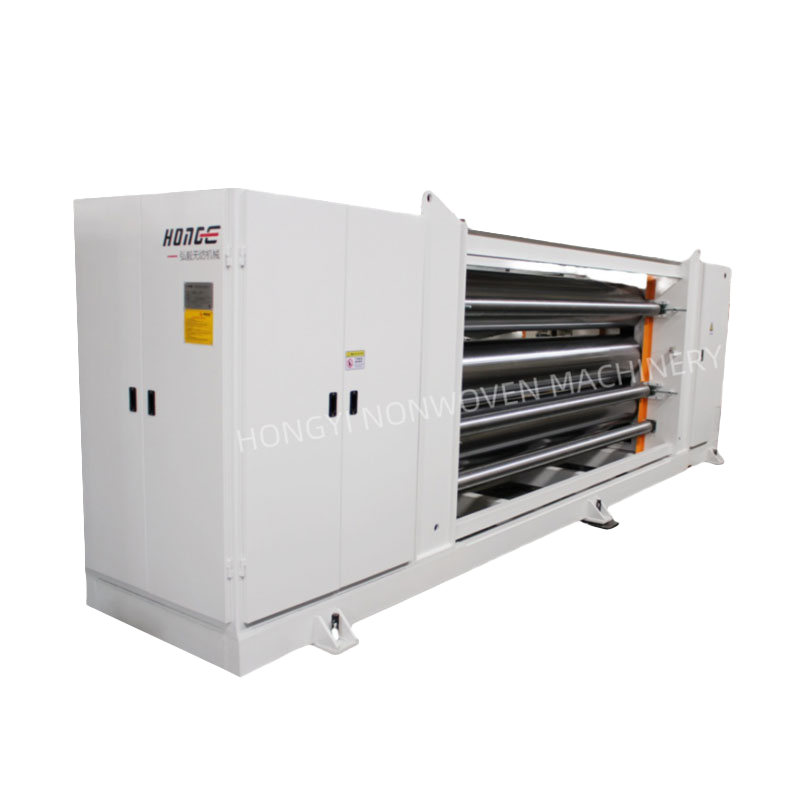
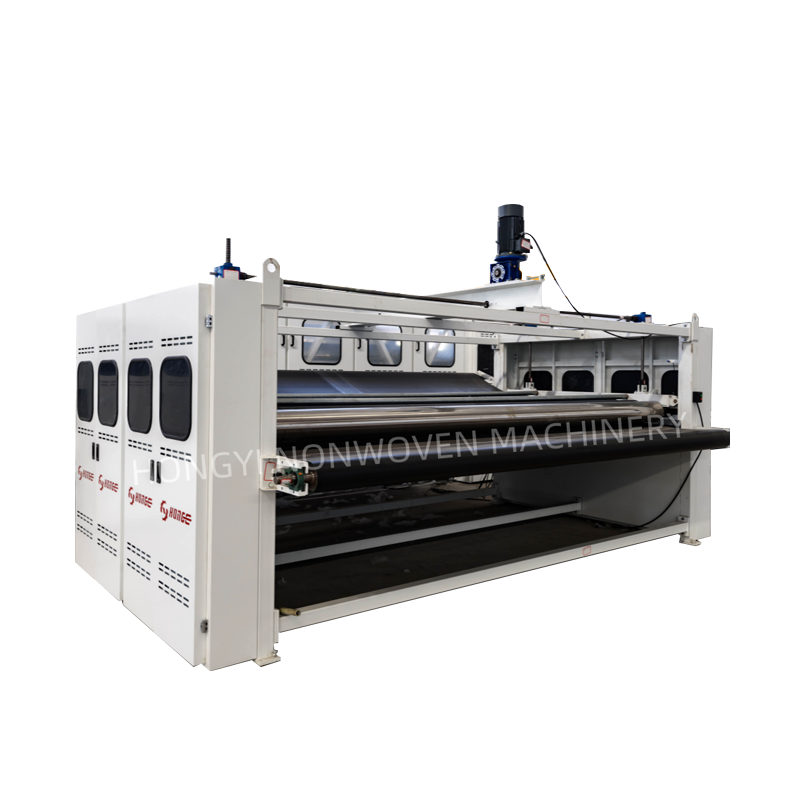
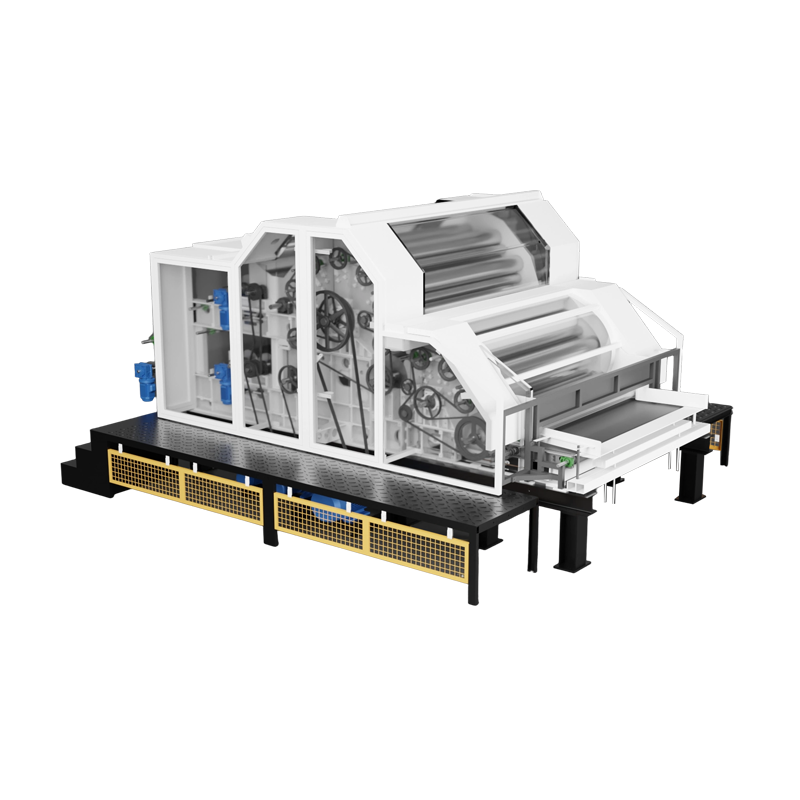
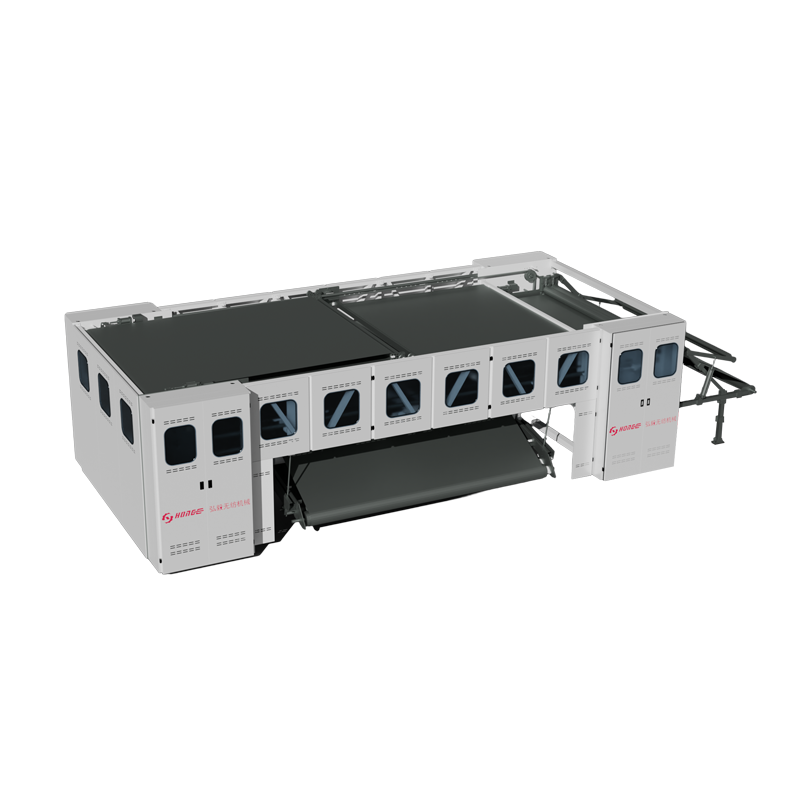
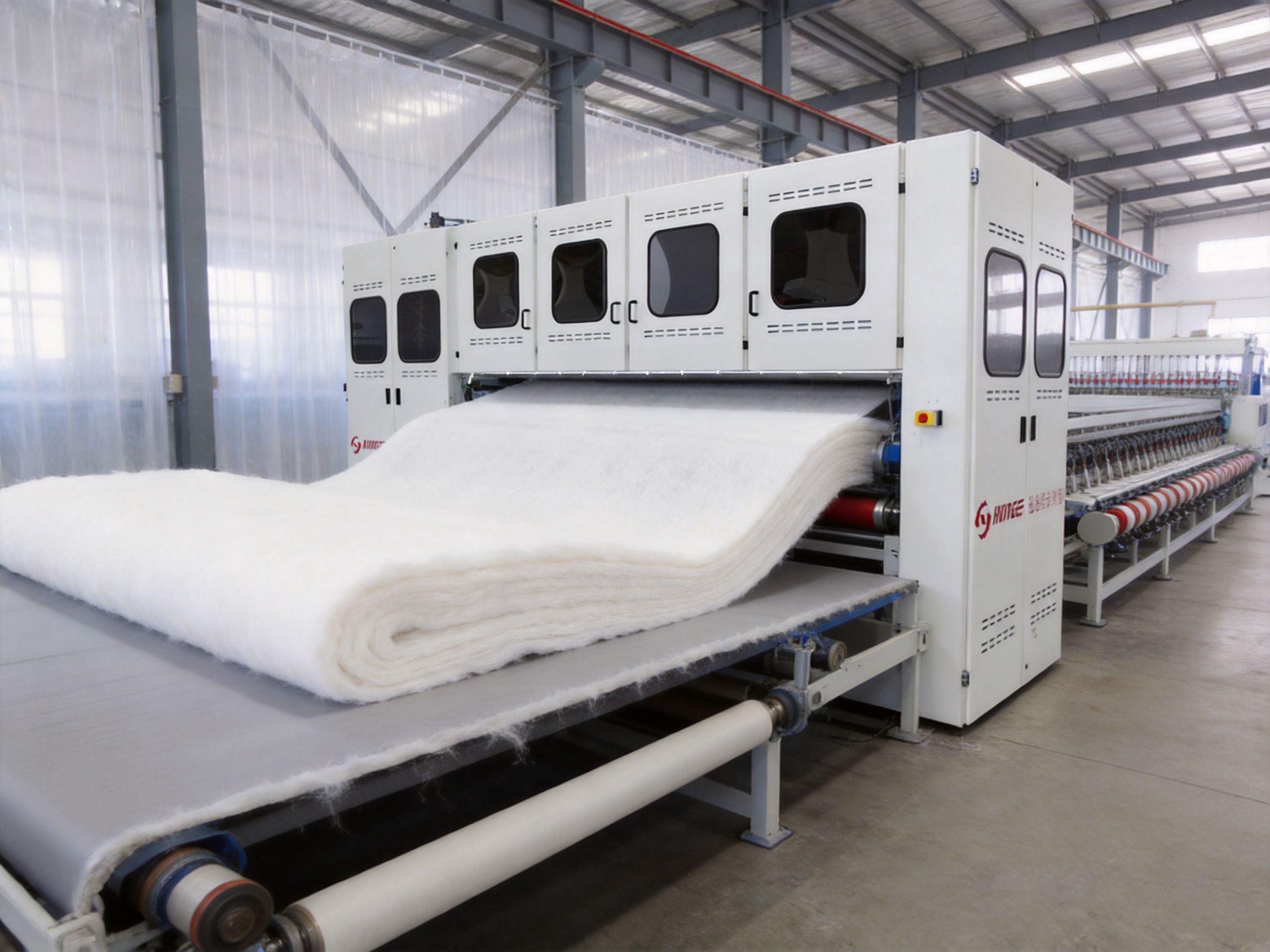
The HYPW Cross Lapper is developed to meet these needs. It is a high-speed unit intended to fold and plate fiber webs from a carding machine evenly into the required weight and thickness. After web laying and pressurization, the fiber batt is transferred smoothly to the next process. The system is suitable for automatic nonwoven production lines where consistency, reliability, and efficient operation are essential.
Product Overview
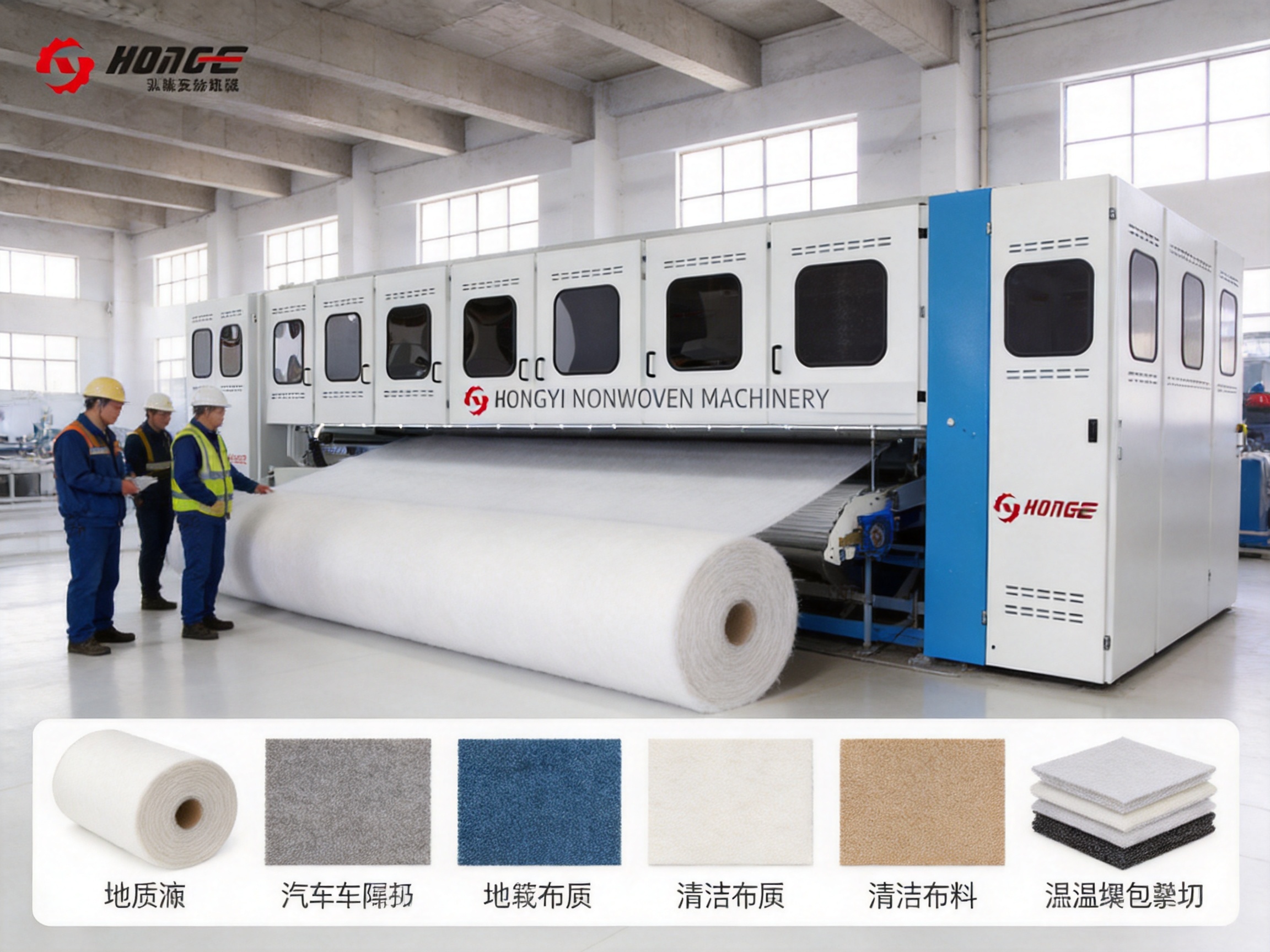
The HYPW Cross Lapper is categorized under web forming and needle punching equipment. It can be integrated with carding machines, needle punching machines, thermal bonding ovens, heat setting machines, and other nonwoven line equipment. Its main purpose is to make the fiber web into a specific width and weight while maintaining high output uniformity and smooth surface quality.
The machine is available with an output apron width from 3000 mm to 7000 mm, allowing it to meet the requirements of different production line widths. The input width can match the width of the carding machine, with an input width of up to 2900 mm. The maximum speed can reach 100 m/min, depending on production configuration, raw material properties, and process requirements. Raw materials may include polyester fiber, polypropylene staple fiber, and other staple fibers commonly used in nonwoven production.
The machine adopts automatic control, and the configuration can be customized according to customer requirements. The electric power supply can be arranged according to local conditions, such as 380 V 50 Hz or customized voltage options. The product is manufactured as new equipment and can be supplied with CE and ISO9001:2000-related quality management support. Video outgoing inspection can be provided, and the after-sales service includes a one-year warranty.
Key Technical Specifications
Item |
Specification |
Practical Value |
Product Type |
Automatic Cross Lapper Machine with Servo Motor |
Designed for precise web laying and stable automatic production |
Model |
HYPW |
Suitable for nonwoven web forming and needle punching lines |
Input Width |
Maximum 2900 mm, or matched to carding machine width |
Supports integration with different carding systems |
Output Apron Width |
3000 mm to 7000 mm |
Enables production of wide nonwoven batts and fabrics |
Maximum Speed |
Up to 100 m/min |
Supports higher production efficiency when process conditions allow |
Control Components |
PLC, motor, gearbox, bearing, gear, pressure-related components |
Provides automatic, coordinated, and reliable operation |
Raw Materials |
Polyester fiber, PP staple fiber, and other suitable fibers |
Works for multiple nonwoven product categories |
Certification |
CE, ISO9001:2000 |
Supports quality assurance and international export requirements |
Customization |
Width, color, voltage, configuration, and line matching can be customized |
Helps customers build production lines according to actual factory needs |
Lead Time |
Generally 2 to 3 months |
Allows planning for new projects and line upgrades |
Origin |
China |
Factory-direct manufacturing and export support |
Structural Design for High-Speed and Stable Operation
A cross lapper must withstand repeated high-speed reciprocating movement. Any weakness in the frame, roller system, curtain system, or transmission layout may cause vibration, web distortion, inaccurate layering, or premature component wear. The HYPW Cross Lapper is built with a reinforced frame using 8 mm thick steel plates. This strong structure improves rigidity and helps the machine maintain dimensional stability during continuous operation.
The frame is the foundation of the machine’s performance. When the frame is insufficiently rigid, the reciprocating carriage may generate vibration, leading to uneven web placement and inconsistent batt density. A reinforced frame reduces mechanical deformation and helps the machine preserve laying accuracy even when operating at higher speeds. This is especially important for wide output widths, where even small mechanical deviations can be magnified across the fabric width.
The curtain system is another critical element. Anti-static PVC curtains are used for conveying, folding, and compensation. Static electricity is a common issue in synthetic fiber processing, particularly with polyester and polypropylene fibers. Static buildup can cause fibers to cling to belts, separate unevenly, accumulate in unwanted areas, or form web defects. Anti-static curtain materials reduce these risks and help the fiber layer move smoothly through the machine.
The bottom belt is made of aluminum alloy. This material selection supports stability, durability, and accurate running. Each curtain drive roller uses seamless steel pipes, with special reinforcement at the bearing ends. Seamless steel pipe rollers offer strength and smoother rotation characteristics, while reinforced bearing ends help withstand repeated load and motion stress. These design choices contribute to long service life, reduced maintenance frequency, and better production continuity.
Precision Web Laying and Reciprocating Motion Control
The performance of a cross lapper depends heavily on how accurately it controls web laying and reciprocating movement. The HYPW Cross Lapper uses segmented precision control for web laying and reciprocating motion. This allows the machine to coordinate different movement zones and maintain stable web distribution across the output apron.
The reciprocating transmission uses synchronous belt drive. Compared with less precise transmission methods, synchronous belt drive supports accurate timing, fast response, smooth movement, and reduced slippage. In web forming, slippage or delay can produce uneven overlaps, density streaks, and cross-direction variations. Synchronous movement helps ensure that the web is placed exactly where the process requires.
The machine can use high-performance frequency conversion or servo drive. Servo drive is particularly valuable for applications that demand precise acceleration, deceleration, and positioning. Fast response helps the machine adapt to line speed changes while reducing web tension fluctuations. Stable operation is essential because the carded web is delicate and can break, stretch, or wrinkle if the motion is poorly synchronized.
Input and output are controlled synchronously to avoid breakage of the cotton layer or fiber web stretch. This is one of the most practical advantages of the system. In many production lines, the carded web is soft, light, and sensitive to tension. If the input speed, lapping motion, and output apron speed are not coordinated, the web may be pulled unevenly. The HYPW Cross Lapper’s synchronized control minimizes this risk and helps protect web integrity.
High Uniformity and Smooth Surface Quality
Uniformity is a core quality index in nonwoven fabric production. Buyers of geotextiles, automotive interior materials, carpet substrates, cleaning cloths, filtration media, and felt products often require strict thickness and weight tolerances. The cross lapper must therefore produce a batt with consistent weight distribution from edge to edge and along the machine direction.
The HYPW Cross Lapper is designed so that the output layer has high uniformity, a smooth surface, neat edges, and stable product quality. By folding and paving the carded web evenly into a predetermined width and thickness, it helps downstream equipment operate under more predictable conditions. Needle punching machines can punch more consistently when the batt thickness is stable. Thermal bonding ovens can bond more evenly when fiber density is uniform. Winding and cutting machines can handle fabric more efficiently when edges are neat and trimming requirements are reduced.
The machine uses a data control system that can compensate output uniformity according to actual process requirements. This is important because real production conditions are rarely perfectly constant. Fiber type, humidity, carding output, line speed, and target weight can all change. A data-controlled cross lapper helps operators adjust parameters and improve web distribution according to production needs.
The use of a man-machine interface allows parameter setting and process data input. Operators can set production requirements more conveniently, reducing dependence on manual mechanical adjustment. A clear interface also helps shorten training time, reduce operating mistakes, and improve repeatability between different product recipes.
Automatic Detection, Alarms, and Operator-Friendly Control
Automation is increasingly important in nonwoven machinery because manufacturers need consistent output, reduced labor dependence, and better process traceability. The HYPW Cross Lapper includes automatic abnormal fault alarm functions. When operating conditions deviate from expected values, the system can alert operators so that corrective action can be taken quickly. This reduces downtime and prevents minor problems from becoming major quality or mechanical failures.
The output bottom curtain width is detected automatically. Automatic detection contributes to easier line operation and better process control. In wide nonwoven lines, precise width control is essential for reducing waste and maintaining product specifications. Automatic detection also supports more stable operation when production specifications are changed.
The machine’s corrective control principle is another important feature. Web correction helps maintain the proper fiber layer path and prevents the batt from shifting or forming uneven edges. When combined with anti-static curtains and synchronized drive, correction control gives the machine a stronger ability to maintain quality over long production runs.
For production managers, these automation features provide practical benefits. They help stabilize production, reduce manual intervention, lower the risk of operator error, improve output consistency, and support the production of higher-value nonwoven materials.
Advantages Over Common Competing Cross Lappers
Many cross lappers in the market can perform basic web folding, but not all are equally suitable for high-speed, wide-width, and quality-sensitive nonwoven production. The HYPW Cross Lapper offers several advantages that distinguish it from ordinary machines.
Stronger Mechanical Structure
Some lower-cost machines use lighter frames that may perform acceptably at low speeds but become unstable during high-speed reciprocating operation. The HYPW Cross Lapper’s reinforced steel plate frame provides better rigidity and durability. This supports stable operation, especially in wide-width configurations and continuous production environments.
Better Anti-Static Web Handling
Static electricity can be a serious issue when processing synthetic fibers. Machines without proper anti-static conveying may suffer from web adhesion, fiber scattering, uneven laying, and cleaning difficulties. The HYPW Cross Lapper uses anti-static PVC curtains and high-strength carbon curtain concepts to reduce stress deformation and static-related web defects. This improves fiber layer stability and reduces quality problems.
More Precise Motion Control
Ordinary mechanical or poorly synchronized systems may cause tension fluctuation and irregular web overlap. The HYPW Cross Lapper uses synchronous belt transmission, frequency conversion or servo drive, segmented motion control, and synchronized input-output control. These features help protect the fiber web and improve laying precision.
Higher Uniformity Compensation Capability
In real production, perfect uniformity cannot be achieved only by mechanical movement. It also requires process data, compensation control, and operator adjustment. The HYPW Cross Lapper uses a data control system that can compensate output uniformity according to actual production requirements. This gives it an advantage in producing stable batt structures for demanding applications.
Better Integration with Complete Production Lines
Changshu Hongyi Nonwoven Machinery Co., Ltd. manufactures not only cross lappers but also complete nonwoven production lines and related equipment, including opening and blending equipment, feeding and carding equipment, needle punching equipment, thermal bonding and heat setting equipment, airlay systems, winding and cutting machines, and assistant equipment. This whole-line manufacturing capability allows the cross lapper to be designed and customized as part of an integrated process rather than as an isolated machine.
Customization for Real Factory Conditions
Different customers have different requirements for width, voltage, color, configuration, raw materials, target product, and production capacity. The HYPW Cross Lapper can be customized according to customer needs. Compared with standard-only suppliers, this flexibility helps factories reduce integration problems and improve return on investment.
Applications in Nonwoven Product Manufacturing
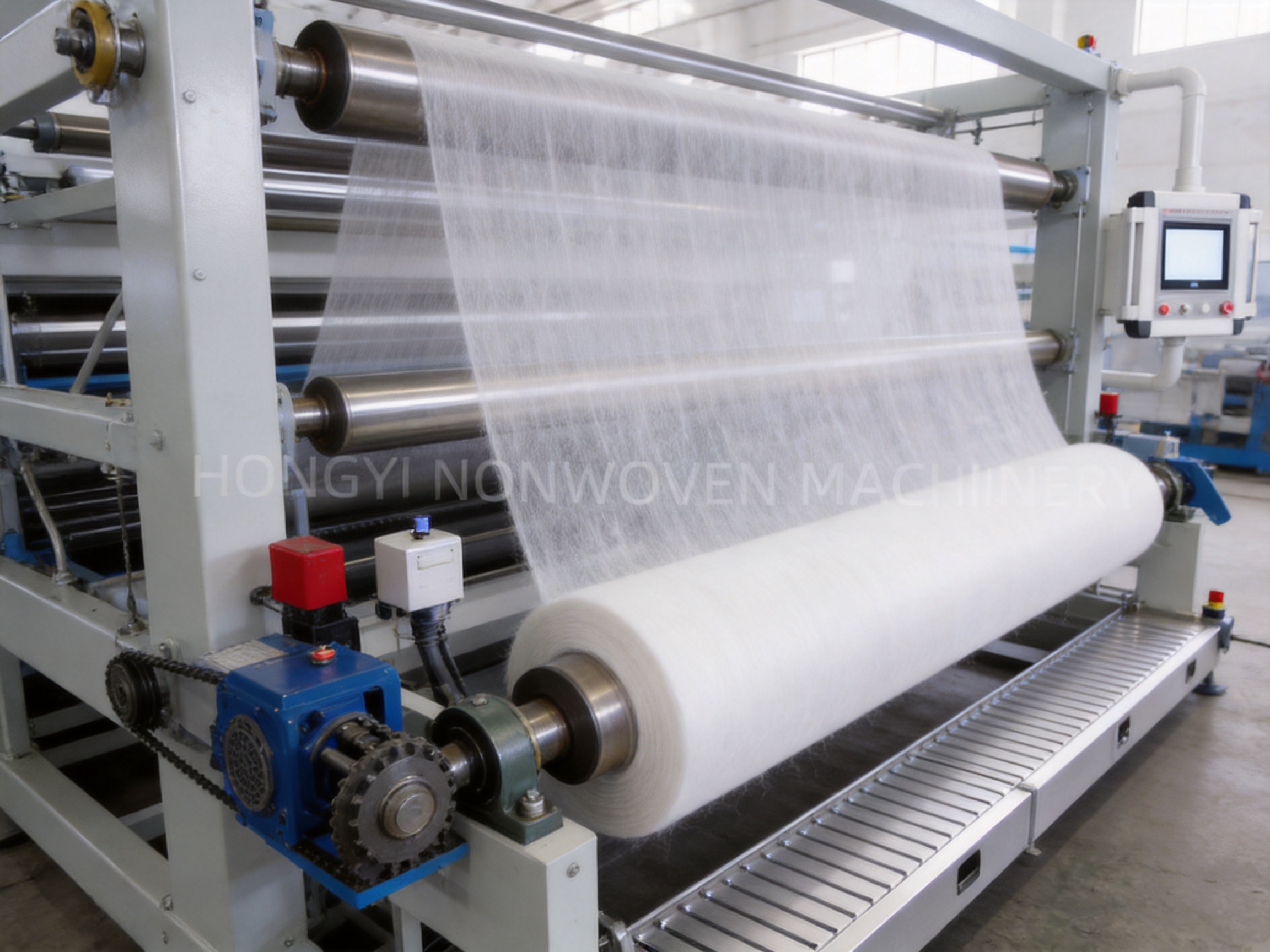
The HYPW Cross Lapper can be used in many nonwoven production lines. Its core function is web forming, so it supports any process where carded fiber layers need to be built into a stable batt before bonding, needling, heat treatment, or finishing.
Needle-Punched Geotextile Production
Geotextiles require strength, dimensional stability, and uniform thickness. Cross lapping helps form a multi-layer batt with controlled weight distribution before needle punching. A stable batt allows needles to entangle fibers consistently, improving tensile strength and reducing weak spots. The wide output options of the HYPW Cross Lapper are suitable for geotextile lines that require large fabric widths.
Nonwoven Carpet and Carpet Substrate Lines
Carpet substrates and felt layers require smooth surfaces, uniform thickness, and clean edges. Uneven web formation can lead to visible defects and inconsistent cushioning performance. The HYPW Cross Lapper’s uniform web laying and neat edge formation help improve carpet product quality and reduce trimming waste.
Automotive Interior Materials
Automotive nonwovens are used in trunk liners, insulation pads, floor materials, acoustic components, and decorative felt layers. These products require consistent density and reliable mechanical performance. A precise cross lapper helps manufacturers achieve repeatable material properties, which is important for automotive supply chains.
Needle-Punched Cleaning Cloths
Cleaning cloths require absorbency, softness, strength, and even texture. The web forming stage affects all of these properties. The HYPW Cross Lapper can help build a uniform batt before needle punching, supporting more consistent cloth performance and appearance.
Wool Felt and Jute Felt Production
Natural and blended fibers can require careful handling because fiber length, crimp, stiffness, and cohesion differ from synthetic fibers. A stable cross lapper with adjustable process parameters can help form suitable batts for wool felt, jute felt, and mixed fiber felt lines.
Thermal Bonding Wadding and Heat-Set Products
Thermal bonded wadding depends on uniform batt thickness and balanced fiber distribution before heating. Uneven web formation may create hard spots, soft spots, shrinkage variation, or bonding defects. The HYPW Cross Lapper can feed a smooth and consistent batt into thermal bonding ovens and heat setting equipment.
Airlaid Waste Felt and Recycled Fiber Products
Recycled fiber products may contain fibers with varying length and properties. Stable web laying and correction control help compensate for some material irregularities. For waste felt lines and recycled fiber applications, a robust cross lapper supports more reliable production.
Manufacturing Strength of Changshu Hongyi Nonwoven Machinery Co., Ltd.
Changshu Hongyi Nonwoven Machinery Co., Ltd. is located at No. 52, Jinxiu Avenue, Zhitang Town, Changshu City, Suzhou City, Jiangsu Province, China. The company is a professional nonwoven machinery manufacturer and trader with more than 20 years of experience in the nonwoven machinery field. This long-term specialization is important because nonwoven machinery requires practical understanding of fibers, line layout, process control, mechanical design, installation, commissioning, and after-sales service.
The company provides both complete nonwoven production lines and individual machines. Its product scope includes opening and blending equipment, feeding and carding equipment, web forming and needle punching equipment, thermal bonded and heat setting equipment, airlay equipment, winding and cutting machines, assistant equipment, and full nonwoven fabric production lines. This broad capability allows the company to design equipment that works together across the whole production process.
For the HYPW Cross Lapper, this manufacturing background brings several advantages. The company understands how the cross lapper must match the carding machine input, how it must feed the needle punching machine or thermal bonding oven, and how web tension, width, speed, and density influence final product quality. This system-level knowledge helps customers avoid common integration problems that occur when machines are purchased from unrelated suppliers.
The company’s products have been supplied to more than 20 countries, including Mexico, Argentina, Brazil, Turkey, Algeria, Egypt, Bangladesh, Vietnam, Thailand, and other Asian countries. Export experience is valuable because international customers often require different voltages, safety expectations, documentation, shipping arrangements, installation support, and communication standards. A manufacturer with export experience can better support overseas projects from inquiry to commissioning.
Advanced Manufacturing and Quality Control
Producing a reliable cross lapper requires more than assembling purchased components. It involves structural design, machining accuracy, welding quality, roller balance, belt alignment, electrical system integration, control programming, inspection, and final testing. Changshu Hongyi Nonwoven Machinery Co., Ltd. focuses on high efficiency, reliability, quality, advanced technology, and precision engineering. These values are reflected in the HYPW Cross Lapper’s reinforced frame, anti-static conveying system, synchronous drive, automatic control functions, and customization ability.
In manufacturing, steel plate cutting, frame welding, stress control, surface finishing, roller preparation, and assembly accuracy all influence machine performance. A cross lapper operates with continuous reciprocating motion, so small assembly errors can cause vibration, belt deviation, bearing stress, or noise. Careful manufacturing helps ensure smooth operation and long service life.
Core components such as PLC, bearings, gearbox, motor, gears, and related pressure components are selected and integrated to support stable automatic operation. The control system must coordinate speed, motion, correction, alarms, and operator input. Electrical layout and programming must be suitable for the production environment, where dust, fiber fly, vibration, and long operating hours are common.
Before delivery, outgoing inspection can be provided, including video inspection where required. This gives customers better confidence before shipment. Packing options include nude packing or PE film, depending on shipping and project requirements. For large nonwoven machinery, practical export packaging and transport planning are essential to reduce risk during long-distance transportation.
Customization and Engineering Support
Nonwoven production lines differ greatly. A customer producing lightweight cleaning cloth may need a different configuration from a customer producing heavy geotextiles or automotive felt. Fiber properties, product width, target GSM, bonding method, plant layout, power supply, automation level, and budget all influence equipment selection. The HYPW Cross Lapper can be customized according to customer needs, which makes it suitable for new production lines, line upgrades, and replacement projects.
Customization may include output width from 3000 mm to 7000 mm, input apron width matched to the carding machine, voltage configuration, color selection, line integration, control functions, and mechanical arrangement. The ability to customize is particularly important for customers expanding production or replacing older equipment while keeping existing machines. A properly matched cross lapper can improve the performance of the whole line without requiring unnecessary changes to other equipment.
Changshu Hongyi’s experience with complete nonwoven production lines allows it to offer more than a single machine. The company can discuss raw material characteristics, target product specifications, output capacity, machine sequence, workshop layout, and downstream bonding requirements. This consultative approach is valuable because the success of a cross lapper depends on its relationship with the upstream and downstream machines.
Process Benefits for Production Managers
For production managers, the value of a cross lapper can be measured in fabric quality, uptime, labor efficiency, energy use, and maintenance requirements. The HYPW Cross Lapper contributes to these areas in several ways.
First, high uniformity reduces product rejection. When batt density is stable, the finished fabric is more likely to meet customer specifications. This reduces waste and improves profitability. Second, smooth operation reduces downtime. A strong frame, reinforced rollers, and reliable transmission support long production runs. Third, automatic control reduces operator burden. Parameter setting, fault alarms, and synchronization help operators manage the process more efficiently.
Fourth, neat edges reduce trimming waste. Fabric with uneven edges may require more cutting, producing waste material and lowering usable output. The HYPW Cross Lapper is designed to form products with two neat edges and stable surface quality. Fifth, better web handling protects delicate fiber layers. Anti-static curtains and synchronized control reduce stretching, breakage, and deformation during lapping.
These advantages are especially important in competitive nonwoven markets, where manufacturers must balance quality and cost. A machine that improves stability can provide long-term savings through reduced waste, fewer stoppages, better product acceptance, and more reliable delivery schedules.
Importance of Servo and Frequency Conversion Drive
Drive technology strongly affects cross lapper performance. The HYPW Cross Lapper can use high-performance frequency conversion or servo drive. Frequency conversion allows motor speed adjustment, which is useful for matching line speed and process requirements. Servo drive offers enhanced precision, fast response, and accurate positioning, which are valuable for high-speed lapping and complex product specifications.
In cross lapping, the reciprocating carriage must accelerate, decelerate, reverse direction, and coordinate with web input and output movement. If acceleration is too abrupt, the web may stretch or shift. If response is too slow, overlap spacing may become irregular. Servo control helps maintain more consistent movement and improves the ability to produce uniform batts.
Compared with older mechanical systems, modern drive systems also support easier recipe changes. Operators can adjust parameters through the human-machine interface rather than relying only on manual mechanical changes. This improves production flexibility when switching between different product widths, weights, or fiber blends.
Anti-Static and High-Strength Curtain Advantages
Fiber web handling is delicate. A carded web can be light, airy, and easily affected by static electricity, air currents, belt surfaces, and tension. The HYPW Cross Lapper uses anti-static PVC curtains for conveying, folding, and compensation. It also adopts anti-static high-strength carbon curtain concepts to avoid stress deformation of the cotton layer operation.
Anti-static performance helps fibers release more predictably from conveying surfaces. This reduces dragging, clinging, uneven folding, and fiber accumulation. High-strength curtain construction helps preserve belt shape and running stability over time. If a curtain stretches or deforms, web placement accuracy may decline. Therefore, curtain strength and anti-static properties directly support long-term product quality.
For factories processing polyester fiber, PP staple fiber, and similar synthetic fibers, anti-static design is not optional; it is a quality requirement. By including anti-static web handling as part of the machine design, the HYPW Cross Lapper provides a practical advantage over lower-grade equipment that may require frequent cleaning, adjustment, or production slowdown due to static-related problems.
Integration with Needle Punching and Thermal Bonding
The cross lapper is positioned between the carding machine and the bonding or consolidation stage. In needle punching lines, the cross-lapped batt enters a needle loom, where barbed needles mechanically entangle fibers. If the batt is uneven, the needle punching result will also be uneven. Dense areas may become too stiff, while thin areas may be weak or porous. A precise cross lapper helps ensure that the needle punching machine receives a stable batt.
In thermal bonding lines, the batt enters an oven or heat setting system where bonding fibers soften and connect the structure. Uniform thickness is essential for even heating. Thick areas may bond differently from thin areas, leading to inconsistent loft, resilience, or strength. The HYPW Cross Lapper’s smooth and uniform output supports better thermal bonding performance.
Because Changshu Hongyi manufactures both web forming equipment and downstream nonwoven machinery, the company can help match the cross lapper with needle punching machines, thermal bonding wadding oven machines, ironing machines, airlaid systems, and winding or cutting equipment. This integrated approach helps customers achieve stable production from fiber opening to finished fabric handling.
Reliability, Maintenance, and Long-Term Operation
Industrial nonwoven machines are expected to operate for long hours. Reliability is therefore a major purchasing factor. The HYPW Cross Lapper’s reinforced steel frame, seamless steel pipe rollers, reinforced bearing ends, synchronous transmission, and automatic alarm functions are all designed to support long-term operation.
Maintenance accessibility is also important. A machine that is difficult to inspect or adjust can increase downtime. With proper design, operators and maintenance personnel can check curtains, rollers, bearings, transmission elements, sensors, and control panels more efficiently. Preventive maintenance, including belt inspection, roller cleaning, bearing lubrication, alignment checking, and electrical system monitoring, helps keep the machine operating at high performance.
The automatic fault alarm function assists maintenance by giving early warning when abnormal conditions occur. Instead of waiting for visible defects or mechanical failure, operators can respond to system alarms and reduce risk. This is particularly important in continuous production lines where one machine stoppage affects the entire process.
Why Factory-Direct Supply Matters
Purchasing from a professional manufacturer provides benefits that may not be available through purely trading-based channels. Changshu Hongyi Nonwoven Machinery Co., Ltd. offers factory-direct production, customization, and technical communication. Customers can discuss machine dimensions, line matching, voltage, output width, raw material, and target product directly with the equipment manufacturer.
Factory-direct communication reduces misunderstanding and improves project accuracy. It also helps when spare parts, technical support, or future line expansion are needed. A manufacturer that understands the original machine design can provide more reliable advice than a supplier without engineering capability.
For international buyers, factory-direct supply can also support wholesale and OEM-type orders. The company has experience exporting to multiple countries and can provide machines for different market needs. This makes the HYPW Cross Lapper suitable for customers establishing new nonwoven factories, expanding existing lines, or upgrading older equipment.
Practical Selection Considerations
When selecting a cross lapper, customers should consider several practical factors. The first is the target output width. The HYPW Cross Lapper offers output apron widths from 3000 mm to 7000 mm, which covers many common nonwoven line requirements. The second is the input width and carding machine match. Proper matching ensures smooth web transfer and reduces tension problems.
The third consideration is product weight and line speed. Although the machine can reach a maximum speed of 100 m/min under suitable conditions, actual production speed depends on fiber type, carding capacity, product GSM, bonding process, and quality requirements. The fourth factor is raw material. Polyester and PP staple fibers are common, but other fibers or blends may require process adjustment.
The fifth factor is automation level. A machine with PLC control, human-machine interface, automatic alarm, width detection, and synchronized drive can reduce labor dependence and improve repeatability. The sixth factor is after-sales support. A one-year warranty, outgoing inspection, customization, and manufacturer communication can help reduce project risk.
Q&A Section
What is the main function of the HYPW Cross Lapper?
The main function is to receive the fiber web from a carding machine, fold and lay it evenly into the required width, thickness, and weight, and then transfer the formed batt to the next process, such as needle punching or thermal bonding.
What output width can the machine provide?
The output apron width can be supplied from 3000 mm to 7000 mm, depending on customer requirements and production line design.
What is the maximum input width?
The input width can be up to 2900 mm, and the input apron width can also be matched to the width of the carding machine.
What raw materials can be processed?
The machine is suitable for polyester fiber, PP staple fiber, and other staple fibers used in nonwoven fabric production. Actual compatibility should be confirmed according to fiber specification and target product.
Why is anti-static curtain design important?
Anti-static curtain design helps reduce fiber clinging, uneven web movement, static buildup, and surface defects. This is especially important when processing synthetic fibers such as polyester and polypropylene.
How does servo drive improve cross lapping quality?
Servo drive provides fast response, accurate motion control, and stable positioning. It helps synchronize reciprocating movement with input and output speeds, reducing web stretching, breakage, and uneven overlap.
Can the machine be customized?
Yes. The configuration, width, voltage, color, and line matching can be customized according to customer needs. This makes the machine suitable for different factories and product applications.
What are the main advantages over ordinary cross lappers?
The machine offers a reinforced steel frame, anti-static conveying system, synchronous belt transmission, frequency conversion or servo drive, data-based uniformity compensation, automatic fault alarm, automatic width detection, and strong customization support.
Which downstream processes can the machine feed?
It can feed needle punching machines, thermal bonding ovens, heat setting equipment, and other downstream nonwoven processes requiring a stable cross-lapped batt.
Why choose Changshu Hongyi Nonwoven Machinery Co., Ltd.?
The company has more than 20 years of experience in nonwoven machinery, provides complete production lines and unit machines, exports to more than 20 countries, and offers customized factory-direct solutions for nonwoven manufacturers.
Conclusion
The HYPW Cross Lapper is a key machine for producing uniform, stable, and high-quality nonwoven batts. Its function may appear simple at first glance, but in practice, precise web forming requires strong mechanical construction, accurate motion control, reliable anti-static conveying, synchronized operation, automatic correction, and operator-friendly control. The machine is designed to meet these requirements while supporting wide output widths, high-speed operation, and customized production needs.
Compared with ordinary cross lappers, it provides advantages in frame strength, web handling, drive precision, uniformity compensation, automatic control, and integration with complete nonwoven lines. These strengths help manufacturers improve fabric quality, reduce waste, protect delicate fiber webs, and increase production reliability.
Changshu Hongyi Nonwoven Machinery Co., Ltd. adds further value through more than 20 years of industry experience, complete line manufacturing capability, export experience, customization support, and commitment to high efficiency, reliability, quality, advanced technology, and precision engineering. For manufacturers producing geotextiles, automotive materials, carpets, cleaning cloths, felt products, thermal bonded wadding, or other nonwoven fabrics, the HYPW Cross Lapper offers a practical and competitive solution for modern web forming.
References
1. Russell, S. J. Handbook of Nonwovens. Woodhead Publishing.
2. Albrecht, W., Fuchs, H., and Kittelmann, W. Nonwoven Fabrics: Raw Materials, Manufacture, Applications, Characteristics, Testing Processes. Wiley-VCH.
3. INDA Association of the Nonwoven Fabrics Industry. Nonwovens Industry Technical Reference Materials.
4. EDANA. Nonwovens Standard Procedures and Industry Guidance Materials.
5. Adanur, S. Wellington Sears Handbook of Industrial Textiles. Technomic Publishing.
6. Technical product information supplied for the HYPW Cross Lapper and related nonwoven machinery by Changshu Hongyi Nonwoven Machinery Co., Ltd.