

Content
- 1 Introduction
- 2 Why Fiber Opening Matters in Nonwoven Manufacturing
- 3 Product Overview
- 4 Two-Stage Opening for Better Fiber Preparation
- 5 Opening Elements for Different Fiber Requirements
- 6 Magnetic Metal Removal and Jam Protection
- 7 Mechanical Design and Manufacturing Strengths
- 8 Advantages Compared with Conventional Single-Stage Openers
- 9 Applications in Nonwoven Fabric Production
- 10 Role in a Complete Nonwoven Production Line
- 11 Manufacturing and Quality-Control Approach
- 12 Operating Recommendations
- 13 Maintenance and Service Considerations
- 14 Company Manufacturing and Export Capability
- 15 How to Select the Correct Configuration
- 16 Frequently Asked Questions
- 16.1 What is a pre-and-fine opener?
- 16.2 Can the machine be used only as a pre-opener?
- 16.3 What materials can be processed?
- 16.4 What is the maximum capacity?
- 16.5 What working widths are available?
- 16.6 How does the machine protect fiber length?
- 16.7 Does the opener remove all impurities?
- 16.8 What opening elements are available?
- 16.9 Can the machine be integrated into a complete nonwoven line?
- 16.10 What safety functions are included?
- 16.11 Is the equipment suitable for recycled fibers?
- 16.12 What information should be supplied when requesting a quotation?
- 17 Conclusion
- 18 References
- 19 Product: HYKS Pre&Fine Opener
Introduction
Fiber preparation is one of the most important stages in nonwoven fabric manufacturing. Before fibers can be carded, airlaid, thermally bonded, needle punched, or formed into a finished web, they must be opened, loosened, blended, and cleaned. Poor preparation at this stage can create uneven fiber distribution, excessive fiber damage, irregular web formation, unstable production, and inconsistent product quality.
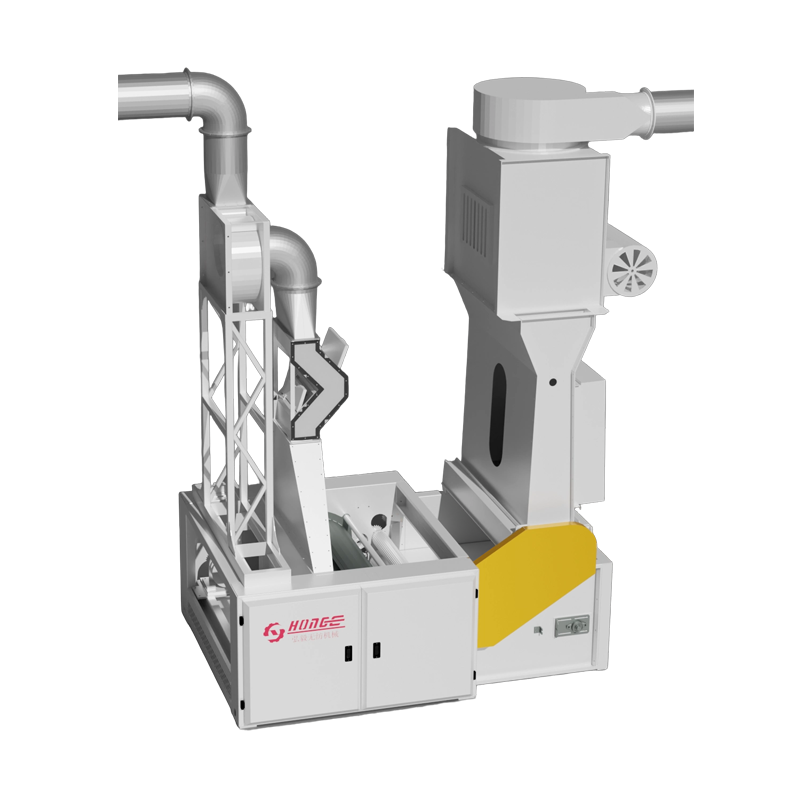
The HYKS Pre&Fine Opener is designed to address these challenges in a single fiber pretreatment solution. It combines controlled pre-opening and fine-opening functions to convert compressed, tangled, or bundled raw materials into a more uniform fiber feed. The machine can be installed as an independent pre-opening or fine-opening unit, or configured as an integrated system when a production line requires both functions.
Designed for nonwoven fabric manufacturers, fiber recyclers, and producers of specialized materials, the machine is suitable for PET fiber, PP fiber, low-melt fiber, waste fiber, and other compatible raw materials. Depending on the production line and fiber characteristics, the machine can be fitted with toothed, pin-plate, or wired opening components.
Its working width can be customized from approximately 1,000 to 2,000 millimeters, while the standard configuration can process up to 1,000 kilograms per hour per set under suitable operating conditions. A strong magnetic plate helps remove ferrous contamination, and an alarm and reverse-running function provide additional protection when material becomes jammed.
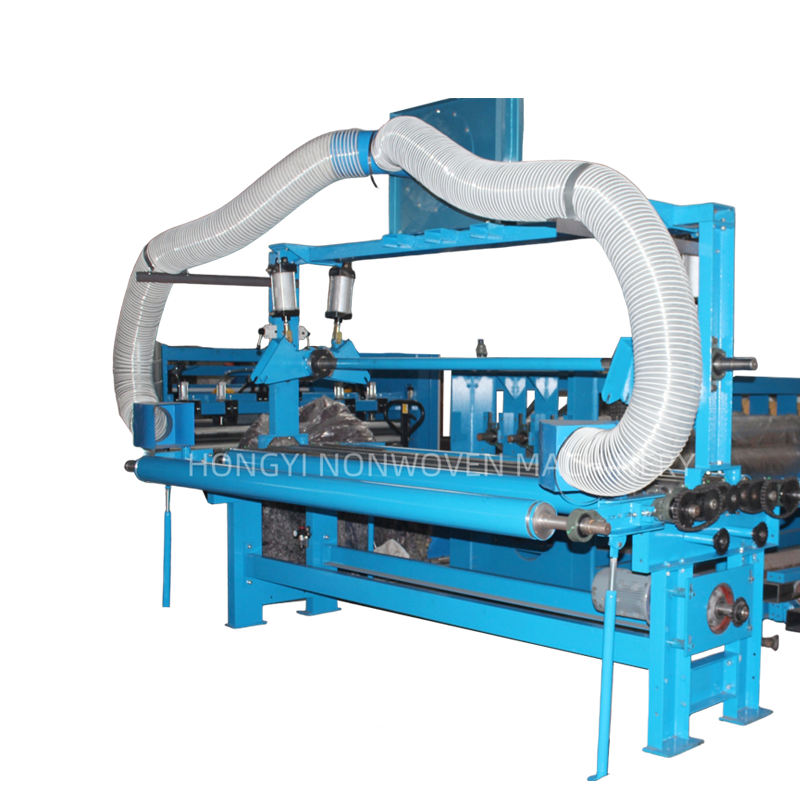
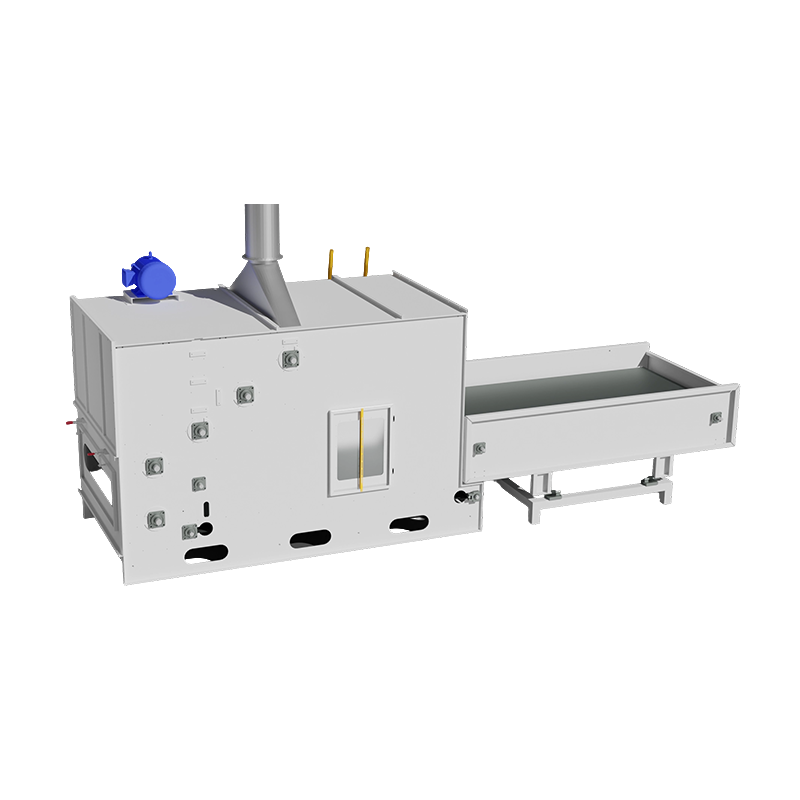
HYKS Pre&Fine Opener
Why Fiber Opening Matters in Nonwoven Manufacturing
Most synthetic and recycled fibers do not enter a nonwoven production line in an ideal state. Bales, compressed packages, recycled textile fragments, and production waste often contain large fiber bundles. These bundles may be compacted during transportation, storage, or recycling. If they are sent directly to a carding or web-forming machine, they can cause uneven feeding and place unnecessary stress on downstream components.
Opening reduces the size and density of fiber bundles. The objective is not simply to break material apart as aggressively as possible. Effective opening must achieve a balance between loosening the fibers and preserving their original length and strength. Excessive mechanical action may shorten or damage fibers, while insufficient opening leaves large bundles that interfere with carding, airlaying, and web uniformity.
Blending is another essential function. Nonwoven manufacturers may combine different fiber types, colors, deniers, lengths, or recycled materials. A well-prepared blend helps stabilize the composition of the final web. Better blending can improve thickness consistency, tensile strength, softness, absorbency, thermal bonding response, and appearance.
Impurity removal is equally important. Recycled and waste fibers may contain metal particles, wire fragments, dust, hard lumps, or other contaminants. A magnetic plate positioned in the material flow can attract ferrous particles before they reach sensitive downstream equipment. Removing these contaminants helps reduce damage to carding clothing, rollers, feed systems, and web-forming machines.
The HYKS Pre&Fine Opener is therefore more than a basic fiber loosening machine. It is a preparation unit that supports a more stable and controlled transition between raw-material handling and the next stage of nonwoven production.
Product Overview
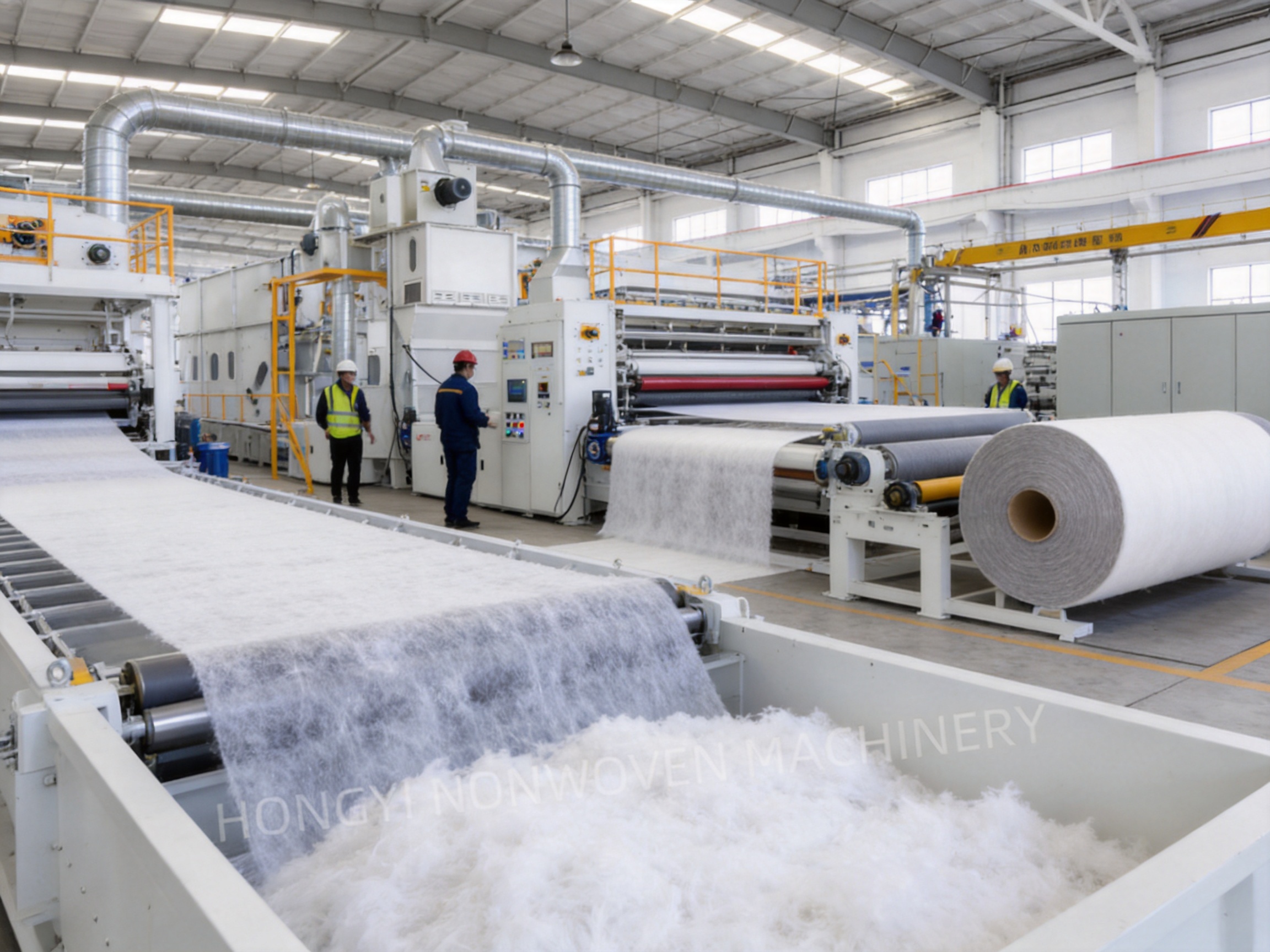
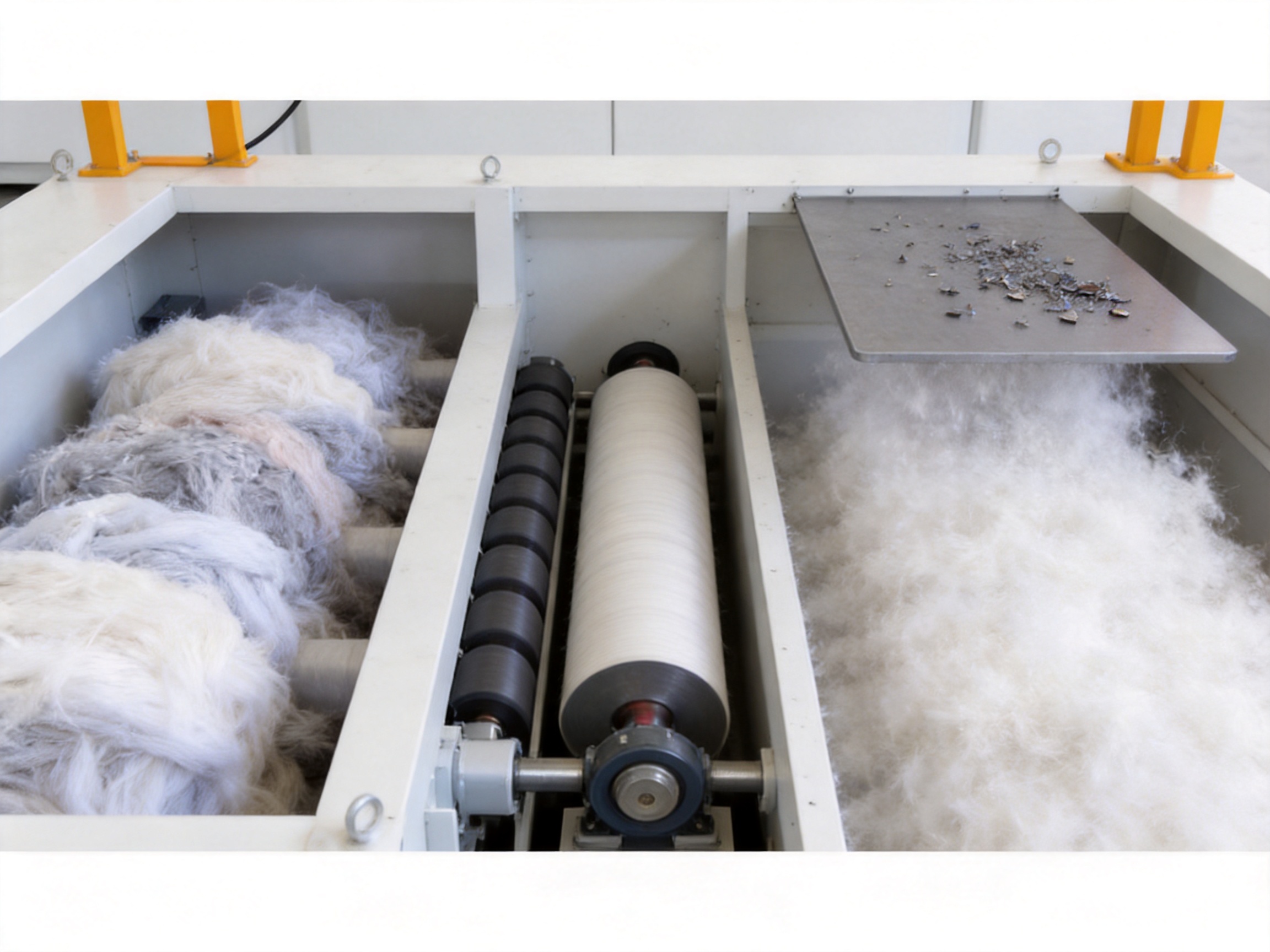
The HYKS Pre&Fine Opener is a fiber raw-material opening machine developed for pretreatment applications. In a conventional line, a pre-opening machine is generally placed after an initial opening machine. It loosens the material further, helps separate compacted bundles, and supports the removal of unwanted metal particles. The prepared material can then be processed by a fine opener before entering carding, airlaying, or another web-forming process.
Different nonwoven lines require different degrees of opening. For this reason, the HYKS design can be arranged in several ways. A customer may select a dedicated pre-opener, a dedicated fine opener, or a combined machine that integrates both stages. This modular approach allows the equipment to be matched with the raw material, target product, line capacity, and available factory space.
The integrated configuration performs initial loosening and subsequent fine processing in a coordinated sequence. Large bundles are first opened in a controlled manner, after which the material receives additional treatment to create smaller and more evenly distributed fiber groups. This staged approach is useful when manufacturers need to protect fiber length while still achieving a high level of opening.
The machine is available under the HYKS model designation, with the HYKS-150 listed as a representative model. Working width, feed configuration, opening elements, motor arrangement, and other specifications can be customized according to the production line.
| Item | Typical Specification |
| Machine type | Pre-opening and fine-opening machine |
| Representative model | HYKS-150 |
| Working width | 1,000–2,000 millimeters, customized |
| Capacity | Up to approximately 1,000 kilograms per hour per set |
| Main cylinder diameter | Approximately 650 millimeters |
| Feed roller diameter | Approximately 75 millimeters |
| Feed roller speed | Approximately 16 revolutions per minute |
| Beater diameter | Approximately 420 millimeters |
| Beater speed | Approximately 900 revolutions per minute |
| Installed power | Approximately 6.95 kilowatts in the listed configuration |
| Raw materials | PET, PP, low-melt fiber, waste fiber, and compatible materials |
| Metal removal | Integrated strong magnetic plate |
| Control and protection | Alarm and reverse-running function for jam protection |
| Working widths available | Approximately 1.0, 1.2, 1.4, 1.6, and 2.0 meters |
| Certification information | CE and ISO9001-related manufacturing documentation |
Actual performance depends on fiber type, moisture, bale density, impurity content, feed consistency, opening-element selection, and downstream line configuration. Final technical parameters should be confirmed through a production evaluation and detailed quotation.
Two-Stage Opening for Better Fiber Preparation
Controlled pre-opening
The first stage is intended to loosen compressed or tangled fiber material without applying unnecessary force. Pre-opening reduces the size of large fiber masses and prepares the material for more detailed treatment. This is particularly useful for PET staple fiber, PP fiber, low-melt fiber, and recycled textile material that has been compacted during storage.
Pre-opening also helps stabilize the feed entering the fine-opening section. Instead of sending irregular blocks into a high-intensity opening zone, the operator can use a controlled first stage to create a more manageable material flow. This can reduce sudden load changes and improve the consistency of the overall line.
Fine opening
The fine-opening stage focuses on further separating smaller fiber bundles. Its purpose is to produce a more uniform fiber structure for carding, airlaying, or other web-forming operations. Fine opening can help downstream equipment distribute fibers more evenly across the working width.
Uniform fiber preparation is especially valuable when producing products with strict requirements for weight, thickness, surface appearance, or mechanical strength. A consistent feed helps the carding machine form a more stable web and helps airlay equipment distribute material with fewer local variations.
Integrated operation
When pre-opening and fine-opening functions are integrated, the machine can provide a continuous sequence of material treatment. The combined arrangement reduces the need for separate equipment in applications where floor space, process simplicity, or line integration is important.
The integrated design also allows the opening intensity to be distributed across multiple stages. Rather than relying on one aggressive opening action, the material is progressively loosened. This can help reduce the risk of excessive fiber breakage while still achieving the desired preparation level.
Opening Elements for Different Fiber Requirements
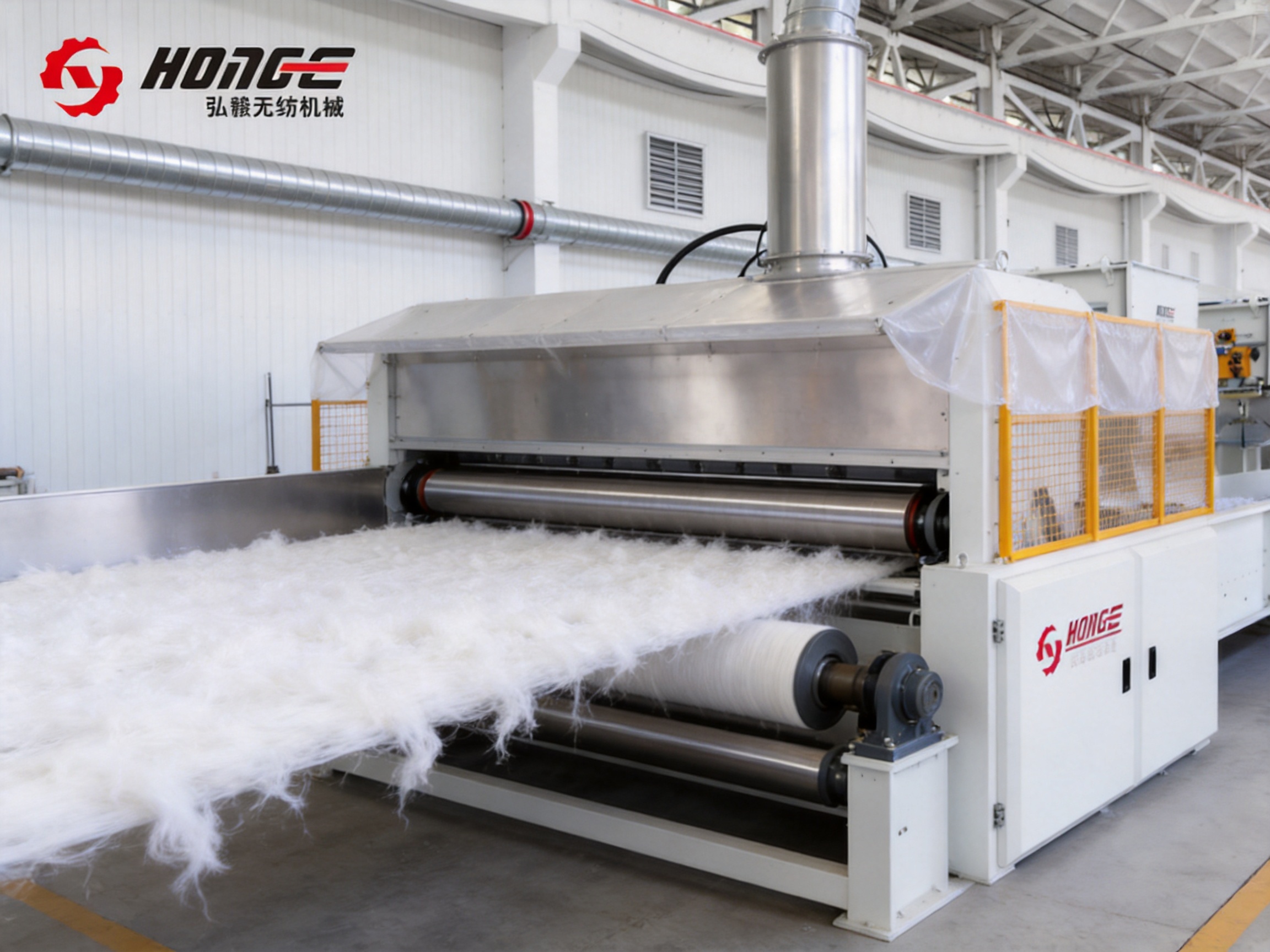
Fiber materials vary widely in length, strength, density, contamination level, and degree of entanglement. One opening configuration cannot provide optimal results for every material. The HYKS Pre&Fine Opener can be equipped with different opening options according to the raw material and production objective.
Toothed opener
A toothed opening element is suitable for applications that require effective engagement with compacted fiber masses. The tooth arrangement can help grip, separate, and loosen fiber bundles as material passes through the opening zone. This configuration may be considered for relatively dense or strongly compressed materials, subject to a trial evaluation.
Pin-plate opener
A pin-plate configuration uses pins to engage the fiber material and separate bundles. It can provide a controlled opening effect for selected synthetic fibers, blends, and recycled materials. The final pin arrangement and operating conditions should be selected according to fiber length and the desired level of opening.
Wired opener
A wired opening element uses carding wire or similar working surfaces to process the material. It can be selected when a more detailed fiber separation effect is required. Wire specifications, working clearance, and operating speed are important factors in determining the balance between opening performance and fiber protection.
The machine structure may use a rigid aluminum-alloy carding plate or carding wire arrangement. The selection should be made in cooperation with the equipment supplier, because the correct configuration depends on the full production process rather than on the opener alone.
Magnetic Metal Removal and Jam Protection
One of the practical advantages of the machine is its integrated metal-extraction function. A strong magnetic plate is included to help attract ferrous particles and metal dust from the fiber stream. This feature is particularly relevant when processing waste fiber, recycled textile material, or raw materials handled in environments where metal contamination is possible.
Metal particles can damage working surfaces, create sparks, block material passages, or accelerate wear on rotating equipment. Even a small piece of wire can create problems when it reaches a high-speed beater or carding component. Early removal therefore supports safer and more reliable operation.
The magnetic plate does not replace a complete contamination-control program. Operators should still inspect incoming material, maintain clean storage areas, and check the magnet regularly. Non-ferrous contaminants may not be attracted by a standard magnetic system and may require other separation methods.
The machine also includes an alarm and reverse-running function for jam protection. If excessive material accumulation or an obstruction is detected, the system can alert the operator and reverse the relevant movement to help release the jam. This protective sequence may reduce the risk of damage to the feed rollers, opening elements, drive system, and structural components.
Proper adjustment remains essential. The reverse function is a protective aid, not a substitute for correct feeding, appropriate working clearances, or scheduled maintenance. Operators should follow the operating instructions and isolate power before manually clearing any obstruction.
Mechanical Design and Manufacturing Strengths
Rigid frame construction
Opening machinery operates under continuous mechanical load. The frame must remain stable while the feed rollers, beaters, cylinders, and other rotating elements operate at working speed. The HYKS design uses an integrated numerical-control machining approach for the bending framework. This approach is intended to improve dimensional consistency, structural rigidity, and assembly accuracy.
A stable frame helps maintain the relationship between the working components. Consistent clearances are important because excessive variation can create uneven opening, additional vibration, increased wear, or unwanted fiber damage.
Precision fabrication
Numerical-control processing can provide repeatable bending and machining results for key structural parts. Controlled fabrication supports more consistent installation and makes it easier to maintain alignment during assembly. It also contributes to a cleaner overall equipment layout and more predictable commissioning.
Precision manufacturing is especially valuable for customized working widths. When a machine is produced in widths from approximately 1,000 to 2,000 millimeters, the structure, feed path, working elements, and drive arrangement must be adapted without compromising stability.
Even feeding by holding action
The feeding system uses a holding method to control the material as it enters the opening zone. Controlled holding helps prevent sudden surges and supports a more even flow across the working width. Stable feeding is important because irregular material loading can cause variations in opening quality and increase the likelihood of blockages.
Even feeding also benefits downstream equipment. A stable supply allows carding and web-forming machines to operate closer to their intended conditions. It can contribute to more consistent basis weight and reduce the need for frequent manual intervention.
Aluminum-alloy carding components
The opening roller structure can use a rigid aluminum-alloy carding plate or carding wire. Aluminum alloy can provide a favorable combination of rigidity and relatively low structural weight. The selected working surface must still be matched to the fiber type and process intensity.
Working components are wear parts and should be inspected periodically. Their condition affects the opening result, power consumption, vibration, and risk of fiber damage. Replacing worn or damaged components at the appropriate time helps maintain stable performance.
Advantages Compared with Conventional Single-Stage Openers
Progressive fiber treatment
A conventional single-stage opener may need to perform both coarse and fine separation in one action. Depending on the material, this can create an uneven compromise. A setting strong enough to separate dense bundles may be too aggressive for delicate fibers, while a gentler setting may leave large bundles unopened.
The pre-and-fine configuration distributes the work across stages. Large bundles are loosened first and then processed more finely. This progressive method provides greater flexibility in managing opening intensity and may help preserve fiber length.
Improved preparation for downstream machinery
When fiber bundles are more uniform, carding and web-forming equipment receive a more consistent feed. This can reduce local thick spots, improve fiber orientation, and support more stable production. The result depends on the entire line, but the quality of opening is an important foundation.
Flexible configuration
The modular design allows the machine to be used in different process arrangements. A producer may install it after a bale opener, before a carding machine, within a recycling line, or as part of a complete nonwoven production system. The equipment can also be adapted to different working widths and opening elements.
Protection of fiber length
Fiber length is a major factor in the performance of many nonwoven materials. Excessive opening can reduce average fiber length and negatively influence web strength or bonding behavior. By using staged treatment, manufacturers can seek the required degree of separation while reducing reliance on one highly aggressive opening action.
Integrated contamination control
The magnetic plate provides a practical level of ferrous-particle protection within the opening process. This is an advantage over basic opening units that do not include a dedicated magnetic extraction component.
Reduced installation complexity
When the pre-opening and fine-opening functions are combined, fewer individual machines may be needed. This can simplify layout planning, reduce the number of transfer points, and make the line easier to operate. The final benefit depends on the required capacity and the selected process configuration.
Applications in Nonwoven Fabric Production
Needle-punched geotextiles
Geotextile production often uses polyester, polypropylene, or recycled fibers. The fibers must be opened and blended before carding and needle punching. A stable feed supports more uniform web formation, which is important for thickness, tensile properties, puncture resistance, and overall product consistency.
Nonwoven carpets and floor coverings
Carpet production may involve synthetic fibers, recycled fibers, blends, or colored materials. Effective opening and blending help distribute the fibers before web formation. The opener can serve as part of a preparation system for needle-punched carpets, underlay, insulation layers, and related products.
Automotive interior materials
Automotive interior components require consistent density, thickness, acoustic performance, and dimensional stability. PET, PP, low-melt fiber, and recycled fiber blends may be used in different products. Careful fiber preparation supports subsequent carding, thermal bonding, hot pressing, or composite-forming processes.
Cleaning cloth and filtration materials
Needle-punched cleaning cloths, filtration media, and absorbent materials benefit from uniform fiber distribution. The required opening configuration depends on fiber length, blend composition, and target structure. The HYKS machine can be integrated into a line in which opening is followed by carding and web consolidation.
Wool felt and jute felt
Natural fibers such as wool and jute can have different opening behavior from synthetic fibers. Their moisture content, fiber length, and tendency to form bundles should be considered when selecting the opening elements and operating parameters. A production trial is recommended before final configuration.
Recycled fiber applications
Recycled fibers often contain a wider range of bundle sizes and may carry dust or metal contamination. The pre-and-fine opening sequence provides a practical way to gradually loosen the material. The magnetic plate adds an additional measure of protection for the production line.
Role in a Complete Nonwoven Production Line
The opener is normally one part of a larger process. A typical line may include bale opening, blending, pre-opening, fine opening, metal separation, carding, cross-lapping or airlaying, needle punching or thermal bonding, winding, cutting, and final inspection.
The correct position of the HYKS Pre&Fine Opener depends on the raw material and the type of line. It may be installed after an initial bale opener, before a carding machine, or within a recycling and fiber-preparation section. In some lines, the machine may operate as a standalone unit. In others, it may be connected to feeding systems and controlled as part of an automatic production sequence.
Changshu Hongyi Nonwoven Machinery provides both individual machines and complete production-line solutions. Its product range includes opening equipment, carding machines, airlay systems, needle-punching machines, thermal-bonding equipment, winding and cutting machines, and auxiliary equipment. This broader capability can simplify line coordination because the opener can be evaluated in relation to the rest of the process.
A complete line assessment should consider the following factors:
1. Raw-material type and average fiber length.
2. Bale density and degree of compression.
3. Percentage of recycled or waste fiber.
4. Expected production capacity.
5. Required web weight and thickness uniformity.
6. Number and type of downstream carding or web-forming machines.
7. Available factory space and material-transfer height.
8. Electrical standards and automation requirements.
9. Metal and dust contamination levels.
10. Required finished-product quality and operating schedule.
Manufacturing and Quality-Control Approach
Equipment quality depends on more than the visible machine structure. It also depends on design accuracy, component selection, machining, welding, assembly, electrical integration, testing, packaging, and after-sales support. A manufacturer with experience across multiple nonwoven processes can evaluate how an opening machine will perform within a complete production system.
Engineering and customization
Working width, capacity, opening elements, feed arrangement, motor configuration, control system, and connection points can be adjusted for different projects. Customization is important because a machine for a narrow laboratory or specialty line has different requirements from a high-throughput industrial line.
Engineering should begin with a clear understanding of the raw material and finished product. The manufacturer can then determine whether the line requires only pre-opening, only fine opening, or an integrated arrangement. This avoids selecting an opener based only on nominal capacity.
Fabrication and assembly
Rigid framework fabrication, numerical-control processing, and careful assembly help establish the mechanical foundation of the machine. Rotating parts should be balanced and aligned, while feed and opening clearances should be checked during installation.
The assembly process should also verify access for cleaning, inspection, and replacement of wear parts. Practical maintainability is important in continuous production because unnecessary downtime can reduce the value of an otherwise efficient machine.
Electrical and control integration
The machine can be supplied with automatic control functions according to project requirements. Alarm, jam detection, and reverse-running functions help protect the equipment. Voltage and control arrangements can be customized for the destination market and factory electrical system.
Control integration may include coordination with upstream feeding equipment and downstream carding or web-forming machinery. Interlocks can help prevent material accumulation when a downstream machine stops. The exact control architecture should be confirmed during technical planning.
Inspection and commissioning
Video outgoing inspection is available as part of the supply process. Before shipment, the manufacturer can inspect the machine, verify key functions, and provide operating information. On-site installation and commissioning requirements should be agreed upon in the contract.
Quality documentation may include equipment drawings, electrical information, operating instructions, maintenance recommendations, spare-parts lists, and inspection records. Such documentation supports installation and operator training.
Operating Recommendations
Correct operation is essential for achieving the expected opening result. Operators should begin with a moderate feed rate and observe the material after the opening stage. If large bundles remain, the setting or configuration may need adjustment. If fibers show excessive damage or the machine draws abnormal power, the opening intensity should be reviewed.
Raw material should be fed as evenly as possible. Sudden large batches can overload the feed section and increase the risk of jams. Storage and preparation areas should be kept clean to reduce contamination entering the machine.
The magnetic plate should be checked and cleaned according to the level of ferrous contamination. Accumulated metal particles can reduce magnetic effectiveness and may become a maintenance concern if not removed regularly.
Operators should monitor vibration, unusual noise, temperature, motor load, and material flow. Changes in these conditions can indicate worn working components, misalignment, loose fasteners, blockage, or an unsuitable operating setting.
Before maintenance, inspection, or manual cleaning, the machine must be stopped and isolated from its power source. Rotating components may continue moving after shutdown, so adequate waiting time and safety procedures are necessary.
Maintenance and Service Considerations
Routine maintenance helps preserve opening quality and extend equipment life. A maintenance schedule should include inspection of feed rollers, belts, bearings, fasteners, carding surfaces, magnetic plates, sensors, and electrical connections.
Opening elements gradually wear as they process synthetic fibers, recycled fibers, dust, and hard contaminants. Worn teeth, pins, or wires may reduce opening efficiency and increase the risk of fiber damage. Replacement intervals depend on raw-material characteristics and operating hours.
Bearings and drive components should be lubricated or inspected according to the equipment manual. The frame and protective covers should be checked for looseness or deformation. Any abnormal vibration should be investigated rather than ignored.
The manufacturer provides a one-year warranty under the listed product information, subject to the applicable supply agreement. Technical support, spare-parts planning, and operator training should be discussed before purchase, particularly for export projects and complete production lines.
Company Manufacturing and Export Capability
Changshu Hongyi Nonwoven Machinery Co., Ltd. is a China-based nonwoven machinery manufacturer and supplier with more than 20 years of experience in the nonwoven equipment field. The company provides both individual machines and complete production-line solutions.
Its equipment portfolio covers needle-punched geotextile lines, nonwoven carpet lines, airlaid waste-felt lines, automotive interior-material lines, needle-punched cleaning-cloth lines, wool-felt lines, jute-felt lines, carding systems, airlay machines, thermal-bonding ovens, ironing equipment, winding machines, cutting machines, and auxiliary equipment.
This product range supports a system-oriented approach to engineering. Instead of treating the opener as an isolated machine, the manufacturer can consider how it interacts with carding, web formation, bonding, needle punching, winding, and cutting.
The company reports supplying equipment to more than 20 countries, including markets in Latin America, Europe, Africa, Southeast Asia, and other regions. International supply experience is valuable because export projects require attention to voltage, certification, packaging, transportation, installation, spare parts, and communication.
Factory-direct supply can also support customized production requirements. Working widths, configurations, raw-material compatibility, control options, and line layouts can be reviewed during the quotation process. Customers should provide detailed technical information to obtain the most accurate proposal.
How to Select the Correct Configuration
The correct configuration should be selected through a technical discussion rather than by capacity alone. A machine rated for a certain throughput may perform differently depending on the density, moisture, contamination, and fiber composition of the material.
Customers should identify whether the material is virgin PET, recycled PET, PP, low-melt fiber, wool, jute, textile waste, or a blend. Fiber length and denier are also important. Long fibers may require a gentler opening action, while heavily compacted waste may require stronger engagement.
The desired final condition should also be specified. Some lines need coarse opening before blending, while others need finely separated fiber groups before carding. The manufacturer can then recommend toothed, pin-plate, or wired opening elements.
Capacity should be considered together with the number of production lines and operating hours. A stable operating rate may be more valuable than the highest theoretical throughput. The supplier should also review space limitations, feeding height, discharge direction, dust-control requirements, and maintenance access.
For large projects, material testing is recommended. A trial can help evaluate opening quality, fiber damage, impurity removal, power consumption, and compatibility with downstream machinery. Trial results provide a more reliable basis for final configuration than general specifications alone.
Frequently Asked Questions
What is a pre-and-fine opener?
A pre-and-fine opener is a fiber preparation machine that performs controlled initial loosening followed by more detailed fiber separation. It prepares synthetic, recycled, or waste fibers for carding, airlaying, needle punching, thermal bonding, or other nonwoven processes.
Can the machine be used only as a pre-opener?
Yes. The equipment can be configured according to the production line. Some customers require a dedicated pre-opening function, while others need fine opening or an integrated pre-and-fine arrangement.
What materials can be processed?
The listed compatible materials include PET fiber, PP fiber, low-melt fiber, waste fiber, and related raw materials. Wool, jute, and other fibers may require a specific evaluation before confirmation.
What is the maximum capacity?
The listed capacity is up to approximately 1,000 kilograms per hour per set. Actual output depends on fiber type, bale density, moisture, contamination, opening configuration, working width, and operating conditions.
What working widths are available?
The working width can generally be customized from approximately 1,000 to 2,000 millimeters. Common specifications include approximately 1.0, 1.2, 1.4, 1.6, and 2.0 meters.
How does the machine protect fiber length?
The staged opening process distributes fiber treatment across a pre-opening and fine-opening sequence. This can reduce the need for one highly aggressive opening action. However, fiber preservation also depends on the selected working elements, speed, clearance, feed rate, and raw-material properties.
Does the opener remove all impurities?
No machine should be considered a complete solution for every type of contamination. The integrated magnetic plate helps remove ferrous particles and metal dust. Other contaminants require appropriate raw-material inspection, screening, dust removal, or additional separation equipment.
What opening elements are available?
The available options include toothed, pin-plate, and wired opening arrangements. The correct option depends on the fiber type, bundle density, desired opening level, and downstream process.
Can the machine be integrated into a complete nonwoven line?
Yes. It can be installed alongside feeding, carding, airlaying, needle-punching, thermal-bonding, winding, cutting, and auxiliary equipment. The layout and control connections should be designed according to the complete production process.
What safety functions are included?
The machine includes a magnetic plate for metal extraction and an alarm and reverse-running function for jam protection. Operators must still follow lockout procedures, inspect the machine regularly, and use appropriate personal protective equipment.
Is the equipment suitable for recycled fibers?
Yes, recycled and waste fibers are among the listed applications. Because recycled materials can vary considerably in bundle size and contamination, a material test and configuration review are recommended.
What information should be supplied when requesting a quotation?
Customers should provide the raw-material type, fiber length and denier, feed form, required capacity, working width, final product, downstream equipment, factory voltage, available space, and preferred automation level. Photos or samples of the raw material can also support technical evaluation.
Conclusion
The HYKS Pre&Fine Opener is designed to provide controlled fiber preparation for modern nonwoven production. By combining pre-opening and fine-opening functions, it helps convert compacted and irregular raw material into a more uniform feed for carding, airlaying, needle punching, thermal bonding, and related processes.
Its main advantages include modular configuration, customized working widths, multiple opening-element options, even feeding, integrated magnetic metal extraction, jam alarm and reverse-running protection, and a rigid structure produced through controlled fabrication methods. The staged opening concept is particularly useful for manufacturers seeking a balance between effective separation and fiber-length protection.
As part of a broader equipment portfolio, the machine can be developed into an individual unit or integrated into a complete nonwoven production line. Changshu Hongyi Nonwoven Machinery combines equipment manufacturing, customization, line engineering, export experience, and after-sales support to serve different nonwoven applications.
For the best result, the machine should be specified according to the actual fiber material and finished-product requirements. A technical assessment, material trial, and complete line review can help ensure that the selected configuration provides the required capacity, opening quality, reliability, and long-term production value.
References
1. Changshu Hongyi Nonwoven Machinery Co., Ltd., HYKS Pre&Fine Opener product specifications and technical description.
2. Changshu Hongyi Nonwoven Machinery Co., Ltd., Nonwoven machinery product portfolio and company information.
3. International Organization for Standardization, Quality management systems principles and manufacturing quality practices.
4. European machinery safety and conformity assessment principles for industrial processing equipment.
5. Textile fiber-opening and blending process principles for nonwoven fabric production.
6. Technical practices for carding, airlaying, needle punching, and thermal bonding of nonwoven materials.